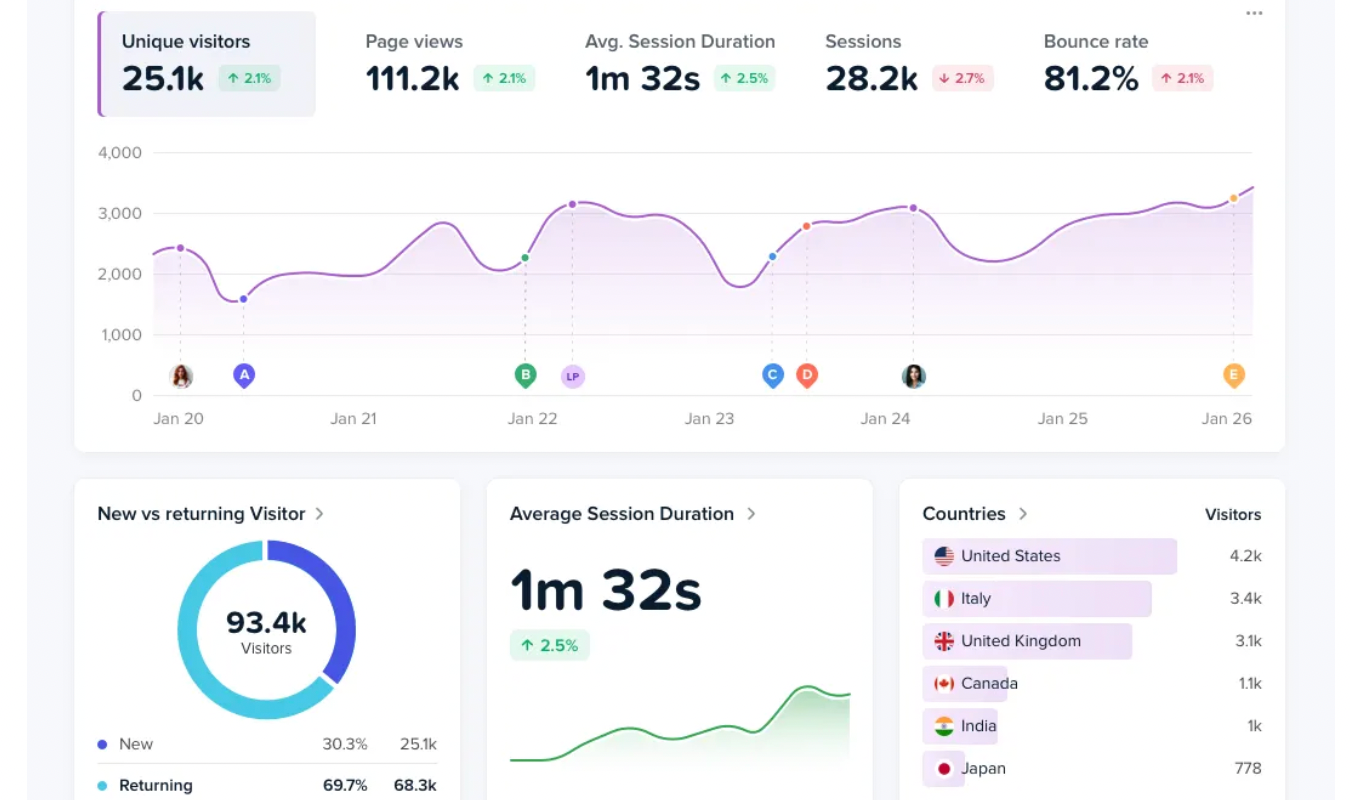
Fullstory is a powerful digital experience analytics platform, but it is not the only way to understand why visitors click, rage-click, abandon carts, or stare at a confusing form field like it owes them money. Many teams love Fullstory for session replay, behavioral analytics, funnels, and product insights. Others start looking for Fullstory alternatives because they want simpler pricing, stronger A/B testing, better developer debugging, easier heatmaps, or a tool that does not require a full analytics committee meeting before lunch.
The best Fullstory alternative depends on what your team actually needs. A small marketing team may want fast heatmaps and visual reports. A conversion rate optimization team may need testing and personalization. A software team may care more about JavaScript errors, network logs, and performance issues. An ecommerce team may simply want to know why shoppers keep abandoning checkout right after typing their ZIP code.
After reviewing the current behavior analytics and session replay market, our top four recommended Fullstory alternatives are Crazy Egg, VWO, LogRocket, and Mouseflow. Each one solves the same big problem from a slightly different angle: helping you see what users really do, not what your dashboard politely pretends they do.
Quick Comparison: Best Fullstory Alternatives
| Tool | Best For | Key Strength | Ideal Team |
|---|---|---|---|
| Crazy Egg | Heatmaps and conversion optimization | Simple visual reports, recordings, surveys, A/B testing | Marketers, SMBs, agencies, ecommerce teams |
| VWO | A/B testing and experimentation | Testing, personalization, heatmaps, session recordings | CRO teams, growth teams, enterprise marketers |
| LogRocket | Frontend debugging and product experience monitoring | Session replay with errors, logs, performance data, AI insights | Product managers, engineers, SaaS teams |
| Mouseflow | Behavior analytics and form optimization | Session replay, heatmaps, funnels, form analytics, feedback | UX teams, ecommerce brands, lead generation sites |
Why Look for a Fullstory Alternative?
Fullstory is often chosen by product, support, engineering, and analytics teams that need deep visibility into digital experiences. It can be excellent for understanding user friction, tracking journeys, replaying sessions, and connecting behavior to business outcomes. However, “excellent” does not always mean “best fit.” A luxury espresso machine is excellent too, but if you only need one cup before a Monday meeting, a simple coffee maker may save your sanity.
Teams commonly compare Fullstory alternatives for four reasons: budget, simplicity, specialization, and workflow fit. Some companies want a lower-cost heatmap and recording tool. Others want experimentation features built directly into the platform. Engineering teams may need technical debugging details that go beyond visual replay. UX teams may want form analytics, feedback surveys, and friction scoring without digging through a complex dashboard.
The right question is not, “Which tool is the most powerful?” The better question is, “Which tool will our team actually use every week?” A platform with 400 features is not helpful if everyone opens it once, nods respectfully, and then returns to guessing.
1. Crazy Egg: Best Fullstory Alternative for Simple Heatmaps and Conversion Wins
Crazy Egg is one of the most approachable Fullstory alternatives for teams that want to improve website conversions without building a massive analytics operation. It focuses on heatmaps, session recordings, surveys, A/B testing, web analytics, error tracking, popup CTAs, and conversion analytics. In plain English, it helps you see what visitors do, ask them what they want, and test better ideas before your homepage becomes a museum of assumptions.
Why We Recommend Crazy Egg
Crazy Egg is especially useful for marketers, small businesses, agencies, bloggers, ecommerce sites, and lead generation teams. Its heatmap reports show where people click, how far they scroll, and which parts of a page receive attention. Session recordings help you watch real visitor behavior, while A/B testing lets you turn those observations into action.
For example, imagine your landing page gets traffic but few signups. Google Analytics may tell you the conversion rate is sad. Crazy Egg can show you that visitors are clicking a non-clickable image, skipping your pricing section, or missing the call-to-action button entirely. That is the kind of insight that turns “our users are mysterious” into “our button is hiding like a raccoon in a trash can.”
Best Features
- Heatmaps that visualize clicks, scrolls, and attention patterns
- Session recordings for watching real user behavior
- A/B testing for validating page changes
- Surveys for collecting direct visitor feedback
- Web analytics and conversion analytics in one platform
- Popup CTAs for testing offers, messages, and lead capture ideas
Where Crazy Egg Beats Fullstory
Crazy Egg is usually easier for non-technical teams to adopt. It is not trying to be an enterprise-grade digital intelligence command center. That is a good thing if your team wants practical answers quickly. Marketers can use it to improve headlines, buttons, page layouts, offers, and checkout flows without needing engineering help for every small experiment.
Where Crazy Egg May Not Be Enough
Crazy Egg may not satisfy teams that need deep product analytics, advanced segmentation, mobile app analytics, or detailed developer debugging. If your main problem is diagnosing complex app errors, LogRocket may be a stronger choice. If your main goal is experimentation at scale, VWO may fit better.
2. VWO: Best Fullstory Alternative for A/B Testing and Experimentation
VWO is a strong Fullstory alternative for teams that want to move beyond observing user behavior and start testing improvements systematically. It combines digital experience optimization, A/B testing, personalization, heatmaps, session recordings, and behavioral insights. If Fullstory helps you understand what users are doing, VWO helps you test what to do next.
Why We Recommend VWO
VWO is built for conversion rate optimization teams, growth marketers, ecommerce brands, SaaS companies, and enterprise websites that run frequent experiments. Its biggest advantage is that behavioral research and testing can live in the same workflow. You can review heatmaps, watch session recordings, identify friction, create a hypothesis, and launch an A/B test.
For example, suppose users are abandoning a pricing page. VWO can help you study where visitors hesitate, then test a shorter pricing table, a new guarantee message, a different CTA, or a redesigned comparison section. Instead of saying, “I think blue buttons convert better because blue feels trustworthy,” you can run a real test and let the data politely end the debate.
Best Features
- A/B testing, split URL testing, and multivariate testing
- Heatmaps and click maps for visual behavior analysis
- Session recordings for understanding individual journeys
- Personalization tools for targeted experiences
- Behavioral insights for identifying friction points
- Experiment reporting for tracking business impact
Where VWO Beats Fullstory
VWO shines when experimentation is the main objective. Fullstory is excellent for understanding digital behavior, but VWO is often more attractive when teams want to build a testing engine. If your company wants to improve conversion rates through repeatable experiments, VWO may feel more directly connected to revenue optimization.
Where VWO May Not Be Enough
VWO can be more than some small teams need. If you only want quick heatmaps and session recordings, Crazy Egg or Mouseflow may feel simpler. If you need engineering-level replay with console logs, network requests, and performance telemetry, LogRocket is more specialized.
3. LogRocket: Best Fullstory Alternative for Product and Engineering Teams
LogRocket is one of the best Fullstory alternatives for software teams that need to understand both user behavior and technical issues. It combines session replay, product analytics, error tracking, frontend performance monitoring, UX analytics, and AI-powered insights. In other words, it does not just show that a user struggled; it helps explain whether the problem came from bad UX, broken code, slow performance, or a gremlin living in your JavaScript bundle.
Why We Recommend LogRocket
LogRocket is ideal for SaaS companies, web apps, product teams, frontend engineers, support teams, and technical customer success teams. Its session replay is especially valuable because it can connect user behavior with technical context such as JavaScript errors, network requests, console logs, and performance data.
Imagine a customer reports, “The dashboard is broken.” That sentence is about as useful as a smoke alarm in a thunderstorm. With LogRocket, your team can replay the session, see what the user clicked, inspect the error, review the network call, and understand what happened without sending five follow-up emails that begin with, “Can you please send a screenshot?”
Best Features
- Pixel-level session replay for web and mobile experiences
- JavaScript error tracking and issue detection
- Network logs and console logs for technical debugging
- Frontend performance monitoring
- Product analytics, funnels, path analysis, and time-series reports
- AI-powered insights for surfacing user struggle and product issues
Where LogRocket Beats Fullstory
LogRocket is particularly strong for debugging and technical product analysis. Fullstory provides strong digital experience intelligence, but LogRocket is built around helping product and engineering teams reproduce issues quickly. If support tickets, frontend bugs, performance problems, or unexplained app failures are major pain points, LogRocket deserves serious attention.
Where LogRocket May Not Be Enough
LogRocket may be too technical for teams that only need marketing-friendly heatmaps and basic recordings. A content site, local service business, or simple ecommerce store may not need logs, errors, and performance telemetry. In that case, Crazy Egg or Mouseflow may offer a faster path to value.
4. Mouseflow: Best Fullstory Alternative for UX, Funnels, and Form Analytics
Mouseflow is a practical Fullstory alternative for teams that want session replay, heatmaps, conversion funnels, journey analytics, form analytics, friction detection, and feedback surveys in one connected behavior analytics platform. It is especially useful for ecommerce, lead generation, UX research, and websites where forms play a major role.
Why We Recommend Mouseflow
Mouseflow is strong because it connects several important UX questions: Where do users click? Where do they drop off? Which form fields cause hesitation? Which pages create friction? What do users say when asked directly? That combination makes it useful for teams that want to improve website journeys without stitching together five separate tools and a spreadsheet named “final-final-v7.”
For example, a B2B company may discover that its demo request form has a high abandonment rate. Mouseflow can show whether visitors pause at the phone number field, rage-click a dropdown, or leave after seeing too many required inputs. That is not just analytics; that is a tiny documentary about your form’s crimes against patience.
Best Features
- Session replay for watching visitor journeys
- Heatmaps for clicks, movement, attention, and scroll behavior
- Conversion funnels for identifying drop-off points
- Form analytics for measuring hesitation, refills, errors, and abandonment
- Friction detection for spotting user struggle
- Feedback surveys for collecting qualitative insights
Where Mouseflow Beats Fullstory
Mouseflow is easier to recommend when form analytics and funnel friction are top priorities. It gives UX and marketing teams a clear way to connect behavior patterns with specific improvements. If your website depends on quote forms, checkout forms, signup forms, or contact forms, Mouseflow can help you find the exact fields that quietly sabotage conversions.
Where Mouseflow May Not Be Enough
Mouseflow may not be the best fit for teams that need enterprise product analytics, advanced engineering diagnostics, or large-scale experimentation. It is a strong behavior analytics platform, but LogRocket is better for technical debugging and VWO is better for structured testing programs.
How to Choose the Best Fullstory Alternative
Choosing among these Fullstory competitors becomes easier when you match the tool to the job. Do not buy a platform because it has the longest feature list. Buy the one that solves your most expensive problem.
Choose Crazy Egg If…
You want fast visual insights, simple heatmaps, session recordings, A/B testing, and conversion tools without a steep learning curve. Crazy Egg is a smart choice for marketing teams, agencies, ecommerce stores, and small to mid-sized businesses.
Choose VWO If…
You want to build a serious experimentation program. VWO is ideal when your team needs A/B testing, personalization, behavioral research, and conversion optimization in one platform.
Choose LogRocket If…
You need to connect user behavior with technical issues. LogRocket is best for product and engineering teams that care about session replay, errors, logs, network activity, and performance monitoring.
Choose Mouseflow If…
You want a balanced behavior analytics tool with strong session replay, heatmaps, funnels, form analytics, and feedback. Mouseflow is especially useful for UX teams and websites with important conversion forms.
Other Fullstory Alternatives Worth Considering
Although our top four picks are Crazy Egg, VWO, LogRocket, and Mouseflow, several other tools may be worth evaluating. Microsoft Clarity is attractive for teams that want free heatmaps and session recordings. Hotjar remains popular for UX research, surveys, and feedback. Contentsquare is a strong enterprise experience analytics platform. PostHog is compelling for engineering-led teams that want product analytics, session replay, feature flags, experimentation, and open-source flexibility.
These tools are not “bad” just because they did not make our top four. Software comparisons are like choosing pizza toppings: the best option depends on appetite, budget, and whether someone in the room insists pineapple is a business requirement.
Practical Experience: What It Feels Like to Switch From Fullstory
When teams move from Fullstory to another platform, the biggest adjustment is usually not technical. It is cultural. Fullstory often attracts teams that are already comfortable with detailed digital experience analysis. Switching to a lighter or more specialized tool forces the team to define what they really need from behavioral data.
In practice, the best migrations begin with a simple audit. List the reports, dashboards, tags, events, funnels, recordings, and alerts your team actually uses. Not the features someone promised to use during an enthusiastic onboarding call. The features people truly open on a Tuesday afternoon when conversions dip and everyone suddenly becomes a detective.
For marketing teams, the transition to Crazy Egg often feels refreshing. The interface is visual, the reports are direct, and the path from insight to test is short. A team can look at a heatmap, notice that a CTA is ignored, adjust the page, and launch an A/B test. That simplicity matters. The faster a team can act, the less likely insights are to die in a slide deck.
For CRO teams, moving to VWO feels more like upgrading the experimentation workflow. Instead of separating research and testing, teams can connect behavior observations with structured experiments. This is especially helpful when stakeholders argue over opinions. A proper test turns “I like this version” into “the data likes this version,” which is much harder to argue with unless your data analyst is having a villain arc.
For product and engineering teams, LogRocket can feel like a relief because it shortens the distance between a complaint and a fix. Support teams can share a replay. Engineers can inspect logs and errors. Product managers can see how the problem affected the user experience. Instead of guessing whether a bug is real, the team gets evidence. That saves time, reduces frustration, and prevents the classic “works on my machine” ritual.
For UX and ecommerce teams, Mouseflow often feels practical because it highlights everyday friction. Form analytics can be surprisingly revealing. A single required field can reduce completion rates. A confusing dropdown can trigger repeated clicks. A checkout step can create hesitation that standard analytics barely notices. Mouseflow helps teams see these moments clearly and fix them before more users escape through the nearest browser tab.
The most important lesson from using Fullstory alternatives is that behavior analytics should lead to decisions, not just curiosity. Watching recordings can become strangely addictive. One minute you are researching checkout friction; the next minute you have watched 47 visitors scroll past your beautifully designed hero section like it was invisible furniture. The goal is not to watch everything. The goal is to find patterns, prioritize fixes, test improvements, and measure results.
A good workflow looks like this: identify a business problem, review relevant sessions or heatmaps, form a hypothesis, make a change, test the result, and document what you learned. Whether you choose Crazy Egg, VWO, LogRocket, or Mouseflow, the platform should support that loop. If it does, you will get more than recordings. You will get a repeatable system for improving digital experiences.
Conclusion
The best Fullstory alternative is not the one with the flashiest dashboard. It is the one that helps your team understand users faster and improve your website or product with less guesswork. Crazy Egg is our recommendation for simple heatmaps and conversion optimization. VWO is the best fit for experimentation and A/B testing. LogRocket is ideal for product and engineering teams that need replay plus technical debugging. Mouseflow is excellent for UX analysis, funnels, forms, and user feedback.
If your team wants a straightforward path from “something is wrong” to “we know what to fix,” these four Fullstory alternatives are worth testing. Start with your main use case, run a short trial, compare how quickly your team finds actionable insights, and choose the tool that makes improvement feel less like archaeology and more like progress.