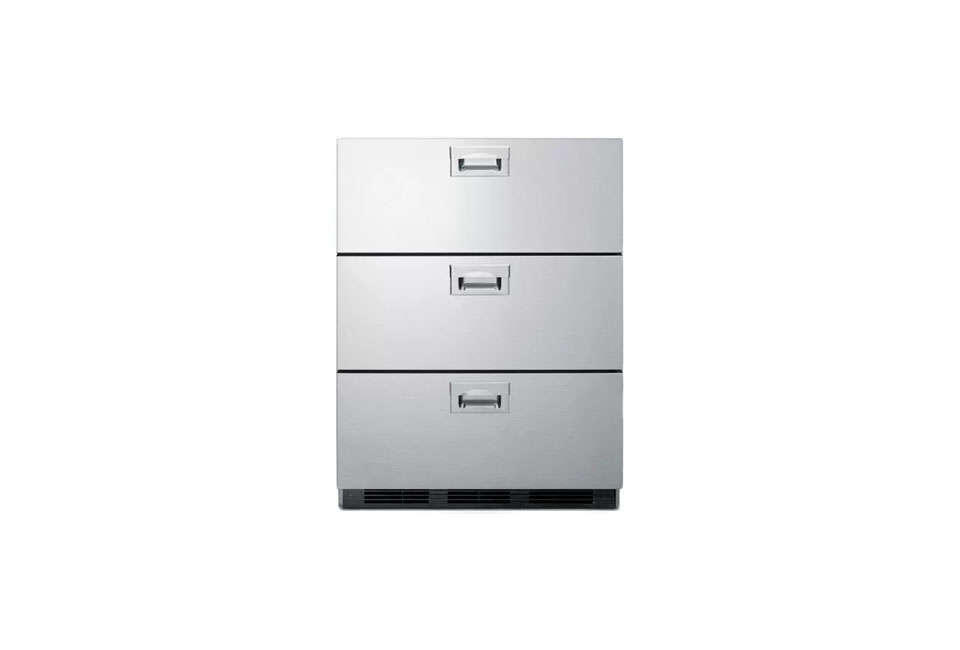
The Summit SP6DS7ADAx 24-inch triple drawer refrigerator is the sort of appliance designed for kitchens where every inch must earn its keep. Instead of hiding food behind one conventional swinging door, it divides the refrigerated space among three pull-out drawers. That layout can make ingredients easier to organize, reduce bending and give an undercounter installation the polished appearance of custom cabinetry.
For product-search accuracy, Summit identifies the official base model as SP6DS7ADA. A trailing “x” may appear in informal titles or represent an unspecified option suffix, but buyers should verify the complete model number on the appliance label and sales paperwork. Summit now lists the original SP6DS7ADA as discontinued and names the newer ADRD24 as its replacement, so shoppers are most likely to encounter the triple-drawer model as remaining dealer inventory, a used appliance or an installed unit that needs service.
What Is the Summit SP6DS7ADA Triple Drawer Refrigerator?
The SP6DS7ADA is a commercial-style, all-refrigerator appliance built for installation beneath a 24-inch counter opening. “All-refrigerator” means there is no freezer compartment stealing space from fresh-food storage. Its three stainless steel drawers are intended for refrigerated ingredients, beverages and prepared foods.
The cabinet measures 32 inches high, 23.75 inches wide and 23.5 inches deep. Its stated capacity is 3.1 cubic feet, and the complete appliance weighs approximately 120 pounds. It may be installed under a counter or used as a freestanding unit because the cabinet is finished on all sides. At less than 24 inches wide, it can fit into many standard compact-appliance openings without demanding a kitchen demolition worthy of its own reality show.
Key specifications at a glance
| Configuration | Three-drawer all-refrigerator |
|---|---|
| Cabinet height | 32 inches |
| Width | 23.75 inches |
| Depth | 23.5 inches |
| Capacity | 3.1 cubic feet |
| Exterior and interior | Stainless steel |
| Defrost system | Automatic |
| Temperature control | Mechanical dial thermostat |
| Installation | Built-in or freestanding |
| Commercial sanitation listing | ETL-S listed to NSF-7 requirements |
Some third-party listings have displayed conflicting capacity descriptions, so the manufacturer’s 3.1-cubic-foot specification should be treated as the dependable figure. This is a compact specialty refrigerator, not a five-cubic-foot food warehouse wearing a tiny stainless steel disguise.
Why the Three-Drawer Design Matters
A drawer refrigerator changes how cold storage is used. In a conventional undercounter refrigerator, users crouch, open one door and search behind bottles, cartons and containers. With this Summit triple drawer refrigerator, each section can be assigned a purpose.
The upper drawer may hold frequently used ingredients, yogurt cups or drink cans. The middle drawer can organize produce, deli items and meal-preparation containers. The lower drawer can store larger packages or items that are used less often. This arrangement makes it easier to see what is available before buying a fourth jar of mustard “just in case.”
The top drawer has a shallower usable depth because of the appliance’s mechanical layout, while the second and third drawers extend farther into the cabinet. All three have an interior height of about 6.25 inches. These dimensions favor cans, short bottles, food pans and low containers rather than tall milk jugs or upright wine bottles. Buyers should measure the containers they use most often instead of relying only on the total capacity figure.
ADA-Height Undercounter Installation
One of the model’s defining features is its 32-inch cabinet height. Summit designed it for placement beneath lower counters used in accessible spaces. That reduced height can also suit compact offices, hospitality suites, healthcare break rooms and residential kitchens with custom counter dimensions.
However, an appliance marketed as ADA compliant does not automatically make an entire kitchen compliant. Counter height, clear floor space, approach, reach range, surrounding cabinetry and the ability to operate the drawers must all be considered. Applicable accessibility requirements should be reviewed for the complete project, particularly in public or commercial facilities. ADA design guidance commonly addresses accessible surfaces and operable elements rather than approving a room based on one appliance alone.
Built-in flexibility
The SP6DS7ADA is designed for built-in installation, allowing it to sit beneath a counter and align with nearby cabinetry. Its finished stainless steel cabinet also permits freestanding placement. This flexibility is valuable when an appliance is moved from a commercial prep area to an office kitchenette or when a kitchen renovation happens in stages.
Exact opening dimensions, ventilation requirements, electrical access and anti-tip installation should be confirmed before purchase. A 120-pound drawer refrigerator should not be treated like a rolling snack cart. Proper leveling is also important because an uneven cabinet can affect drawer movement, gasket contact and overall stability.
Commercial Construction and NSF-7 Listing
The appliance uses stainless steel for the cabinet, drawer fronts and interior surfaces. Stainless steel is appropriate for foodservice settings because it is durable, relatively easy to wipe down and visually compatible with other commercial equipment. Recessed pulls keep the exterior streamlined, while magnetic gaskets help the drawers close securely.
Summit describes the model as ETL-S listed to NSF-7 standards for commercial use. NSF develops public-health standards and supports testing and certification programs for products used in food and water environments. For a restaurant, café, hospitality operation or institutional kitchen, a relevant sanitation listing may matter more than decorative features or app connectivity. Nobody has ever prevented a food-safety problem by asking a refrigerator to join the Wi-Fi.
Local health departments and building authorities may impose additional requirements, so operators should confirm that the appliance and its intended use satisfy current local rules. A commercial listing is valuable, but it does not replace installation permits, temperature monitoring procedures or routine cleaning.
Cooling System and Temperature Management
The SP6DS7ADA uses automatic defrost and fan-assisted cooling. Automatic defrost reduces the need to manually remove ice, while internal air circulation helps distribute cold air throughout the drawers. The temperature is adjusted with a mechanical dial rather than a digital control panel.
A mechanical thermostat is simple and generally easy to operate. Its weakness is that it does not display an exact internal temperature. Owners should therefore place an appliance thermometer inside and verify performance after installation, after major thermostat adjustments and whenever the refrigerator is heavily restocked.
USDA food-safety guidance recommends maintaining a refrigerator at 40°F or below. Because temperature can vary according to loading, room conditions and how often drawers are opened, users should trust a thermometer rather than the dial’s position or the highly scientific “this soda feels chilly” test.
Automatic defrost advantages
Automatic defrost makes daily ownership easier, particularly in a busy foodservice environment. Ice accumulation can reduce usable space and interfere with airflow, so a system that manages defrosting automatically minimizes routine labor. Owners must still keep the interior clean, avoid blocking air circulation and inspect gaskets for crumbs, tears or residue.
Where the SP6DS7ADA Works Best
Commercial food-preparation areas
The three drawers can keep frequently used ingredients close to a prep station. Sandwich fillings, garnishes, dairy products, sauces and packaged components can be divided into logical zones. Staff can open only the required drawer rather than exposing the entire refrigerator interior every time someone needs sliced cheese.
Accessible residential kitchens
The lower cabinet height and pull-out storage may improve access for some users, especially when paired with an appropriately planned counter and clear floor area. Drawers also bring stored items outward, reducing the need to reach toward the back of a deep compartment.
Office kitchens and hospitality spaces
The compact width and professional stainless steel finish suit employee break rooms, executive suites, hotel service areas and entertainment spaces. Separate drawers can be used for beverages, lunches and shared condiments, although no engineering standard can stop one coworker from leaving half a sandwich in the refrigerator until it develops voting rights.
Compact apartments and secondary kitchens
The Summit undercounter refrigerator can supplement a main refrigerator or provide cold storage in a studio, guest suite, home bar or basement kitchen. Its limitation is height inside each drawer, so it works better as organized specialty storage than as the only refrigerator for a household that buys large containers.
Advantages of the Summit SP6DS7ADA
- Three separate storage zones: Ingredients and beverages can be organized by category, frequency of use or user.
- ADA-height cabinet: The 32-inch profile fits beneath lower counters when incorporated into a properly planned accessible space.
- Built-in or freestanding use: The finished cabinet offers more placement flexibility than an unfinished built-in-only model.
- Stainless steel construction: The professional finish is durable and appropriate for many residential or commercial interiors.
- Automatic defrost: Routine ice removal is minimized.
- Commercial sanitation listing: ETL-S listing to NSF-7 requirements supports use in qualifying foodservice applications.
- Simple controls: The dial thermostat avoids complicated menus, software updates and mystery error messages written in appliance hieroglyphics.
Potential Drawbacks
The biggest concern for today’s buyer is availability. Summit lists the SP6DS7ADA as discontinued, which means new inventory may be limited and seller information may be outdated. Before paying, buyers should confirm whether the appliance is genuinely new, whether the original manufacturer warranty applies and whether parts or authorized service are available in their area.
Its 3.1-cubic-foot capacity is also modest. Three drawers improve organization, but dividers do not create additional cubic feet through optimism. The shallow drawer height rules out many tall containers, and the mechanical thermostat lacks the precision, alarms and visible readout found on newer premium models.
The older R134a refrigeration platform is another sign of the product’s generation. Summit’s current ADRD24 replacement uses a newer hydrocarbon refrigerant, a digital thermostat, alarms, frost-free operation, soft-close drawers and a larger 4.8-cubic-foot interior. The replacement has two drawers rather than three, so buyers must decide whether they value additional drawer separation or newer controls and greater capacity.
Buying a Discontinued SP6DS7ADA
A remaining-stock or used SP6DS7ADA can still be useful, but it should be evaluated more carefully than a current production model. Confirm the serial number, manufacturing history, complete suffix and electrical requirements. Ask whether the thermostat, compressor, fan and automatic defrost system have been tested.
Inspect each drawer for smooth travel and verify that the cabinet remains square. Check magnetic gaskets for cracks, hardening or gaps. Look for corrosion, dents and signs that harsh chemicals have damaged the stainless steel. Plug the refrigerator in and use a thermometer to confirm that it can cool consistently to a food-safe temperature.
For used commercial equipment, cleanliness matters as much as cooling. Remove drawers where permitted by the manual, examine corners and tracks, and determine whether previous spills have reached areas that are difficult to sanitize. A suspicious smell should not be accepted as “restaurant character.”
Practical Ownership Experience: What Daily Use Is Likely to Feel Like
The following experience-based assessment is drawn from the appliance’s documented dimensions, drawer configuration and operating features rather than a claim of personal long-term ownership.
During the first few days, the three-drawer layout is likely to be the feature owners notice most. It encourages deliberate organization. A home user might place breakfast foods in the top drawer, produce and deli containers in the middle, and drinks or meal-preparation ingredients in the bottom. In a café, the drawers could separate garnishes, dairy products and packaged foods. Once a routine is established, users spend less time searching and are less likely to disturb unrelated items.
The format is particularly convenient when several people share the refrigerator. Assigning a drawer to each user, department or ingredient category can prevent clutter. It also makes inventory checks quicker because the contents come outward with the drawer instead of remaining hidden behind the first row of containers.
The compromise appears when loading taller products. Standard beverage cans, yogurt cups, shallow food containers and wrapped ingredients should be straightforward to arrange. Gallon jugs, tall bottles and bulky takeout packages may not fit upright. Owners may need to transfer foods into lower containers, which improves organization but adds another dish to wash. The refrigerator rewards neat planners and quietly judges everyone else.
The recessed handles create a clean, compact front and reduce protrusions in a narrow aisle. Users with limited hand strength should nevertheless test the drawer effort when possible. Magnetic gaskets provide a firm seal, and a fully loaded drawer may feel heavier than expected. Proper leveling can help the drawers move and close consistently.
The mechanical thermostat should feel refreshingly uncomplicated: turn the dial, allow the cabinet to stabilize and check a thermometer. The lack of a digital display, however, means owners cannot confirm temperature with a quick glance. In a commercial environment, an independent thermometer or data logger becomes especially useful. Temperature should be checked after large deliveries because loading numerous room-temperature items can temporarily warm the cabinet.
Automatic defrost will reduce maintenance, but it does not make the appliance self-cleaning. Drawer tracks, gaskets and stainless surfaces still require regular attention. Spills should be handled promptly before they dry in corners or interfere with seals. Mild cleaners and soft cloths are preferable to abrasive pads that can scratch the finish.
Noise perception will depend on the room. In a restaurant or office break area, compressor and fan sounds are unlikely to attract much attention. In a silent studio apartment or bedroom-adjacent kitchenette, cycling may be more noticeable. Because the model is discontinued, an unusually loud fan, persistent vibration or extended compressor operation should be investigated instead of dismissed as normal.
During a power outage, keeping drawers closed helps retain cold air. FoodSafety.gov notes that an unopened refrigerator can generally keep food safe for about four hours, although actual conditions vary. Perishable food that has remained too warm for too long should be discarded rather than taste-tested. A drawer refrigerator may tempt users to “just check one thing,” but every inspection releases cold air and shortens the safe window.
Long-term satisfaction will depend heavily on the purchase price and condition. At an attractive clearance or used-equipment price, the SP6DS7ADA can provide organized stainless steel refrigeration in a specialized opening. At a price close to a current model, its older controls, smaller capacity and uncertain parts availability become harder to justify. The smartest owner experience begins before installation, with careful measurements, a service check and realistic expectations about what 3.1 cubic feet can hold.
Final Verdict
The Summit SP6DS7ADAx 24-inch triple drawer refrigerator remains an interesting solution for buyers who prioritize compact dimensions, three separate storage drawers, stainless steel construction and installation beneath an ADA-height counter. Its commercial sanitation listing and built-in flexibility make it more capable than a basic dorm-style refrigerator.
Still, it is an older, discontinued appliance. A well-maintained unit can remain practical, particularly in an existing installation where replacing cabinetry would be expensive. New buyers should compare its condition and price with the current Summit ADRD24, which offers more capacity and modern controls but changes the layout from three drawers to two.
In other words, the SP6DS7ADA is not obsolete simply because it lacks a touchscreen. It is a focused piece of refrigeration equipment with a useful layout and a few age-related compromises. Measure carefully, verify the exact model, test the temperature and make sure those three drawers fit the foods you actually buynot the beautifully identical containers used in appliance advertisements.
SEO Tags
Note: The official manufacturer model verified for this article is SP6DS7ADA. Confirm any additional suffix or trailing “x” with the seller because options and model variations may affect specifications, installation requirements and warranty coverage.