Gravity has a reputation for being the quiet kid in the back of the universenever asking for attention, yet somehow running the entire group project.
So when a new study hints that gravity might behave a little too strong in certain ultra-gentle conditions, it’s no surprise the headlines got spicy.
The claim making the rounds: observations of “wide binary” stars appear to show motion that’s about 30–40% stronger than what Newton’s and Einstein’s gravity would predictbut only when the acceleration is incredibly tiny.[1]
Before we toss out textbooks (please don’tthose things are expensive), here’s what’s really going on. The research sits in a very specific corner of astrophysics:
gravity in the ultra-low-acceleration regimea regime that’s hard to test in the Solar System but shows up naturally in long-period, widely separated pairs of stars.
And yes, the results intersect with the long-running “dark matter vs. modified gravity” debate like a bowling ball through a stack of pins.[2]
What Newton and Einstein Actually Said (In Normal Human Language)
Newton’s gravity: the dependable classic
Newton’s law of universal gravitation is famously simple: two masses attract each other, and the force drops off with the square of the distance.
It’s the physics equivalent of a sturdy pickup truckmaybe not flashy, but it hauls planets, moons, apples, and most of your everyday reality just fine.
In many situations, Newton’s equation predicts motions with impressive accuracy, especially when gravity is relatively “strong” and speeds are not near light speed.[7]
Einstein’s gravity: space-time does the bending
Einstein didn’t “replace” Newton so much as he extended the rulebook. In general relativity, gravity isn’t a force pulling on objectsit’s the curvature of spacetime
guiding how objects move. This framework has racked up a century of wins in tests ranging from light-bending to time dilation to gravitational waves.[7][9]
So why would anyone say Newton and Einstein are “wrong”? Usually, they mean:
in a particular regime (very weak gravity, enormous distances, cosmic scales), the standard approach may need extra ingredients (like dark matter)
or a tweak to how gravity behaves.
The Study Behind the Headline: Wide Binary Stars and Gaia
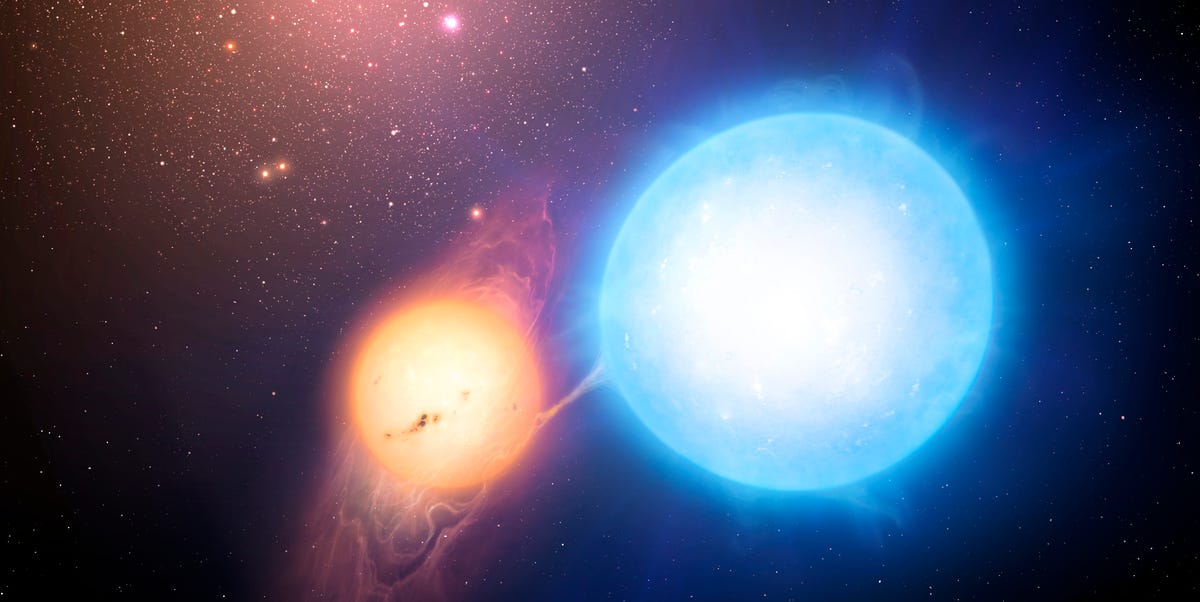
The headline-making work centers on wide binary stars: pairs of stars that are gravitationally bound but separated by thousands of astronomical units (AU).
For perspective, Pluto is about 40 AU from the Sun. A wide binary can be separated by 5,000–20,000 AU or moreso far apart their mutual gravity is extremely weak.[2][10]
Researchers used data from the European Space Agency’s Gaia mission, which tracks positions and motions of stars with staggering precision.
One widely reported analysis discussed a sample on the order of tens of thousands of wide binaries within a few hundred light-years, looking for how their relative motions compare to Newton-Einstein expectations.[1][4]
The headline result (and the numbers people repeat)
In the ultra-low-acceleration regimearound ~0.1 nanometers per second squaredthe observed accelerations can look roughly 30–40% higher
than predicted by standard gravity models, while at higher accelerations the data line up much more closely with Newton-Einstein expectations.[1][4]
In technical terms, one analysis reports an acceleration-boost factor of about ~1.37 in the low-acceleration domain, with the most pronounced boost at the weakest accelerations.[2]
Another later method using more complete velocity information (including radial/line-of-sight data where available) reports evidence that a similar “anomaly” appears below roughly 10-9 m/s², while higher accelerations remain consistent with Newtonian expectations.[3][4]
Why Wide Binaries Are a Big Deal (And Why They’re So Annoying)
Wide binaries are compelling because they’re local. They live in our galactic neighborhood, where we don’t expect a lot of dark matter clumping on tiny scales.
That makes them a tempting place to ask: if we see “extra” gravity, is it because gravity itself changesrather than because invisible matter is hiding nearby?[4][10]
They’re also relevant because the acceleration scale where MOND-like effects are expected is around
a0 ≈ 1.2 × 10⁻¹⁰ m/s², which is right in the ballpark of the weak accelerations wide binaries can probe at large separations.[10]
But here’s the catch: wide binaries are messy. Their orbits take forever. You don’t watch a full orbityou get a “snapshot” of positions and velocities and then do statistics.
That means subtle biases and contamination can loom large, like a single popcorn kernel in your teeth that somehow ruins your whole day.[3][10]
MOND: The Alternative Gravity Idea That Refuses to Leave the Group Chat
Modified Newtonian Dynamics (MOND) was proposed in the early 1980s as a way to explain why stars in the outer parts of galaxies orbit faster than
Newtonian gravity predicts if you only count visible matter. The usual mainstream solution is dark matter: add invisible mass, and the math behaves.
MOND instead says: maybe gravity (or inertia) changes character when accelerations get extremely small.[8][10]
AQUAL and the “external field effect”
Some MOND-flavored formulations (including a framework often referred to as AQUAL) make specific predictions for how wide binaries should behave,
especially because the binaries sit inside the Milky Way’s gravitational environment. That “background pull” can matter in MOND-like models via an idea called the
external field effect, which changes how small systems behave when embedded in a larger gravitational field.[1][4]
In the headline study narrative, the wide-binary result is presented as lining up with these MOND-type expectations in the weakest-acceleration regime.[1][2]
Does This Really “Contradict” Newton and Einstein?
If “contradict” means “Newton and Einstein are toast,” then nogravity is not getting canceled.
General relativity has cleared a mountain of tests in strong and moderate gravity, from classic solar-system checks to precision timing and gravitational-wave observations.[7][9]
If “contradict” means “there may be a specific regime where the simplest Newtonian/GR expectations don’t match data without extra assumptions,” then yes,
that’s the kind of tension these studies are pointing at.[2][4][10]
The big scientific question: signal or systematics?
The wide-binary debate is partly spicy because different groups, using different selection cuts and modeling assumptions, do not all land on the same conclusion.
Some analyses argue the data favor MOND-like behavior at low accelerations, while others find Newtonian gravity provides a better fitespecially when modeling
contamination from hidden “third stars” (triple systems) and other confounding populations.[5][10]
That disagreement doesn’t mean anyone is “cheating.” It means this is a hard measurement.
In fact, one detailed review notes that multiple teams have published results pointing in different directions and that statistical choices, sample selection,
and treatment of contaminants can bias conclusions if not handled carefully.[10]
Common “gotchas” in wide-binary gravity tests
-
Hidden triples: One star might secretly be two stars. That can inflate apparent velocities and also mess with mass estimates.
Both effects can mimic “stronger gravity.”[10] - Chance alignments and flybys: Not every close-looking pair is truly bound; some are passing ships in the night.[10]
-
Measurement limitations: Proper motions are great, but full 3D velocities require accurate radial velocities too.
Newer Bayesian approaches try to use more complete velocity information, but that shrinks sample sizes and shifts uncertainty budgets.[3][4] -
Galactic environment effects: Tides, local stellar density, and the Milky Way’s field can all influence wide systemsexactly the sort of details
that matter when you’re hunting for a 30–40% effect in the weakest-gravity regime.[4][10]
Where Dark Matter Fits Into This (And Why It Won’t Be Fired Today)
Dark matter remains the dominant explanation in mainstream cosmology because it helps account for large-scale structure, galaxy clustering, and multiple
observational pillarswhile still being (painfully) elusive in direct detection.
NASA summarizes the current “cosmic budget” estimate as roughly 5% ordinary matter, 27% dark matter, and 68% dark energy.[6]
The wide-binary argument is interesting because it targets a scale where dark matter is not expected to conveniently clump around individual nearby star pairs.
Some researchers argue that trying to “save” Newton-Einstein gravity here with dark matter would require an implausible local dark matter density for the Solar neighborhood.[4]
Still, one anomaly does not topple a framework. It can, however, force better questions:
If a low-acceleration anomaly is confirmed, does it point to MOND-like physics, a more complex dark matter scenario, or an unrecognized observational bias?
The honest answer right now is: it’s still being fought out in the literaturewith strong opinions and stronger statistics.[10]
What Would Actually Settle This?
Science is not decided by vibes or viral headlines. It’s decided by repeatable patterns, predicted in advance, showing up in independent data sets.
For wide binaries, the “next steps” are refreshingly concrete:
1) More and better 3D velocities
Approaches that incorporate full 3D velocity information (including line-of-sight velocities) aim to reduce ambiguity from projection effects and strengthen orbit inference.
A 2025 peer-reviewed report describes a Bayesian framework to infer gravity-related parameters from 3D velocities and notes agreement with earlier low-acceleration findings,
while emphasizing the need for accurate radial velocities.[3][4]
2) Independent pipelines and rival assumptions
The field benefits when different teams run different methods on the same Gaia dataand on future catalogsbecause disagreements reveal where sensitivity lives.
Some models that more aggressively account for triple contamination have reported stronger support for Newtonian gravity than for MOND, while still acknowledging remaining uncertainties.[5]
3) Predictions that differ in more than “how big is the bump?”
The best discriminators are qualitative. For example: does the anomaly depend on the Milky Way’s external field in the way MOND predicts?
Does it vary with location in the Galaxy? Does it show up consistently across stellar masses and binary ages?
The more “fingerprint-like” the pattern, the harder it is to explain away as a generic bias.[10]
4) Cross-checks with gravity’s other report cards
Even if wide binaries hint at a low-acceleration deviation, any successful theory must also respect gravity’s many verified victories.
NASA emphasizes that general relativity has been repeatedly tested rather than assumed, and modern gravitational-wave astronomy continues to probe strong-field regimes.[7][9]
Bottom Line: Gravity Isn’t BrokenBut It Might Be More Subtle Than We Thought
The responsible takeaway is not “Newton and Einstein were wrong,” but:
there may be a measurable puzzle in an extreme low-acceleration regime that deserves careful testing.
Wide binary starstracked by Gaiaoffer a rare natural lab for that regime, and the results so far are intriguing enough to keep the debate alive.[2][10]
If future analyses confirm a consistent, environment-dependent anomaly at around the MOND acceleration scale, physics may need an upgrade:
a modified gravity law, a novel dark matter behavior, or a better understanding of the astrophysical “noise” inside these delicate stellar pairs.
Either way, it’s a great reminder that the universe still has plot twistsand gravity is apparently auditioning for a speaking role.
Experiences: What It Feels Like When Gravity Gets “Weird” (500+ Words)
Even if you don’t spend weekends reading arXiv abstracts for fun (and if you do, no judgmentthere are worse hobbies), you’ve probably felt the emotional rhythm
of a “gravity is broken!” story: curiosity, disbelief, a quick mental inventory of everything you thought you knew, and then the slow realization that science
doesn’t flip tablesit adjusts them by millimeters.
1) The headline whiplash experience
The first experience many readers have is pure cognitive whiplash. One day, gravity is the most reliable force in nature. The next day, a headline tells you
Newton and Einstein might have missed something. The honest reaction is usually: “Wait… do I still weigh the same?”
(Answer: yes. Please don’t try to float out of chores.)
But then you read the details, and the drama becomes more relatable: the alleged mismatch happens at accelerations so tiny you would never notice them in daily life.
It’s like discovering your favorite recipe tastes slightly different at the top of a mountain during a full moonfascinating, but it doesn’t mean dinner is canceled.
2) The “physics class” experience: learning that great theories come with fine print
A surprisingly common experience for students is the moment they realize “Newton works” and “Newton is the final word” are different sentences.
Newton’s gravity gets you to the Moon; Einstein helps you run GPS; quantum physics explains why the Sun shines.
The pattern is: older theories remain incredibly useful inside their domains, while newer theories explain what happens at the edges.
Wide binaries live right on one of those edgeswhere forces are faint and the universe gives you only a snapshot, not a full movie.
That’s part of the fun: science isn’t about worshipping a name on a law; it’s about keeping what works and investigating what doesn’t.
The “fine print” is where discoveries hide.
3) The backyard telescope experience: noticing how slow the universe really is
If you’ve ever looked through a telescope at a double star, you’ve had the strangest kind of patience practice: you’re watching a cosmic dance that unfolds
on timescales that laugh at human calendars. Wide binaries take that to an extreme. Their orbital periods can be so long that no one gets to “watch” a full orbit
not you, not your kids, not your kids’ kids. So astronomers do something very human: they collect lots of snapshots and use statistics to infer the dance steps.
That experiencebuilding a story from incomplete framesis also why the debate is intense. When the effect you’re looking for is subtle, your assumptions matter.
Is that star pair truly alone? Is there a hidden third star? Is a “binary” actually a chance alignment? The universe doesn’t label the data for you.
It hands you the puzzle pieces and smirks.
4) The researcher mindset experience: excitement with a side of caution
There’s a specific emotional flavor to “maybe we found something”: it’s a mix of excitement and self-defense.
You want the result to be real, but you also know every possible way it could be wrongbecause reviewers and rival teams will definitely bring them up.
That’s why you see papers and reviews arguing over selection cuts, contamination models, and statistical methods.
It’s not personal (well, it’s mostly not personal). It’s how hard measurements mature.[10]
And if the anomaly holds up? That’s when the experience becomes legendary: not because Newton and Einstein “failed,” but because the universe revealed a new layer
of behavior in a place we finally learned how to look. The best scientific moments don’t erase the pastthey make the past make even more sense.