Note: This article is written for web publication and synthesizes real solar-physics findings from reputable scientific and space-science sources, including NASA, NOAA, the National Solar Observatory, Stanford solar research resources, NYU Abu Dhabi research updates, Nature Astronomy reporting, and major science publications.
The Sun Is Not QuietIt Is Ringing Like a Star-Sized Bell
The Sun may look like a calm golden disk from Earth, but up close it is a roaring, boiling, magnetically tangled ocean of plasma. It vibrates, pulses, rotates, erupts, andbecause apparently being a 4.6-billion-year-old nuclear furnace was not dramatic enoughsometimes produces waves that make scientists sit up straighter in their chairs.
One of the most fascinating discoveries in modern solar physics is a mysterious class of solar waves that appear to move much faster than expected. Popular headlines have described them as a “new acoustic wave on the Sun” that “defies physics.” The more precise scientific name is less snackable but more accurate: high-frequency retrograde vorticity waves, or HFR waves. These waves were reported in Nature Astronomy after researchers analyzed roughly 25 years of solar observations from space-based and ground-based instruments.
The headline sounds like science fiction, but the puzzle is very real. These solar waves appear as swirling motions near the Sun’s equator. They move in the opposite direction of the Sun’s rotation and travel about three times faster than standard hydrodynamic theory predicts for similar waves. In other words, the Sun is not breaking physics. It is breaking our current explanation of it, which is almost as exciting and much less likely to get a stern letter from Newton.
What Are Solar Waves?
Solar waves are waves that travel through or across the Sun’s plasma. Since the Sun is not solid, it behaves more like a vast, electrically charged fluid than a glowing basketball. Different forces produce different kinds of waves, including acoustic waves, gravity waves, magnetic waves, and Rossby-type waves related to rotation.
In everyday life, we think of sound as something moving through air. On the Sun, sound-like waves move through plasma. These waves are generated by pressure fluctuations caused by turbulent convection beneath the visible surface. Hot plasma rises, cooler plasma sinks, and the entire system churns like a pot of soup designed by a very ambitious physics department.
Solar scientists study these vibrations through a field called helioseismology. Just as geologists use earthquake waves to study Earth’s interior, helioseismologists use the Sun’s natural oscillations to infer what is happening inside our star. Because we cannot simply peel the Sun open like an orangeand because that would be a terrible afternoonwaves give researchers one of the best tools for probing the hidden solar interior.
Acoustic Waves and P-Modes
The best-known solar sound waves are called p-modes, short for pressure modes. These are standing acoustic waves trapped inside the Sun. They bounce through the solar interior and return to the surface, creating tiny motions that sensitive instruments can measure. Millions of these oscillation patterns exist at once, creating a kind of solar symphony that no human ear could survive, even if space carried sound normally.
These pressure waves have helped scientists map the Sun’s internal rotation, study convection, and understand how energy moves below the photosphere, the visible “surface” of the Sun. But the newly discussed HFR waves are different. They are not simply ordinary acoustic p-modes. They are vorticity waves, meaning they involve swirling motions in the solar plasma. Still, because they are detected through solar oscillation studies and discussed alongside acoustic-wave science, they are often described in popular media as a new acoustic mystery.
The Discovery: A Solar Wave That Moves Too Fast
The HFR wave discovery came from researchers associated with New York University Abu Dhabi, New York University, and the Tata Institute of Fundamental Research. The team used long-term solar data to detect a previously unknown wave pattern on the Sun. These waves were found through helioseismic and correlation-tracking methods, which allow scientists to study subtle surface motions and connect them to deeper solar behavior.
The waves were unexpected for three major reasons. First, they travel retrograde, meaning opposite the Sun’s rotation. Second, they appear as large-scale vortices near the equator. Third, their phase speeds are about three times faster than similar Rossby-Haurwitz waves predicted by standard theory.
That last point is the troublemaker. Standard hydrodynamicsthe physics of fluid motion without extra magnetic or exotic complicationsdoes not explain the observed speed. Scientists investigated whether magnetism, gravity, or compressibility could account for the acceleration. According to the published research, those mechanisms did not provide a complete explanation. The result is not “physics is fake.” The result is “our model is missing something important.” That is how science usually gets its coffee.
Why “Defies Physics” Does Not Mean What It Sounds Like
When a headline says a solar wave “defies physics,” it can sound as if the Sun has tossed the rulebook into a coronal mass ejection and declared itself independent. In reality, scientists use this kind of language to describe an observation that does not fit existing models. Physics is not defeated. It is being invited to update its résumé.
The HFR waves challenge current theories of solar dynamics because their high-frequency retrograde behavior is difficult to reproduce with known mechanisms. Researchers have considered links to magnetic fields, rotational forces, internal gravity waves, and turbulent convection. None has fully solved the puzzle yet.
This is exactly why the discovery matters. The Sun’s surface is visible, but its deeper interior is not directly observable with ordinary telescopes. If HFR waves are carrying information from hidden layers, they may reveal properties of deep solar magnetism, viscosity, entropy gradients, or large-scale convection that are currently difficult to measure.
How Scientists Listen to the Sun
Modern solar science depends on a fleet of observatories and instruments. NASA’s Solar Dynamics Observatory, known as SDO, continuously watches the Sun and provides high-resolution data about its atmosphere, magnetic field, and surface motion. The Helioseismic and Magnetic Imager, or HMI, aboard SDO is especially important for tracking solar oscillations and magnetic activity.
On the ground, the Global Oscillation Network Group, or GONG, uses a worldwide network of telescopes to observe the Sun nearly continuously. Because Earth rotates, one telescope eventually loses the Sun below the horizon. A global network solves the problem by handing off observations from one location to another, like a relay race where the baton is a 1.4-million-kilometer-wide nuclear furnace.
These instruments measure tiny Doppler shifts in light from the solar surface. When plasma moves toward us, its light shifts slightly blue. When it moves away, the light shifts slightly red. By tracking these small changes over time, researchers can reconstruct wave patterns and study the Sun’s internal motions.
Rossby Waves, Vorticity, and the Solar Weather Machine
To understand HFR waves, it helps to know about Rossby waves. On Earth, Rossby waves are large atmospheric and oceanic waves influenced by planetary rotation. They help shape weather patterns, jet streams, and storm tracks. The Sun, being a rotating plasma sphere, can also host Rossby-like waves.
Solar Rossby waves move through the Sun’s rotating fluid layers and can influence large-scale flows. HFR waves appear related to this family, but their speed and structure make them unusual. They are described as vorticity waves because they involve swirling patterns rather than simple up-and-down motion.
One fascinating detail is their equatorial antisymmetry. That means the pattern in the northern hemisphere is mirrored in an opposite way in the southern hemisphere. This kind of structure offers clues about how the waves are shaped by rotation and internal solar conditions.
Why These Waves Matter for Space Weather
Solar waves may sound like an abstract topic, but they connect to very practical concerns. The Sun’s magnetic field drives sunspots, solar flares, coronal mass ejections, and the broader 11-year solar cycle. These events create space weather, which can affect satellites, GPS, radio communication, power grids, aviation, and astronaut safety.
During solar maximum, sunspots become more numerous and eruptions become more frequent. Powerful solar flares release intense bursts of radiation, while coronal mass ejections can launch billions of tons of plasma and magnetic field into space. If Earth is in the path, the result can be geomagnetic storms, bright auroras, satellite drag, navigation errors, and occasional headaches for power-grid operators who were probably hoping for a quiet Tuesday.
Understanding the Sun’s interior helps improve models of solar activity. If mysterious waves reveal hidden magnetic behavior below the surface, they could eventually contribute to better space-weather forecasting. That does not mean tomorrow’s forecast will say, “Partly cloudy with a 40 percent chance of high-frequency retrograde vorticity.” But in the long term, better solar interior models can improve our ability to anticipate solar storms.
The 2026 Connection: Hidden Magnetic Waves Deep Inside the Sun
Solar-wave research did not stop with the 2022 HFR wave discovery. More recent work has also pointed to large-scale waves inside the Sun shaped by internal magnetic fields. In 2026, researchers reported evidence for global-scale magnetically modified Rossby waves deep within the Sun. These waves may provide a new way to infer the strength and structure of hidden magnetic fields below the visible surface.
This matters because the solar magnetic field is the engine behind the solar cycle. The Sun’s magnetic system twists, stretches, rises, reconnects, and occasionally erupts with enough energy to remind every satellite in orbit who is boss. If scientists can use waves to map hidden magnetic fields, they gain a more powerful tool for understanding why solar activity grows, peaks, and declines.
The HFR discovery and the later magnetic-wave findings both point in the same exciting direction: the Sun is still full of hidden motion. Every new wave type is like a coded message from the solar interior. Scientists are learning to read those messages, even when the handwriting is made of plasma and rotating magnetism.
Specific Examples of Solar Waves in Action
Example 1: Pressure Waves Beneath the Photosphere
Pressure waves, or p-modes, are produced by turbulent convection. They travel through the Sun, refract because sound speed changes with temperature and depth, and return to the surface. By measuring them, scientists can infer temperature, density, composition, and motion inside the Sun.
Example 2: Rossby-Type Waves
Rossby waves are large-scale waves influenced by rotation. On the Sun, they move in patterns connected to solar rotation and large-scale flow. They may help scientists understand how angular momentum and turbulence behave in the solar convection zone.
Example 3: High-Frequency Retrograde Vorticity Waves
HFR waves are the mysterious newcomers. They move opposite the Sun’s rotation and appear as vortices near the equator. Their speed is the main puzzle: about three times faster than expected under standard hydrodynamic theory.
Example 4: Magnetically Modified Waves
Recent studies of magnetically influenced solar waves suggest that hidden magnetic fields can modify large-scale wave behavior. These waves may become valuable tools for probing solar magnetism in regions that telescopes cannot directly see.
What Might Be Driving the Mystery Wave?
Scientists have not yet reached a final explanation for HFR waves, but several possibilities remain under investigation. One possibility is that the waves are affected by internal magnetic fields in a more subtle way than current models capture. Another is that turbulent convection or rotational dynamics produce unexpected coupling between different wave modes. A third possibility is that the solar interior contains gradients or flow structures that are not yet represented accurately in simulations.
The answer may involve magnetohydrodynamics, the physics of electrically conducting fluids influenced by magnetic fields. The Sun is a natural magnetohydrodynamic laboratory, although “laboratory” feels like an understatement when the equipment is larger than a million Earths and occasionally throws plasma into interplanetary space.
The mystery is also a reminder that stars are not simple. The Sun is our closest star and the most studied star in the universe, yet it continues to surprise us. That is good news. A predictable Sun would be scientifically convenient, but a surprising Sun teaches us more.
Why This Discovery Is Important for Stellar Physics
Solar-wave discoveries do not apply only to the Sun. The Sun is a benchmark for understanding other stars. Since astronomers can observe the Sun in far more detail than any other star, every lesson learned here improves models of stellar interiors, magnetic cycles, and plasma behavior across the universe.
Other stars also rotate, convect, generate magnetic fields, and produce stellar activity. Some flare more violently than the Sun. Some rotate faster. Some have magnetic environments that could affect exoplanets orbiting nearby. By understanding the Sun’s hidden wave patterns, scientists build better tools for interpreting distant stars that appear as mere points of light.
Experience Section: What It Feels Like to Explore Solar Waves from Earth
There is something oddly humbling about studying solar waves from a planet 93 million miles away. You begin with a familiar objectthe Sun, the thing that makes mornings possible and car seats too hot in Julyand then discover that it is vibrating with millions of hidden modes. Suddenly the everyday Sun becomes less like a lamp and more like a living instrument.
For many space enthusiasts, the first real experience with solar waves comes through sonification. NASA and other science teams have converted solar oscillation data into sound, speeding up or translating frequencies so human ears can detect patterns. The result is not exactly a catchy radio single. Nobody is adding it to a road-trip playlist unless the road trip is to a graduate seminar. But it is unforgettable. The Sun seems to hum, pulse, and breathe. It turns data into something emotional.
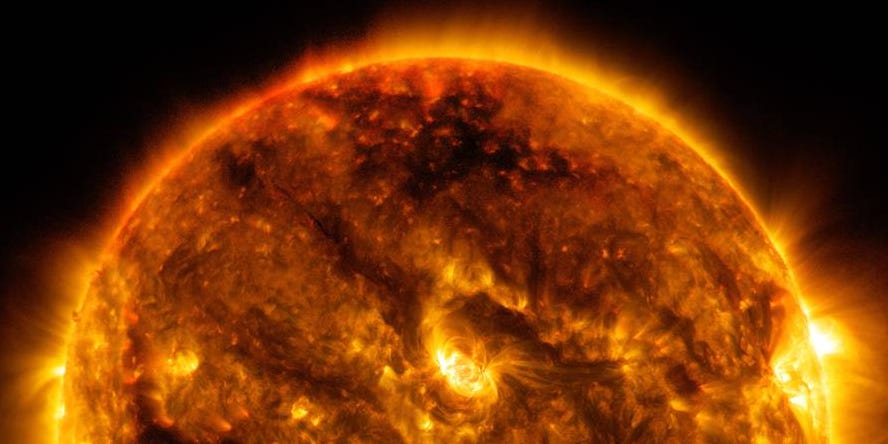
Another powerful experience is watching time-lapse imagery from the Solar Dynamics Observatory. In ultraviolet wavelengths, the Sun looks alive. Magnetic loops rise from active regions. Bright flares flash. Dark filaments stretch across the surface. Coronal plasma follows invisible magnetic highways. When you know that waves are also moving beneath and across this surface, every image feels deeper. You are not just seeing light; you are seeing the outer skin of a complicated interior machine.
Amateur sky-watchers can also connect with solar science safely through solar-filtered telescopes or eclipse-viewing equipment. The key word is safely. Looking at the Sun without proper certified protection is a fast way to turn curiosity into permanent eye damage, and that is not the kind of science experiment anyone needs. With the right gear, however, the Sun reveals sunspots, granulation, prominences, and changing activity. Even a simple view of sunspots can make the solar cycle feel real.
There is also the experience of auroras. When solar storms disturb Earth’s magnetic field, charged particles can create glowing curtains of light near the poles and sometimes much farther south than usual. Seeing auroras after learning about solar waves changes the experience. The lights are beautiful on their own, but they also become part of a larger story: internal solar motion, magnetic-field evolution, eruptions, solar wind, Earth’s magnetosphere, and finally a sky that looks painted by electricity.
For students and science writers, the HFR wave mystery is especially valuable because it shows how real science works. Discoveries do not always arrive as tidy answers. Sometimes they arrive as stubborn questions. A wave moves too fast. A model fails. A familiar star behaves strangely. Then scientists check the data, test explanations, reject weak ideas, build better models, and keep listening.
That is the real experience behind the phrase “defies physics.” It is not chaos. It is curiosity sharpened by evidence. The Sun sends a signal, researchers notice the signal does not fit, and the next chapter of solar physics begins. Not bad for something most people only think about when choosing sunscreen.
Conclusion: The Sun Still Has Secrets
The discovery of high-frequency retrograde vorticity waves shows that the Sun remains a scientific frontier. These waves move opposite the Sun’s rotation, form swirling patterns near the equator, and travel much faster than current theory predicts. They do not overthrow physics; they expose gaps in our models of solar dynamics.
By studying solar waves, scientists can peer beneath the visible surface of the Sun and investigate hidden processes that shape magnetic activity, sunspots, flares, and space weather. Acoustic waves, Rossby waves, magnetic waves, and mysterious HFR waves all help researchers decode the solar interior.
The Sun is close, familiar, and essentialbut not fully understood. Every strange wave is a reminder that even our nearest star can surprise us. And when the Sun surprises us, it is wise to pay attention. After all, this is the star that powers life on Earth, drives space weather, and apparently still enjoys giving physicists homework.