Every technology conference has a booth row. You know the scene: branded tablecloths, tired banners, pens that stop working by Tuesday, and someone offering a stress ball shaped like a cloud because apparently “cloud security” needed a mascot. But at ShmooCon 2016, one booth managed to do something rare. It did not merely hand out swag. It pulled people in, challenged them, made them laugh, and quietly taught everyone a lesson about what a truly great conference booth should be.
The booth belonged to Fortego, and its secret weapon was a game called BattleBits. On paper, BattleBits was simple: take a hexadecimal value, convert it to binary, and punch the answer into a physical controller as fast as possible. In practice, it was the kind of nerdy, competitive, hands-on experience that makes a hacker conference crowd stop walking, forget lunch, and say, “Wait, I can beat that score.” That is when a booth becomes more than marketing. It becomes a gravitational field.
This article looks at why the BattleBits booth stood out at ShmooCon 2016, what made it so perfectly matched to its audience, and what modern event marketers, cybersecurity companies, makers, and conference exhibitors can learn from it. Spoiler: the answer is not “order more keychains.”
What Made ShmooCon 2016 the Right Place for a Booth Like BattleBits?
ShmooCon has always had a different flavor from giant corporate technology expos. Held in Washington, D.C., the annual hacker convention brought together security researchers, engineers, students, hardware tinkerers, policy-minded technologists, and people who can probably explain packet captures before their first coffee. The 2016 edition took place at the Washington Hilton and continued the conference’s tradition of mixing serious information security research with community-driven events, creative technical demonstrations, and hallway conversations that could accidentally turn into whiteboard sessions.
That environment matters. A generic giveaway booth might work at a broad business expo, but ShmooCon attendees are not easily hypnotized by free plastic objects. This is a crowd that values cleverness, technical depth, and authenticity. If you want their attention, you need to earn it. A booth that says “schedule a demo” is fine. A booth that says “prove how fast your brain can convert hex to binary” is suddenly speaking the local language.
At ShmooCon 2016, several security companies were present, and many of them used familiar booth tactics: swag, small prizes, demos, and friendly conversations. Those are not bad tools. They are simply common tools. Fortego’s BattleBits worked because it turned the booth into a challenge. Instead of asking people to passively receive a pitch, it invited them to actively participate. That single design choice changed everything.
The Booth: Fortego’s BattleBits Game
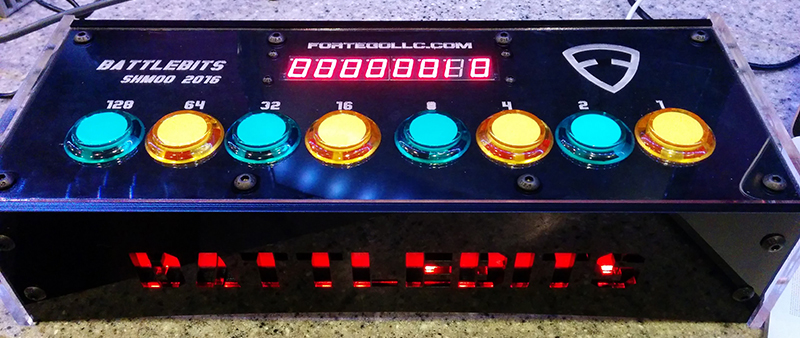
BattleBits was built around a beautifully simple idea: show the player a random byte in hexadecimal, then ask them to enter the matching eight-bit binary value using physical buttons. The controller used eight inputs representing powers of two: 1, 2, 4, 8, 16, 32, 64, and 128. Players had to hit the correct combination as quickly as possible. If the displayed value was, for example, 0xA3, the player needed to think through the byte, translate it into binary, and press the right buttons before their confidence melted into math-flavored panic.
The beauty of the game was that it looked harder than it was, then became harder again when speed entered the room. Anyone who understood hexadecimal could jump in quickly. Anyone who did not could still learn the trick: break the byte into two four-bit nibbles, solve each half, then combine them. Suddenly, the game was not just entertainment. It was a tiny teaching machine with a leaderboard attached.
That is why BattleBits felt so at home at ShmooCon. It rewarded exactly the skills the audience enjoyed showing off: pattern recognition, number-system fluency, fast hands, and the ability to pretend you are calm while a small crowd watches you press buttons like you are defusing a toaster.
Why This Was Not Just a Game, But Smart Booth Design
The best conference booth does not scream for attention. It creates a reason for people to approach. BattleBits had several built-in advantages that many expensive trade show activations never achieve.
1. It Was Instantly Understandable
A strong booth experience should not require a five-minute explanation before it becomes interesting. BattleBits could be understood almost immediately: see the value, press the bits, beat the clock. Even if a passerby did not fully understand the math, the social signal was obvious. People were competing. Scores mattered. The buttons were real. The crowd was reacting. That is booth gold.
2. It Matched the Audience Perfectly
Great marketing is not about impressing everyone. It is about resonating deeply with the right people. BattleBits was built for a computer-literate crowd. Hexadecimal, binary, bytes, nibbles, hardware controllers, and leaderboards are not random decoration at a hacker conference. They are cultural shorthand. Fortego did not simply put its logo on a game. It created an experience that felt native to the room.
3. It Encouraged Repeat Attempts
Many booth demos are one-and-done. You listen, nod politely, take a brochure, and later discover the brochure has formed a small colony at the bottom of your backpack. BattleBits encouraged people to try again. A bad score was not a failure; it was a personal insult delivered by mathematics. A decent score begged to be improved. A great score became a target for everyone else. That repeatability kept energy around the booth.
4. It Created Natural Conversation
The smartest booths do not force a sales conversation too early. They let the experience create the opening. After someone played BattleBits, Fortego’s team had a natural reason to talk: “Nice run,” “You were fast on the low nibble,” or “Want to try again?” From there, the conversation could move toward the company, its work, and its technical credibility without feeling like a cold pitch in a fleece vest.
The Hardware Charm: BeagleBone, Custom Cape, and Maker Energy
Another reason BattleBits worked was that it had physical presence. The controllers, often described as “decks,” were built around BeagleBone hardware and a custom cape, with software involving JavaScript and Python. That combination gave the booth a maker-friendly personality. It was not a tablet running a generic lead form. It was a purpose-built object that looked and felt like something someone cared enough to design.
For a hacker conference, that matters. Hardware invites inspection. Buttons invite touching. Custom boards invite questions. A polished commercial kiosk might be impressive, but a clever handmade game earns a different kind of respect. It says, “We build things.” In cybersecurity, that message is often more persuasive than a slide deck with thirteen arrows pointing to a lock icon.
The creator associated with the hardware, Riley Porter, also represented another important part of hacker culture: sharing. The idea that design files and code could be released so others could build their own version gave BattleBits extra credibility. Open design is not just a technical choice. In communities like ShmooCon, it is a trust signal. It says the project is not smoke and mirrors. It is real enough to be studied, copied, improved, and lovingly broken by someone with a soldering iron and too much caffeine.
What BattleBits Teaches About Conference Booth Strategy
Modern event marketers often talk about “engagement,” but the word can get stretched until it means anything from scanning a badge to making eye contact near a banner. BattleBits is a useful case study because it shows what real engagement looks like: voluntary participation, visible challenge, emotional response, and memorable interaction.
Make the Audience the Hero
At many booths, the company is the star. The visitor watches a demo, listens to a pitch, and receives information. BattleBits flipped the script. The visitor became the performer. The company became the host of the arena. That shift is powerful because people remember what they do more than what they are told.
Use Competition Carefully
A leaderboard can be cheesy when it feels bolted on. BattleBits made the leaderboard meaningful because the game itself was skill-based and relevant. Players were not spinning a prize wheel or guessing how many candies were in a jar. They were demonstrating a tiny but real technical ability. That made the competition feel legitimate, especially in a room full of people who appreciate precision.
Keep the Interaction Short
Conference floors move quickly. A great booth interaction should be short enough for someone to try without rearranging their day, but satisfying enough to create a memory. BattleBits nailed that rhythm. A round could be quick. The emotional payoff was immediate. The next person could step up. The line itself became advertising.
Let the Booth Explain the Brand Without a Speech
Fortego’s BattleBits booth communicated technical fluency, creativity, and audience awareness before anyone said a word about services. That is the best kind of branding: demonstrated, not declared. A company can say it is innovative. Or it can build a booth that makes security professionals voluntarily line up to convert bytes under pressure. One of those is a slogan. The other is evidence.
Why Swag Alone Usually Fails
Swag is not useless. People like useful items, and a good sticker can live on a laptop longer than some startups live in office space. But swag alone rarely creates a strong memory. It is transactional. You give me a pen; I give you three seconds of attention. We both move on with our lives.
BattleBits worked because it gave attendees a story. Someone could leave the booth and say, “I just played this hex-to-binary speed game,” which is much more interesting than, “I acquired another foam object.” In the world of conference marketing, stories travel. Objects sit in hotel rooms until suitcase weight becomes a moral crisis.
The lesson is not that every booth needs a custom electronics game. The lesson is that a booth should offer an experience that reflects the audience’s identity. At a cybersecurity conference, technical play is a natural fit. At a medical conference, the equivalent might be a diagnostic simulation. At a design conference, it might be a live critique wall. At a developer conference, it might be a debugging race. The form changes. The principle does not.
ShmooCon Culture Made the Booth Even Better
ShmooCon’s broader culture helped BattleBits shine. The conference has long been associated with original talks, hands-on technical curiosity, community traditions, and side events that reward participation. Events like Hack Fortress, charity activities, hardware demonstrations, and security research presentations gave attendees a mindset of exploration. People were already primed to try things, learn things, and compare notes.
That environment made a game like BattleBits feel less like a marketing stunt and more like part of the conference ecosystem. It belonged. It was playful but not empty. Technical but not tedious. Competitive but not hostile. In other words, it understood the room. That may be the most important booth design principle of all.
Specific Examples: Why BattleBits Was So Addictive
Imagine stepping up to the controller. A byte appears. Your brain begins its tiny internal committee meeting. The high nibble looks manageable. The low nibble suddenly looks like it was designed by a mischievous raccoon. You press the buttons. Maybe you nail it. Maybe you miss one bit and experience the ancient programmer emotion known as “off by one, but in public.” Either way, you want another try.
That loop is powerful because it combines three ingredients: clarity, challenge, and feedback. The task is clear. The challenge is real. The result is immediate. This is the same reason classic arcade games, typing tests, and capture-the-flag puzzles can become addictive. The player always believes the next run will be better. Sometimes the player is correct. Sometimes the player learns humility from a byte.
BattleBits also had spectator appeal. A passerby could watch for a few seconds and understand the tension. Fast players looked impressive. Mistakes were funny without being cruel. People waiting in line could mentally solve the next value and quietly judge the current player, as conference attendees have done since the dawn of lanyards.
Lessons for Cybersecurity Companies and Event Marketers
If you are planning a booth for a cybersecurity conference, BattleBits offers several practical lessons. First, do not underestimate your audience. Technical people enjoy technical challenges when those challenges are respectful, well-designed, and fun. Second, create an activity that can be understood quickly from a few feet away. Third, make the interaction physical if possible. Buttons, lights, boards, locks, puzzles, and displays can give your booth a presence that a laptop demo cannot always match.
Fourth, design for conversation after participation. The booth should not trap visitors in a sales funnel before they have had a reason to care. Let the experience warm up the relationship. Finally, make the activity worth talking about. A good booth gives people a reason to bring a colleague over. A great booth makes them say, “You have to try this.” BattleBits landed in that second category.
The Deeper Reason It Worked: Identity
The best conference booth you will ever see is rarely the most expensive one. It is the one that understands identity. BattleBits told attendees, “This is for people like you.” It rewarded knowledge that mattered in the community. It turned abstract computing concepts into a fast physical challenge. It felt like a game that could only truly thrive in a room full of hackers, engineers, and security nerds.
That is why the booth is still worth discussing years later. It was not just clever. It was culturally accurate. It did not chase attention with noise; it earned attention with relevance. In marketing terms, it had audience fit. In human terms, it was fun. In hacker terms, it had buttons, bits, and bragging rights. Honestly, that is a dangerously effective combination.
Experience Add-On: What It Felt Like to Encounter a Booth Like This
Picture walking through ShmooCon 2016 after a dense technical talk. Your brain is full of security research, your badge is swinging from your neck, and you are doing the classic conference shuffle: half networking, half hunting for coffee, half pretending three halves make sense because you have been awake since dawn. Around you are booths trying to stand out. Some have banners. Some have giveaways. Some have people smiling with the quiet desperation of anyone who has said “Can I scan your badge?” too many times in one morning.
Then you notice a small crowd. Not a polite crowd, either. A real one. People are leaning in. Someone is laughing. Someone else is clearly trying to look casual while waiting for a turn. That is the first sign of a good booth: people gather around it even when they are not being paid in candy.
You move closer and see the BattleBits setup. The premise clicks quickly. Hex value on display. Binary buttons waiting below. Speed matters. Accuracy matters more. The game looks easy enough to tempt you and hard enough to embarrass you, which is the perfect difficulty level for a technical crowd. If it were too easy, nobody would care. If it were too hard, nobody would try. Instead, it sits in that magical zone where your brain says, “I know this,” and your hands reply, “Do we, though?”
Watching someone play is half the fun. A fast player makes the process look automatic, like their fingers are wired directly into a lookup table. A slower player becomes a suspense film in eight bits. You can almost see the mental arithmetic happening: 128? No. 64? Yes. 32? Maybe. Wait, what was the number again? The crowd understands because everyone has been there. Computing is full of tiny translations that feel obvious until time pressure turns them into soup.
When you finally step up, the controller changes from an object into a challenge. The buttons feel real. The display feels personal. The leaderboard is no longer decoration; it is a witness. You start strong, miss one value, recover, then immediately want another round. That is the emotional hook. The game does not need a long pitch because the experience creates its own motivation. You are not being told to engage. You are already engaged.
The best part is what happens afterward. People talk. They compare methods. Some solve by memorized nibble patterns. Some think in powers of two. Some claim they were faster in practice, which is the official anthem of every leaderboard-adjacent human activity. The booth team has an easy opening to join the conversation, and because the interaction was enjoyable, the conversation feels natural. Nobody is cornered. Nobody is trapped in a slideshow. The booth has earned attention the honest way.
That is why BattleBits remains such a strong example of conference booth design. It created a shared experience, not just a branded stop. It let the audience show skill, learn something, laugh at mistakes, and come back for another attempt. In a conference world where many booths disappear from memory before the elevator doors close, BattleBits had staying power. It was small, smart, technical, and wonderfully specific. In short, it was exactly the kind of thing ShmooCon deserved.
Conclusion
Shmoocon 2016: The Best Conference Booth You’ll Ever See is more than a nostalgic look at a clever hacker-con game. It is a blueprint for how to create memorable booth engagement. Fortego’s BattleBits succeeded because it respected the audience, transformed a technical concept into a physical challenge, encouraged competition, and made conversations feel natural. It proved that the most effective conference booth is not always the loudest, largest, or most heavily swagged. Sometimes, it is the one with eight buttons, a byte on the screen, and a line of people who cannot resist proving they still remember binary.
Publisher note: This article is written as an original SEO-focused editorial synthesis based on publicly available information about ShmooCon 2016, BattleBits, Fortego, hacker conference culture, and interactive booth engagement best practices. No source-link elements or citation placeholders are included in the publishable body copy.