Imagine dropping through an orange sky so thick it looks like the universe forgot to clean its windows. Below you, a frozen world slowly appears: pale highlands, dark drainage channels, rounded “rocks” that are probably water ice, and a landscape that looks oddly familiarlike Earth after someone swapped water for liquid methane and turned the thermostat down to “absolutely not.” That was the view from the Huygens spacecraft when it landed on Titan, Saturn’s largest moon, on January 14, 2005.
The Huygens probe, part of the Cassini-Huygens mission, became the first spacecraft to land on a moon in the outer solar system. More importantly, it gave humanity its first ground-level look at Titan, a world hidden under a dense, golden atmosphere. Before Huygens, Titan was a mystery wrapped in haze and orbiting Saturn like a cosmic riddle. After Huygens, scientists had images, atmospheric measurements, chemical data, and a jaw-dropping realization: Titan is alien, yes, but it also behaves in ways that feel strangely Earth-like.
This is the story of what Huygens saw, what it measured, and why those grainy orange pictures still matter two decades later.
What Was the Huygens Spacecraft?
Huygens was not a spacecraft in the sleek, movie-star sense. It was more like a heavily armored science barrel with parachutes, batteries, instruments, and one very important job: survive the plunge through Titan’s atmosphere long enough to send data back to Cassini. The probe was built by the European Space Agency and delivered to Saturn by NASA’s Cassini orbiter, with the overall Cassini-Huygens mission involving NASA, ESA, and the Italian Space Agency.
Cassini launched in 1997 and reached Saturn in 2004. Huygens separated from Cassini in December 2004 and coasted alone toward Titan. On landing day, it entered Titan’s atmosphere, deployed parachutes, and began a descent lasting more than two hours. During that fall, it collected data on wind, temperature, pressure, atmospheric composition, haze, surface brightness, and the shape of the land below.
Its most famous instrument was the Descent Imager/Spectral Radiometer, or DISR. That instrument took pictures during the descent and built mosaics of Titan’s surface as the probe rotated beneath its parachute. It also measured light and surface reflectance, using a lamp near touchdown because sunlight on Titan is weak and heavily filtered by haze.
What Did Huygens See While Falling Through Titan’s Atmosphere?
At first, Huygens saw very little. Titan’s upper atmosphere is loaded with haze made from complex organic particles created when sunlight breaks apart methane and nitrogen. From space, Titan looks like a smooth orange ball, almost featureless. Huygens had to descend beneath that haze before the surface began to reveal itself.
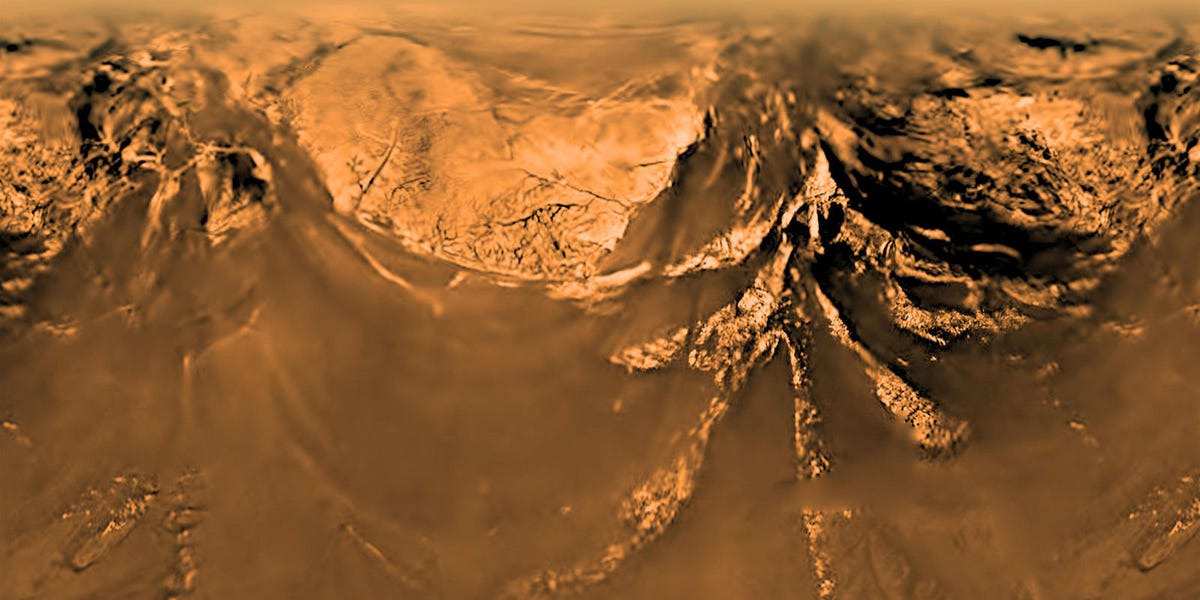
As the probe dropped lower, the view sharpened. Huygens saw bright highlands cut by dark branching channels. These channels looked remarkably like river systems on Earth, with tributaries feeding into broader paths. But Titan’s “rivers” are not carved by liquid water. On Titan, water is frozen hard as rock. The fluid that falls as rain, flows across the ground, and gathers in lakes and seas is mainly methane and ethane.
The images showed a landscape shaped by erosion, drainage, and possible flash floods. Some dark areas appeared to be low plains where liquid hydrocarbons may have pooled or flowed in the past. The brighter areas looked like elevated terrain. In other words, Huygens saw weather written into the ground.
The View from Five Kilometers Above Titan
One of the most dramatic Huygens views came from about five kilometers above Titan’s surface. The fish-eye-style panorama shows a circular world of orange-brown terrain, with lighter hills and darker channels spreading across the landscape. The distortion makes Titan look like a tiny planet from a dream, but the science is very real.
From this altitude, the landing site appeared to sit near the boundary between brighter, rougher terrain and darker, flatter ground. That contrast gave scientists clues about Titan’s surface processes. The lighter uplands may have been eroded by methane rainfall, while the darker plains may have collected organic-rich sediments washed downhill.
If Earth has mountain streams carrying gravel after a thunderstorm, Titan may have methane runoff carrying icy pebbles after rare but intense rain. It is not a perfect comparison, but it is close enough to make planetary scientists lean forward in their chairs.
Touchdown: What Did Titan’s Surface Look Like?
When Huygens finally landed, it did not splash into a methane sea, as some scientists had once considered possible. Instead, it came down on a solid surface: a cold floodplain scattered with rounded pebbles. The first surface image showed an orange horizon, dim lighting, and many smooth objects resting on the ground. These objects looked like stones, but on Titan they are likely made mostly of water ice.
The landing site looked weirdly familiar. NASA compared one Huygens surface view with a lunar surface image to help people understand scale. Some objects near the center of the image were roughly the size of a person’s foot, while more distant objects appeared smaller near the horizon. The scene was not sharp by modern smartphone standards, but considering it came from a moon around Saturn, it deserves a standing ovation.
The pebbles appeared rounded, suggesting they may have been shaped by transportperhaps tumbled by flowing methane, much like river stones on Earth are smoothed by water. The ground itself may have had a crust over softer material below. Huygens hit, bounced or shifted slightly, and continued transmitting from the surface.
Titan’s Orange Light: Why Everything Looked Like Burnt Caramel
The famous Huygens images are orange because Titan’s atmosphere filters sunlight through a thick haze of organic aerosols. The moon receives far less sunlight than Earth because Saturn orbits far from the Sun, and Titan’s atmosphere scatters and absorbs much of what remains. The result is a dim amber world, as if sunset decided to move in permanently.
This orange haze is not just visual drama. It is chemistry in action. Titan’s atmosphere is mostly nitrogen, with methane and other carbon-rich compounds mixed in. Sunlight and energetic particles break molecules apart, allowing new organic compounds to form. Those compounds help create the haze that blankets Titan.
For scientists, Titan is valuable because it may preserve chemical processes similar to those that occurred on early Earth before oxygen became abundant. Titan is not Earth 2.0, and no one should pack a swimsuit for its methane lakes, but it is one of the best natural laboratories for studying prebiotic chemistry in the solar system.
Huygens Confirmed Titan Is an Active World
Before Cassini-Huygens, Titan was known to have a thick atmosphere, but its surface was largely hidden. The mission revealed that Titan is not a dead icy ball. It has weather, surface liquids, dunes, possible cryovolcanic features, lakes, seas, and an underground ocean. Huygens provided the close-up evidence that helped turn Titan from a mystery into a world with recognizable processes.
The probe’s descent images showed channels and drainage patterns. Cassini later expanded the picture from orbit, mapping lakes and seas of methane and ethane, especially near Titan’s poles. Together, Huygens and Cassini revealed a methane cycle that resembles Earth’s water cycle: evaporation, cloud formation, rainfall, runoff, and collection in surface basins.
That does not mean Titan is comfortable. Its surface temperature is around minus 290 degrees Fahrenheit. Water ice behaves like bedrock. Methane can exist as liquid. The atmosphere is dense, and the sunlight is weak. Titan is Earth-like only after a very large asterisk.
The Science Instruments That Made the Landing More Than a Photo Op
Huygens did not simply take pictures and call it a day. Its six instruments investigated Titan from multiple angles. The Huygens Atmospheric Structure Instrument measured temperature, pressure, density, and electrical properties. The Doppler Wind Experiment helped scientists understand winds during descent. The Gas Chromatograph Mass Spectrometer studied atmospheric composition. Other instruments analyzed aerosols, surface properties, and light.
These measurements were crucial because Titan’s atmosphere is unlike anything else around a moon in our solar system. It is dense, mostly nitrogen, and rich in methane chemistry. Huygens measured conditions all the way down to the surface and continued sending data after landing. The probe survived impact and transmitted from the ground for more than an hour, which is the spacecraft equivalent of finishing a marathon and then offering to help clean up.
Its data showed that Titan’s lower atmosphere was cold, dense, and chemically active. Surface pressure was greater than Earth’s sea-level pressure, even though Titan is much smaller than Earth. That thick atmosphere helps make Titan one of the most fascinating places in planetary science.
Did Huygens Find Liquid Methane at the Landing Site?
Huygens did not land in a lake, and its camera did not show liquid flowing around it. However, the images and measurements strongly suggested that liquids had shaped the region. The channels seen from above looked like drainage networks. The rounded pebbles hinted at transport. The dark plains looked like places where material could have been deposited by flows.
Scientists often describe the landing area as a floodplain. It may have been dry when Huygens arrived, but Titan’s climate can produce methane rainfall and runoff. Think of a dry riverbed in a desert on Earth: empty most of the time, then suddenly very busy when a storm arrives. Titan’s version is colder, slower, and powered by hydrocarbons instead of water.
The probe’s surface instruments also helped explore whether the ground was solid, crusty, damp, or soft below. Results have been interpreted as consistent with a surface that was not hard rock in the Earth sense, but a complex icy-organic material shaped by Titan’s environment.
Why the Huygens Images Still Feel So Powerful
The Huygens pictures are not glossy, high-resolution postcards. They are fuzzy, orange, compressed, and scientifically processed. Yet they remain some of the most haunting images in space exploration. Why? Because they are real views from the surface of a world more than a billion kilometers from Earth.
They show a horizon under an alien sky. They show stones on the ground. They show a place where weather happens, where landscapes evolve, and where chemistry has been working for ages in the cold. The images bridge the gap between imagination and evidence. Titan stopped being just “Saturn’s hazy moon” and became a place you could almost stand onprovided you brought a pressure suit, serious insulation, and zero expectations of breathing.
How Huygens Changed Our Understanding of Titan
Huygens helped confirm that Titan is one of the most Earth-like worlds in the solar system in terms of surface processes. It has a dense atmosphere, clouds, rain, river-like channels, lakes, seas, dunes, and organic chemistry. But every familiar feature has an alien twist. Rivers are methane. Rocks may be water ice. Sand may be made of organic particles. Rain falls in a world so cold that ordinary water is as solid as granite.
The mission also changed how scientists think about habitability. Titan’s surface is probably too cold for life as we know it to operate there easily. But the moon may have a subsurface ocean of liquid water beneath its icy crust. Meanwhile, its surface and atmosphere provide a natural chemistry lab full of carbon compounds. That combination makes Titan a prime target for future exploration.
NASA’s Dragonfly mission, a rotorcraft lander planned for Titan, builds directly on the legacy of Cassini-Huygens. Huygens proved landing on Titan was possible. Dragonfly aims to go further by flying from place to place and studying Titan’s chemistry in different environments.
What Would You See If You Stood Where Huygens Landed?
If a human could stand safely at the Huygens landing site, the first impression would be the sky. It would not be black like the Moon’s sky or blue like Earth’s. It would glow orange-brown, thick with haze. The Sun would be a small, muted disk, more like a bright spot behind fog than a blazing star.
The ground would look like a frozen floodplain. Around you would be rounded icy pebbles, dark organic material, and low terrain stretching toward a blurry horizon. The air would be dense. Sound might travel differently than on Earth. Gravity would be weak, so you would feel lighter, though your spacesuit would still make you move like a very determined refrigerator.
There would be no trees, no water streams, no birds, and no friendly breeze in the Earthly sense. Yet the place would not feel geologically boring. It would feel like a landscape with a past: rainstorms, runoff, sediment, erosion, and chemistry layered into the ground.
Experience Section: Seeing Titan Through Huygens’ Eyes
Looking at the Huygens landing images is a different experience from looking at most space photos. A sharp image of Saturn’s rings can make you gasp instantly. A colorful nebula can look like the universe hired a graphic designer. Huygens asks for something slower. At first glance, the surface image may look like a blurry orange parking lot after a dust storm. Then your brain catches up: this is not Earth. This is Titan. Those are not ordinary rocks. That is not ordinary sunlight. That horizon belongs to a moon of Saturn.
The emotional power comes from the mix of strange and familiar. The scene has pebbles, channels, plains, and a sky. It has the basic grammar of a landscape. But every “normal” detail turns sideways when you understand the conditions. The pebbles may be ice. The rivers may run with methane. The sand may be organic material formed in the atmosphere and settled over time. The air is mostly nitrogen, like Earth’s, but the environment is colder than any winter your weather app has ever dared to display.
There is also something wonderfully humble about Huygens. It did not roll around. It did not drill deep into the crust. It did not take selfies with a robotic arm. It arrived, looked, measured, listened to the atmosphere, touched the ground, and sent home what it could before its relay geometry and batteries ended the conversation. In an age when we expect high-definition everything, Huygens reminds us that exploration is not always cinematic. Sometimes it is a brief signal from an orange world saying, “Here is what I saw.”
For writers, educators, and science lovers, Huygens offers a nearly perfect example of why space exploration matters. The mission turned speculation into experience. Before it landed, Titan was mostly an object of models, telescope observations, and questions. Afterward, it became a place with a photographed surface. That shift is huge. A place you can see is easier to study, explain, and care about.
It also gives us a fresh way to think about Earth. Titan shows that rivers, rain, erosion, and atmospheric cycles are not exclusive to our planet. Nature can remix the same ideas using different materials. On Earth, water shapes landscapes. On Titan, methane and ethane take the stage. Earth has blue skies and oceans of water. Titan has orange haze and hydrocarbon seas. The comparison does not make Titan less alien; it makes the alien feel more meaningful.
When people ask what Huygens saw on Titan, the simple answer is “an orange, icy floodplain with rounded pebbles.” But the better answer is bigger: Huygens saw proof that worlds can be active in unexpected ways. It saw a moon where chemistry falls from the sky, where rain may carve channels, and where a hidden story is written into frozen ground. Not bad for a probe that looked like a science-packed casserole dish with a parachute.
Conclusion
The Huygens spacecraft saw one of the most extraordinary landscapes ever photographed: Titan’s hazy orange sky, branching drainage channels, bright highlands, dark plains, and a surface scattered with rounded icy pebbles. Its landing confirmed that Titan is not just another frozen moon, but a complex world with weather, erosion, organic chemistry, and a methane-based cycle that echoes Earth’s water cycle in a deeply alien way.
Huygens lasted only a short time on Titan’s surface, but its legacy is enormous. It gave scientists ground truth for Cassini’s orbital observations, revealed details of Titan’s atmosphere and surface, and inspired future missions that will continue the investigation. The probe’s pictures may be grainy, but their message is crystal clear: even in the cold outer solar system, worlds can be dynamic, surprising, and strangely familiar.