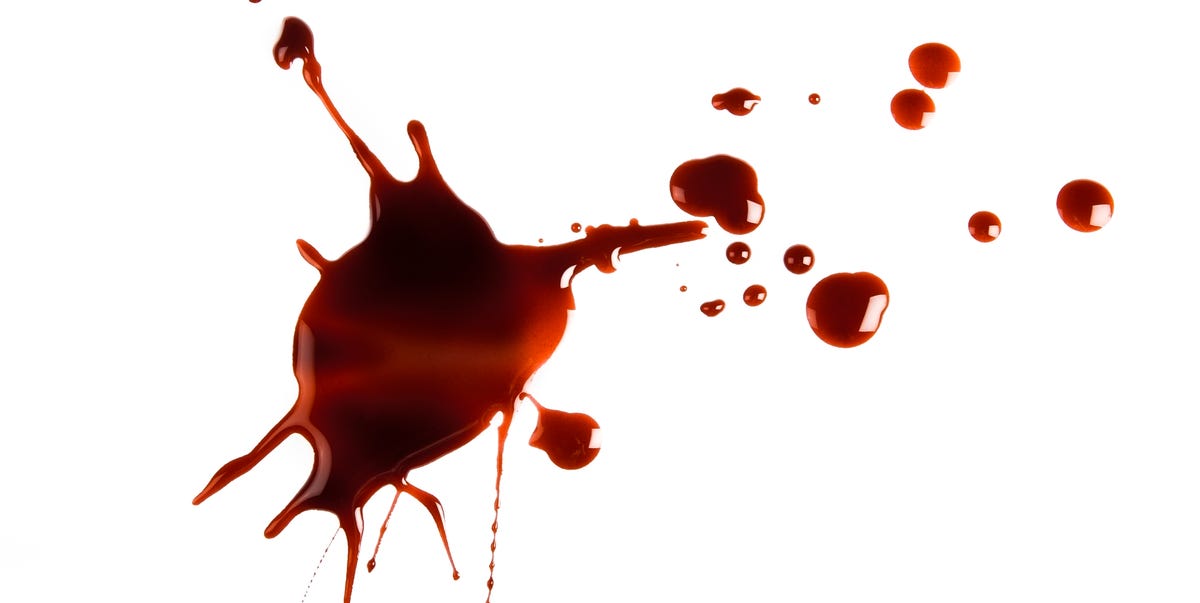
Blood at a crime scene is not exactly subtle. It does not whisper. It tends to announce itself with all the restraint of a fire alarm. But for decades, the real challenge has not been finding blood. It has been figuring out what those stains can reliably say about what happened.
That is where the weird physics comes in. Scientists are taking a closer look at how blood droplets fly, stretch, curve, splash, wick into fabric, and dry on surfaces. The goal is not to turn detectives into wizards with laser pointers. It is to make bloodstain pattern analysis more scientific, less subjective, and more useful in serious investigations, including murder cases.
In other words, researchers are trying to teach crime-scene evidence to speak in full sentences instead of vague dramatic hints. That may sound like a niche hobby for people who love fluid mechanics a little too much, but it could matter in courtrooms where a few inches, a few seconds, or a mistaken interpretation can change everything.
Why Bloodstains Matter in the First Place
Bloodstain pattern analysis, often called BPA, has long been used to help investigators reconstruct violent events. Analysts study the size, shape, location, and distribution of stains to answer questions such as where an injured person may have been standing, whether blood dripped or was projected, what direction it traveled, and what kind of motion may have produced the pattern.
At its most basic level, the logic seems straightforward. A round drop that falls straight down looks different from a stretched-out stain that hits a wall at an angle. A cluster of tiny stains can suggest force, motion, or impact. A trail may show movement. A fan-like pattern may point to repeated swings or cast-off. It is part geometry, part observation, and part hard-earned crime-scene experience.
The problem is that blood is not a perfect little math problem. It does not politely behave like a clean marble rolling across graph paper. It is a complex biological fluid moving through messy, real-world environments full of textured walls, soft fabric, air resistance, changing angles, and surfaces that can turn a neat droplet into a forensic tantrum.
Where the Weird Physics Starts
Blood Is Not Just “Red Water”
One reason this research matters is that blood is complicated. It contains cells, proteins, and plasma, and its behavior changes depending on motion, surface contact, and even time. When a droplet flies through the air, strikes glass, lands on painted drywall, or hits a cotton shirt, it does not always behave the same way.
That means the final stain can be shaped by far more than just the original event. Surface roughness matters. Surface absorbency matters. The angle of impact matters. The speed matters. Gravity matters. Air drag matters. Even whether the surface is slanted or horizontal can change what the stain looks like and what an analyst might conclude from it.
This is why scientists have been studying droplet impact on inclined surfaces, the spreading of blood-like fluids, and the way blood interacts with rough or absorbent materials. A stain is not just evidence of violence. It is evidence filtered through physics.
Straight Lines Can Oversimplify a Curved World
Traditional bloodstain reconstruction often works backward from stains using geometry. Analysts estimate the angle of impact from a stain’s width and length, then project lines back toward an area of origin. In many cases, that approach can be helpful. But it can also oversimplify what really happened.
Scientists have pointed out that real droplets do not always travel in tidy straight lines. They move through air under the influence of gravity and drag, which means their paths are curved. That may sound like a small correction, but it can make a big difference when investigators are trying to determine whether a person was standing, crouching, seated, or moving.
And in homicide investigations, that distinction is not academic. It can affect whether a physical account fits a suspect’s statement, whether a self-defense claim looks plausible, or whether the timing and direction of force make sense.
How Physics Could Make Bloodstain Analysis Better
From “Looks Like” to Measurable Modeling
The most promising shift in the field is the move from visual interpretation alone to data-supported modeling. Researchers are using high-speed cameras, controlled impact experiments, computational fluid dynamics, and statistical methods to study how bloodstains form under known conditions.
That matters because it gives investigators something better than gut instinct dressed up in lab jargon. Instead of relying only on pattern familiarity, scientists can test how droplets behave at different velocities, angles, and surface conditions, then compare those measured outcomes to what appears at a real scene.
The long-term dream is not a magic app that solves crimes in five clicks. It is something more realistic and more valuable: tools that estimate likely regions of origin, quantify uncertainty, and tell analysts what conclusions are solid, which ones are tentative, and which ones are simply unsupported.
Impact Speed May Leave Clues
Researchers have also been studying how impact speed changes the appearance of stains. On some surfaces, faster impacts can create more pronounced spreading, edge features, or tiny secondary droplets sometimes called satellites. On fabric, the story gets even more interesting because blood can wick along fibers, smearing the original impact signature like a nosy editor rewriting the evidence.
Recent work on cotton fabrics suggests that certain visible features, including finger-like edges and surrounding droplets, may help estimate how fast blood was traveling when it hit the material. That is a big deal because clothing is everywhere in violent cases, yet fabric has traditionally been one of the trickiest places to interpret bloodstains confidently.
So yes, weird bloodstain physics now includes the thrilling forensic question: what exactly did the shirt do to the droplet? Science is glamorous in its own special way.
What This Could Mean for Murder Cases
When people hear that physics might help solve murders, it is tempting to imagine a dramatic reveal in which a computer rotates a 3D blood cloud and instantly identifies the killer. Real life is less cinematic and more spreadsheet-shaped. Still, the potential is real.
Better bloodstain science could help investigators do several things more reliably. It could improve estimates of where a bloodletting event began. It could help distinguish passive dripping from projected impact. It could sharpen interpretations of movement, directionality, and relative position. It could also reduce the risk of overconfident testimony by replacing broad claims with more careful, quantitative language.
That last point matters because bloodstain evidence often works best as part of a larger puzzle. On its own, it may not identify a killer. Combined with scene photographs, DNA, autopsy findings, witness accounts, phone records, and timelines, though, it can become much more powerful.
For example, a physics-informed reconstruction might support the conclusion that blood traveled from low to high, struck a vertical surface at an oblique angle, and originated from a region inconsistent with a witness’s version of events. That still is not the same as proving guilt. But it can test stories against physical reality, and physical reality is usually less interested in courtroom theatrics than humans are.
Gunshots Complicate Everything
Gunshot scenes are one area where newer bloodstain physics may be especially useful. Researchers studying back spatter and forward spatter have shown that droplet size, speed, and direction can be influenced by more than the wound itself. Muzzle gases and bullet behavior can alter how blood moves through the air, which means a simplistic reading of stains may miss important details.
That is important because bloodstain testimony in shooting cases can sound extremely confident to juries. But if the droplets were pushed, accelerated, or disrupted by factors outside a simple straight-line model, then the conclusions need to reflect that complexity. Physics does not make the scene easier. It makes the interpretation more honest.
Walls Are Easier Than T-Shirts
Another practical insight from current research is that surfaces do not all deserve equal trust. A smooth non-absorbent wall may preserve droplet geometry in a relatively readable way. A woven shirt, couch cushion, or hoodie can absorb and distort blood so quickly that the original impact information starts to blur almost immediately.
That does not make fabric useless. It means analysts need surface-specific science. If researchers can better understand how different textiles change a stain’s edges, spread, and satellite patterns, then clothing evidence could become more informative than it used to be. And in a real murder case, a jacket sleeve or pant leg may tell a very different story than the tile floor nearby.
Why the Field Still Needs Caution
Here is the uncomfortable part. Bloodstain pattern analysis has been criticized for years because some conclusions have been based too heavily on training, experience, and subjective judgment rather than robust validation. The field has faced scrutiny from researchers, legal advocates, and innocence organizations that argue forensic testimony has sometimes sounded more certain than the underlying science actually allows.
That criticism is not just philosophical. Error-rate studies have shown that analysts can disagree with each other, and not always trivially. In some situations, the same bloodstains can lead trained practitioners to different classifications or interpretations. That does not mean the discipline is worthless. It means the discipline has limits, and those limits need to be visible instead of hidden behind impressive vocabulary.
To its credit, the field has not ignored these problems. Standards work has pushed for more structured methodology, data-supported interpretations, bias awareness, and clearer procedures. That is a good sign. Mature sciences do not pretend uncertainty does not exist. They measure it, report it, and build better tools around it.
So the smartest way to think about bloodstain physics is not that it is rescuing a perfect field. It is helping strengthen an imperfect one.
What the Future of Bloodstain Science Might Look Like
The future probably will not belong to analysts who merely stare at stains and declare a story with Sherlock-level certainty. It will belong to analysts who can combine observation with validated models, digital measurements, 3D documentation, and probability-based conclusions.
That could mean software that estimates a region of origin while showing confidence ranges instead of a single dramatic point in space. It could mean better scene scanners that capture stain thickness and shape more accurately. It could mean separate models for blood on tile, drywall, cotton, denim, and wood. It could also mean courtroom testimony that sounds less like “this absolutely happened” and more like “this interpretation is consistent with the following measured conditions.”
Frankly, that would be progress. The justice system does not need prettier certainty. It needs better reliability.
Bottom Line
Scientists think weird bloodstain physics could help solve murder cases because blood droplets obey rules, even when violent crime does not. By studying how blood moves through air, strikes surfaces, wicks into fabrics, and forms patterns under known conditions, researchers are giving investigators better ways to reconstruct what may have happened.
But the real breakthrough is not that physics turns blood into a perfect witness. It is that physics may stop people from asking bloodstains to say more than they truly can. That is good science, good forensic practice, and in the highest-stakes cases, a very good thing.
Scene-to-Courtroom Experiences: What This Work Looks Like in Real Life
In real investigations, the experience of working with bloodstains is far less glamorous than television likes to pretend. The first reality is visual overload. A scene may contain drops, smears, transfer stains, pools, diluted traces, partial cleanups, and contamination risks all at once. Investigators are not walking into a tidy puzzle. They are entering a chaotic environment where every stain has to be documented before it dries further, gets stepped on, or loses context.
For crime-scene personnel, one of the most frustrating experiences is knowing that a pattern may look meaningful while also knowing that appearances can be deceptive. A stain on drywall behaves differently from one on glass. A stain on a bedsheet can spread through fibers and distort fast. By the time evidence is photographed, collected, and interpreted, the analyst is already dealing with a translation problem: how much of the original event is still visible, and how much has been rewritten by physics?
Researchers in laboratories face a different kind of challenge. They create controlled messes on purpose so real crime scenes can be understood better later. That means launching droplets, filming impacts with high-speed cameras, testing fabrics, changing surface angles, and measuring how stains spread and dry. It is repetitive, technical work. Yet it is also deeply practical because every controlled experiment chips away at the same question: what can a stain actually tell us, and what is just confident guesswork wearing a lab coat?
Then there is the analyst’s courtroom experience, which may be the most difficult part of all. In court, nuance is not always popular. Juries want answers. Lawyers want sharp yes-or-no statements. But the honest scientific answer is often narrower. A careful analyst may be able to say that a pattern is consistent with projected blood traveling at a certain angle range, or that the likely origin region contradicts one account and fits another better. What science often cannot do, at least not honestly, is leap from pattern to certainty without acknowledging limitations.
That tension is exactly why the newer physics-based work matters. It gives forensic experts stronger footing when they explain what they know, what they do not know, and how they got there. Instead of relying only on experience or analogies to prior cases, they can increasingly point to measured behavior: how droplets curve in flight, how fabrics change edge patterns, how velocity affects satellites, and how uncertainty should be calculated rather than ignored.
For families, detectives, defense attorneys, prosecutors, and jurors, the lived experience of this shift is simple even if the science is not. Better bloodstain physics does not make tragedy easier. It makes interpretation more disciplined. In the best version of the system, that means fewer exaggerated claims, fewer avoidable mistakes, and a better chance that forensic evidence helps reveal what happened instead of merely sounding convincing while everyone nods nervously at the word “spatter.”
Conclusion
Bloodstain analysis is moving away from old-school intuition and toward a more measured partnership with physics, statistics, and careful forensic standards. That is a healthy shift. Murder investigations demand evidence that is not just dramatic, but dependable. If scientists can keep turning messy droplet behavior into tested, transparent knowledge, bloodstains may become less of a courtroom gamble and more of a trustworthy reconstruction tool.