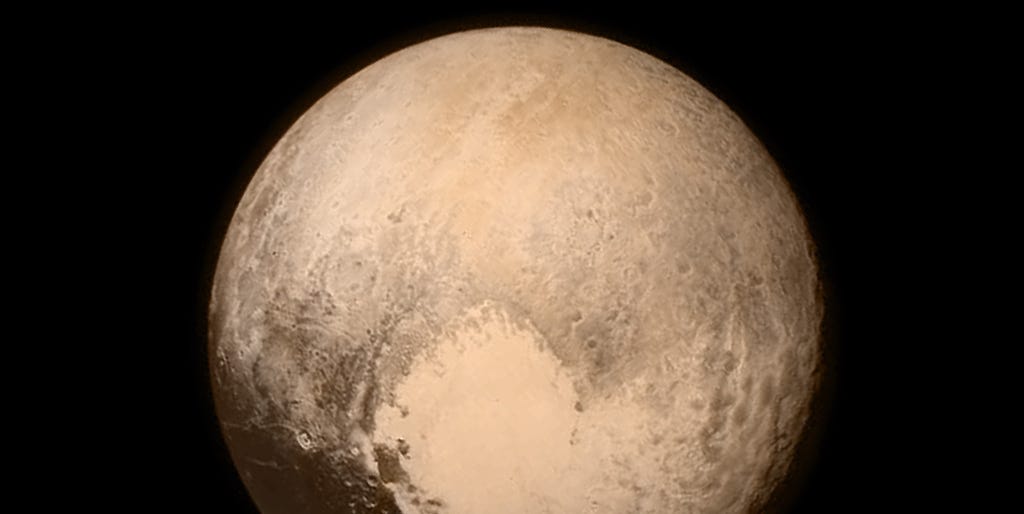
Pluto has spent decades proving that being small does not prevent a world from being spectacularly dramatic. First, astronomers argued about whether it should be called a planet. Then NASA’s New Horizons spacecraft flew past in 2015 and revealed mountains, glaciers, haze layers, strange blades of methane ice, and an enormous bright region shaped suspiciously like a Valentine.
That feature, known as Tombaugh Regio, quickly became Pluto’s most recognizable landmark. Yet its charming appearance hid a serious planetary-science puzzle. Why is one side of the heart a deep, pear-shaped basin? Why is it filled with gleaming nitrogen ice? Why does it sit near Pluto’s equator, almost exactly opposite the dwarf planet’s largest moon, Charon?
A detailed set of three-dimensional collision simulations has provided a surprisingly violent answer. Pluto may have acquired the western half of its heart when a roughly 435-mile-wide icy planetary body struck it slowly and at a shallow angle. Rather than exploding, melting, or vanishing into Pluto’s interior, part of the impactor may still be buried beneath the basin like a cosmic souvenir Pluto never managed to digest.
Pluto’s Heart Is Actually Two Different Regions
Before discussing the ancient collision, it helps to clarify what scientists mean by “Pluto’s heart.” The full bright feature is called Tombaugh Regio, named after Clyde Tombaugh, the American astronomer who discovered Pluto in 1930.
The heart’s western lobe is Sputnik Planitia, a vast, brilliant plain dominated by frozen nitrogen, with smaller amounts of methane and carbon monoxide ice. Its eastern lobe is brighter than much of Pluto but has a thinner coating of volatile ice and a very different geological structure.
In other words, Pluto’s heart is not one giant heart-shaped crater. It is more like two neighboring landscapes that happen to form an adorable shape when viewed from space. Nature apparently enjoys branding.
Sputnik Planitia is the portion that interests impact researchers most. The broader basin is approximately 1,200 by 2,000 kilometers, or about 745 by 1,240 miles, and its central plains sit roughly 3 to 4 kilometers below the surrounding terrain. Its elongated, pear-like outline is unusual for a conventional impact basin, which is one reason its origin remained difficult to explain.
What New Horizons Discovered at Pluto
Before New Horizons, Pluto was little more than a blurry collection of pixels. The spacecraft’s close flyby on July 14, 2015, transformed it into a recognizable world. Images showed rugged water-ice mountains bordering smooth plains, glaciers flowing through valleys, enormous faults, pits created by sublimating ice, and terrain ranging from ancient and cratered to astonishingly young.
Sputnik Planitia was one of the greatest surprises. Scientists could identify few, if any, conventional impact craters across much of its surface. That suggested the visible nitrogen ice was being renewed on geological timescales, erasing old scars before they could accumulate.
The plain is divided into polygonal cells, some tens of kilometers wide. These patterns are believed to be produced by solid-state convection. Warmer nitrogen ice slowly rises, spreads, cools, and descends again. The process is extremely slow by human standards but lively enough to make Pluto look as though someone installed a gigantic frozen lava lamp.
Sputnik Planitia also functions as an enormous glacier and reservoir for Pluto’s volatile ices. Nitrogen can sublimate into gas when warmed and later freeze onto the surface again. This movement connects the heart to Pluto’s atmosphere, seasons, winds, and long-term climate. Research has even suggested that daily and seasonal nitrogen cycling around the basin helps drive regional atmospheric circulation.
The Giant Impact Explanation
A Glancing Blow Instead of a Direct Hit
Scientists had long suspected that Sputnik Planitia began as an impact basin. The difficulty was reproducing its peculiar shape. A direct collision normally creates something closer to a circular crater. Sputnik Planitia looks stretched, with a broad northern section and a narrow southern end.
Researchers led by Harry Ballantyne of the University of Bern modeled collisions using three-dimensional smoothed-particle hydrodynamics. This technique represents planetary bodies as hundreds of thousands of interacting particles governed by gravity, pressure, temperature, material strength, and equations describing the behavior of rock and ice.
The team varied the impactor’s size, composition, speed, and approach angle. The most promising results involved a differentiated object approximately 700 to 730 kilometers wide. Like a miniature planet, it had a rocky core wrapped in a thick shell of water ice.
Instead of striking Pluto vertically, the body arrived at an angle between about 15 and 30 degrees and at a relatively low speedonly modestly above the two bodies’ mutual escape velocity. One particularly successful simulation used a 30-degree collision at 1.2 times escape velocity.
Why Scientists Describe the Collision as a “Splat”
Calling an event involving a 435-mile-wide object a “splat” makes it sound like Pluto was hit by a poorly aimed snowball. In planetary terms, however, the description is useful.
Pluto and the impactor were extremely cold. Their rocky interiors remained strong during the relatively slow collision instead of becoming completely molten. The impactor’s icy shell absorbed and redirected some of the energy, while its rocky core traveled through Pluto’s outer ice before losing momentum near Pluto’s core-mantle boundary.
In the simulations, the impactor’s core did not simply merge with Pluto’s core. It remained as a concentrated deposit of dense rock beneath the southern part of the newly formed basin. Scientists call this kind of buried mass concentration a mascon, short for “mass concentration.”
Meanwhile, ice from the impactor and Pluto collapsed into the excavated region. The simulated result closely resembled Sputnik Planitia: rounded and broad near the initial collision point, then tapering in the direction traveled by the impactor’s core. Six simulated hours after impact, Pluto had a giant pear-shaped scar and a dense rocky remnant lodged underneath it.
How a Collision Scar Became a Bright White Heart
The collision may have created the basin, but it did not instantly paint a white heart on Pluto. The brightness came later.
Because Sputnik Planitia is several kilometers lower than neighboring terrain, it became a natural cold trap. Nitrogen from Pluto’s atmosphere and surface could migrate into the depression, freeze, and accumulate. Over time, the basin filled with a deep sheet of bright nitrogen-rich ice.
Nitrogen ice is much softer than the water ice forming Pluto’s bedrock. At Pluto’s frigid temperatures, water ice behaves more like stone, strong enough to build mountains several kilometers high. Nitrogen ice can deform and flow more easily, allowing it to behave like a glacier.
Heat escaping from Pluto’s interior may warm the base of the nitrogen layer enough to drive convection without turning the entire glacier into liquid. Older material descends while fresher ice rises, continually remodeling the surface and helping erase impact craters.
The eastern side of Tombaugh Regio probably gained some of its bright coating through related volatile transport. However, its thinner layer of nitrogen ice and different terrain mean the eastern lobe remains one of the unanswered parts of the story. The impact model mainly explains Sputnik Planitia, not every square mile of the full heart shape.
Why Pluto’s Heart Is in Such a Strange Location
Sputnik Planitia does not merely have an unusual shape. It occupies a suspiciously organized position.
Pluto and Charon are tidally locked. Charon always presents the same side toward Pluto, while Pluto also keeps the same hemisphere facing Charon. Sputnik Planitia lies close to the anti-Charon pointthe side of Pluto facing directly away from the moon.
That alignment is unlikely to be accidental. Planetary bodies can gradually reorient when their mass becomes unevenly distributed, a process known as true polar wander. A region with extra mass tends to move toward an equatorial position aligned with the tidal axis. A region with missing mass tends to migrate toward a pole.
This created a problem. Sputnik Planitia is a deep depression, so it should initially represent a shortage of mass. Why, then, did it remain near the equator instead of wandering poleward?
The Earlier Subsurface Ocean Explanation
One influential explanation proposed that Pluto contains a global ocean of liquid water beneath its ice shell. According to that model, the impact that formed Sputnik Planitia thinned the shell. Denser liquid water then bulged upward beneath the basin. Combined with the mass of accumulated nitrogen ice, this created a positive gravity anomaly heavy enough to reorient Pluto.
Surface fractures, the apparent absence of an ancient frozen equatorial bulge, and models of Pluto’s thermal evolution have also been interpreted as evidence that a buried ocean may have existedor might still exist. Some researchers have suggested that ammonia or insulating layers of gas hydrates could help keep such an ocean from freezing completely.
The New Rocky Mascon Alternative
The newer impact simulations offer another source for the missing mass: the impactor itself.
If a large rocky core remains embedded beneath Sputnik Planitia, it could provide the dense material needed to create a positive mass anomaly. The heart could then settle near Pluto’s equator without requiring a large, present-day global ocean.
This explanation neatly connects two mysteries. The oblique collision accounts for Sputnik Planitia’s elongated shape, while the buried rocky core helps explain its location near Pluto’s tidal axis.
It is the planetary equivalent of discovering that a dent in a wall stays oddly heavy because the hammer is still inside it.
Does This Mean Pluto Has No Ocean?
No. The study presents an alternative hypothesis, not a final verdict on Pluto’s interior.
The simulations show that Sputnik Planitia’s shape and orientation can potentially be explained without a thick global ocean. That weakens the argument that the basin’s location alone proves an ocean exists. It does not erase other evidence related to Pluto’s tectonics, thermal history, chemistry, and possible cryovolcanism.
There are also uncertainties in the impact model. Scientists do not know the exact thickness of Sputnik Planitia’s nitrogen ice, the detailed density structure beneath the basin, or precisely how Pluto’s interior evolved after the collision. The simulations necessarily simplify some material properties and follow the immediate impact for hours rather than modeling every stage of the next several billion years.
Future studies must determine whether the proposed buried core could remain stable, whether the basin would relax into its present shape, and how quickly Pluto would reorient. The most honest conclusion is that Pluto’s ocean has gone from “possibly required” to “still possible, but no longer the only explanation.”
Why This Discovery Matters Beyond Pluto
The Pluto heart mystery is not merely a story about one unusually photogenic dwarf planet. It may reveal a previously underappreciated style of collision in the outer solar system.
Near Earth, planetary impacts often occur at tremendous speeds. Objects in the Kuiper Belt can collide more slowly because of their orbital environment. At very low temperatures, their ice and rock can also retain substantial strength. Those conditions allow an impactor to survive in ways that would be unlikely during a hotter, faster collision.
Instead of being completely vaporized or mixed into its target, an impactor may leave behind large regions composed partly of foreign material. Its core can become lodged beneath the surface, producing a chemically and gravitationally unusual province that survives for billions of years.
If that happened on Pluto, similar hidden remnants may exist inside other dwarf planets and icy moons. Features once interpreted as evidence of oceans, unusual crustal thickness, or internal differentiation might sometimes contain material delivered by ancient collisions.
The implications also reach back to Pluto’s early history, when the Kuiper Belt contained more large objects moving through a crowded and chaotic environment. Pluto’s heart may be a fossil from that perioda frozen record of a collision from the solar system’s unruly youth.
What Scientists Still Need to Learn
New Horizons gave researchers extraordinary images and compositional measurements, but it was a flyby mission. The spacecraft raced past Pluto rather than entering orbit, so it could not repeatedly map the dwarf planet’s gravity, monitor seasonal changes over many years, or use radar and geophysical instruments to probe deeply beneath the surface.
A future Pluto orbiter could test the rocky-mascon hypothesis by measuring subtle variations in the dwarf planet’s gravity field. Those measurements could reveal whether unusually dense material is concentrated beneath Sputnik Planitia. Radar sounding might help estimate the thickness of the nitrogen glacier and the structure of Pluto’s water-ice shell.
Long-term imaging could also reveal how quickly the polygonal cells move, where nitrogen is accumulating, and whether glaciers continue flowing into the basin. Such observations would help separate processes caused by climate from those inherited from the original impact.
Until then, Pluto remains a planetary detective story with only one close-up witness and a great deal of circumstantial evidence.
Conclusion: Pluto’s Heart Was Probably Born From a Scar
The leading new explanation for Pluto’s mysterious heart begins with an ancient collision. A large, differentiated body approached at a shallow angle and relatively low speed, carving out a pear-shaped basin while leaving part of its rocky core buried beneath the surface.
The depression then became a collecting basin for brilliant nitrogen ice. Glacial flow, sublimation, condensation, and convection continually refreshed that ice, transforming an impact scar into the smooth, luminous western lobe of Tombaugh Regio.
The buried impactor core may also explain why Sputnik Planitia stayed near Pluto’s equator and aligned with Charon. That possibility reduces the need to invoke a large subsurface ocean, although it certainly does not prove Pluto is dry inside.
The result is wonderfully ironic. Pluto’s famous symbol of affection may have been created by one of the least romantic events imaginable: a catastrophic collision followed by billions of years of frozen weather.
Experiencing the Pluto Heart Mystery From Earth
Most people will never stand beside Sputnik Planitia, which is probably fortunate because the average surface temperature is around minus 380 degrees Fahrenheit and the local atmosphere is not especially committed to supporting human respiration. Nevertheless, the Pluto heart discovery offers an unusually accessible way to experience planetary science from home.
Start With the Famous Global Portrait
Open a high-resolution natural-color image captured by New Horizons and locate the bright heart. At first glance, Tombaugh Regio appears almost decorative. Spend another minute examining it, however, and the symmetry begins to disappear.
The western lobe is brighter, smoother, and more sharply defined. It resembles a tilted teardrop or light bulb. The eastern lobe is diffuse and textured, blending into surrounding terrain. Recognizing that difference is the first important experience: the “heart” is a visual coincidence assembled from distinct geological units.
Zoom In Until the Smooth Plain Becomes Complicated
Next, examine detailed images of Sputnik Planitia. The seemingly blank white area breaks into polygonal cells, dark-edged boundaries, scattered pits, and flowing margins. Blocks of water ice appear to float within softer nitrogen ice, rather like enormous bergs trapped in a frozen sea.
This scale change is one of the pleasures of planetary exploration. From millions of miles away, Pluto looks simple. At regional scale, it becomes a world with moving glaciers, changing frost, drifting haze, and landscapes that would keep an entire generation of geologists happily arguing.
Reconstruct the Collision Mentally
Imagine a body roughly 700 kilometers across approaching Pluto. That is not a pebble, a meteor, or even a conventional asteroid. It is a substantial world with its own rocky core and icy mantle.
Now tilt its path. Instead of driving straight downward, let it skim into Pluto at a shallow angle. The first contact opens a broad cavity. The impactor continues downrange, stretching the disturbed region. Its ice spreads into the collapsing basin, while its protected rocky center plows beneath the surface and eventually stops near Pluto’s deeper interior.
This mental reconstruction makes the pear shape easier to understand. The rounded end marks the initial excavation. The narrow end follows the impactor’s direction of travel. A shape that initially looked arbitrary becomes a record of motion.
Compare Competing Explanations
The most authentic scientific experience comes from resisting the temptation to declare the mystery permanently solved. Place the two major explanations side by side.
In the ocean model, an impact thinned Pluto’s outer shell and allowed dense water to rise beneath Sputnik Planitia. In the rocky-mascon model, the dense material is the surviving core of the object that struck Pluto. Both can help explain why a depression behaves gravitationally like a heavy region.
Ask what observations would distinguish them. A detailed gravity map could reveal the depth and shape of the dense material. Radar might locate boundaries inside the ice shell. Measurements of deformation could indicate whether the interior is rigid, partially molten, or separated by liquid water.
This exercise demonstrates how planetary scientists work with limited evidence. They cannot drill into Pluto or casually send a graduate student to collect samples. They build models, compare predictions with visible geology, identify contradictions, and design future observations capable of eliminating alternatives.
Appreciate the Timescale
Finally, consider how many chapters are compressed into the heart’s appearance. The basin may have formed early in Pluto’s history. Nitrogen later migrated into it. The ice began flowing and convecting. Pluto may have reoriented. Seasonal cycles continued repainting the surface, while impacts elsewhere accumulated over billions of years.
The image returned by New Horizons is therefore not a snapshot of one event. It is the combined result of collision physics, internal heat, orbital dynamics, atmospheric circulation, glaciology, and deep time.
That is the real experience offered by Pluto’s mysterious heart. A charming shape becomes an invitation to read an entire world’s historyand to discover that even at the frozen edge of the solar system, geology refuses to be boring.