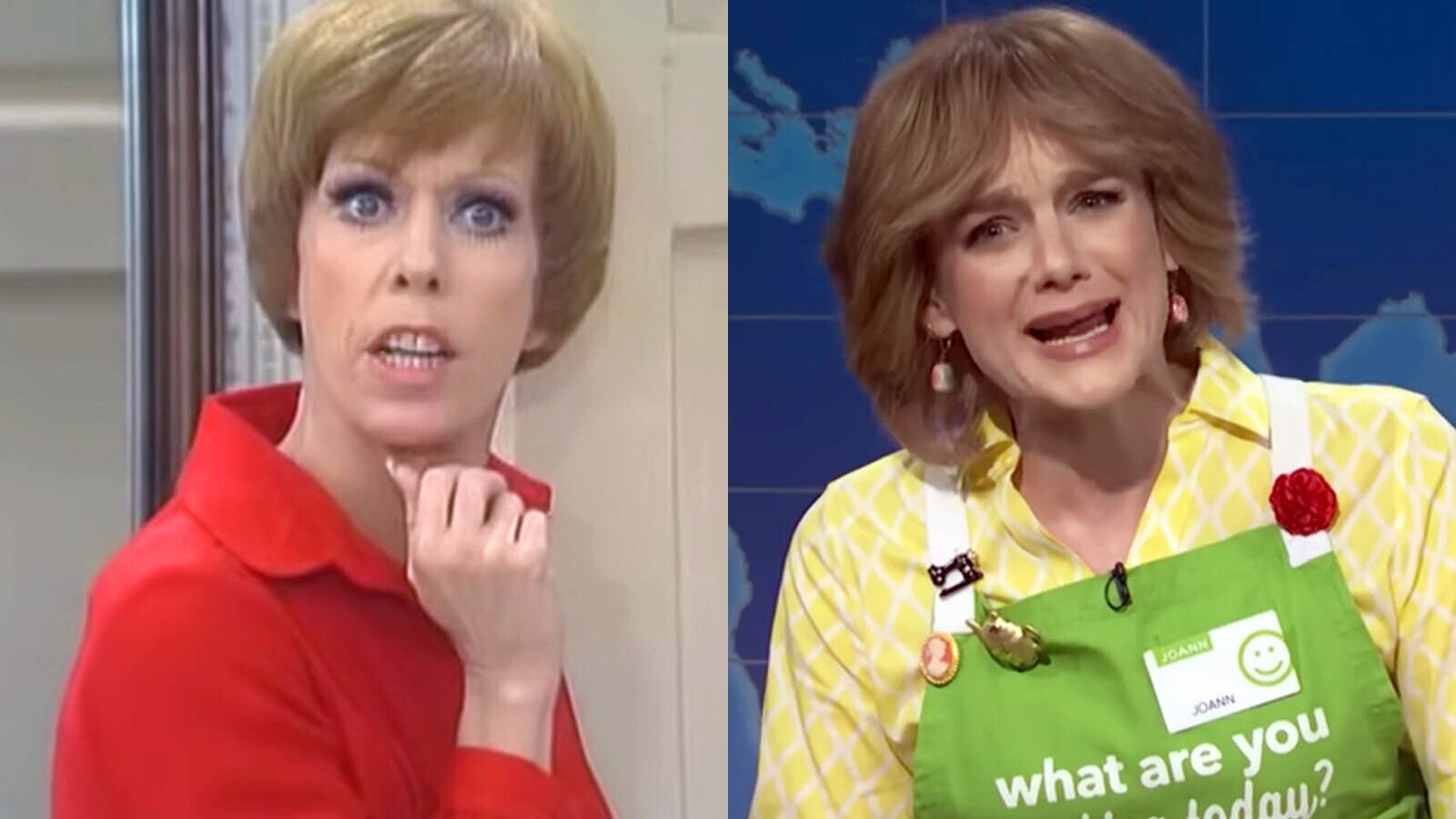
For years, one of the quiet jokes in comedy history was that Saturday Night Live was built in opposition to an older kind of television. When Lorne Michaels launched the show in 1975, he wanted something younger, sharper, stranger, and less polished than the variety programs that had ruled network TV. In that mental map, The Carol Burnett Show stood for everything early SNL was determined not to be: broad, cozy, middle-American, performer-friendly, and cheerfully theatrical.
And now? Well, after 50 years, a mountain of cameos, a national addiction to callback sketches, and an audience that treats breaking character like a love language, Saturday Night Live has drifted toward the very style it once resisted. That does not mean SNL has become a carbon copy of Carol Burnett’s classic series. It still does political satire, celebrity impersonations, and topical cold opens with the urgency of a show that lives in the news cycle. But emotionally, structurally, and even stylistically, modern SNL often feels less like a punk rock ambush and more like a giant, lovable, expertly chaotic variety reunion.
In other words, SNL has become a little more like The Carol Burnett Show. And that is not an insult. It may actually be the punch line to the entire history of television comedy.
Once upon a time, “too Carol Burnett” was the insult
To understand why this comparison lands, you have to go back to the beginning. Early SNL sold itself as anti-establishment television. It was late-night, live, messy, downtown, and proudly suspicious of old-school network slickness. Michaels wanted “sketches,” not “skits.” He wanted a sharper voice, a different rhythm, and a new relationship with the audience. In his view, the Burnett model belonged to a previous era of TV show business: musical numbers, recurring characters, middle-aged domestic themes, and performers who occasionally delighted in each other’s mistakes.
That difference mattered because The Carol Burnett Show was not some minor target. It was one of the giants. Burnett’s series had huge reach, enormous cultural visibility, and a comic ensemble that turned live energy into part of the fun. If early SNL wanted to announce itself as new, it had to define what “old” meant. Burnett became the shorthand.
But history has a terrific sense of irony. The very things that once seemed old-fashioned now look like strengths. Warmth ages better than snark. Ensemble joy ages better than attitude. And visible delight between performers ages especially well when audiences are exhausted by overproduced content and algorithmic sameness. The anti-Burnett stance helped create SNL. The slow erosion of that stance helped keep it alive.
What “The Carol Burnett Show” really represented
It was organized chaos, not soft comedy
People sometimes misremember Burnett’s show as merely wholesome, as if it were a tidy hour of safe smiles and curtain-call niceness. That sells it short. Yes, it was family-friendly by network standards. Yes, it loved theatricality. Yes, it had broad characters and musical sparkle. But it also understood the comic power of unpredictability.
One of the enduring images of The Carol Burnett Show is Tim Conway trying to crack Harvey Korman. Conway would push a line reading, add a physical bit, or improvise some nonsense that made Korman visibly lose the battle to stay in character. Those moments were not failures. They were proof of life. The audience was watching human beings enjoy the danger of performance in real time. The sketch was funny, but the chemistry was funnier.
That spirit matters because modern viewers have embraced exactly that quality on SNL. The thing Lorne Michaels once treated like an aesthetic problem has become, in many famous cases, part of the appeal. Burnett’s comedy was not careless. It was skilled enough to let looseness breathe.
It was a variety machine built on personality
The Carol Burnett Show also understood something television executives still chase: viewers do not just return for jokes. They return for company. Burnett’s opening audience Q&A, her closing ear tug, the recurring characters, the sense that the cast actually enjoyed one another, and the blend of sketch, music, parody, and personality all made the show feel less like a content delivery system and more like an invitation into a shared comic world.
That is why the comparison to modern SNL now feels so sharp. Once SNL was the rebellious younger cousin kicking at the furniture. Today it is one of the most historic institutions on television, and institutions eventually discover the power of ritual. Suddenly the old Burnett playbook does not look corny. It looks durable.
How SNL drifted toward Burnett’s DNA
Breaking character became a feature, not a bug
No piece of evidence is more obvious than the audience’s changing relationship to breaking. There was a time when corpsing on SNL could be treated like sloppy work. Then came the sketches that turned it into legend. Rachel Dratch’s “Debbie Downer” at Disney World became famous partly because the cast could barely hold it together. Ryan Gosling’s alien-abduction appearances with Kate McKinnon became instant crowd-pleasers because his attempts to stay composed were doomed from the start. Once viewers began sharing those moments like prized baseball cards, the rule quietly changed.
And what does that look like? It looks a lot like Carol Burnett territory. Not because SNL now aims to fall apart every week, but because audiences have decided they enjoy seeing the seams. In a live comedy show, professionalism is impressive. Professionalism plus imminent collapse is irresistible.
Nostalgia is no longer a side dish
Another shift is structural. Modern SNL is deeply invested in its own memory. The show has always loved recurring characters, but recent years have leaned harder into legacy as an organizing principle. Classic bits return. Former cast members drop in. old catchphrases get dusted off. The anniversary machinery has grown bigger, shinier, and more self-aware. SNL has become curator, museum, reunion special, and weekly comedy show all at once.
That makes it feel increasingly like a variety institution instead of a purely topical grenade. It still wants a hot take on the week’s headlines, sure, but it also wants applause for familiar rhythms. It wants the audience to recognize a wig, a voice, a desk segment, a character entrance, a song cue. That is classic variety-show behavior. It is built on pleasure through recognition.
The cameos are half the point now
Once upon a time, surprise appearances on SNL felt like seasoning. Now they are often central to the event. The show has embraced the grand tradition of the star-stuffed television spectacle. When a major political cold open lands, when an anniversary special rolls around, or when a big host arrives, viewers are not only asking whether the sketch is funny. They are asking who will walk through the door next.
Again, that is a variety-show instinct. Burnett’s series thrived on guest energy, on seeing performers bounce off one another, and on the sheer delight of different comic worlds colliding. SNL has not abandoned its own identity by doing this. It has simply become comfortable admitting that a live network comedy show can also be a party.
SNL50 made the comparison impossible to ignore
If anyone still needed proof, the 50th-anniversary season and anniversary special provided it with all the subtlety of a brass section. SNL50 was not just a celebration of a sketch show. It was a televised monument to the idea of television variety itself: famous entrances, old sketches revived for a roaring crowd, musical turns, sentimental callbacks, reunion energy, and a giant cloud of affectionate self-mythology hanging over everything.
That special worked precisely because it leaned into what SNL has become. It was no longer pretending to be a scrappy outsider kicking down the doors of mainstream culture. It is mainstream culture. It is the establishment with good wigs. And the event succeeded by treating that reality not as a problem but as entertainment.
There is a wonderfully funny contradiction in this. For decades, SNL defined itself against old television. Then it turned 50 and threw one of the most old-television parties imaginable: a huge ensemble, musical nostalgia, beloved bits, celebrity guests, self-reference, and emotional curtain-call energy. That is not just SNL with a birthday cake. That is an old-school variety spectacular wearing trendy shoes.
Why this is not bad news for SNL
Some comedy fans hear a comparison to Burnett and imagine decline, as if the show has softened or lost its bite. But the better interpretation is that SNL has expanded its toolkit. It still has political satire. It still has topical speed. It still has digital shorts, weird pre-tapes, and the occasional sketch that feels like it was written by someone who drank cold brew directly out of a laboratory beaker. What it has added is a deeper comfort with generosity.
Burnett’s influence is not just about broadness. It is about permission. Permission for performers to play big. Permission for chemistry to matter as much as cleverness. Permission for the audience to feel affection instead of merely admiration. That change helps explain why so many recent SNL highlights are not simply the sharpest jokes. They are the sketches where everyone seems gloriously, contagiously alive.
It is also worth noting that this shift helps the show survive the internet. In an era when clips travel faster than full episodes, what spreads best is often not the most disciplined writing. It is the moment with personality. The glance. The crack-up. The cameo. The sudden collapse of composure. Burnett’s style turns out to be remarkably compatible with social-media-era comedy because it creates instantly shareable proof that humans were having fun in the same room.
Where the comparison stops
To be fair, SNL has not literally become The Carol Burnett Show. Burnett’s series was less political, more musical, and more openly theatrical. It lived in a different network era, with a broader family audience and a different speed of cultural conversation. SNL remains more cynical, more news-driven, and more committed to impersonation as a central engine.
And yet the larger point still stands. The live-TV magic that made Burnett’s show beloved has seeped into modern SNL more than the show’s mythology would once have allowed. The institution that prized distance now sells closeness. The brand that once prized coolness now understands the value of warmth. The series that once recoiled from being “too Carol Burnett” now routinely benefits from exactly the kind of audience joy Burnett mastered decades ago.
The bigger lesson: TV comedy always circles back to warmth
Television has a habit of pretending it has outgrown its past. Every new generation insists it is smarter, stranger, edgier, and less sentimental than the one before it. Then audiences remind everyone that they still like laughter with personality. They still like chemistry. They still like the feeling that something delightfully unstable might happen live on camera. In that sense, the history of TV comedy is not a straight line. It is a loop.
Carol Burnett figured out long ago that viewers love excellence, but they also love invitation. SNL figured out that viewers love danger, but they also love recognition. Put those truths together and you get the modern form of the show: still topical, still famous, still capable of being absurdly uneven, but now much more willing to be a communal event rather than a weekly lecture from cool kids in Manhattan.
Extended reflections and viewing experiences
If you have watched SNL across multiple eras, the Burnett comparison feels less like a criticism than a strange little emotional realization. You notice it in the rhythms first. A modern episode often begins with the expected topical cold open, but somewhere along the line it starts turning into a hangout. A former cast member appears. A host revives a favorite character. Someone smirks at the wrong moment. The audience erupts not just because a joke landed, but because a memory landed. That is variety-show pleasure.
There is also a difference in how the show feels in the room, even through the screen. Old SNL stories often emphasize pressure, ego, panic, and the fear of bombing. Those ingredients are still there, of course; no live comedy institution ever becomes a day spa. But the modern viewer often responds most strongly to the moments that feel communal rather than combative. A sketch becomes more enjoyable when it seems like the performers are rooting for one another. A cameo hits harder when it feels earned instead of desperate. A laugh gets bigger when the room shares it at once.
That is where Burnett’s spirit sneaks in. The Carol Burnett Show made viewers feel like they were in on the fun. Not in a smug, you-had-to-be-there way, but in a generous way. The show said, basically, come sit with us; Tim Conway may ruin Harvey Korman’s life for the next four minutes, and it is going to be glorious. More and more, modern SNL offers a version of that invitation. It is not asking you to admire the architecture from afar. It is asking you to enjoy the wobble.
There is something oddly comforting about this, especially in a fragmented media world. A live comedy show that can still create a shared national reaction is rare. When SNL really works now, it often works because it combines the old and the new: current references, yes, but also the antique magic of performers playing off each other in real time. The show becomes less of a weekly content package and more of a public gathering disguised as entertainment.
Maybe that is why the Burnett comparison feels so right in 2026. It does not mean SNL has become tame. It means it has become comfortable enough with its own legacy to loosen its tie. It trusts memory more. It trusts the audience more. It even trusts imperfection more. And in a medium obsessed with polish, that trust can feel almost radical.
The funniest part is that Lorne Michaels spent decades building the most famous live sketch show in America, only for the culture to decide that one of its most lovable qualities is the thing he once resisted: the joy of watching great performers nearly crack each other up. That is not a defeat. That is television history settling an old argument with a grin.
Conclusion
So yes, Saturday Night Live has become, in some meaningful ways, The Carol Burnett Show. Not literally. Not completely. But spiritually? Absolutely. It has become more nostalgic, more ensemble-driven, more dependent on recognizable rituals, more welcoming of visible performer delight, and more willing to turn live looseness into part of the entertainment.
The joke is that early SNL wanted to be rock and roll while Burnett represented old TV showmanship. Fifty years later, SNL is old TV showmanship too, just with sharper political jokes and better lighting cues. And once you stop treating that as a fall from grace, it becomes something sweeter: proof that the best live comedy does not just chase cool. It builds connection.
Carol Burnett understood that a long time ago. SNL took the scenic route. But it got there.