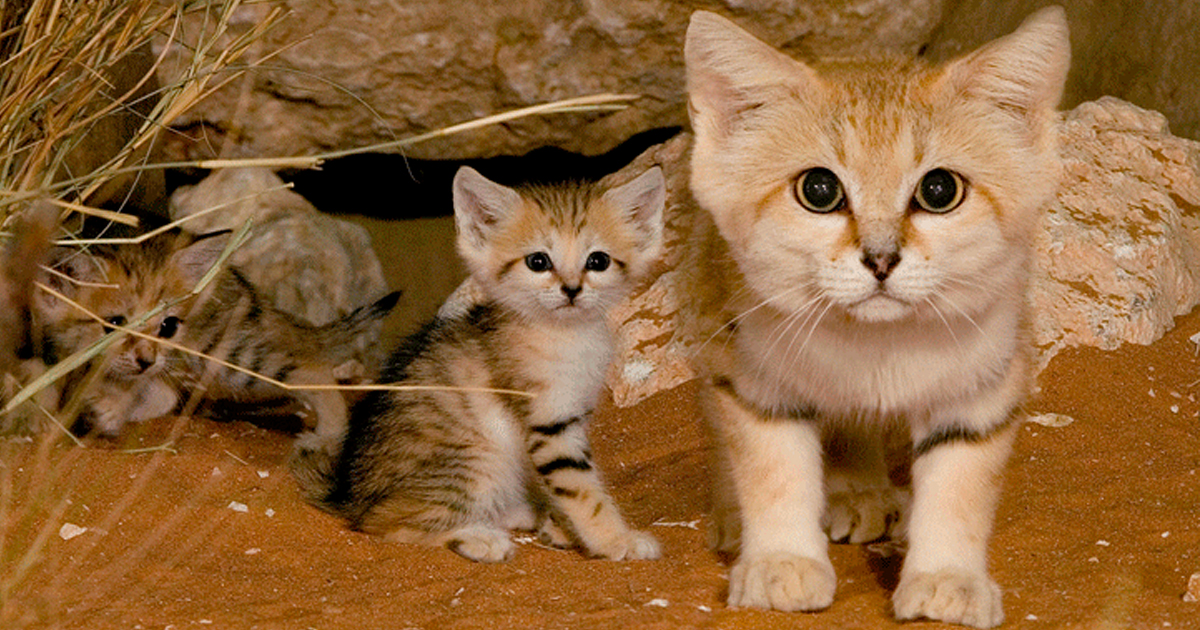
Some animals are majestic. Some are mysterious. And then there are sand cats, the tiny desert felines that look like someone took a house kitten, gave it survival skills, and dropped it into the Sahara with a tiny backpack full of confidence. With oversized ears, round faces, short legs, and permanently “I did nothing wrong” expressions, sand cats are famous online for looking like baby cats forever. The joke practically writes itself: with sand cats, the adults are kittens, and the kittens are also kittens.
But behind the adorable face is one of the toughest small wild cats on Earth. The sand cat, scientifically known as Felis margarita, is a true desert specialist. It lives in some of the driest, hottest, coldest-at-night places on the planet, from North Africa and the Arabian Peninsula to parts of Southwest and Central Asia. It does not simply survive in the desert; it has the kind of biological résumé that makes other cats look like they are still deciding whether to leave the couch.
This article explores what sand cats are, where they live, why they look so ridiculously cute, how they hunt, why they should never be treated as pets, and what makes them such remarkable desert survivors.
What Is a Sand Cat?
The sand cat is a small wild cat native to desert regions. It is sometimes called the sand dune cat, although it does not live only on dunes. Unlike many wild cats that can tolerate several habitats, the sand cat is strongly associated with true desert and arid landscapes. It is one of the few cats built specifically for life where water is scarce, daytime heat can be brutal, and nighttime temperatures can drop fast enough to make the sand file a complaint.
Adult sand cats are roughly the size of domestic cats, but they often appear smaller because of their short legs, compact bodies, and round heads. Their sandy-colored fur blends beautifully into desert terrain, making them hard to spot against pale rocks, dry grass, and dusty flats. They are not mini lions, not house cats in vacation mode, and definitely not plush toys with whiskers. They are wild carnivores with serious survival equipment hidden under an extremely marketable face.
Why Do Adult Sand Cats Look Like Kittens?
The sand cat’s kitten-like appearance comes from several features working together: a broad head, large eyes, low-set ears, short legs, and a small, sturdy frame. In humans, this combination triggers the classic “baby schema” response, which is why many people see a sand cat and immediately lose the ability to speak in adult vocabulary.
Those low, wide ears are especially important. They make the cat look cartoonishly adorable, but they also serve a serious purpose. Sand cats rely heavily on their hearing to locate prey, including rodents moving under the sand. Their ears help detect faint sounds in open desert environments, where a hidden meal may be the difference between a successful night and an empty stomach.
Their thick fur also adds to the “permanent kitten” illusion. Sand cats often look soft and rounded, with a slightly fluffy coat that makes them appear cuddly. The truth is less cuddly and more tactical. Their fur provides insulation against temperature extremes, helping protect them from both heat and cold. In other words, the fluff is not decoration. It is desert-grade engineering.
Where Do Sand Cats Live?
Sand cats live across scattered desert regions in North Africa, the Middle East, and parts of Central Asia. Their range includes areas such as the Sahara, Arabian deserts, Iran, Pakistan, Turkmenistan, Kazakhstan, and nearby arid regions. Their distribution is not smooth or continuous. Instead, populations appear in patches, often separated by large areas where conditions may not support enough prey or suitable shelter.
They prefer sandy and stony deserts with sparse vegetation, such as grasses and small shrubs. Completely bare shifting dunes are not always ideal because prey may be limited there. A good sand cat neighborhood needs cover, burrow sites, and enough small animals to hunt. Think of it as desert real estate: location matters, but so does the rodent buffet.
Because sand cats are secretive, nocturnal, and hard to track, scientists still know less about them than many larger cats. Their fur-covered paws can leave little evidence behind, and their remote habitat makes fieldwork difficult. Studying them is a little like trying to monitor a tiny beige ninja that works the night shift.
Built for the Desert: Sand Cat Adaptations
Furry Feet for Hot Sand
One of the sand cat’s most famous adaptations is the dense hair on the soles of its feet. This fur helps protect the paw pads from scorching sand and cold desert ground. It also improves movement across loose surfaces. As a bonus, it can make footprints faint and difficult to follow, which is useful when you are a small predator trying not to become someone else’s dinner.
Water? Optional, Apparently
Sand cats can survive for long periods without drinking free-standing water. They get much of the moisture they need from their prey, especially small rodents. This does not mean water is biologically irrelevant, but it does mean sand cats are remarkably adapted to places where water sources may be rare, temporary, or far away.
Burrows Are Desert Air Conditioning
During the heat of the day, sand cats often rest in burrows. They may dig their own or use burrows abandoned by other animals. These underground shelters protect them from extreme temperatures, sandstorms, and predators. If your apartment has air conditioning, insulation, and protection from danger, congratulations: you and the sand cat understand the value of good housing.
Camouflage That Works Too Well
Their pale sandy coat helps them disappear into desert landscapes. This camouflage helps them ambush prey and avoid detection by larger predators. A sand cat sitting still among rocks or dry plants can be surprisingly hard to see, which is impressive for an animal that looks like it should have its own sticker pack.
What Do Sand Cats Eat?
Sand cats are carnivores. Their diet includes small rodents, gerbils, jerboas, birds, reptiles, insects, and sometimes snakes. They are known for being bold hunters, capable of taking on venomous snakes by stunning them with quick paw strikes before delivering a killing bite. Yes, the cat that looks like a sleepy plush toy may also be a tiny desert snake fighter. Nature enjoys plot twists.
Their hunting style depends on stealth, hearing, and speed. Sand cats usually hunt at night, when temperatures are cooler and prey animals are active. They move low to the ground and listen carefully for movement. If prey is underground, they may dig it out. Their large ears are not just cute satellite dishes; they are precision listening equipment.
Because desert prey can be unpredictable, sand cats need to be efficient. They may travel significant distances while hunting, and newer research suggests some individuals may use larger home ranges than previously believed. This matters for conservation because animals that roam widely need enough connected habitat to survive.
Are Sand Cats Social?
Sand cats are mostly solitary. Adults generally avoid each other except during breeding season or when a mother is raising kittens. They communicate through scent marking, vocalizations, and other cat-style messages that probably translate roughly to “this is mine,” “I am available,” and “please respect my tiny desert boundaries.”
Their vocalizations can be surprisingly loud for such small animals. During mating periods, sand cats may make barking or rasping calls. This helps individuals find each other across open terrain. It also proves that even the cutest desert cat can sound like it has strong opinions.
Sand Cat Kittens: Actual Kittens, Somehow Even Smaller
Sand cat kittens are born tiny, helpless, and deeply committed to being adorable. A typical litter may include two to four kittens, though litter size can vary. After a gestation period of about two months, the mother gives birth in a protected den. The kittens grow quickly, developing the strength and coordination they need for desert life.
Young sand cats may begin exploring outside the den as they grow, but they depend on their mother for food and protection early in life. By several months old, they become more independent. In the wild, their survival depends on learning how to hunt, avoid predators, handle temperature extremes, and navigate a world where almost everything is either hot, sharp, hungry, or all three.
The funny thing is that adult sand cats retain so many kitten-like features that seeing a baby sand cat next to an adult can feel like comparing a kitten with a slightly more experienced kitten. The adult may have the wisdom of a desert predator, but the face still says, “I require snacks and emotional support.”
Are Sand Cats Endangered?
The sand cat is currently generally listed as a species of Least Concern by the IUCN, but that label can be misunderstood. Least Concern does not mean “nothing to worry about.” It means the species is not currently classified as threatened at a global level based on available data. However, sand cats remain difficult to study, and some regional populations may be declining or poorly understood.
Threats include habitat degradation, overgrazing, road expansion, settlement growth, off-road vehicle damage, trapping, poisoning meant for other predators, and possible disease or competition from domestic animals. Because sand cats live in remote deserts, population changes may go unnoticed for a long time. A species can be hard to count and still be vulnerable in specific regions.
Conservationists need better data on where sand cats live, how far they roam, how many survive in different regions, and which threats matter most locally. Camera traps, radio collars, field surveys, and habitat protection all play a role. For a tiny animal with a big range and an even bigger mystery cloud, research is not a luxury. It is the map.
Can Sand Cats Be Pets?
No. Sand cats should not be kept as pets. Their appearance may scream “cuddle me,” but their biology says “wild desert carnivore with specialized needs.” They are not domesticated, not bred for life in human homes, and not suited to typical pet care. A domestic cat has had thousands of years to negotiate a relationship with humans. A sand cat has had thousands of years to become excellent at surviving in deserts and judging everyone from a burrow.
Keeping wild cats as pets can harm both the animal and the owner. Sand cats require specific diets, controlled environments, veterinary expertise, and behavioral management. Illegal or irresponsible wildlife trade can also damage wild populations. The best way to love sand cats is to support conservation, responsible zoos, habitat protection, and educationnot to try to turn a desert specialist into a sofa accessory.
Why Sand Cats Became Internet Stars
Sand cats became popular online because they combine two irresistible forces: extreme cuteness and surprising toughness. They look like they belong in a children’s book, yet they live in some of Earth’s harshest environments. They are small but fearless, fluffy but fierce, precious-looking but highly capable.
This contrast makes them perfect for viral fascination. A photo of a sand cat delivers instant emotional confusion: “Is this a kitten? Is it a warrior? Why does it look like it knows my secrets?” Their round faces and wide ears make them easy to anthropomorphize, but their real story is even better than the meme version.
The internet often flattens animals into cuteness, but sand cats deserve more than a squeal and a share button. They are part of complex desert ecosystems. They help control prey populations, survive in extreme climates, and remind us that small wild cats are just as worthy of attention as lions, tigers, and leopards.
Sand Cats vs. Domestic Cats
At first glance, a sand cat may look like a domestic cat’s desert cousin. They are similar in size, and both belong to the cat family. But the comparison has limits. Domestic cats are flexible generalists that can live near people, adapt to many environments, and sometimes decide a cardboard box is spiritually superior to every bed ever purchased.
Sand cats are specialists. Their bodies and behaviors are shaped by desert survival. Their furred paws, hunting habits, burrow use, camouflage, and water-saving diet all reflect life in arid regions. They are also more elusive and less studied than domestic cats. Your house cat may knock a pen off a desk for attention. A sand cat may vanish into the night and leave almost no tracks.
Why Small Wild Cats Matter
Big cats get the movie posters. Small wild cats get overlooked. That is unfortunate because small cats make up a large and fascinating part of the wild cat family. They often play important ecological roles as predators of rodents, birds, reptiles, and insects. They are also indicators of habitat health.
Sand cats matter because deserts matter. Desert ecosystems may look empty to casual observers, but they are full of life adapted to extreme conditions. Protecting sand cats also means paying attention to fragile habitats that are easily damaged by development, overgrazing, and recreational vehicle use. A desert is not a blank space. It is a living system with rules, relationships, and residents wearing tiny fur boots.
How to Help Sand Cats
Most people will never meet a sand cat in the wild, and that is perfectly fine. Wild animals do not need us to visit their living rooms uninvited. But people can still help by supporting reputable conservation organizations, learning from accredited zoos, avoiding exotic pet content that encourages ownership, and sharing accurate information.
Another simple step is to broaden the conversation about wildlife. Conservation is not only about famous animals. It is also about lesser-known species that live quietly in difficult places. Sand cats may be small, but their story opens the door to bigger topics: desert conservation, responsible research, illegal wildlife trade, climate pressures, and human impact on fragile habitats.
Experience Section: What Sand Cats Teach Us About Wonder, Survival, and Not Judging by the Face
The first experience many people have with sand cats is not in a desert or a zoo. It is usually online, somewhere between a coffee break and a complete loss of productivity. You see a photo of a tiny beige cat with huge ears and a serious little face, and your brain instantly files it under “kitten.” Then you read that it hunts snakes, survives without regular drinking water, and moves through deserts at night like a whisper with paws. Suddenly, the cute kitten is also an action hero.
That moment is part of what makes sand cats so memorable. They challenge our assumptions. We often connect cuteness with helplessness, but sand cats prove that an animal can look delicate and still be incredibly tough. Their softness is not weakness. Their small size is not a disadvantage in the right environment. Their “baby face” is not a sign that they need rescuing or handling. It is simply the face of a wild species that has mastered its niche.
Learning about sand cats also changes how we see deserts. To many people, deserts seem empty, flat, and lifeless. Sand cats reveal the opposite. A desert may look quiet during the day, but at night it becomes a stage for movement, hunting, listening, hiding, and survival. Under the surface are rodents. In the scrub are birds and reptiles. In the burrows are animals waiting out the heat. Somewhere in that moonlit landscape, a sand cat may be listening for the faint scratch of prey beneath the sand.
There is also a useful lesson in how sand cats conserve energy. They do not waste effort trying to dominate the desert. They adapt to it. They rest during the hottest hours, use burrows as shelter, hunt when conditions improve, and get moisture from food. Humans, who often respond to inconvenience by buying three gadgets and complaining loudly, could learn something from that elegant efficiency.
Another experience connected to sand cats is the temptation to possess what we admire. Because they look adorable, some people may imagine them as exotic pets. But real appreciation means respecting distance. A sand cat belongs to the desert, not a living room. It is not a status symbol or a collectible creature. The more we understand the species, the clearer it becomes that love for wildlife should lead to protection, not possession.
Sand cats are also a reminder that mystery still exists. In an age when we can zoom in on satellite maps, stream animal videos, and identify birds with apps, it is humbling to know that scientists are still learning basic details about a small cat that roams remote deserts. How far do they travel? How stable are their populations? Which habitats matter most? What threats are increasing fastest? The sand cat keeps some secrets, and those secrets are an invitation to keep studying, not to pretend we already know everything.
Perhaps the best way to experience sand cats is with a mix of delight and respect. Laugh at the kitten face, absolutely. Admire the ears. Enjoy the photos. Send one to a friend with a message like, “Important: desert marshmallow with murder skills.” But also remember the real animal behind the meme. It is a predator, a survivor, a desert specialist, and a small but meaningful piece of wild nature.
In the end, sand cats are charming because they are full of contradictions. They look soft but live hard. They seem tiny but roam widely. They appear innocent but hunt with precision. The adults look like kittens, the kittens look like even smaller kittens, and all of them are far more capable than their round faces suggest. That is the magic of the sand cat: it makes you smile first, then makes you pay attention.
Conclusion
Sand cats are among the most fascinating small wild cats in the world. Their kitten-like appearance makes them internet favorites, but their real value goes far beyond cuteness. These desert specialists are built for extreme environments, from their fur-covered paws to their sharp hearing and moisture-efficient diet. They survive where many animals cannot, hunting at night, sheltering in burrows, and blending into landscapes that seem empty until you know how to look.
They also remind us that conservation should not be reserved for the biggest or most famous animals. Small wild cats deserve attention, research, and protection too. The sand cat may look like a permanent kitten, but it is a serious predator and an important part of desert ecosystems. Admire it, learn about it, protect its habitat, and please do not try to make it your roommate. The desert already hired it for a full-time job.