A simple mall trip should not feel like a financial therapy session with fluorescent lighting, soft pretzels, and three-for-two candle sales. Yet for one stay-at-home mom, seeing other shoppers leave with armfuls of bags made her feel left behind. She came home, told her husband she felt poor, and expected comfort. Instead, he told her that if she felt that way, maybe it was time to get a job.
That response landed like a dropped shopping bag full of glass ornaments. The wife went silent, walked away, and the internet did what the internet does best: turned one household disagreement into a full-blown public seminar on marriage, money, unpaid labor, personal spending, and whether “fun money” should come with emotional hazard lights.
The story is not just about one wife, one husband, or one mall receipt. It touches a much bigger issue facing modern families: how couples talk about money when one partner earns the paycheck and the other does unpaid work at home. When expectations are unclear, even a $100 mall purchase can become a symbol of resentment, comparison, and feeling financially invisible.
The Mall Trip That Sparked a Marriage Money Debate
According to the widely discussed story, the husband and wife had been married for 13 years and had two children. The wife had been a stay-at-home mom for years, a choice she reportedly made because she wanted to be present for the children. The husband, meanwhile, said he had preferred a dual-income household but accepted the arrangement.
Financially, the family did not appear to be in survival mode. The husband said he earned about $130,000 after taxes, lived in a low-cost-of-living city, and gave his wife $1,000 per month in personal “fun money.” This allowance was separate from household expenses, child-related costs, bills, and necessities. In other words, this was not grocery money wearing lipstick. It was spending money.
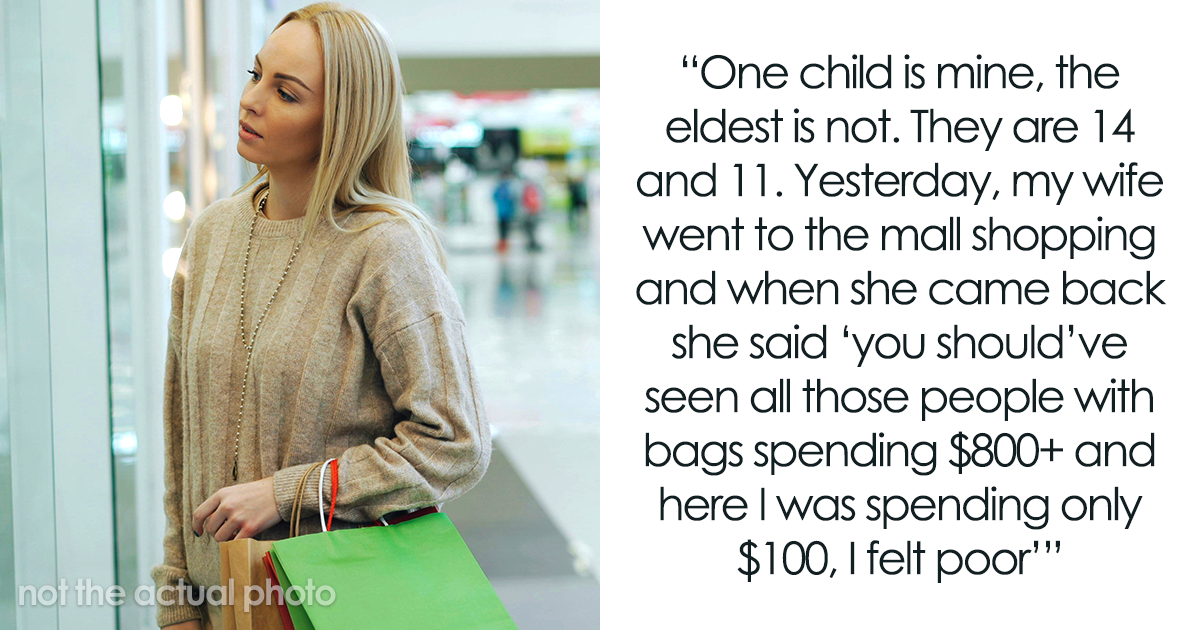
After returning from the mall, the wife said she had seen other people spending hundreds of dollars and carrying many shopping bags. She had spent only around $100 and said she felt poor. Her husband, frustrated by what he saw as an unfair complaint, replied that if she felt poor, perhaps she should get a job.
Technically, his comment was practical. Emotionally, it was about as soft as a shopping cart to the ankle.
Why Her “I Feel Poor” Comment Hit a Nerve
On paper, $1,000 a month in personal spending money sounds generous to many households. For plenty of American families, that amount could cover groceries, utilities, car insurance, debt payments, or the emergency fund that keeps everyone from panic-ordering ramen after a flat tire.
But the phrase “I feel poor” is rarely just math. It often means, “I feel behind,” “I feel less free than others,” or “I feel like I do not have the same choices.” That does not mean the feeling is always financially accurate. Feelings can be real and still fail an audit.
Social comparison plays a huge role here. A mall is practically a museum of other people’s disposable income. You do not see the credit card debt, the return pile in the trunk, the family argument waiting at home, or the person who bought eight bags and will eat cereal for dinner until payday. You only see the glossy surface: the bags, the brands, the cheerful illusion that everyone else has unlocked the deluxe life package.
That is why the wife’s mall comment struck such a nerve. To her, the $100 purchase may have felt small compared with the $800 shopping sprees around her. To her husband, it may have sounded ungrateful, especially if he believed he was already providing a comfortable life and trying to invest for the family’s future.
The Husband’s Response: Fair Point, Bad Packaging?
Many readers sided with the husband because his argument had a clear logic: if she wanted more spending power, a job could provide it. A second income can change a family’s lifestyle dramatically, especially when children are older and full-time childcare is no longer the same obstacle it was during the toddler years.
However, tone matters. “Maybe it’s time to get a job” can sound less like a budgeting suggestion and more like a dismissal. It may imply that her years at home were not work, or that her feelings were silly because she did not earn the income herself.
That is where the conversation becomes complicated. Stay-at-home parenting is unpaid, but unpaid does not mean worthless. According to U.S. time-use data, adults in households with young children spend significantly more time on caregiving and household activities than adults without young children. Not-employed adults with young children spend more time caring for household members and doing household tasks than employed adults with young children. Parenting does not stop being labor just because no payroll department sends a W-2.
Still, unpaid labor and unlimited lifestyle spending are not the same topic. A stay-at-home spouse contributes real value, but the household still has one income. If one partner wants to spend like a dual-income couple while the other wants to save and invest like a cautious financial squirrel, conflict is almost guaranteed.
SAHM Life: Valuable Work, Vulnerable Position
Being a stay-at-home mom can be rewarding, exhausting, lonely, meaningful, repetitive, and occasionally sticky for reasons nobody can explain. It can also create financial vulnerability. When one partner earns the income, the other may feel dependent, even in a loving marriage.
Pew Research Center has found that stay-at-home parenting remains a significant part of American family life, with mothers far more likely than fathers to be out of paid work for family-care reasons. This matters because leaving the workforce can affect not only current income but also future earnings, retirement savings, confidence, professional networks, and bargaining power inside the relationship.
That vulnerability can show up in surprising ways. A stay-at-home parent might not complain about the mortgage, insurance, or the family vacation budget. Instead, the feeling bursts out during a mall trip: “I felt poor.” The statement may sound dramatic, but underneath it could be anxiety about identity, status, freedom, or the fear of being financially dependent forever.
Of course, the husband may have his own invisible stress. Being the sole earner can feel like carrying the whole family budget on one pair of shoulders while everyone asks why the shoulders are tense. He may worry about retirement, college expenses, investments, emergencies, and the very real fact that even good incomes can disappear if illness, layoffs, or bad luck walk through the door wearing muddy shoes.
Why $1,000 a Month Can Still Feel “Not Enough”
Here is the strange thing about personal spending: it expands to fill the emotional space available. If someone is trying to keep up with friends who travel often, buy luxury items, upgrade cars, and dine out like every salad comes with a tiny crown, $1,000 can feel restrictive. If someone is comparing that same number to a family with no personal spending budget at all, it looks enormous.
The problem is not the number alone. It is the benchmark. Compared with zero, $1,000 is a fortune. Compared with a friend’s designer haul, it may feel like a coupon with sneakers on.
This is why couples need to define what personal money is for. Is it for clothes, beauty appointments, hobbies, lunches, gifts, entertainment, and impulse buys? Is it use-it-or-save-it? Can it roll over? Is it equal for both spouses? Does the working spouse also get $1,000, or is one person’s personal budget quietly treated as more legitimate because it comes from a paycheck?
Without clear rules, “fun money” becomes anything but fun. It becomes a monthly emotional obstacle course with receipts.
The Bigger Issue: Spending vs. Investing
The husband reportedly preferred to invest extra money rather than increase spending. The wife, meanwhile, compared their lifestyle with friends who took trips, bought new cars, or spent more freely. This is a classic saver-versus-spender conflict.
Neither side is automatically wrong. Saving and investing are essential, especially when a household depends on one income. Emergency savings, retirement planning, insurance, and long-term goals matter. Nobody wants to arrive at age 65 with a closet full of impulse purchases and the retirement plan of “hope the couch has loose change.”
At the same time, a family that only saves and never enjoys money can become emotionally dry. If one partner feels the household has become a financial monastery, resentment can build. Money is not only for survival and future security; it is also for reasonable enjoyment, memory-making, comfort, and the occasional overpriced mall pretzel that tastes like capitalism and salt.
The challenge is balance. A healthy family budget should leave room for security and joy. The question is not “Should we invest or spend?” The better question is, “How much can we safely enjoy now while still protecting our future?”
What the Internet Got Rightand Wrong
Online commenters often move fast. In this case, many focused on the $1,000 monthly allowance and concluded the wife was being unreasonable. That reaction is understandable. In a country where many adults worry about prices, bills, childcare, and emergency expenses, complaining about a four-figure personal budget can sound tone-deaf.
But the internet also tends to flatten marriages into scoreboard math. Husband earns money: one point. Wife stays home: one point. Wife complains: minus three points. Husband says get a job: depends on tone, add popcorn.
Real relationships are messier. A spouse can be financially privileged and emotionally dissatisfied. A breadwinner can be generous and still communicate harshly. A stay-at-home parent can contribute deeply and still need a realistic view of the household budget. Two things can be true at once, which is inconvenient for comment sections but excellent for reality.
What This Couple Should Have Discussed Instead
The most useful conversation would not begin with “get a job” or “give me more money.” It would begin with curiosity.
The husband could ask, “When you say you feel poor, what do you mean?” That question changes the conversation from accusation to investigation. Maybe she means she feels embarrassed around wealthier friends. Maybe she feels financially dependent. Maybe she misses earning her own money. Maybe she wants more luxury spending. Those are very different problems with very different solutions.
The wife could ask, “Can we look at the budget together and decide what is realistic?” That approach recognizes that more spending has trade-offs. Increasing her personal budget may mean investing less, saving less, delaying a trip, or changing retirement goals. Seeing the full picture can turn vague frustration into practical planning.
They could also discuss whether returning to work makes sense. With children ages 14 and 11, the family’s needs may be different from when the kids were toddlers. A part-time job, remote work, freelance work, school volunteering that leads to paid opportunities, or career training might give the wife more independence without flipping the household upside down.
Financial Respect Goes Both Ways
In single-income households, respect must travel in both directions. The earning spouse should not treat money as personal power. The stay-at-home spouse should not treat income as an endless dispenser of lifestyle upgrades. Marriage is not an ATM with wedding photos.
Financial respect means the breadwinner recognizes unpaid domestic work as real contribution. It also means the stay-at-home spouse recognizes that the paycheck has limits, risks, and future obligations. Both partners deserve personal spending money if the budget allows. Both partners deserve transparency. Both partners deserve a voice in major financial decisions.
A good system might include shared accounts for household expenses, equal personal spending accounts, clear savings goals, and monthly money check-ins. The check-ins should not feel like court hearings. Snacks help. So does avoiding phrases like “your money” and “my money” unless the couple has intentionally chosen separate finances.
Experience Section: Lessons From the “I Feel Poor” Marriage Fight
One experience many couples can relate to is the shock of realizing that income and financial comfort are not the same thing. A family can earn a solid income and still feel squeezed if their expectations grow faster than their budget. The mall is a perfect setting for this emotional trap. It puts wants on display and hides the price of keeping up. A person may walk in feeling fine and walk out wondering why everyone else seems to be living in a music video.
Another common experience is the emotional awkwardness of asking for spending money. Even in a loving marriage, a stay-at-home spouse may feel childish or powerless if every personal purchase depends on the earning spouse’s approval. That is why structured personal money can help. When both partners agree on a monthly amount, the stay-at-home spouse does not need to explain every coffee, sweater, or eyebrow appointment like they are presenting evidence in a courtroom.
However, personal money should come with shared understanding. If $1,000 per month is the amount, then both spouses should know what that number includes. Is it only fun spending? Does it include haircuts, cosmetics, clothes, lunches with friends, subscriptions, gifts, or hobbies? Confusion breeds resentment. Clarity is cheaper than counseling, though counseling can be very helpful too.
A third lesson is that comparisons can quietly poison gratitude. The wife saw shoppers spending more and felt poor. Many people have had a version of that moment. Maybe it happened at a school pickup line full of luxury SUVs, a friend’s vacation post, a neighborhood renovation, or a birthday party that looked like a small royal wedding. The danger is assuming the visible lifestyle tells the whole story. It rarely does. Some people can afford what they buy. Some cannot. Some are funded by bonuses. Some are funded by debt. Some return half the bags next week. Comparison is a terrible financial advisor because it never shows the spreadsheet.
For breadwinners, the experience may be different but equally emotional. They may hear “I feel poor” as “You are not providing enough.” That can sting, especially if they work hard, save carefully, and feel pressure to protect the family. In that moment, defensiveness is natural. But defensiveness can turn a vulnerable comment into a fight. A better response might be, “That hurt to hear because I work hard to make sure we are secure. Can we talk about what you felt today?” That sentence is not magic, but it is less likely to set the kitchen on fire.
For stay-at-home parents, the lesson is to separate emotional needs from financial requests. Saying “I felt poor at the mall” is honest, but it is also vague. Saying “I miss having my own income,” “I feel embarrassed when friends spend much more,” or “I want us to budget for occasional bigger purchases” gives the conversation a direction. Specific feelings create solvable problems. Vague resentment creates fog.
Couples can also benefit from creating a “lifestyle reality check” once or twice a year. This means looking at income, savings, retirement contributions, debt, upcoming expenses, and personal spending. Then they can decide together whether to increase fun money, plan a trip, invest more, or explore additional income. The goal is not to shame anyone. The goal is to make the family budget feel like a shared map instead of a secret file guarded by the person with the paycheck.
The biggest experience-based takeaway is simple: money fights are usually not only about money. They are about appreciation, freedom, fear, identity, fairness, and the story each person tells themselves about what the other person values. In this case, the wife may have wanted empathy. The husband may have wanted gratitude. Neither received what they hoped for, so the conversation collapsed.
That does not make the marriage doomed. It means the couple has reached a point where assumptions need updating. After 13 years, the family structure that worked when the children were small may need a new agreement. Maybe she returns to work. Maybe they adjust personal spending. Maybe they set clearer investment goals. Maybe they stop comparing themselves with friends whose finances they do not actually know. Ideally, they do all of this before the next mall trip turns into a congressional hearing with scented candles.
Conclusion
The story of the SAHM wife who felt poor after a mall trip is not just a viral argument about whether $1,000 in fun money is enough. It is a reminder that money conversations in marriage need both math and empathy. The husband had a reasonable point about income and lifestyle expectations, but his delivery hurt. The wife had a real feeling, but her comparison-based complaint ignored the financial reality of a single-income household.
The healthiest answer is not to shame stay-at-home moms or dismiss breadwinners. It is to build a clearer partnership. A family budget should recognize unpaid labor, respect the pressure of earning, protect long-term goals, and allow reasonable enjoyment. Most of all, couples should talk before resentment starts shopping for a megaphone.