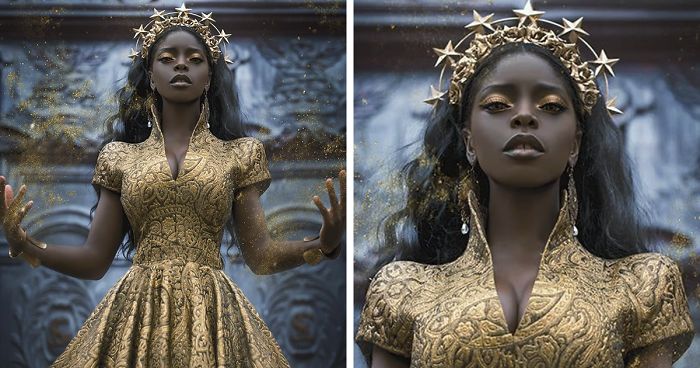
Some photographs capture a face. Others open a portal, hand you a velvet cloak, and quietly inform you that reality has been canceled for the afternoon.
This collection of fantasy photoshoots featuring Black women belongs firmly in the second category. Across 30 imaginative portraits, models appear as forest guardians, celestial rulers, enchanted warriors, gothic heroines, and queens whose crowns look as though they come with their own diplomatic immunity. The elaborate costumes, sculptural hairstyles, dramatic lighting, handcrafted accessories, and dreamlike settings turn portrait photography into visual storytelling.
The images are beautiful on a purely aesthetic level, but their appeal reaches beyond beautiful dresses and strategically released fog. They place Black women at the center of fantasy worlds as powerful protagonists rather than background characters, symbols, or disposable sidekicks. Each portrait insists that magic can look regal, futuristic, romantic, mysterious, playful, and unmistakably Black.
Fantasy Photography Is More Than Dressing Up
A fantasy photoshoot usually begins with a character rather than an outfit. The creative team may imagine an immortal queen, a woodland oracle, a cosmic traveler, or a warrior returning from a battle nobody else was brave enough to attend. From there, every visual choice helps build that character’s world.
Costumes establish the period and mood. Makeup introduces supernatural details. Hair can form a crown, halo, silhouette, or architectural feature. Props suggest a history that exists beyond the frame. Lighting determines whether the subject feels warm and divine, cold and mysterious, or approximately three seconds away from turning an irritating duke into a decorative frog.
Portrait photographers frequently use light as a storytelling tool rather than merely a way to make a subject visible. Soft light can create an ethereal glow, while side lighting, backlighting, shadows, and stronger contrast can produce mystery or drama. Reflectors, softboxes, natural window light, and carefully controlled highlights help preserve detail while shaping the emotional atmosphere of a portrait.
The strongest fantasy portraits therefore feel like still frames from stories that viewers desperately want to finish. Who is this woman? What kingdom does she rule? Why is the forest glowing behind her? More importantly, where can we obtain her cape?
Black Women Belong at the Center of Imaginary Worlds
For generations, mainstream fantasy was often presented through an unnecessarily narrow visual vocabulary. Medieval-inspired kingdoms, fairy tales, fairy courts, and magical academies repeatedly centered white heroes, even when the stories involved dragons, talking trees, immortal sorcerers, and other concepts noticeably less realistic than a diverse population.
Fantasy photography challenges those inherited limitations because independent artists do not need to wait for a film studio to approve their imagination. A photographer, model, makeup artist, costume designer, and stylist can build an entire mythology in one afternoon. Granted, it may be an afternoon involving eight extension cords, a broken artificial flower, and someone yelling, “Please stop stepping on the wings,” but the creative freedom is real.
Contemporary Black portraiture has increasingly blurred the traditional divisions between art, fashion, editorial photography, and personal expression. Aperture’s The New Black Vanguard, for example, highlights artists whose conceptual portraits reshape ideas about race, beauty, gender, and power while resisting the notion that Blackness is a single, uniform experience. Many of these images are collaborative creations involving Black photographers, designers, stylists, and models.
That collaborative energy is visible in fantasy photoshoots. The model is not simply placed inside someone else’s dream. She often helps determine the pose, attitude, movement, styling, and emotional identity of the character. The result is less “woman wearing costume” and more “empress allowing the camera crew five minutes of her time.”
Fantasy Portraiture and the Spirit of Afrofuturism
Not every photograph of a Black woman wearing magical clothing should automatically be labeled Afrofuturist. Fantasy portraiture can draw from fairy tales, historical fashion, mythology, gothic art, folklore, science fiction, or pure invention. Still, some images share important qualities with Afrofuturism, especially when they combine African diasporic culture with speculative worlds, technology, spirituality, liberation, and reimagined histories.
The National Museum of African American History and Culture describes Afrofuturism as a creative framework that expresses Black identity, agency, and freedom while envisioning liberated possibilities for Black life. The movement appears across literature, fashion, film, music, theater, visual art, and activism.
Within that framework, a portrait can perform several tricks at once. It can honor cultural memory, challenge the present, and invent a future in which Black characters possess unquestioned authority. A woman wearing metallic armor and traditional-inspired adornment may appear ancient and futuristic simultaneously. A floral queen can evoke ancestral knowledge without being trapped in the past. A cosmic traveler can enter science fiction without leaving her cultural identity at the spaceship door.
The Metropolitan Museum of Art similarly characterizes Afrofuturism as an approach that centers Black culture while examining the past, questioning the present, and imagining more empowering futures. Its Afrofuturist period room includes works that combine reclaimed history, spiritual symbolism, handcrafted materials, fashion, and speculative storytelling.
This helps explain why fantasy photoshoots can feel emotionally significant. They are not merely escapes from reality. They can be rehearsals for possibility.
The Visual Ingredients Behind the 30 Stunning Photos
Regal Costumes That Build Instant Mythology
Voluminous gowns, corseted bodices, embroidered capes, metallic armor, flowing sleeves, and layered fabrics give the portraits immediate narrative weight. Even when the materials are modern, the silhouettes can suggest royal courts, forgotten civilizations, or futuristic dynasties.
A successful costume also creates movement. Chiffon catches the wind. Beaded fabric glitters under directional light. Long sleeves widen a pose, while a fitted piece creates the controlled posture of a warrior or ruler. One well-placed train can transform an ordinary patch of grass into the sovereign territory of a woodland monarchy.
The original gallery credits reveal how collaborative these transformations can be. Individual entries identify creative teams such as photographer Maria Lipina, model Normila17, and costume designer Narnia Dress. Another image credits photographer Bella Kotak, model Olubukola Ogunniyi, makeup artist Beauty by Bellamere, and crown designer Agnieszka Osipa. A separate portrait pairs photographer Simply Savannah Art with model Tiara Gasper.
Crowns, Jewelry, and Accessories With Main-Character Energy
Fantasy accessories rarely understand the concept of “too much,” and society is better for it. Floral crowns, antlers, jeweled headpieces, metallic halos, staffs, masks, swords, and oversized necklaces help communicate a character’s role before viewers know anything about her story.
A delicate crown may suggest a fairy monarch. Sharp metallic pieces can signal danger or authority. Natural materials such as branches, shells, feathers, and flowers connect a subject to the landscape. A glowing orb requires no explanation whatsoever. It is glowing, it is mysterious, and someone in the fictional kingdom definitely wants to steal it.
Black Hair as Art, Identity, and Storytelling
Braids, locs, twists, coils, Afros, sculptural updos, and elaborate extensions can become central parts of a fantasy character’s design. Rather than hiding natural texture to imitate familiar European fairy-tale imagery, these portraits often allow Black hair to define the silhouette.
Hair has long held cultural, practical, social, and expressive meaning within Black communities. Styles such as cornrows and Bantu knots carry histories extending far beyond contemporary fashion, while hair continues to play an important role in identity and creative self-presentation.
In fantasy photography, that expressive potential expands. Braids may be threaded with gold, pearls, wire, flowers, or tiny lights. An Afro can form a radiant halo. Locs can fall over armor like ceremonial ropes. The hairstyle stops being an afterthought and becomes part of the mythology.
Lighting That Respects Every Skin Tone
Rich skin tones can reflect warm highlights, saturated colors, and metallic accents beautifully when photographers expose and shape the light with care. Poor lighting can flatten detail or create muddy shadows, but thoughtful lighting reveals subtle variations in complexion while preserving the atmosphere of the scene.
Fantasy photographers may use warm rim light to separate a model from a dark background, soft frontal light to illuminate facial detail, or colored lights to create an otherworldly environment. Blue light can suggest moonlight or ice; red and gold can produce royal warmth; green can transform an ordinary garden into an enchanted forest where the neighborhood homeowners association has no authority.
Makeup That Completes the Character
Fantasy makeup often balances beauty with storytelling. Metallic pigments can create a celestial appearance. Crystals and gems suggest magic. Graphic lines may resemble tribal-inspired markings, futuristic circuitry, or fictional symbols. White lashes, unusual lip colors, luminous highlighter, and carefully placed body paint push the face beyond conventional editorial beauty.
The most effective makeup does not overwhelm the model’s features. It supports the character while keeping the person emotionally present. Viewers should notice the woman’s expression before wondering whether the glitter was applied with a brush, a stencil, or the direct assistance of a very cooperative fairy.
Locations That Feel Larger Than the Frame
Forests, flower fields, rocky coastlines, abandoned buildings, castles, beaches, and controlled studio sets can all become fantasy realms. A shallow depth of field softens distracting details, while fog, reflected light, practical effects, and digital compositing extend the illusion.
Ordinary places are often surprisingly useful. A small cluster of trees can resemble an ancient forest when photographed from a low angle. A textured wall can become a palace interior. A public park can become a royal garden, provided nobody catches a picnic table in the background.
Thirty Images, Countless Possible Characters
Although every photograph has its own visual identity, the 30-picture collection can be appreciated through several recurring fantasy archetypes.
Woodland Guardians and Flower Queens
These portraits emphasize leaves, vines, flowers, earthy colors, and natural textures. The characters seem able to command roots, communicate with birds, and identify precisely which visitor dropped a plastic bottle near the enchanted river.
Celestial Rulers and Cosmic Travelers
Stars, moons, silver makeup, glowing effects, iridescent fabrics, and deep blue backgrounds connect Black beauty with the scale of the universe. The imagery feels futuristic without sacrificing softness or elegance.
Warriors, Knights, and Battle-Ready Heroines
Armor, weapons, dramatic stances, leather details, and strong directional lighting produce characters who clearly have quests to complete. These images are satisfying because Black women are allowed to embody strength without losing glamour, vulnerability, individuality, or a truly excellent pair of boots.
Gothic Nobility and Dark-Fantasy Icons
Black lace, candlelight, shadowy forests, elaborate collars, crimson accents, and haunting expressions create a darker mood. The subjects may appear mysterious or dangerous, but they remain active owners of the scene rather than helpless victims waiting for a lantern-carrying hero.
Mermaids, Water Spirits, and Ocean Royalty
Blue-green palettes, shells, pearls, wet-look makeup, reflective fabrics, and flowing silhouettes transform models into beings connected with rivers, oceans, and mythic underwater kingdoms. These portraits remind viewers that mermaids are imaginary, meaning their casting department has absolutely no excuse for being boring.
Future Ancestors and Reimagined Royalty
Some images feel simultaneously historical and futuristic. Traditional-inspired patterns may appear beside metallic materials. Old-world silhouettes are paired with surreal makeup. The visual language suggests characters who carry ancestral memory into worlds that have not yet been built.
Why Representation in Portraiture Matters
Photography has never been a neutral record of who people are. It can reinforce stereotypes, but it can also offer individuals and communities a means of defining themselves. Historical research from the National Gallery of Art shows that Black Americans embraced portrait photography as a tool for self-representation, dignity, community memory, and resistance to dehumanizing images during the 19th and early 20th centuries.
That history gives contemporary fantasy portraits additional resonance. A Black woman photographed as a queen is not important because Black women must be royal to deserve respect. It matters because visual culture has so often restricted which people were permitted to appear romantic, heroic, magical, delicate, eccentric, or powerful.
Artists such as Zanele Muholi, Lorna Simpson, Mickalene Thomas, and Deana Lawson have used portraiture to investigate Black identity, visibility, beauty, gender, power, and personal history from distinct perspectives. Their work demonstrates that representation is not simply about placing someone inside an existing frame. It is also about questioning who designed the frame and whether it needs to be dramatically set on fire.
Fantasy photoshoots continue that conversation in an accessible, highly shareable form. A single image posted online can reach viewers who may never enter a museum or read an art-history essay. It can inspire a young photographer, costume maker, model, writer, or fantasy fan to create a world that includes them from the beginning.
How to Appreciate and Share Fantasy Photos Responsibly
The internet makes visual art easy to discover and equally easy to separate from its creators. When sharing a fantasy portrait, viewers should preserve credits for the photographer, model, makeup artist, stylist, costume designer, prop maker, retoucher, and other collaborators whenever that information is available.
Crediting matters because a photograph that appears effortless may represent weeks of planning and many hours of physical work. Costumes may be handmade. Crowns may contain hundreds of individual pieces. Models may pose in uncomfortable conditions. Photographers may spend substantial time refining color, light, and composition. Even the majestic fog may come from a machine that refuses to work until everyone has become emotionally exhausted.
Viewers should also avoid treating all Black fantasy imagery as interchangeable or “exotic.” African cultures are diverse, and visual references have specific origins. An artist may be drawing from a particular tradition, a personal invention, European historical fashion, speculative design, or several influences at once. Curiosity and accurate credit are far more respectful than assigning a vague label to everything with beads and gold fabric.
The Experience of Viewing Black Women in Fantasy Photoshoots
Scrolling through a gallery like this can feel like entering a series of fully formed worlds without receiving a map. The first portrait may introduce a flower-covered sovereign standing in soft light. The next might replace warm woodland colors with steel, armor, and a stare capable of ending a rebellion before lunch. A third image may move into deep space, where silver details and cosmic colors turn the model into a traveler from a civilization with significantly better fashion technology.
The variety is part of the pleasure. Viewers are not asked to accept one approved version of Black beauty. They encounter deep and light complexions, natural hair and elaborate wigs, gentle expressions and commanding poses, romantic gowns and aggressive armor. One subject may look like she offers healing spells. Another appears to charge a consultation fee before explaining that the curse is permanent.
Details become more rewarding the longer one looks. A crown may echo the shapes of nearby branches. Gold makeup might repeat the embroidery on a bodice. A photographer may place the brightest area directly behind the model’s head, creating a halo without needing to attach anything to the costume. Hands, posture, chin position, and eye contact quietly reveal whether the character is welcoming, grieving, challenging, or preparing to seize a throne that was obviously hers all along.
The images can also trigger a satisfying form of imaginative participation. Viewers begin inventing names, histories, alliances, and rivalries. Perhaps the woman in the red dress rules a volcanic kingdom. Maybe the silver-armored figure protects a moon colony. The queen in the water may control the tides but refuse to answer messages before sunrise. A photograph becomes the first sentence of a story, and the viewer instinctively supplies the second.
For Black viewers, the experience may carry another layer. Seeing Black women presented as magical protagonists can counter years of fantasy imagery in which Black characters were absent, minimized, or limited to narrow roles. Recognition does not require every portrait to represent every Black woman. Its power comes from abundance: the freedom to be heroic in one frame, mysterious in another, romantic in the next, and delightfully villainous whenever the lighting is good.
For photographers and other creators, the gallery can function as a practical inspiration board. It demonstrates how ordinary landscapes can become imaginary realms through styling, angles, color, and controlled light. It shows that a compelling fantasy portrait does not always require a movie-sized budget. A clear concept, collaborative team, thoughtful lighting, and one committed model can accomplish an astonishing amount. Access to an abandoned castle is useful, certainly, but apparently not mandatory.
Most importantly, the experience leaves viewers wanting morenot only more photographs, but more films, novels, games, comics, and artworks in which Black women occupy the full spectrum of imagination. The gallery does not merely show what fantasy photography currently looks like. It hints at how much larger the genre can become when artists stop treating inclusion as a special effect and start treating it as part of the world.
Conclusion: A Wider and More Wonderful Fantasy World
These 30 fantasy photoshoots succeed because they combine craftsmanship with possibility. The costumes are elaborate, the lighting is atmospheric, and the settings are transportive, but the models remain the undeniable centers of every imagined universe.
The collection celebrates Black women as queens, warriors, spirits, travelers, guardians, and characters too original to fit neatly into a familiar category. It also demonstrates what becomes possible when photographers and creative teams are free to build fantasy worlds beyond old casting conventions.
Great fantasy art does not shrink imagination by telling audiences who can belong. It expands imagination until more people can recognize themselves inside it. These portraits do exactly thatand they manage to make flowers, swords, crowns, fog, and dangerously dramatic capes look like completely reasonable everyday accessories.
Note: This article analyzes the artistic themes and cultural significance of the photo collection. The original photographs should be published only with appropriate permission and complete creator, model, stylist, and designer credits.