Working from home can get messy. Coffee cups colonize the desk, video calls expose laundry mountains, and somebody eventually asks why there is a spreadsheet open at 10:47 p.m. But when Banksy works from home, apparently the bathroom gets overrun by stenciled rats.
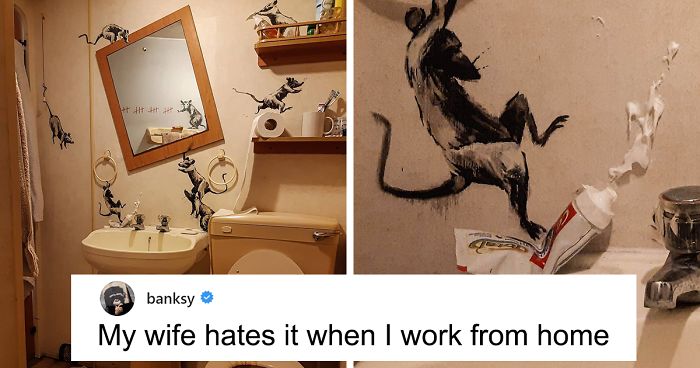
In April 2020, during the first wave of COVID-19 lockdowns, the famously anonymous street artist posted five images on his official Instagram account. The photos showed what appeared to be a private bathroom invaded by a gang of Banksy’s signature rodents. His caption delivered the punchline with perfect deadpan timing: “My wife hates it when I work from home.”
At the time, this was Banksy’s newest revealed work, and it was almost comically suited to the moment. A street artist famous for slipping images onto public walls had been pushed indoors. Instead of a brick building or urban underpass, he turned a toilet, mirror, sink, and towel rack into an unruly miniature stage.
The result was funny, strange, slightly disgusting, and immediately recognizable as Banksy. In other words, a pretty efficient day at the home office.
Banksy’s Bathroom Became a Tiny Lockdown Disaster Zone
The artwork did not simply consist of a few rats painted neatly on a wall. Banksy arranged the images and real bathroom objects to make the rodents appear physically involved in a full-scale domestic rebellion.
One rat balances near a towel ring while forcing toothpaste from a tube. Another appears to run on a toilet paper roll as though it were a treadmill designed by a fitness influencer with a very limited equipment budget. Elsewhere, a rat hangs near a light switch, bathroom products are pushed around, and another rodent appears to relieve itself on the toilet seat.
Perhaps the most memorable detail is visible in the mirror. A rat marks lines on the wall, apparently counting the passing days of confinement. It is a simple visual joke, but anyone who experienced the peculiar blurring of time during early lockdown could understand it immediately.
Monday became Thursday. Thursday became “is it acceptable to eat cereal for dinner again?” The rat’s tally marks captured that atmosphere without requiring a lengthy statement about social isolation.
Nine Rats, One Bathroom and Absolutely No Security Deposit
Several reports described nine rats spread throughout the installation. Each appears to have a different destructive assignment. Together, they create the impression that the room has been occupied by a tiny criminal organization specializing in toiletries.
The cleverness lies in the interaction between Banksy’s stencils and ordinary objects. A drawn rat does not merely stand beside a tube of toothpaste; its placement makes the toothpaste part of the action. The toilet paper, mirror, sink, shelving, and fixtures become pieces of visual storytelling.
This approach gives the installation a playful three-dimensional quality. Banksy has long understood that context can do half the talking. Put an image in the right location and the wall, door, pipe, or piece of street furniture becomes part of the joke.
In the bathroom work, domestic clutter replaces urban architecture. The scale is smaller, but the method is familiar.
Why Banksy’s “My Wife Hates It When I Work From Home” Caption Worked So Well
There are artists who might accompany a new installation with 700 words about spatial tension, post-industrial consciousness, and the emotional violence of ceramic surfaces.
Banksy wrote one sentence about annoying his wife.
The caption helped the artwork travel because it sounded like a joke millions of people could have made while adjusting to work-from-home life. In 2020, kitchens suddenly became offices. Bedrooms became classrooms. Dining tables became conference rooms. Partners discovered exactly how loudly the other person typed.
Against that background, “My wife hates it when I work from home” made an internationally famous artist sound temporarily ordinary. Maybe your spouse was tired of Zoom meetings. Banksy’s supposed spouse had to deal with a bathroom full of painted rodents and strategically abused toothpaste.
We all suffered differently.
A Rare Glimpse Behind the Banksy Curtain
The Instagram post was particularly fascinating because Banksy carefully protects his personal life and public identity. His anonymity has been central to his career and to the mythology surrounding his work for decades.
That made the reference to “my wife” instantly interesting. Was it a straightforward personal detail? A joke? A deliberate piece of misdirection? With Banksy, viewers have learned not to treat every apparent clue as an invitation to update a biography.
Even the bathroom itself should be approached cautiously. Contemporary coverage generally described it as appearing to be Banksy’s bathroom or an installation presented as a home setting. The artist did not suddenly upload a real estate listing, floor plan, and convenient map pin.
The uncertainty is part of the experience. Banksy gives the public enough information to make a story irresistible, then quietly disappears while everyone debates the details.
Why Rats Keep Appearing in Banksy’s Art
For longtime Banksy followers, the bathroom’s furry troublemakers were old acquaintances. Rats are among the artist’s most familiar recurring subjects.
Banksy’s stenciled rodents have appeared as protestors, painters, troublemakers, workers, and small figures performing acts of resistance. They often seem clever, underestimated, and perfectly comfortable operating in places respectable society would prefer not to examine too closely.
The New Yorker, in a major profile of Banksy’s career, noted his repeated use of rats and discussed his fascination with powerless outsiders effectively organizing and pushing back. Banksy has also openly acknowledged the influence of French stencil artist Blek le Rat, whose rodent imagery predates Banksy’s international fame.
The Rat as an Outsider
A rat is an ideal Banksy character because it already carries cultural baggage. People think of rats as unwanted urban residents. They survive in hidden spaces, move at night, and appear to ignore the human rules established around them.
That makes them useful symbols for outsiders and overlooked populations. A rat can be comic and threatening at the same time. It can represent survival, rebellion, opportunism, or society’s habit of labeling certain groups as undesirable.
In the 2020 bathroom installation, however, another reading becomes possible. The rats look stir-crazy.
They are climbing, squeezing, running, marking time, and generally treating the bathroom like a theme park after management has gone home. Their wild behavior mirrors the nervous energy of confinement. The outside world is restricted, so every object inside becomes a potential source of entertainment.
Suddenly, the toothpaste is an activity.
A Street Artist Forced to Work Without the Street
One reason the Banksy work-from-home artwork attracted so much attention was the obvious contradiction at its center. Banksy is identified with street art. His reputation grew through images placed in public environments, often unexpectedly and without the formal ceremony of a gallery opening.
Lockdown disrupted that relationship between artist and location. Public movement was restricted, and people around the world were staying indoors. Banksy responded by shrinking his canvas to the size of a bathroom.
Coverage from PBS NewsHour, Forbes, Architectural Digest, Hyperallergic, Observer, The Art Newspaper, and other outlets emphasized the novelty of seeing the artist bring his visual language into a domestic space. The rats remained unmistakably Banksy, but their environment had changed.
That change arguably became the subject of the work itself.
What does a street artist do when the street is temporarily unavailable? He works from home. What happens when Banksy works from home? Apparently, the plumbing develops a political consciousness.
The Location Was Smaller, but the Audience Was Global
There is another interesting contradiction. The work was physically confined to a private-looking room, yet Instagram immediately gave it an international audience.
Banksy’s public murals traditionally invite discovery. Someone sees an image on a building. Photographs circulate. News organizations report on it. Crowds gather. Questions about ownership, preservation, vandalism, and authenticity follow.
The bathroom piece skipped the discovery stage. Banksy photographed the work and published it himself on Instagram. The public encountered the installation primarily as a sequence of images selected by the artist.
In that sense, the phone screen became the street corner.
The artwork’s online presentation also made sense during a period when museums, galleries, entertainment venues, and countless public spaces faced closures or restrictions. People were consuming culture from couches and bedrooms. Banksy delivered an artwork that was already prepared for that reality.
The Lockdown Details Made the Artwork Instantly Relatable
The bathroom rats were not accompanied by an explicit manifesto about COVID-19. Banksy did not need one. Timing, setting, and a few carefully selected visual details established the context.
The tally marks suggest someone counting days. The frantic rodents suggest restlessness. The bathroom setting suggests a person trapped inside long enough to begin looking at household fixtures with creative desperation.
Then there is the toilet paper.
During the first months of the pandemic, toilet paper unexpectedly became one of the symbolic consumer products of public anxiety. Images of empty shelves and stories about panic buying circulated widely. Banksy’s decision to include a rat running on an unrolling toilet paper roll was therefore particularly well timed, whether viewers read it as social commentary or simply an excellent visual gag.
The installation captures a specific historical mood: fear outside, boredom inside, uncertain calendars, internet humor, domestic disruption, and the strange need to make jokes because the alternative was staring silently at another breaking-news notification.
Banksy Turns Chaos Into an Accessible Visual Joke
Banksy’s popularity has often been connected to the immediate readability of his images. A viewer does not necessarily need an art history degree to understand the first layer of the joke.
Look at the bathroom. Rats wrecked it. Read the caption. His wife is annoyed. Laugh.
Only after that initial reaction do additional questions emerge. Why rats? Why a bathroom? Why count the days? What does it mean for an artist associated with anonymous public intervention to reveal a supposedly private interior on Instagram?
This layering is one of Banksy’s most effective habits. The image works quickly, but it does not always stop working after the punchline.
Humor Can Carry Serious Context
Humor played an enormous role in online culture during lockdown. People made memes about homeschooling, sourdough starters, video meetings, sweatpants, and forgetting which day it was. The jokes did not prove that the situation was harmless. Often, they revealed exactly how stressful it had become.
Banksy’s rats fit comfortably into that environment. Their chaos is funny because it exaggerates a familiar feeling: prolonged confinement can make normal routines feel increasingly absurd.
The rat marking the wall is especially effective. It is not a complicated image. Yet it transforms a simple lockdown joke into a visual record of waiting.
Sometimes a tiny painted rat with lipstick understands the calendar better than the rest of us.
What the Banksy Bathroom Artwork Says About Creative Constraints
Artists are frequently told that limitations can encourage creativity. This advice usually sounds charming until the limitation is something substantial, such as a worldwide public health emergency.
Still, Banksy’s home installation demonstrates a useful creative principle: changing the environment does not necessarily require abandoning a recognizable artistic language.
He retained his rats. He retained his stencil-based visual vocabulary. He retained humor and social observation. What changed was the surface and the relationship between artwork and location.
Instead of waiting for ideal working conditions, the project appears to ask what can be done with the conditions already available.
That does not mean everybody should stencil nine rats on the family bathroom. Please discuss major toothpaste-related installations with the household before proceeding.
But the broader creative lesson remains valuable. A photographer unable to travel can reconsider the familiar rooms around them. A writer with limited time can focus on a smaller story. A designer can turn a restriction into part of the concept rather than treating it only as an obstacle.
My Experience With Work-From-Home Chaos Makes Banksy’s Rats Feel Very Familiar
There is a reason I find this Banksy piece more relatable than a technically perfect image hanging silently in a spotless gallery. The bathroom installation understands an unpleasant truth about working from home: once professional life enters a domestic space, normal boundaries can become hilariously fragile.
I have seen the work-from-home version of this problem play out in countless ordinary ways. A person starts with an ambitious plan. There will be a designated desk. Work begins at 9 a.m. Lunch occurs at noon. The computer closes at 5 p.m. The entire arrangement will be calm, healthy, and beautifully organized.
Three days later, the laptop is on the kitchen counter, somebody is answering an email while brushing their teeth, and a coffee mug has been missing long enough to qualify for its own documentary series.
That is what Banksy’s rats remind me of. They look like a visual representation of small disruptions multiplying until the room develops an independent personality.
When Home Becomes the Office, Everything Starts Competing for Attention
Working in a conventional office usually creates physical signals. You arrive. You sit at a workstation. Meetings happen in meeting rooms. Eventually, you leave.
At home, a person can be three feet from unfinished laundry while discussing quarterly objectives. A delivery arrives during a presentation. A family member asks an innocent question at the exact moment the microphone is unmuted.
Even ordinary objects begin to feel strangely active. The refrigerator becomes a coworker with no respect for productivity. The couch launches aggressive recruiting campaigns every afternoon. The bed waits nearby with a benefits package built entirely around naps.
Banksy’s bathroom rats push this domestic disorder into cartoon territory. The toothpaste is under attack. Toilet paper becomes exercise equipment. The mirror records time. Nothing is behaving according to its original job description.
That is exaggerated, obviously, but good humor often works by exaggerating something recognizable.
Creative Work Can Look Like Destruction to Someone Else
The funniest idea in the caption may be the gap between the artist’s perspective and his wife’s supposed perspective.
Banksy sees an installation.
She sees the bathroom.
This is a familiar problem in creative households. A person making something can become completely absorbed in process. Cardboard on the floor is not trash; it is “material.” Thirty open browser tabs are not a technical emergency; they are “research.” Paint on the table is not a stain; apparently, it is “evidence of experimentation.”
From inside the creative process, disorder can feel purposeful. From six feet away, it may look as though a small tornado recently received an arts grant.
The Banksy work-from-home caption captures that difference in one sentence. It also makes the famously mysterious artist seem like every other person who has ever attempted to explain a questionable home project with the phrase, “No, seriously, I’m working.”
The Best Part Is How Little the Artwork Explains
My favorite aspect of the piece is that Banksy leaves room for viewers to bring their own lockdown experiences to it.
Someone may see cabin fever. Another person may focus on the recurring symbolism of rats. A remote worker may immediately identify with the blurred border between workplace and private space. Someone else may simply appreciate the physical comedy of a rat weaponizing toothpaste.
The artwork does not demand a single interpretation before allowing the viewer to enjoy it.
That quality matters online, where people often encounter art while scrolling through news, advertisements, family photographs, jokes, and videos of dogs refusing to enter bathtubs. An image has a fraction of a second to interrupt the stream.
Banksy’s bathroom does exactly that. First, the chaos catches your attention. Then the individual details encourage a closer look. Finally, the caption changes the entire scene into a domestic comedy.
A Personal Reminder to Use the Room You’re Already In
Beyond the jokes, I think the installation offers a surprisingly practical creative reminder. People often postpone projects because the environment is not perfect.
They need a bigger office. Better equipment. More time. A quieter schedule. A dramatic studio with enormous windows and at least one mysterious plant.
Banksy’s lockdown work suggests another possibility: examine the room you already have.
The bathroom is not simply a bathroom in these images. A towel ring becomes a structure for a character. A toilet paper roll becomes a moving platform. The mirror creates a second visual plane. Toothpaste becomes a prop.
Creative attention changes the usefulness of the environment.
I would not claim that every limitation is secretly a gift. That kind of inspirational language can become annoying very quickly, particularly when discussing a period as difficult as the early pandemic. But limitations can change the questions a creator asks.
Instead of “Why can’t I make my normal work?” the question becomes “What work belongs in this strange situation?”
Banksy’s rats were a memorable answer.
Conclusion: Banksy’s Work-From-Home Rats Captured a Strange Moment
“My Wife Hates It When I Work From Home” became one of the most memorable art images associated with the early lockdown period because it combined Banksy’s familiar visual language with an environment almost everyone suddenly understood: home.
The nine mischievous rats appear to destroy an ordinary bathroom, but the installation does more than deliver a clever visual prank. It reflects restlessness, disrupted routines, isolation, creativity under constraint, and the increasingly blurry border between personal and professional spaces.
Most importantly, the work never forgets to be funny. Banksy transformed a global moment of uncertainty into a scene involving toothpaste, toilet paper, and rodents with serious behavioral problems.
That may be the real genius of the piece. The world outside had changed dramatically. Banksy looked at confinement, looked at his signature rats, and apparently decided the bathroom was not going to survive the week.
Editorial note: The phrase “newest work” in this article’s title reflects the original April 2020 news context. Banksy published the Instagram bathroom images on April 15, 2020; this article discusses that historical artwork and its reception.