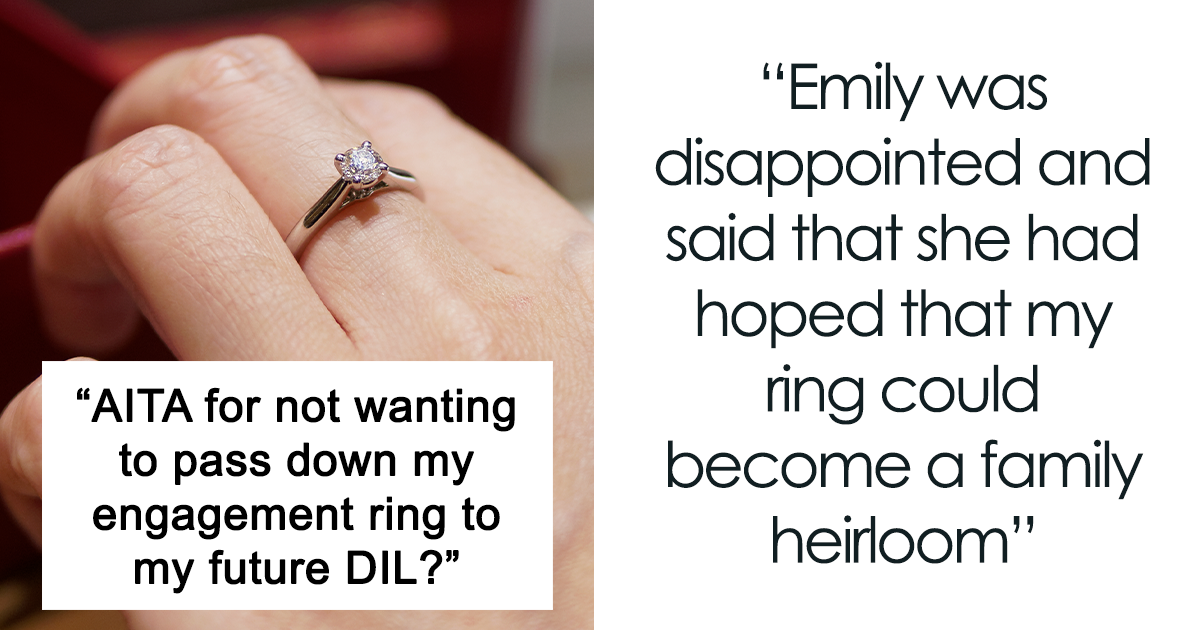
An engagement ring can be tiny enough to disappear beneath a couch cushion, yet powerful enough to start a family argument visible from space. That is exactly what happened when a mother declined to hand over the ring she had worn throughout her marriage so her adult son could use it to propose to his longtime girlfriend.
The son believed the arrangement would save him from spending a large amount of money on a new diamond ring. His fiancée liked the mother’s ring and viewed receiving it as a meaningful sign that she was being welcomed into the family. The problem was simple but apparently shocking to everyone except the ring’s owner: the mother still wore it, still loved it, and had no desire to surrender it.
After she said no, the son reportedly called her “selfish and materialistic.” He also argued that diamonds were a scam while simultaneously insisting that he needed her diamond. It was a philosophical position with all the structural integrity of a wet paper straw.
What Happened in the Engagement Ring Dispute?
According to the publicly shared account, the mother’s 26-year-old son and his girlfriend announced that they planned to marry. During the family conversation, they asked whether the mother would give them her engagement ring.
The ring was not an antique inherited from an earlier generation. Her husband had personally selected and purchased it when he proposed. She had worn it daily for many years and wanted to continue wearing it for the rest of her life. She did suggest that it might eventually be passed to a future grandchild, but she was not ready to turn it into an heirloom while she was still actively enjoying it.
The couple did not accept that answer gracefully. The son said buying another ring could push him into debt. His fiancée expressed disappointment because she had imagined the ring as a symbol of acceptance. They even pointed out that the mother could retain her wedding band, as though they were negotiating a corporate asset sale rather than asking a living woman to remove deeply sentimental jewelry from her finger.
The mother’s husband supported her decision and reportedly appreciated that the ring he gave her remained so meaningful after many years of marriage. Online commenters also overwhelmingly defended her right to keep it.
Was the Mother Really Being Materialistic?
No. Wanting to keep an object because of its emotional meaning is nearly the opposite of materialism.
A purely materialistic response would focus mainly on resale value, diamond size, brand prestige, or the possibility of trading the ring for something more expensive. The mother’s explanation focused on memory, commitment, continuity, and the personal history attached to wearing the ring every day.
Sentimental value cannot be measured with a jeweler’s loupe. The ring represented the day her husband proposed, the beginning of their marriage, and years of shared experience. To her son, it may have looked like an available financial shortcut. To her, it was a continuing symbol of a relationship that had not ended.
Calling her materialistic therefore missed the point spectacularly. She was not refusing to give up a random luxury item gathering dust in a drawer. She was declining to stop wearing her own engagement ring.
An Heirloom Must Be Given, Not Declared
The word “heirloom” sounds romantic, but it is not a magic spell that transfers ownership. A person cannot simply point at someone else’s jewelry, announce that it should become a family tradition, and expect the current owner to start looking for a padded envelope.
Wedding-etiquette guidance consistently recommends asking respectfully, avoiding assumptions, and giving the owner time to decide. Families should also discuss whether a ring may be resized, reset, sold, or returned under certain circumstances. Most importantly, no relative should be pressured into surrendering a meaningful piece of jewelry.
A genuine family heirloom usually becomes one because its owner voluntarily chooses to pass it down. That decision may happen during the owner’s lifetime, through a will, or after relatives have discussed the item openly. The tradition is meaningful precisely because it is a gift. When pressure replaces generosity, the symbol of family connection begins to resemble an invoice.
The Timing Matters
Some people enjoy passing jewelry to younger relatives while they are alive because they can see the item being worn and appreciated. Others prefer to keep wearing their jewelry until death. Neither approach is morally superior.
In this case, the mother was alive, married, and still wearing the ring every day. Asking politely was not automatically wrong, although it was certainly bold. Refusing to accept her answer was the real problem.
The Son’s Financial Argument Does Not Create an Obligation
Beginning a marriage with unnecessary debt is rarely a sparkling idea. However, the solution is not to transfer the expense to another person by demanding her property.
An engagement ring does not have to contain a large natural diamond. Couples can choose a modest ring, a vintage piece, a lab-grown stone, a colored gemstone, a plain band, or no ring at all. They can also buy an affordable temporary ring and upgrade it later when their finances improve.
If the couple believed the diamond industry was overpriced, they had even more reason to reject the assumption that an expensive diamond was required. “Diamonds are a scam, so give me your diamond” is not a budget plan. It is a contradiction wearing formal clothes.
Financial responsibility begins with matching wedding decisions to available resources. A proposal should express commitment, not demonstrate a talent for locating relatives with desirable assets.
The Fiancée’s Wish to Feel Accepted Was Understandablebut Misguided
The fiancée’s feelings deserve more nuance. She reportedly saw the ring as a token of being welcomed into the family. That desire may have been sincere. Family jewelry can carry tremendous emotional significance, and an heirloom engagement ring often connects a new marriage to earlier generations.
However, acceptance cannot be proven by one particular object. A future daughter-in-law can be welcomed through affection, invitations, support, shared traditions, photographs, recipes, stories, or another piece of jewelry willingly offered for the occasion.
Demanding the mother’s ring also placed the mother in an unfair emotional trap: surrender the object or appear to reject the fiancée. Healthy family relationships should not require symbolic ransom payments.
Why Engagement Rings Carry So Much Emotional Weight
An engagement ring is both property and a personal symbol. Its financial value may be documented, but its emotional value develops through use. Each anniversary, hardship, move, celebration, and ordinary Tuesday can add another invisible layer of meaning.
That is why disputes involving heirloom engagement rings often become more intense than arguments about ordinary belongings. One person sees precious metal and gemstones. Another sees a proposal, a spouse, a marriage, or a relative who is no longer alive.
Modern heirloom guidance recommends learning the history of a piece before passing it down. Couples should also consult the family before altering an inherited setting, since resizing or resetting a ring can permanently change its original form.
Who Legally Owns an Engagement Ring?
The legal answer depends on when the dispute happens and which state’s law applies. In many states, an engagement ring given before a wedding is treated as a conditional gift: ownership may depend on whether the marriage actually occurs. Rules differ, and a few jurisdictions take different approaches concerning fault or unconditional gifts.
In 2024, the Massachusetts Supreme Judicial Court ruled that a $70,000 engagement ring had to be returned to the purchaser after the wedding was canceled, regardless of who caused the breakup. The court joined the modern no-fault approach followed by many jurisdictions.
That legal debate is separate from the mother’s situation. Her marriage had taken place long ago, and the ring had been given to her by her husband. Her adult son had no automatic ownership interest merely because he hoped to use it in another proposal.
Anyone transferring a valuable family ring should consider documenting whether the transaction is a permanent gift, a loan, or a gift subject to conditions. Romantic optimism is lovely, but written expectations can prevent a future courtroom from becoming the world’s least enjoyable jewelry counter.
How Families Can Pass Down Jewelry Without Creating Drama
Let the Owner Start the Conversation
The cleanest arrangement occurs when the owner offers the jewelry voluntarily. Relatives may express admiration or ask whether a piece has a future inheritance plan, but repeated hints can quickly become pressure.
Discuss Ownership Clearly
Families should decide who will legally own the ring after it is transferred. They should also discuss what happens if an engagement ends, a marriage ends, the recipient dies, or the recipient wants to sell or redesign the piece.
Record the Ring’s Story
A short written history can identify previous owners, important dates, photographs, gemstone details, and the meaning attached to the ring. Estate-planning experts frequently recommend discussing and documenting plans for sentimental property before illness or death makes the process more difficult.
Get an Appraisal and Appropriate Insurance
An appraisal can document the ring’s characteristics, replacement value, condition, and ownership. It may also reveal loose stones or worn prongs before damage occurs. Replacement value should not be confused with resale value, which may be considerably lower.
Ask Before Changing the Design
Resetting an heirloom can create a ring the recipient genuinely enjoys wearing, but the original owner may consider the setting part of the family history. Permission and expectations should be addressed before a jeweler removes a single stone.
What a Healthier Conversation Could Have Sounded Like
The son could have asked, “Would you ever consider passing down your ring, or would you prefer to keep wearing it?” After hearing no, the correct response would have been, “I understand. It means a great deal to you, and I respect that.”
The couple could then have asked whether the mother knew of another family item, affordable jeweler, vintage ring, or alternative stone. Perhaps she would have offered to help them search. Perhaps she would have shared the story of her ring so they could find a new design inspired by it.
Instead, the disagreement became a test of loyalty. Once labels such as “selfish” and “materialistic” entered the room, the conversation stopped being about jewelry and started being about control.
Related Experiences: What Families Can Learn From Similar Ring Conflicts
Experiences shared in wedding communities show that heirloom rings work best when three people agree: the current owner, the person proposing, and the person expected to wear the ring. Remove any one of those voices, and a romantic tradition can become an emotional game of hot potato.
Consider a mother who has upgraded her engagement ring and keeps the original in a safe. She may be delighted to offer the unused ring to her child. Because the decision is hers, the transfer feels generous rather than forced. The recipient can express gratitude, discuss possible alterations, and preserve the ring’s history.
Now consider a widow who continues wearing her engagement ring because it reminds her of her late spouse. Even if the ring has been in the family for generations, asking her to surrender it for an upcoming proposal may cause genuine pain. The object is not waiting for its next assignment. It is still serving its emotional purpose.
Another common conflict occurs when a recipient appreciates the meaning of an heirloom but dislikes its style. One person may view redesigning the ring as a practical way to continue the tradition. Another may see removing the stones as dismantling a piece of family history. Bridal experts therefore advise discussing modifications before accepting or resetting heirloom jewelry.
A sensible compromise might involve using the heirloom ring temporarily during the proposal, placing it on a necklace afterward, or preserving it while purchasing a different everyday ring. Families may also use a single inherited gemstone in a new setting while saving the original mounting. None of these options works without clear consent, but they show that tradition does not have to be an all-or-nothing proposition.
Financial pressure creates another recurring pattern. Couples sometimes assume that an engagement ring must meet an unofficial price threshold to prove the seriousness of their relationship. That belief can lead them toward debt or make them resent relatives who own expensive jewelry. A healthier approach is to set a realistic budget together and choose a ring based on shared priorities.
There are also experiences in which families lose heirloom jewelry after a breakup or divorce because no one discussed ownership. Depending on the jurisdiction and the circumstances of the transfer, the person who received the ring may have a legal claim to keep it. Sentimental expectations alone may not bring it back. Written agreements can feel unromantic, but losing a great-grandmother’s ring tends to feel even less romantic.
Finally, many families discover that the most treasured “heirloom” is not the most expensive object. A modest ring, handwritten recipe, photograph, watch, quilt, or letter may carry more emotional weight than a large diamond. Traditions grow from stories and voluntary acts of lovenot from the market price of the item involved.
The lesson from these experiences is consistent: ask, listen, and accept the answer. A relative who gives away treasured jewelry deserves gratitude. A relative who keeps it deserves respect. No one should have to prove love by handing over property before they are ready.
Conclusion
The mother in this engagement ring dispute was not being materialistic. She was protecting an object that remained meaningful within her own active marriage. Her son was free to ask once, but he was not entitled to turn her refusal into evidence of selfishness.
A family heirloom should travel between generations through generosity, conversation, and consent. It should never be created by pressure, guilt, or an adult child announcing that the current owner has enjoyed it long enough.
The ring may eventually pass to a grandchild, remain with the mother throughout her life, or be distributed according to her estate plans. That choice belongs to her. After all, the first rule of inheriting something is that the owner must actually decide to give it to you.
Note: This article analyzes a publicly shared online account and broader engagement-ring practices. Names and personal details are presented as reported and have not been independently verified. Legal information is general and should not replace advice from an attorney licensed in the relevant state.