A family trip to Disney usually promises castles, character photos, and at least one adult wondering family dispute, however, the proposed vacation delivered something else entirely: accusations, angry texts, and a Mother’s Day argument that no amount of pixie dust could fix.
According to a mother’s account shared online, her three teenagers declined an invitation to visit Disney with their father, stepmother, and younger half-siblings. The mother said she gave the teens the opportunity to decide for themselves. When all three rejected the invitation, the stepmother blamed her, insisting that the children belonged to her too.
The disagreement was not really about theme-park tickets. It exposed years of unresolved conflict involving divorce, stepparenting boundaries, teenagers’ autonomy, emotional pressure, and the uncomfortable truth that family titles do not automatically create family trust.
What Happened With the Disney Invitation?
In the original online post, the mother said she and her former husband shared three children: a 16-year-old son, a 15-year-old daughter, and a 14-year-old son. The couple had separated during her pregnancy with their youngest child and later developed what she described as a high-conflict co-parenting relationship.
Communication between the former spouses was largely handled through a parenting application, and their custody agreement reportedly contained detailed rules intended to reduce arguments. The mother also alleged that disagreements involving the father’s new wife had previously resulted in court involvement, parenting classes, and therapy for the children.
Most importantly, this was not a case involving three young children who suddenly refused a person they barely knew. The teenagers had reportedly spent years interacting with their stepmother. According to their mother, they had already chosen to reduce their time at their father’s home from an equal schedule to one weekend per month.
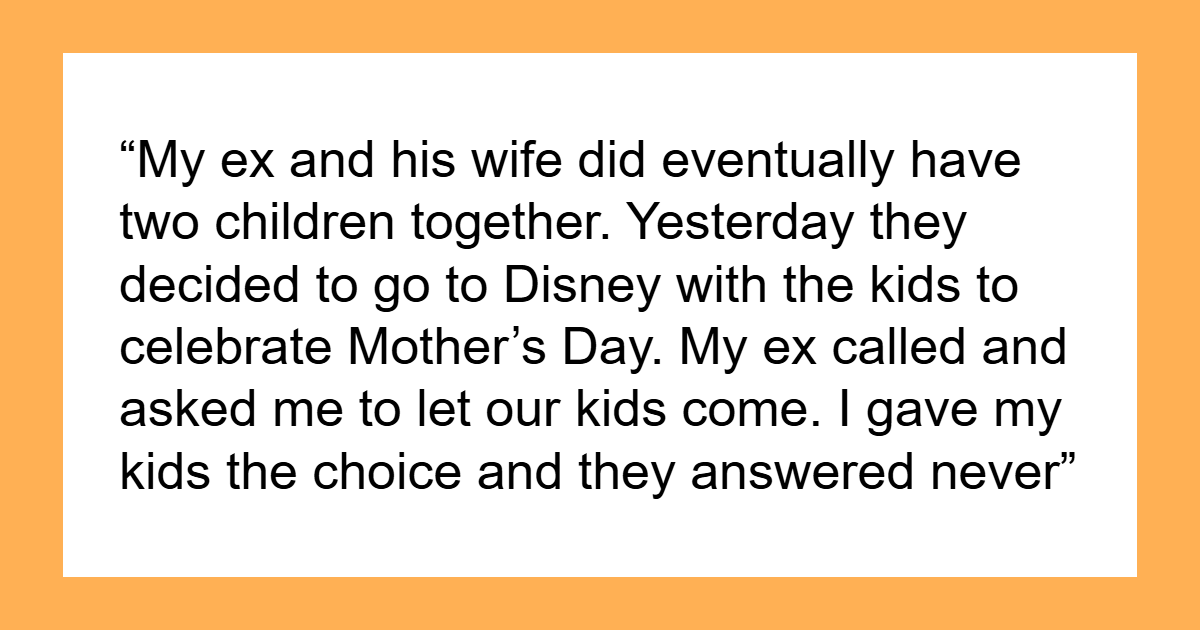
When their father later invited them to join a Mother’s Day Disney outing, their mother presented the offer and allowed them to answer. All three declined. The mother described their response as an immediate and emphatic “never.” The stepmother then called her in tears, claimed the teenagers were also her children, and accused the biological mother of being heartless.
These details come from one participant’s online account and cannot be independently verified. Nevertheless, the situation offers a useful case study in how not to repair a strained blended-family relationship. ection>
Why the Children’s Decision Matters
Teenagers Are Participants, Not Family Luggage
Ages 14, 15, and 16 are significant. Teenagers still need parental guidance, limits, and protection, but they are also developing personal judgment, stronger identities, and greater independence. A healthy parent does not surrender every decision to a teenager, yet neither should a teen’s emotional experience be treated like an inconvenient pop-up advertisement.
The Disney trip was not a medical decision, a school requirement, or a legally mandated exchange. It was an optional family outing. Allowing the teens to express whether they felt comfortable attending was therefore reasonable, particularly given the history described by their mother.
Listening to adolescents does not mean they control the household. It means their preferences receive age-appropriate weight. The CDC’s guidance for parents recognizes that teenagers gradually need greater autonomy while continuing to benefit from involved, attentive adults. The American Bar Association similarly notes that a child’s preference may be considered in custody matters, although the legal significance varies by jurisdiction and is never determined by age alone. 3>A Choice Is Not Automatically Parental Alienation
The father reportedly accused the mother of influencing the children against his wife. That possibility should be taken seriously in any separated family because children should not be recruited into adult warfare. However, a teenager refusing contact does not, by itself, prove manipulation by the other parent. There is a crucial difference between a parent saying, “You are not allowed to like your stepmother,” and a parent saying, “You were invited; tell me whether you want to go.” In the reported story, the mother claimed she passed along the invitation and did not forbid attendance. Professionals also warn against assuming that every negative reaction to one household was planted by the other household. Children may respond to rules, previous conflicts, broken trust, inconsistent treatment, or their own adjustment to divorce. The behavior and relationship history must be examined rather than replaced with a convenient villain. ection> Becoming a stepparent can be emotionally complicated. A stepparent may contribute money, transportation, meals, supervision, encouragement, and countless invisible acts of care. It is understandable to hope that those efforts eventually produce affection. What cannot be demanded is the emotional outcome. A wedding can create a stepfamily in an afternoon, but it cannot manufacture trust before dessert. Child-development and family specialists consistently emphasize that stepchildren often need time to accept a parent’s new spouse. Biological relationships begin with an established history; stepfamily relationships usually begin after loss, disruption, or major household change. The Child Mind Institute notes that love and trust commonly come automatically with a biological parent but must be earned gradually by a stepparent. University extension programs in Missouri, Minnesota, and Utah likewise advise stepparents to remain patient, respect the child’s existing parental relationships, and avoid rushing intimacy. 3>The Word “Mom” Cannot Be Assigned Like a Wi-Fi Password
The biological mother alleged that the stepmother repeatedly wanted the children to call her “mom.” That request may sound affectionate from the adult’s perspective, but it can create pressure for children who already have an involved mother. A child may love a stepmother deeply while calling her by her first name. Another may use “Mom” naturally after years of closeness. A third may never choose that title, despite having a respectful and positive relationship. None of these outcomes can be forced without risking resentment. The American Academy of Pediatrics advises stepparents not to take children’s resistance personally and recognizes that unresolved emotions from divorce may shape their behavior. Missouri Extension guidance specifically recommends letting children decide what to call a stepparent. The label should follow the bond; the bond should not be dragged behind the label like a suitcase with a broken wheel. ection> The mother said the stepmother had discussed infertility and IVF struggles with the children in ways that made them feel responsible for fulfilling her emotional needs. Infertility can involve profound grief, stress, and disappointment. Those emotions deserve compassion and appropriate support. Children, however, should not become the treatment plan. When a child is expected to comfort an adult, manage that adult’s emotional reactions, or provide a particular kind of affection to prevent distress, the family roles may become reversed. Cleveland Clinic describes emotional parentification as a situation in which a child becomes an adult’s emotional support system, sometimes suppressing personal feelings to keep the adult stable. A stepparent can say, “I care about you and would enjoy spending time together.” That is an invitation. Saying, “You must treat me as your mother because I suffered and need this from you” turns affection into an obligation. The stepmother’s reported tears do not automatically make her manipulative. She may have been genuinely hurt. But genuine pain does not give an adult permission to transfer responsibility for that pain to teenagers or to blame another parent for refusing to control their feelings. Disney can provide memorable experiences, but it is not a substitute for emotional safety. A strained relationship does not become healthy simply because the argument is transported to a place with fireworks. Large, expensive gestures sometimes fail because they focus on the desired result rather than the damaged process. The adults may imagine smiling group photos, matching shirts, and a public image of family unity. The teenagers may imagine hours of forced togetherness, guilt, childcare expectations, or another argument occurring far from home. The issue is especially sensitive because the invitation concerned Mother’s Day. Even teenagers who liked their stepmother might reasonably prefer to spend that holiday with their biological mother. Expecting them to leave their mother in order to validate their stepmother’s role placed the invitation inside an obvious loyalty conflict. The American Academy of Pediatrics and the Child Mind Institute warn that children of divorce should not feel forced to prove loyalty to one parent by rejecting another. Healthy holiday planning reduces guilt, makes expectations clear, and keeps adult disappointment away from the children. ection> This is the part where the biological mother’s response deserves a little scrutiny too. Laughing during an emotional phone call was not the most diplomatic choice. It probably increased the stepmother’s humiliation and gave the father another detail to use in the argument. A calmer response might have been: “I understand that you are disappointed. The children were invited and made their own decision. I will not pressure them, and any further discussion should go through their father and our parenting app.” That response would have acknowledged the feeling without accepting blame. It also would have created a written boundary instead of extending a chaotic telephone conversation. Still, one imperfect laugh does not erase the central issue. According to the mother’s account, she had dealt with years of accusations, court disputes, emotional pressure, and repeated boundary conflicts. People occasionally laugh when something feels absurd, tense, or overwhelmingly familiar. Her reaction may have been unhelpful, but it was not the reason the teenagers declined the trip. The father’s role is easy to overlook because the argument occurred between the two women. Yet he was the connecting adult: former husband, current husband, biological father, and co-parent. He should not have expected his former wife to manufacture affection for his current wife. He also should not have dismissed the possibility that his own decisions and his household environment had contributed to the teenagers’ withdrawal. A more productive response would have involved curiosity: Research summarized by the Gottman Institute recommends establishing connection before correction in blended families. Studies indexed by PubMed also associate the quality of stepparent-child relationships with adolescent adjustment and health, suggesting that the emotional quality of the relationship matters more than simply occupying the role. ection> The stepmother should release the demand to be regarded as an equal mother. A healthier goal would be becoming a trustworthy adult whose exact title is chosen freely by each child. Trust is more likely to grow through calm conversations, kept promises, respectful boundaries, and low-pressure time together than through expensive vacations intended to produce instant closeness. Especially when the stepparent-child bond is weak, the biological parent should usually take the lead on major correction. The stepparent can support household expectations without immediately acting as the chief enforcement officer. The teenagers may need time with their father that is not presented as a loyalty test involving his wife or younger children. Rebuilding that relationship should not depend on their performing enthusiasm for the entire blended household. A neutral family therapist experienced in divorce and stepfamilies can help distinguish ordinary adolescent independence from deeper relational injury. Therapy should not be used to pressure teenagers into compliance; it should create a safer structure for listening and accountability. The stepmother can process rejection with her spouse, therapist, support group, or trusted friends. The teenagers should not be required to repair her self-image or prove that her years of effort were worthwhile. AACAP advises families to seek professional evaluation when stepfamily conflict produces persistent distress, withdrawal, anger, or major behavioral changes. It also emphasizes that each child may respond differently to remarriage and new household relationships. ection> Families dealing with similar conflicts often discover that the invitation itself is rarely the real problem. The event merely reveals what has been quietly building underneath. Consider a teenager who repeatedly refuses vacations with a parent’s new spouse. From the outside, the teen may appear ungrateful. The family is paying for hotels, meals, and entertainment, so why not enjoy it? After a calm conversation, the teen explains that every trip includes forced photographs, public demands to call the stepparent “Mom,” and criticism whenever the teen asks to contact the other household. The teen is not rejecting the destination. The teen is rejecting the emotional conditions attached to attending. Once those conditions are removed, shorter activities may become possible. A casual lunch with no family-performance requirements can accomplish more than a seven-day vacation packed with expectations. In another common experience, a stepmother enters the family determined to be warm and involved. She cooks, attends games, remembers birthdays, and tries to create traditions. She is hurt when her stepchildren still introduce her by her first name. Instead of demanding recognition, she changes her approach. She tells the children that they may call her whatever feels comfortable. She stops comparing herself with their mother and begins asking what kind of relationship they actually want. Nothing changes dramatically the next morning. There is no violin music, tearful hug, or conveniently placed camera crew. Over several years, however, the children begin seeking her advice because she has become predictable, respectful, and emotionally safe. The relationship succeeds precisely because she stops insisting on what it must look like. A divorced father notices that his teenagers increasingly avoid his home. He assumes his former spouse is poisoning them against him. During family counseling, the teenagers describe a different problem: every visit revolves around keeping their stepmother happy. Their father dismisses complaints, punishes visible discomfort, and accuses them of disloyalty whenever they ask for time alone with him. The father initially feels attacked. Eventually, he recognizes that defending his marriage does not require ignoring his children. He begins scheduling individual time with them, responds to criticism without immediately arguing, and sets limits when his wife seeks emotional reassurance from the teenagers. The relationship does not heal instantly, but communication improves because the father stops searching for an outside person to blame. Biological mothers can also create problems by treating every invitation from the other household as a threat. One mother realizes that her children carefully study her face before saying they enjoyed time with their father and stepmother. She has never directly forbidden affection, but her sighs and sarcastic comments communicate disapproval. She changes her behavior and tells them they do not have to protect her feelings. The children become more honest, and the reduced loyalty pressure helps them establish relationships in both homes. This example matters because supporting teenagers’ choices must include their freedom to say yes as well as no. Respecting autonomy is not the same as encouraging rejection. Healthy blended families are not created by demanding equal affection, staging expensive bonding opportunities, or assigning villains whenever children resist. They develop through patience, consistency, accountability, and respect for relationships that existed before the new marriage. In the Disney dispute, the mother was justified in presenting the invitation and allowing three teenagers to answer. Her laughter was not ideal, but forcing the children to attend would have protected the adults’ preferred family image at the expense of the teenagers’ stated boundaries. The stepmother’s disappointment may have been real. Her next step, however, should not be a louder demand. It should be a quieter question: “What have I done that made this relationship feel unsafe or forced, and what can I change without requiring anything from them in return?” That question offers no instant fairy-tale ending. It does offer something more useful: a realistic beginning.The Stepmother’s Biggest Mistake: Demanding a Relationship
Marriage Creates a Legal Role, Not Instant Emotional Intimacy
Emotional Pressure Is Not the Same as Love
Why a Disney Trip Could Not Repair the Relationship
Was the Mother Wrong to Laugh?
What the Father Should Have Done Differently
How the Family Could Begin Repairing the Damage
1. Stop Arguing About Titles
2. Replace Grand Gestures With Reliable Behavior
3. Let the Biological Father Lead Discipline
4. Give the Teens Individual Access to Their Father
5. Use Professional Support
6. Keep Adult Emotions With Adults
Experiences That Show Why Choice and Boundaries Matter
The Teen Who Rejected Every “Perfect Family” Outing
The Stepmother Who Stopped Chasing the Title
The Father Who Mistook Rejection for Manipulation
The Mother Who Learned Not to Overmanage
The Lesson Behind All Four Experiences