If your living room could talk, it would probably ask for two things: a comfortable seat and a light source that doesn’t
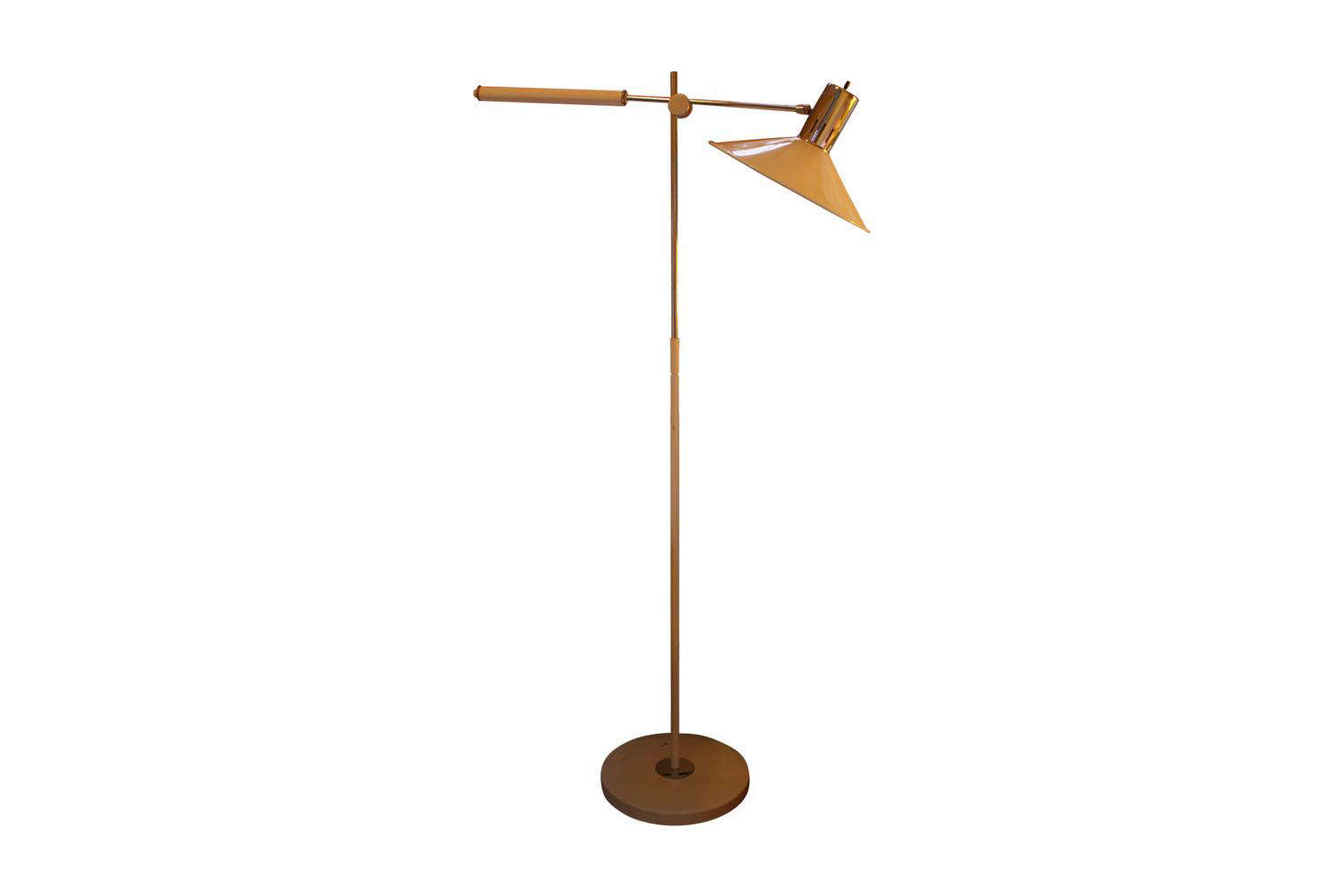
require you to read your book like a campfire ghost story. Enter the mid century Italian swing arm floor lamp
a brilliant mash-up of sculpture and practicality that can reach, swivel, tilt, and basically do everything except make you espresso.
These lamps aren’t just “old.” They’re designed: thoughtfully engineered forms from Italy’s mid-century boom years
(roughly the 1950s–1960s, give or take) when lighting makers treated your home like a stage set and every bulb deserved
a spotlight moment. Today, whether you’re hunting a vintage gem or buying a modern reissue, this style is still one of the
smartest ways to add warm, flexible task lighting without cluttering your space.
What Makes a Lamp “Mid Century,” “Italian,” and “Swing Arm”?
Mid-century: function that looks like art
Mid-century lighting tends to favor clean geometry, honest materials, and an overall “less fuss, more wow” attitude.
Think brass, chrome, enameled metal, opaline glass, and shapes that feel architecturalcones, cylinders, globes,
and long, confident lines.
Italian: the sweet spot of engineering and style
Italian design in this era had a knack for making technical solutions feel elegant. A hinge wasn’t hiddenit was celebrated.
A counterweight wasn’t bulkyit was refined. This mindset is why Italian lighting became a global reference point for modern interiors,
and why collectors still chase names and manufacturers associated with Italy’s design golden age.
Swing arm: the reason you’ll actually use the lamp daily
“Swing arm” means the lamp’s arm (or arms) pivots on joints so you can move light exactly where you want it:
over a book, across a sofa, onto a side table, or aimed at a painting like it’s at a museum opening. This is task lighting
with a personalityflexible, precise, and surprisingly space-efficient.
The Anatomy of a Great Italian Swing Arm Floor Lamp
1) The base: stability you can trust
Swing arm lamps need a stable foundation, because an extended arm is basically a lever daring gravity to start drama.
Many Italian examples lean into weighted basesoften metal, sometimes stone. Marble bases are especially
associated with iconic Italian floor lighting, prized for their mass and visual presence. The key is simple: the farther the arm reaches,
the more the base needs to anchor the lamp.
2) The arm: joints, tension, and “stay where I put you” engineering
A good swing arm doesn’t flop. It holds position through friction joints, tension springs, knuckle pivots, or adjustable collars.
Mid-century Italian design often makes the mechanics part of the beauty: joints that look like jewelry, elbows that feel
satisfyingly precise, and arms that glide instead of squeak.
3) The shade: controlling glare like a pro
Shades in this style tend to be purposeful: spun aluminum cones for directed light, enameled metal for crisp beams,
or glass diffusers for a softer glow. If you want reading light, you’re usually looking for a shade that blocks direct glare
from the bulb and aims illumination downward or outward.
4) The switch and cord: small details, big usability
Vintage lamps often use inline cord switches or foot switchesconvenient when the lamp is tucked behind furniture.
If you’re shopping secondhand, pay attention to where the switch sits (because nothing ruins “Italian design fantasy”
faster than crawling behind a chair to turn on a light).
Why This Lamp Style Works So Well in Real Homes
A swing arm floor lamp can function like multiple fixtures in one:
- Reading light beside a chair or sectional, aimed right at your pages.
- Accent light angled toward a wall for a gentle, room-expanding wash.
- “Overhead” effect when the arm reaches across a table surface (without ceiling wiring).
Designers often talk about layering lightmixing ambient, task, and accent sources so a room feels flexible and inviting.
A swing arm floor lamp is basically the MVP of that strategy because it can behave like task lighting one minute and soft accent lighting the next.
Icon Energy: The Italian Floor Lamp Tradition (and What to Borrow From It)
Even if you’re shopping specifically for a swing arm style, it helps to understand the broader Italian floor-lamp tradition
because it explains why these lamps look the way they do.
Take the famous Italian “reach” concept: a lamp that provides light where a ceiling fixture would, without being attached to the ceiling.
The best-known example is the Castiglioni brothers’ Arco floor lampan Italian design classic with a marble base and a long,
engineered span that can extend over a seating or table area. It’s not a swing arm lamp in the strict sense, but it’s the same philosophy:
put light exactly where people live, and make the solution look effortless.
For swing arm lovers, that translates into a few timeless ideas you’ll see again and again:
long arms, smart counterbalance, refined metalwork, and shades designed to control heat and glare.
How to Choose the Right Mid Century Italian Swing Arm Floor Lamp
Start with function: what do you need the lamp to do?
- For reading: Choose a directed shade and a jointed arm that can position light over your shoulder.
- For ambiance: Look for a shade/diffuser that softens light and an arm that can aim toward a wall.
- For flexibility: Prioritize smooth joints and a base that feels confidently heavy.
Get proportions right (so it looks intentional, not accidental)
Proportion rules aren’t meant to box you inthey’re meant to save you from buying a lamp that looks like it’s wearing
the wrong size hat. A handy guideline for shade sizing is to keep the shade proportionate to the base and overall height,
so the bulb isn’t glaring at eye level when you’re seated. If possible, test this in your space: sit down where you’ll use the lamp,
then check whether the light feels pleasant or intrusive.
Vintage vs. reissue: pick your adventure
Vintage can deliver authentic patina, original hardware, and that “I found this treasure” feeling.
Reissues often deliver modern electrical safety, updated sockets, and easier parts replacement.
Neither is “better” universallyyour best choice depends on whether you want a collectible object, a daily workhorse, or both.
Shopping Smarts: How to Spot Quality (and Avoid Regret)
Check build quality like you’re a friendly detective
- Joints: Do they tighten securely? Do they drift downward under the weight of the shade?
- Base: Is it stable when the arm is fully extended? Does it wobble on your floor type?
- Materials: Real brass and solid metal parts usually feel substantial; thin, lightweight parts may not age as well.
Look for authenticity cluesespecially on famous silhouettes
Some iconic Italian lamps are heavily copied. If you’re paying premium money, ask for clear photos of maker marks,
labels, or documentation. On widely imitated designs, authenticity often shows up in precision:
cleaner joints, better finishing, more stable engineering, and details that copycats struggle to match.
Ask the “unsexy” questions (they’re secretly the best ones)
- Has the lamp been rewired? If yes, when and by whom?
- Does it take standard bulbs/sockets, or rare parts?
- Is there a dimmerand is it compatible with LED bulbs?
- Are there any cracks in a stone base, or bends in the arm?
Styling a Mid Century Italian Swing Arm Floor Lamp
Create a reading nook that feels “designed”
Place the lamp slightly behind and to the side of your chair so the light falls onto your book without casting your head’s shadow
like a dramatic eclipse. Pair it with a simple side table and one other light source in the area (a table lamp or wall sconce)
to avoid that harsh “single spotlight” effect.
Use it to balance a living room
Living rooms look best when light comes from multiple points rather than one lonely ceiling fixture. A common strategy is to light
multiple corners with a mix of floor and table lamps, creating a cozy “glow map” instead of a bright center and dark edges.
A swing arm floor lamp can handle one corner while also reaching inward when you need it.
Let the metal finish connect the room
Brass plays beautifully with walnut, oak, and warm neutrals. Chrome and polished aluminum feel crisp with black, white,
and cooler tones. If your room has mixed metals, choose the lamp that ties your biggest pieces togetherhardware, frames, or furniture legs
so it looks intentional rather than accidental.
Care, Safety, and “Please Don’t Burn Down the Vibe” Tips
Vintage wiring: treat it with respect
If you’re buying vintage, assume the wiring may need attention unless you have proof it was recently updated.
Frayed cords, loose sockets, and brittle insulation are all common with older lamps. If you’re not comfortable evaluating that,
a licensed electrician or an experienced lamp repair shop is worth itespecially for a piece you plan to use daily.
Rewiring can be straightforwardbut know your limits
Rewiring a lamp is a common DIY project, but safety matters: unplug before working, use proper parts, and follow reliable
instructions and protective practices. If anything about the lamp’s internal wiring or stability seems questionable, don’t gamble
get professional help.
Bulbs: choose comfort over “tiny artificial sun”
For most homes, warm-white LEDs (often around the warm end of the spectrum) give a flattering glow and reduce heat compared to
traditional high-watt bulbsespecially important in smaller metal shades. Always follow the lamp’s recommended wattage limits
and avoid bulbs that run hotter than the fixture was designed to handle.
Conclusion: The Lamp That Reaches Where Life Happens
A mid century Italian swing arm floor lamp is one of those rare home upgrades that’s both practical and genuinely fun.
It solves real problemsglare, dark corners, awkward layoutswhile adding sculptural presence that makes your room feel curated.
Choose one with stable weight, smooth joints, and a shade that controls glare, and you’ll end up with a piece that works hard
every day while looking like it belongs in a design book.
Real-Life Experiences: Living With a Mid Century Italian Swing Arm Floor Lamp
The first thing you notice once you actually live with a swing arm floor lamp is how quickly it becomes a household habit.
Not a “nice-to-have.” A reflex. You walk into the room, you swing the arm over your chair, and suddenly your evening feels
ten percent more civilizedlike you’re the main character in a tasteful movie where everyone owns at least one good book and
nobody is lit by overhead fluorescents.
In my favorite setup, the lamp sits behind the corner of a sectional, with the arm able to reach two zones: a reading seat and the coffee table.
On weeknights it’s a quiet partnerangled down for a chapter or two, then nudged toward the wall for a softer glow while the TV is on.
On weekends it turns into a party trick. People inevitably ask, “Waitcan that move?” and you get to demonstrate the joint action like a proud
curator. (It’s the adult version of showing someone a cool pen that clicks in four colors.)
The second experience is the “furniture shuffle realization.” A swing arm lamp makes rearranging your room easier because the light can adapt.
Move the chair? Swing the arm. Add a small desk? Angle the shade. When you don’t have to commit to a single fixed beam, you feel freer to evolve
the room. That’s especially helpful in apartments or multipurpose spaces where your living room is also your office, your reading lounge, and your
“I swear I’ll do yoga here” area.
Then there’s the vintage ownership storyline: a little romance, a little responsibility. If you buy an older Italian-style lampespecially one with
brass and marbleyou’ll probably experience the “patina debate.” At first you may want to polish everything until it gleams. Then you realize the
gentle aging is the point. The tiny scuffs are the lamp’s résumé. I’ve found the sweet spot is to clean it thoroughly (dust hides in joints like it’s paying rent),
but only polish selectivelyjust enough to make it feel cared for without erasing its history.
One more very real moment: the day you decide to check the cord. It’s not glamorous, but it’s empowering. You inspect for cracks, you confirm the switch
works smoothly, and if anything feels off, you schedule a rewire. After that, you stop worrying and start enjoying. The lamp becomes what it was always
meant to be: not a museum object you tiptoe around, but a daily-use tool that happens to look incredible.
Finally, there’s the oddly satisfying “precision light” feeling. Overhead lighting is blunt. A swing arm lamp is intentional. When you aim it exactly
where you need itonto a page, a sketchbook, a puzzle, or even a plant you’re trying to keep aliveyou realize why mid-century Italian design still matters.
It makes ordinary life easier in a way that also feels beautiful. And honestly, if a lamp can do that, it has earned its spot on your floor.