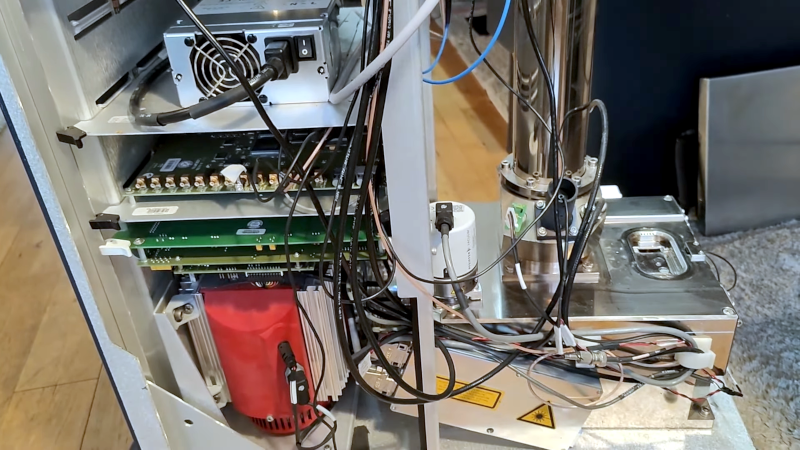
A mass spectrometer looks like the kind of machine that should either identify mysterious molecules or quietly launch a satellite. Inside, however, it is not magic. It is a carefully organized collection of vacuum hardware, ion optics, electronics, pumps, detectors, cables, seals, and software-controlled precision. A mass spectrometer tear down is fascinating because it turns an intimidating laboratory instrument into a visible story: sample goes in, ions are created, ions are sorted, signals are measured, and a computer turns the whole tiny parade into a spectrum.
This article explores what you typically find inside a mass spectrometer, why each component matters, and what a careful tear down reveals about the engineering behind analytical chemistry. We will focus especially on common quadrupole, GC-MS, LC-MS, and MALDI-style systems, while keeping the discussion practical, safe, and friendly enough that your brain does not need a lab coat.
What Is a Mass Spectrometer?
A mass spectrometer is an analytical instrument used to identify and measure atoms, molecules, and fragments of molecules by their mass-to-charge ratio, usually written as m/z. In plain English, the instrument gives molecules an electric charge, moves them through controlled electric or magnetic fields, separates them by how they behave, and records the result as a mass spectrum.
The basic architecture of nearly every mass spectrometer includes three core sections: an ion source, a mass analyzer, and a detector. Many systems also include an inlet, a vacuum chamber, ion lenses, a data system, cooling fans, power supplies, and one or more pumps. When connected to gas chromatography or liquid chromatography, the mass spectrometer becomes part of a larger workflow that can separate complex mixtures before the molecules reach the detector.
Why Tear Down a Mass Spectrometer?
A mass spectrometer tear down can be done for repair, training, salvage, reverse engineering, education, or plain curiosity. Older lab instruments often appear on surplus markets after a university, pharmaceutical lab, forensic facility, or industrial testing site upgrades its equipment. A broken mass spectrometer may no longer produce usable data, but it can still teach a tremendous amount about vacuum engineering, high-voltage electronics, precision machining, analytical chemistry, and scientific design.
That said, this is not a toaster with a PhD. A mass spectrometer may contain high-voltage circuits, fragile vacuum parts, sharp sheet metal, heavy pumps, hot zones, contaminated surfaces, laser modules, chemical residue, and delicate glass or ceramic components. A responsible tear down begins with documentation, hazard awareness, and respect for the instrument. The best approach is slow, methodical, and slightly paranoidin other words, exactly how you should treat a machine that used to convince ions to fly in formation.
The Outer Shell: More Than a Fancy Metal Box
The first thing you notice during a mass spectrometer tear down is the enclosure. It is usually a heavy, rigid frame with removable panels, airflow channels, vibration isolation, and service access points. The outer case protects users from electronics and moving parts, but it also protects the instrument from dust, temperature swings, vibration, and accidental bumps.
Good mass spectrometer design is surprisingly architectural. Pumps need airflow. Electronics need cooling. Vacuum chambers need stable mounting. Cables must avoid heat and electromagnetic interference. The instrument may look like a beige refrigerator that went to graduate school, but inside it is arranged like a tiny industrial city where every neighborhood has a job.
The Sample Inlet: Where the Journey Begins
The sample inlet is the gateway into the instrument. In a GC-MS system, compounds exit a gas chromatograph column and enter the ion source. In an LC-MS system, liquid from the chromatography system reaches an atmospheric-pressure ionization source such as electrospray ionization. In a MALDI system, a laser hits a prepared sample spot on a plate, creating ions from molecules embedded in a matrix.
During a tear down, the inlet often reveals the personality of the instrument. GC-MS inlets may show heated transfer lines and carefully insulated passages. LC-MS interfaces may include nebulizer assemblies, capillaries, heated desolvation zones, and ion transfer tubes. MALDI instruments may contain sample stages, laser optics, and mechanical positioning systems. Each design solves the same basic problem: how to introduce real-world samples into a high-precision ion-sorting machine without turning the inside into molecular soup.
The Ion Source: The Instrument’s Molecular Spark Plug
The ion source is where neutral molecules become charged particles. Without ionization, the mass analyzer has nothing to steer, filter, trap, or measure. This is why the ion source is one of the most important and most interesting components found during a mass spectrometer tear down.
Electron Ionization Sources
In many GC-MS instruments, electron ionization uses a hot filament to produce electrons. These electrons collide with vapor-phase molecules and knock electrons away, creating positively charged ions. The process often creates predictable fragmentation patterns, which is useful for matching spectra against reference libraries.
When removed from the instrument, an electron ionization source may look like a small precision metal assembly with ceramic insulators, filament mounts, repeller plates, lenses, and tiny screws that seem designed specifically to escape onto the floor. It is compact, but it performs a demanding job: producing reproducible ions in a clean, controlled region under vacuum.
Electrospray Ionization Sources
In LC-MS systems, electrospray ionization is common for biomolecules, pharmaceuticals, metabolites, and many polar compounds. Liquid sample is sprayed through a charged needle, forming tiny droplets. As solvent evaporates, ions are transferred into the gas phase and guided toward the mass analyzer.
A tear down of an electrospray source reveals why LC-MS instruments look like they have plumbing and lightning in the same neighborhood. There are fluid lines, high-voltage connections, gas flows, heaters, seals, and carefully shaped pathways. The design has to manage liquid flow, solvent evaporation, ion creation, and contamination control all at once. It is elegant engineering, even if it occasionally behaves like a moody espresso machine.
MALDI Sources
MALDI, short for matrix-assisted laser desorption/ionization, is commonly used for large biomolecules such as proteins and polymers. A laser pulse strikes a sample mixed with a matrix material, producing ions that can be analyzed, often by time-of-flight mass spectrometry.
In a MALDI mass spectrometer tear down, the source region may include a laser path, mirrors, lenses, a sample plate stage, position sensors, and a high-vacuum chamber. The mechanical precision can be impressive. The instrument must aim the laser accurately, move the sample plate reliably, and collect ions in a repeatable way. It is part chemistry lab, part optical bench, and part tiny robotic stage show.
The Vacuum System: The Unsung Hero
Mass spectrometers need vacuum because ions must travel without constantly crashing into neutral gas molecules. If the pressure is too high, ions scatter, reactions occur, signal quality drops, and the instrument becomes less of a mass spectrometer and more of an expensive confusion generator.
A tear down often exposes several vacuum components: roughing pumps, turbomolecular pumps, vacuum gauges, valves, O-rings, metal seals, tubing, and chamber walls. The roughing pump brings the system down from atmospheric pressure to a lower pressure range. The turbomolecular pump then creates a much higher vacuum for the analyzer region. Some instruments use differential pumping, meaning different zones are kept at different pressures so ions can move from atmospheric or near-atmospheric regions into high vacuum.
The vacuum hardware is often heavy, beautifully machined, and surprisingly dramatic. Turbopumps spin at extremely high speeds and must be handled carefully. Vacuum chambers may be made from stainless steel or aluminum, with polished sealing surfaces that must remain clean and undamaged. One fingerprint in the wrong place can become tomorrow’s troubleshooting mystery.
Ion Optics: Tiny Traffic Controllers for Charged Particles
After ions are created, they need guidance. Ion optics are electrodes, lenses, plates, skimmers, and apertures that use electric fields to focus and direct ions. Unlike glass lenses that bend light, ion lenses shape the path of charged particles.
During a mass spectrometer tear down, ion optics often appear as stacked metal discs, rods, cones, or plates separated by ceramic insulators. Their shapes may look simple, but their voltages and spacing are carefully designed. A small misalignment can reduce sensitivity. A dirty aperture can cause signal loss. A damaged insulator can create electrical leakage. This is where the instrument quietly proves that small parts can have large opinions.
The Mass Analyzer: The Sorting Machine
The mass analyzer is the heart of the system. It separates ions according to mass-to-charge ratio. Different types of mass analyzers do this in different ways, and a tear down may reveal very different hardware depending on the instrument model.
Quadrupole Mass Analyzer
A quadrupole analyzer uses four parallel rods with radio-frequency and direct-current voltages applied to them. Only ions with selected stable trajectories pass through to the detector at a given setting. By scanning voltages, the quadrupole can transmit ions across a range of m/z values.
In a tear down, the quadrupole often looks like four highly polished rods mounted with extreme precision. The rods may be cylindrical or hyperbolic in design, and their alignment matters greatly. This is not a place for “close enough.” The quadrupole is a molecular bouncer, and it checks every ion’s credentials at the door.
Time-of-Flight Analyzer
A time-of-flight analyzer accelerates ions and measures how long they take to reach the detector. Lighter ions generally arrive sooner than heavier ions when they carry the same charge and are given similar energy. Some instruments use reflectrons, which improve resolution by correcting for energy differences among ions.
A tear down of a time-of-flight system may reveal a long flight tube, pulsed extraction electrodes, detector assemblies, high-voltage sections, and carefully designed vacuum geometry. The instrument’s empty-looking tube is actually doing serious analytical work. It is basically a molecular racetrack, except the runners are ions and nobody gets a medal because they are atoms.
Ion Trap and Orbitrap Concepts
Ion trap instruments store ions in electric fields and then eject or detect them in controlled ways. Orbitrap instruments measure ion motion around a central electrode and convert that motion into high-resolution mass data. These analyzers can be more complex to interpret visually during a tear down, but they show how varied mass spectrometer engineering can be.
The important takeaway is that the analyzer is not merely a tube or chamber. It is a tuned physical system that transforms ion behavior into information. Every screw, insulator, voltage feedthrough, and machined surface supports that goal.
The Detector: Turning Ion Impacts Into Data
After ions are separated, they must be detected. Common detector technologies include electron multipliers, microchannel plates, Faraday cups, and other ion-sensitive devices. The detector converts ion arrival into an electrical signal that software can process into a mass spectrum.
An electron multiplier is especially interesting in a tear down because it amplifies tiny ion events into measurable signals. When ions strike the detector surface, secondary electrons are produced and multiplied through a cascade. The result is a signal strong enough for the instrument electronics to measure. In practical terms, the detector is the part that hears the faint ion whisper and turns it into a spreadsheet-friendly shout.
Power Supplies and Electronics
A mass spectrometer contains multiple power supplies. Some provide low-voltage power for control boards and fans. Others generate high voltages for ion sources, detectors, lenses, pulsed extraction systems, or quadrupoles. Radio-frequency electronics may drive quadrupole rods or ion traps. Sensitive amplifiers capture detector signals. Digital boards communicate with the computer and instrument firmware.
During a tear down, the electronics section often looks like a museum of specialized boards, ribbon cables, shielded connectors, transformers, capacitors, and heat sinks. The layout matters because noise is the enemy of clean data. Good mass spectrometry electronics must control high-energy processes while measuring extremely small signals. That is like trying to hear a mosquito while standing next to a lawn mower.
Cooling, Fans, and Thermal Design
Mass spectrometers generate heat from pumps, heaters, electronics, lamps, lasers, and power supplies. Stable temperature matters because heat can affect electronic drift, vacuum performance, source stability, and mechanical alignment. That is why teardown photos often show carefully placed fans, ducts, heat sinks, and temperature sensors.
Thermal design is easy to overlook because it is not as glamorous as lasers or ion traps. But without cooling, the instrument becomes unreliable. In scientific equipment, boring parts are often heroic. A fan may not get invited to the Nobel ceremony, but without it, the data might be toast.
Software and Control Systems
The physical instrument is only half the story. Modern mass spectrometers rely heavily on software for tuning, calibration, acquisition, diagnostics, vacuum control, data processing, and method management. A tear down reveals the hardware, but the instrument’s personality often lives in firmware and control software.
Software coordinates voltages, gas flows, pump states, source temperature, scan speed, detector gain, calibration routines, and safety interlocks. It also converts raw signals into spectra, chromatograms, peak lists, and quantitative reports. In daily lab use, the computer is the friendly face of a very complicated machine.
What a Tear Down Teaches About Instrument Design
A mass spectrometer tear down teaches that analytical instruments are systems, not isolated parts. The ion source is useless without vacuum. The detector is meaningless without stable ion transmission. The mass analyzer cannot perform well if electronics are noisy. The software cannot rescue a dirty source forever. Every section depends on the others.
The tear down also shows why maintenance matters. Dirty ion sources reduce sensitivity. Leaky seals ruin vacuum performance. Aging filaments fail. Pump oil can contaminate systems if handled poorly. Detector gain changes over time. Cables loosen. Fans clog. Scientific accuracy depends not only on theory, but also on cleaning schedules, calibration standards, and patient troubleshooting.
Common Parts Found During a Mass Spectrometer Tear Down
Vacuum Pumps
These may include roughing pumps, diaphragm pumps, scroll pumps, or turbomolecular pumps. Their role is to create the low-pressure environment required for ion travel.
Vacuum Chamber
The chamber houses the ion source, analyzer, detector, or all three, depending on the system. It is often precision-machined and sealed with O-rings, gaskets, or metal seals.
Ion Source Assembly
This includes parts that create ions, such as filaments, spray needles, capillaries, skimmers, lenses, target plates, or laser-interaction regions.
Mass Analyzer
This may be a quadrupole rod set, ion trap, flight tube, sector assembly, or another specialized analyzer design.
Detector Assembly
The detector captures ions and turns their arrival into electrical signals. It is usually connected to sensitive amplification electronics.
Control Boards and Power Supplies
These regulate voltages, monitor sensors, run pumps, drive radio-frequency systems, and communicate with software.
Safety Considerations Before Any Real Tear Down
A real mass spectrometer tear down should be treated as a technical service activity, not casual tinkering. Instruments may contain high-voltage capacitors that remain charged after power is removed. Vacuum pumps can be heavy and may contain oil. Internal components may have been exposed to unknown samples, solvents, biological materials, or hazardous residues. MALDI systems may include laser assemblies. Some instruments contain fragile ceramics, sharp metal edges, or powerful magnets.
For educational writing and observation, the safest approach is to study documented tear downs, manufacturer diagrams, service notes, and training materials. If a physical instrument must be handled, it should be done by trained people with proper equipment, documentation, and safety procedures. Curiosity is excellent. Surprise high voltage is not.
Practical Example: A Broken Laboratory Mass Spectrometer
Imagine a surplus laboratory mass spectrometer that no longer boots properly. The outer panels come off first, revealing a rigid frame, cooling fans, and labeled cable harnesses. The vacuum pump area shows a roughing pump connected by reinforced tubing. A turbomolecular pump sits closer to the analyzer chamber. The electronics bay contains power supplies, control boards, and high-voltage modules. The source region is shielded and carefully mounted. The detector cable is short and well protected to reduce noise.
As the tear down continues, the instrument becomes easier to understand. The sample path leads to the ion source. The source leads into ion optics. The optics lead to the analyzer. The analyzer leads to the detector. The detector connects to electronics. The electronics connect to software. What looked mysterious from the outside becomes logical from the inside. It is still complex, but it is no longer a black box. It is a chain of physical decisions.
What Can Be Salvaged?
A non-working mass spectrometer may contain valuable parts, though many are highly specialized. Useful salvage may include vacuum fittings, pumps, stepper motors, fans, power supplies, precision machined parts, cables, sensors, valves, heat sinks, and optical components. However, parts should be evaluated carefully, especially if contamination or electrical hazards are possible.
The most educational salvage is often not the most expensive part. A quadrupole rod assembly, an ion source, or a detector housing can become a teaching display. A vacuum gauge can demonstrate pressure measurement. A turbopump can explain high-vacuum engineering. Even a small ceramic insulator can start a conversation about why materials matter in scientific instruments.
Why Mass Spectrometers Are So Expensive
A mass spectrometer is expensive because it combines several difficult technologies in one instrument. It needs vacuum engineering, precision machining, stable high-voltage electronics, sensitive detection, clean sample handling, advanced software, reliable automation, and careful calibration. The hardware must perform consistently across thousands of runs while detecting tiny quantities of material.
The price also reflects support, validation, manufacturing tolerances, research and development, and application-specific design. A mass spectrometer is not costly because scientists enjoy dramatic invoices. It is costly because convincing invisible charged particles to reveal chemical truth is not exactly a weekend craft project.
Experiences and Reflections From a Mass Spectrometer Tear Down
The most memorable part of a mass spectrometer tear down is the moment when the machine stops feeling mysterious and starts feeling intentional. From the outside, it may seem like a sealed cabinet full of laboratory wizardry. Once the panels are removed, patterns appear. Heavy parts sit low for stability. Pumps are isolated from sensitive areas. Vacuum lines follow short, direct paths. Electronics are separated from heat and noise. The instrument begins to explain itself.
One useful experience is learning to trace the sample pathway before touching anything. Start visually at the inlet and follow the route toward the ion source, analyzer, and detector. This mental map prevents the tear down from becoming a random pile of expensive-looking metal. It also helps explain the instrument to others. When you can point to each section and say, “sample enters here, ions form here, separation happens here, signal appears here,” the entire system becomes less intimidating.
Another important experience is discovering how much of mass spectrometry depends on cleanliness. The inside of the source region often tells a story. Deposits, discoloration, worn filaments, or contaminated lenses can explain poor sensitivity better than any dramatic software error message. In many instruments, routine source cleaning is not glamorous, but it can make the difference between sharp peaks and sad little bumps that look like the instrument lost interest.
A tear down also teaches humility. Scientific instruments are designed by teams of people who thought carefully about airflow, grounding, shielding, service access, vacuum conductance, thermal expansion, and user safety. A bracket that looks ordinary may solve three problems at once. A cable route may avoid interference. A ceramic spacer may prevent leakage at high voltage. The deeper you look, the more you appreciate the quiet intelligence built into the hardware.
There is also a strong lesson in documentation. Photos, labels, sketches, and organized parts trays are not optional luxuries. They are survival tools. Removing twenty similar screws from five different places without documentation is an excellent way to create a puzzle nobody asked for. A good tear down feels slow at first, but the reward is understanding. A rushed tear down produces only a box of parts and a suspicious feeling that something important rolled under the table.
Perhaps the best experience is seeing how multiple fields meet inside one machine. Chemistry explains the ions. Physics explains their motion. Electrical engineering controls the fields. Mechanical engineering holds everything in alignment. Computer science turns signals into usable data. Vacuum technology keeps the ion path clear. A mass spectrometer tear down is not just about taking apart a laboratory instrument; it is about watching several branches of science shake hands inside a metal cabinet.
For students, technicians, engineers, and curious readers, the lesson is simple: complex machines become understandable when broken into systems. The ion source has a job. The analyzer has a job. The detector has a job. The vacuum system has a job. The software has a job. Once those jobs are clear, a mass spectrometer changes from “mysterious science box” into one of the most impressive tools humans have built for asking matter what it is made of.
Conclusion
A mass spectrometer tear down reveals a beautiful mix of precision hardware and clever science. Behind the panels are ion sources, vacuum chambers, pumps, analyzers, detectors, electronics, and software systems working together to identify molecules by mass-to-charge ratio. Whether the instrument is a quadrupole GC-MS, an LC-MS system, or a MALDI time-of-flight unit, the same core idea remains: create ions, separate them, detect them, and interpret the data.
The real value of a tear down is not simply seeing what is inside. It is understanding why each part exists. The vacuum system protects ion travel. The ion source creates charged particles. Ion optics guide them. The mass analyzer sorts them. The detector records them. The software makes sense of the result. That chain of purpose is what turns a complicated machine into a readable story.
And yes, it is still fair to be impressed. Any instrument that can identify molecules from tiny signals while juggling high voltage, vacuum pressure, thermal control, and precision electronics deserves respect. Also, maybe a small round of applause from the ions.