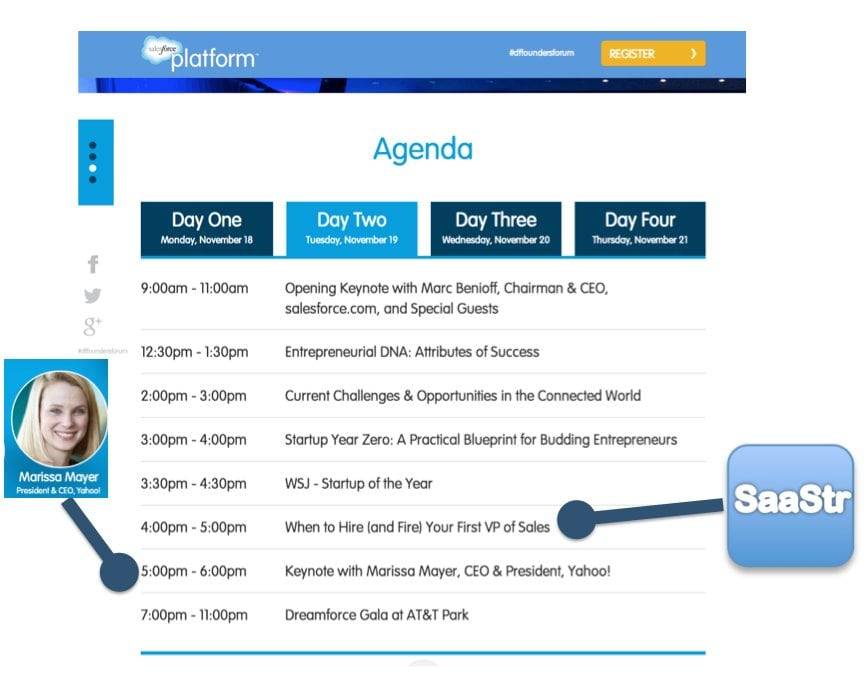
There are ordinary speaking engagements, and then there are speaking engagements that make you reread the conference schedule three times to confirm nobody accidentally dragged your name into the wrong box.
That was the deliciously surreal situation surrounding Jason Lemkin’s appearance at Dreamforce 2013. Lemkin, the entrepreneur behind EchoSign and the emerging SaaStr community, was scheduled to deliver a practical session for software founders shortly before Yahoo CEO Marissa Mayer took one of the conference’s biggest stages.
Were they truly the two hottest speakers at Dreamforce ’13? That depends on whether your definition of “hot” leans toward famous technology executives or people willing to explain why your first vice president of sales may turn your promising startup into an expensive bonfire. Either way, it was a pairing worth remembering.
Dreamforce 2013 Was More Than a Software Conference
Dreamforce had already become the annual migration of the Salesforce ecosystem, but the 2013 edition pushed the event into another category entirely. Held from November 18 through November 21 at San Francisco’s Moscone Center, it was expected to attract more than 120,000 registered attendees from 65 countries.
The program contained more than 1,250 breakout sessions, an expanded Cloud Expo featuring hundreds of partners, developer activities, hands-on workshops, product demonstrations and a much-publicized hackathon. Green Day was booked for the gala concert, because apparently a normal closing reception with cheese cubes would not have been sufficiently cloud-enabled.
Dreamforce blended several events into one enormous package. It was a user conference, developer convention, executive summit, startup festival, training program and networking marathon. Attendees could study technical architecture in the morning, listen to a global business leader in the afternoon and spend the evening attempting to remember the names of 47 people they had met while standing near a coffee station.
A Rare Free Door Into Enterprise Technology
One of the most appealing features was the availability of a free keynote and expo pass. That mattered to early-stage founders, students and independent professionals who could not justify the cost of a complete conference registration.
Even without access to every breakout session, visitors could observe Salesforce’s expanding ecosystem, meet potential partners, watch product demonstrations and hear from major speakers. For a young SaaS company, a single productive conversation could be worth more than several months of enthusiastic online networking conducted entirely through profile pictures.
Why Jason Lemkin Belonged on the Dreamforce Stage
By 2013, Jason Lemkin had accumulated the kind of operating experience that startup founders actually wanted to hear about. He had co-founded and led EchoSign, an electronic-signature company acquired by Adobe in 2011. After the acquisition, he served as an executive at Adobe and began publishing detailed advice about building software-as-a-service businesses.
That advice became the foundation of SaaStr. The growing community focused on the uncomfortable questions founders often avoided: When should a company hire senior executives? How should sales teams be compensated? What happens when growth stalls? How much recurring revenue is enough to support another layer of management?
Lemkin’s style stood apart because it mixed numbers, operating scars and direct language. He did not treat enterprise sales as a mystical art conducted by charismatic people in expensive jackets. He broke it into stages, roles, targets and repeatable processes.
The Founders Forum Lineup
His Dreamforce appearance was part of the Founders Forum, a track created for entrepreneurs building and scaling technology companies. The wider lineup included leaders associated with Dropbox, Eloqua, Get Satisfaction and other important enterprise software businesses, along with investors such as Mark Suster and Gordon Ritter.
Eloqua was especially relevant to the cloud-software story. Oracle had agreed to acquire the marketing automation company in a transaction valued at approximately $871 million, demonstrating how strategically valuable specialized SaaS platforms had become.
This was not a collection of motivational speakers offering ten ways to believe more aggressively in yourself. These were operators and investors who had hired teams, raised capital, sold software, lost deals, survived board meetings and discovered that “rapid growth” usually creates rapid growth in problems as well.
The Session Every SaaS Founder Needed
Lemkin’s session addressed a topic capable of making founders simultaneously hopeful and nervous: When to Hireand FireYour First VP of Sales.
The first vice president of sales is one of the most consequential hires in a B2B software company. Choose the right person at the right stage, and the business may transform a founder-led sales process into a scalable revenue organization. Choose the wrong person too early, and the company can burn through cash while producing impressive spreadsheets about deals that never close.
Do Not Hire a Sales Executive to Discover Your Market
A founder should not expect a new VP of Sales to arrive and magically determine who needs the product, why they need it and how much they will pay. Before making the executive hire, the company should already have evidence that customers will buy through a reasonably repeatable process.
Early customers do not need to arrive through identical channels, but there should be recognizable patterns. The founder should understand the target buyer, common objections, approximate sales cycle and reasons deals are won or lost.
Hiring a senior sales leader before those fundamentals exist is like hiring an airline pilot while the engineering team is still debating whether to build wings. Leadership matters, but basic aerodynamics remain annoyingly important.
Match the Candidate to the Company’s Current Stage
A sales executive who successfully managed 200 representatives at a public company may not be the right person to recruit the first five representatives at a startup. Large-company leaders often inherit established brands, support teams, territories, systems and customer demand. Early-stage SaaS companies offer a laptop, a partially documented process and a founder asking why the pipeline did not triple before lunch.
The first VP of Sales must be willing to recruit personally, coach individual representatives, join customer calls and improve the sales process while operating it. The candidate should know how to build the next stage of the organization, not merely how to supervise the stage the founder hopes to reach five years later.
Measure Reality, Not Presentation Skills
Senior sales candidates are often exceptionally persuasive. That is useful professionally and occasionally dangerous during interviews. Founders should verify previous performance, speak with former colleagues and understand exactly what the candidate built.
Did the person create a team or inherit one? Did revenue grow because of their leadership, a famous brand, an exceptional product or a booming market? Can former representatives explain how the candidate coached them? Would strong performers willingly work for that leader again?
A polished hiring presentation is not evidence of a functioning revenue engine. It is evidence that the candidate knows how to give a polished hiring presentation.
Then Came Marissa Mayer
Following a tactical discussion about SaaS sales with a marquee keynote featuring Marissa Mayer created a striking contrast. Lemkin’s session was built around a specialized operating problem. Mayer’s conversation with Salesforce CEO Marc Benioff examined leadership, product design, organizational culture and Yahoo’s attempted transformation.
Mayer had joined Yahoo as president and CEO in July 2012 after a long career at Google, where she was one of the company’s earliest employees and an influential product executive. At Yahoo, she inherited a famous internet brand facing strategic confusion, declining momentum and intense public scrutiny.
Her Dreamforce appearance offered attendees a glimpse into how she was trying to change the organization from within.
Leaders Should Remove Obstacles
One of Mayer’s strongest leadership ideas was that executives should help employees move faster by clearing away bureaucracy, organizational friction and unnecessary resistance. Instead of acting as the company’s most important individual contributor, a leader should create conditions in which talented people can do their best work.
Yahoo developed an employee feedback initiative commonly described as PB&Jprocesses, bureaucracy and jams. Employees could identify obstacles that were slowing them down, and widely supported issues received attention from leadership.
The lesson applied well beyond Yahoo. Startups frequently praise speed while gradually constructing approval chains that require three meetings, two documents and a ceremonial nod from someone who is currently on vacation. Removing friction is not glamorous, but neither is losing six weeks to a decision everyone understood on day one.
Simplicity Is a Serious Product Strategy
Mayer also emphasized simplicity in product design. A product must not only be usable; it must be useful. Features should support the customer’s actual objective rather than serve as decorative evidence that the engineering team had a busy quarter.
The best products often make the desired action obvious. That principle is particularly important in SaaS, where complexity can increase onboarding time, support costs and customer churn. A crowded interface may look sophisticated in a presentation while making real users wonder whether completing a basic task requires a certification course.
Priorities Require Exclusion
Mayer’s comments on prioritization provided another useful connection to the startup world. Important work rarely ends with an empty task list. Leaders must decide which goals deserve attention and accept that lower-value tasks may remain unfinished.
Founders often describe everything as a priority: enterprise sales, small-business growth, international expansion, mobile development, partnerships, hiring and a redesigned website featuring a slightly rounder button. When everything is urgent, the organization does not have priorities. It has a collection of alarms.
Why the Two Sessions Worked So Well Together
The playful claim about Dreamforce’s “hottest two speakers” contained more truth than the joke initially suggested. Lemkin and Mayer represented two different but connected levels of company building.
Lemkin focused on the moment when a founder must convert personal selling ability into an organization. Mayer focused on leading a large company by shaping culture, encouraging feedback, simplifying products and removing obstacles.
One conversation examined how to install a crucial executive function. The other examined how a chief executive creates an environment in which thousands of people can perform. Both were ultimately about leverage: achieving more through systems, teams and disciplined decisions rather than relying on heroic individual effort.
Tactical Advice and Big-Stage Vision
Large technology conferences need both kinds of content. Marquee keynotes generate excitement and establish broad themes. Smaller founder sessions provide the practical details that attendees can apply on Monday morning.
A keynote may inspire a CEO to remove organizational barriers. A breakout session may help that same CEO avoid hiring the wrong sales leader and spending the next nine months removing a very expensive organizational barrier.
How Attendees Could Get Real Value From Dreamforce
With more than a thousand sessions, no attendee could experience everything at Dreamforce 2013. The smartest strategy was not to collect the maximum number of sessions. It was to select a few problems that mattered and build a schedule around them.
Choose Sessions Based on Current Bottlenecks
A founder struggling to build a sales team would gain more from a focused VP of Sales discussion than from a broad presentation about global transformation. A developer evaluating the Salesforce platform should prioritize technical workshops. A marketing leader should seek sessions dealing with demand generation, automation and customer data.
The best conference agenda is personal. It reflects the problems waiting at the office, not merely the famous names printed in the program.
Leave Space for Unexpected Conversations
Scheduling every minute is another common mistake. Some of the most useful conference moments happen in hallways, lunch lines and expo booths. Attendees need enough open space to continue a promising conversation rather than sprinting away because a calendar notification has ordered them to cross three buildings in four minutes.
Turn Notes Into Decisions
Conference notebooks often become beautifully organized archives of ideas that are never used. After each valuable session, attendees should identify one decision, experiment or conversation to pursue.
For Lemkin’s session, that action might have been rewriting the VP of Sales job description or delaying the search until more representatives were succeeding. After Mayer’s keynote, it might have been creating a structured method for employees to report internal obstacles.
Experience Notes: What It Feels Like to Speak Before a Technology Icon
Presenting shortly before a globally recognized executive creates a peculiar combination of confidence and panic. On one hand, the schedule placement feels like a compliment. On the other, it reminds the speaker that thousands of attendees are already thinking about the keynote that follows.
The useful response is not to compete with celebrity. A breakout speaker wins by being specific. Marissa Mayer could discuss Yahoo’s transformation, leadership philosophy and product vision. Lemkin could give founders a detailed framework for solving one of the hardest problems in SaaS. Different rooms, different expectations and different forms of value.
Preparation Becomes Ruthlessly Practical
For a session about hiring a VP of Sales, vague advice would not survive contact with the audience. Founders would arrive carrying real problems: failed hires, missed targets, board pressure and uncertainty about whether their companies were ready for executive leadership.
That means every slide must earn its place. A useful presentation explains warning signs, stage fit, candidate evaluation and early performance indicators. It avoids spending 15 minutes defining sales for an audience that crossed San Francisco to discuss scaling it.
The most effective preparation also anticipates disagreement. Some founders hire senior sales leaders early and succeed. Others remain in founder-led sales for too long. A strong speaker acknowledges these variations while giving the audience a clear default framework.
The Room Matters More Than the Stage
A giant conference can make speakers obsess over stage size, lighting and attendance. Yet the real opportunity is the concentration of relevant people in one room. A session filled with founders actively wrestling with sales leadership can produce better questions than a larger but less focused audience.
Interactive discussion is especially valuable because hiring failures are rarely caused by one universal mistake. One company may recruit an executive who is too senior. Another may hire a talented leader from the wrong sales model. A third may have a good executive but an immature product, weak demand or unrealistic expectations.
The audience’s questions expose those differences and turn a presentation into a working session rather than a one-way performance.
Humor Helps Carry a Serious Message
The original “hottest two speakers” framing worked because it acknowledged the obvious contrast. Mayer was one of the most recognizable executives in technology. Lemkin was building a fast-growing specialist audience around SaaS operations. Pretending the levels of celebrity were identical would have been absurd, so the joke made the invitation warmer and more memorable.
Humor is useful when the underlying advice is difficult. Hiring the wrong executive can cost a startup a year of runway and organizational confidence. Founders need to hear that clearly, but they do not need the message delivered as though someone is reading the company’s final will.
After the Session, the Real Work Begins
The applause ends quickly. What remains are conversations with founders, follow-up questions, new relationships and evidence about which ideas resonated. A conference appearance can become a testing ground for a larger body of work.
For SaaStr, that mattered. The community was already attracting a substantial online readership and hundreds of attendees to its own gatherings. Dreamforce placed its practical SaaS guidance inside the largest enterprise software event of the era, helping validate the appetite for detailed founder education.
The broader experience offers a durable lesson for speakers: do not measure success only by room size. Measure whether people understood the argument, changed a decision, continued the conversation and shared the ideas afterward. A packed room is exciting. A useful room builds a community.
Conclusion: Two Speakers, One Enduring Lesson
Dreamforce 2013 captured an important moment in enterprise technology. Cloud software was rapidly reshaping how companies sold, marketed, collaborated and served customers. Salesforce had built a conference large enough to combine product training, startup advice, celebrity keynotes, developer culture and a stadium concert.
Within that spectacle, the pairing of Jason Lemkin and Marissa Mayer made surprising sense. Lemkin addressed the mechanics of scaling a SaaS sales organization. Mayer examined the responsibilities of leadership inside a large technology company. One explained how to hire the person who builds a revenue team; the other explained how leaders can help entire organizations move.
The names, companies and technologies have evolved since 2013, but the central questions remain familiar. When should a founder surrender part of the sales process? How can leaders remove bureaucracy? Which products are genuinely useful? What should an organization prioritize?
Those questions are why the best conference sessions outlive the badges, banners and aggressively branded tote bags. They give people frameworks they can still use after the stage lights go dark.
SEO Metadata
Note: This article is a newly written historical retrospective based on publicly documented information about Dreamforce 2013, Jason Lemkin’s Founders Forum appearance and Marissa Mayer’s keynote discussion.