Note: This article is written as an original, SEO-friendly feature based on publicly available information about Yuichi Yokota’s snowstorm Gundam photo series, Gundam Factory Yokohama, the RX-78F00 moving Gundam, and the January 6, 2022 Tokyo-area snowfall.
Some travel memories arrive politely. A sunset. A bowl of ramen. A train gliding into a station exactly on time, as if it has a personal vendetta against lateness. And then there are the memories that stomp into your brain wearing 25 tons of mechanical armor while snow whips sideways like the weather itself has joined the special effects department.
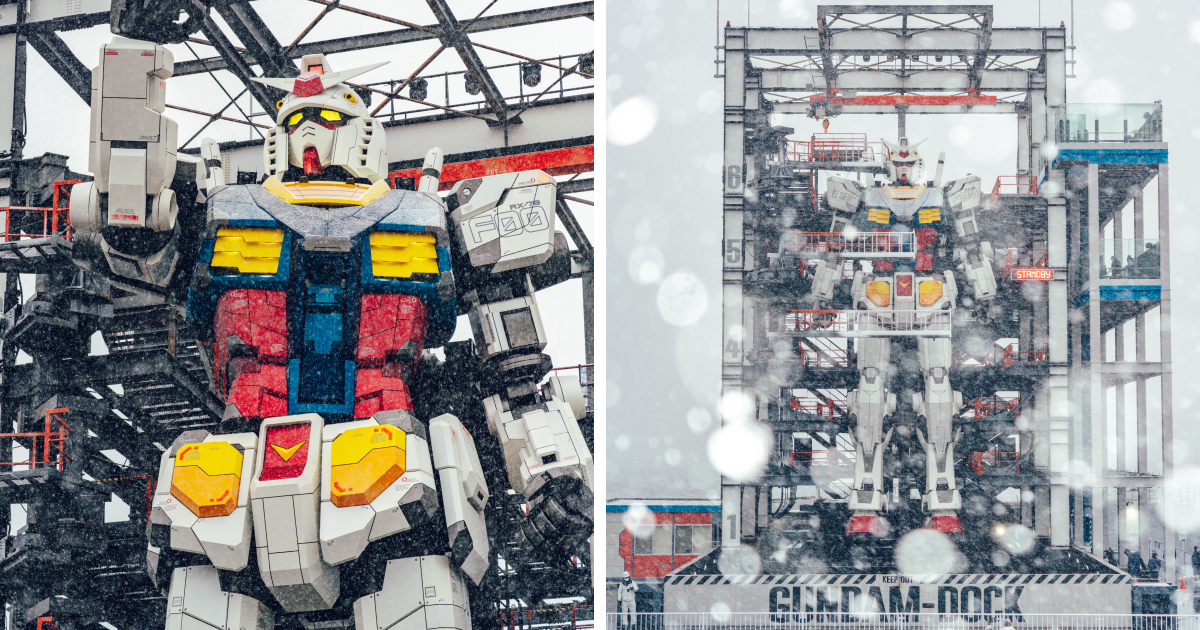
That is the magic behind “I Took Pictures Of The Gundam Starting Up In The Very Middle Of A Snowstorm (15 Pics)”, a striking photo story centered on the life-size moving Gundam at Gundam Factory Yokohama. Shot during a rare heavy snowfall around Tokyo and Yokohama on January 6, 2022, the images show the enormous RX-78F00 Gundam appearing to wake up in the middle of a blizzard. For Gundam fans, it was not just a cool photo set. It was the kind of scene that makes your inner twelve-year-old grab your adult self by the collar and whisper, “See? Giant robots were always the correct dream.”
The photographer, Tokyo-based artist Yuichi Yokota, captured the Gundam as snow wrapped the harbor in a cinematic haze. The result looked less like a tourist attraction and more like a dramatic frame from a live-action mecha film: glowing eyes, metal limbs, falling snow, and a machine that seemed one dramatic orchestral swell away from saving humanity.
Why These Gundam Snowstorm Photos Hit So Hard
The appeal of this photo series is easy to understand. Most people have seen pictures of giant Gundam statues in Japan. They are impressive in daylight, spectacular at night, and usually surrounded by excited visitors holding phones at extremely ambitious angles. But snow changes everything.
Snow softens the city. It hides ordinary pavement, mutes background clutter, and turns harsh lighting into atmosphere. In Yokohama, it transformed the Gundam Factory setting into something otherworldly. The RX-78F00 Gundam was no longer just standing in front of a dock structure; it looked like a machine emerging from a frozen battlefield. The snow gave the entire scene scale, mood, and movement.
That is why the phrase “Gundam starting up in a snowstorm” works so well as a visual hook. It combines three irresistible things: a legendary anime icon, extreme weather, and the illusion of a machine coming alive. It is basically clickbait for the soul, except this time the bait is a giant robot and the click is emotionally justified.
The Real Gundam Behind The Photos
The Gundam in the snowstorm was the RX-78F00 Gundam, the centerpiece of Gundam Factory Yokohama, a limited-time entertainment and engineering attraction at Yamashita Pier in Yokohama. Unlike a normal statue, this one moved. It stood about 18 meters tall, weighed around 25 tons, and included multiple points of articulation that allowed it to perform choreographed movements from its dock.
The attraction officially opened in December 2020 and became one of Japan’s most talked-about pop culture landmarks. It was developed as part of the broader dream of bringing a life-size Gundam closer to reality, blending anime nostalgia with robotics, mechanical design, entertainment engineering, and a healthy amount of “because we can.”
For longtime fans, the RX-78F00 design echoed the classic RX-78-2 Gundam from Mobile Suit Gundam, the 1979 anime series that helped define the “real robot” genre. Instead of magical robots powered by pure heroic shouting, Gundam treated mobile suits as military machines with pilots, politics, technology, and consequences. That grounded approach is one reason the franchise has endured for decades.
So when visitors saw the Yokohama Gundam move, even slowly, it was not just a mechanical demonstration. It was a childhood concept taking physical form. Add a snowstorm, and suddenly the whole thing felt mythic.
The January 2022 Snowstorm Made The Scene Rare
Tokyo and Yokohama are not strangers to winter, but heavy snow in the region is not an everyday event. On January 6, 2022, the Tokyo area experienced unusually prolonged snowfall, and heavy snow warnings were issued for the city and surrounding areas for the first time in four years. That detail matters because it explains why the photos feel so unusual. This was not a planned winter light show with a sprinkle of fake flakes. It was real weather arriving at exactly the right dramatic moment.
Snow can turn even a convenience store parking lot into a moody art film. Put it around a life-size moving Gundam, and the effect multiplies. The falling snow added texture to every frame. It blurred the distance, caught the lights, and made the Gundam appear larger because the surrounding world looked smaller, quieter, and more vulnerable.
What Makes The Images Feel Like A Movie
1. The Gundam Looks Awake
The phrase “starting up” is powerful because it suggests a transition. A machine is not simply standing there; it is becoming active. In the photos, the Gundam’s lighting and posture create the impression of readiness. Viewers can imagine servos humming, cockpit screens flickering, and some very serious operator saying, “System check complete,” while everyone else wisely steps behind something reinforced.
2. The Snow Creates Natural Motion
Still photography often has to imply movement. Falling snow does that beautifully. Each flake becomes a tiny streak of action, filling the image with energy even when the main subject is massive and slow. The contrast between the Gundam’s weight and the snow’s lightness makes the photos feel balanced: steel and softness, machine and weather, science fiction and nature.
3. The Scale Feels Almost Absurd
A giant robot is already dramatic. A giant robot in a snowstorm is wonderfully ridiculous in the best possible way. It feels like the universe briefly opened a bonus level. The Gundam towers over the scene, while the snow makes the air visible around it. That visible air helps the viewer understand the machine’s size in a more physical way.
4. Yokohama’s Harbor Setting Adds Atmosphere
Yamashita Pier already had a strong industrial-waterfront mood. In clear weather, it felt like a futuristic exhibition space. In snow, it looked like a launch site during an emergency. The dock structure behind the Gundam helped sell the illusion that this was not a display, but a hangar. The result was part theme park, part anime opening sequence, and part “please tell me someone brought a tripod.”
Why Gundam Still Captures Global Imagination
Gundam is not just a robot franchise. It is a cultural machine with many moving parts: anime, model kits, video games, films, collectibles, exhibitions, and full-scale statues. The franchise began with Mobile Suit Gundam in 1979 and grew into one of the most recognizable names in Japanese pop culture. For many fans, Gundam represents the perfect intersection of design, storytelling, engineering, and imagination.
One reason Gundam has lasted so long is that it understands scale emotionally. The robots are huge, yes, but the stories often focus on human conflict, fear, responsibility, and survival. A mobile suit is never just a cool machine. It is a symbol of ambition, war, protection, and sometimes the terrible habit humans have of building astonishing things and immediately asking, “Can we weaponize it?”
That emotional weight helps explain why the Yokohama Gundam photos resonated. Viewers were not only looking at a large mechanical attraction. They were looking at a familiar fictional idea crossing into the real world, wrapped in snow, light, and atmosphere.
The Photography Lesson Hidden In The Blizzard
Great photography is not always about perfect conditions. Sometimes it is about recognizing that imperfect conditions are the gift. A clear day would have produced clean travel photos. A snowstorm produced drama.
For anyone interested in travel photography, cosplay photography, street photography, or pop culture landmarks, Yokota’s Gundam snowstorm series offers a useful lesson: weather is not always the enemy. Rain, fog, snow, and wind can add story. They can make a familiar subject feel rare. They can turn a place everyone photographs into a scene only a few people were patient, prepared, or delightfully stubborn enough to capture.
Of course, snow photography is not effortless. Cold drains batteries faster. Lenses fog. Autofocus can struggle. Gloves make camera controls feel like tiny escape-room puzzles. And if you are shooting in a storm, every decision becomes more urgent because comfort is leaving your body one snowflake at a time.
But when everything works, the reward is enormous. Snow simplifies backgrounds, reflects light, and adds depth. Around the Gundam, it made the images feel less like documentation and more like storytelling.
Why The 15 Pics Feel So Shareable
The internet loves images that can be understood instantly but appreciated slowly. These Gundam snowstorm photos do exactly that. At first glance, the viewer thinks, “Giant robot in snow. Awesome.” After a second look, details emerge: the glow of the Gundam’s lights, the density of the snowfall, the cold industrial setting, the sense of scale, and the timing required to catch the moment.
The title also does a lot of work. “I Took Pictures Of The Gundam Starting Up In The Very Middle Of A Snowstorm” sounds personal, immediate, and visual. It does not over-explain. It invites curiosity. The parenthetical “15 Pics” tells readers there is a gallery experience waiting, which is perfect for a web audience that wants both a story and a visual payoff.
In SEO terms, the topic naturally connects several search interests: Gundam, Gundam Factory Yokohama, snowstorm photography, Japanese pop culture, anime landmarks, travel photography, and life-size robot attractions. Better yet, these keywords do not need to be forced. They belong to the story.
Gundam Factory Yokohama: A Temporary Landmark With A Lasting Legacy
Gundam Factory Yokohama was always a limited-time attraction, and it eventually closed after years of drawing fans, tourists, photographers, families, engineers, and people who simply enjoy pointing at large things and saying, “Whoa.” Its moving Gundam became a symbol of what happens when pop culture is treated not as disposable entertainment, but as a design challenge worthy of serious engineering.
The RX-78F00 did not sprint across the harbor or fight space invaders, which is probably for the best because Yokohama traffic has enough going on. But it moved. It raised its arm, shifted its body, lit up, and performed in a way that made fiction feel reachable. That was enough.
In the snowstorm photos, the attraction’s temporary nature becomes even more poignant. The Gundam was there for a limited window. The snowstorm was rare. The photographer was present at the right time. The machine moved, the snow fell, the shutter clicked, and a moment that could have disappeared became a visual memory shared around the world.
What Viewers Can Take From This Photo Story
The biggest takeaway is simple: wonder is often a matter of timing. The Gundam was impressive every day, but the snowstorm made it unforgettable. The same subject, seen under different conditions, can tell a completely different story.
For photographers, that is a reminder to revisit familiar places when the weather changes. For travelers, it is a reminder that not every inconvenience ruins the day. Sometimes the delayed train, cold fingers, wet shoes, or unexpected storm becomes the reason the memory survives. For Gundam fans, it is proof that the franchise’s visual language remains powerful even outside animation.
And for everyone else? It is a reminder that life occasionally gives us scenes so cinematic they feel fake, and our only job is to notice them before the snow melts.
Extra Experience: Standing Before A Gundam In A Snowstorm
Imagine arriving at the harbor with your coat pulled tight, your breath visible, and your camera already complaining silently from the cold. The sky is not dramatic in a clean postcard way. It is heavy, gray, and restless. Snowflakes hit your sleeves, your lens hood, your eyelashes. Somewhere nearby, visitors shuffle in that careful winter walk everyone adopts when the ground may or may not be plotting against them.
Then the Gundam begins to light up.
At first, it is subtle. A glow cuts through the snowfall. The white armor, already pale against the storm, begins to separate from the background. The machine’s edges become clearer, then softer again as another curtain of snow blows across the scene. You raise the camera, but for a second you forget to shoot. That is the funny thing about awe: it is terrible for productivity.
The Gundam does not need to move quickly to feel alive. In fact, the slow movement makes it feel larger. Fast motion belongs to small things: birds, cars, people late for coffee. A giant machine moving slowly feels heavy, deliberate, and important. When the RX-78F00 shifts in the snow, it gives the impression that the whole environment is responding to it. The dock becomes a launch bay. The lights become warning signals. The snow becomes battlefield debris. Your brain, raised on movies and anime, starts adding sound effects without permission.
Taking pictures in that moment would be both thrilling and mildly ridiculous. You would be balancing artistic ambition against the practical reality that your fingers are turning into frozen breadsticks. Every shot would require choices: wide angle to show the full scale, tighter framing to catch the glowing head, vertical composition for drama, horizontal composition for the storm, exposure compensation to protect the snow highlights, shutter speed fast enough to hold detail but slow enough to let the snowfall breathe.
The best images would probably come from patience. You would wait for the snow to thicken, then thin. You would watch the light bounce off the armor. You would notice how people in the foreground add scale, but too many people break the illusion. You might crouch slightly to make the Gundam tower higher in the frame, then immediately regret crouching because cold pavement is not a luxury seating option.
What makes the experience memorable is not only the subject. It is the contrast. Gundam is a symbol of futuristic technology, human ambition, and mechanical power. Snow is quiet, natural, and temporary. Put them together and the scene becomes strangely emotional. The machine looks powerful, but the weather makes it vulnerable. The snow lands on its armor the way it lands on everything else. For a moment, even a giant robot belongs to the same winter as the rest of us.
That is why these photos work beyond fandom. You do not need to know every Gundam series, timeline, pilot, mobile suit model number, or debate about Universal Century continuity to enjoy the image. You only need to understand the feeling of seeing something impossible-looking appear in real life. The snowstorm makes the scene feel discovered rather than staged, as if the photographer stumbled into a secret launch sequence happening just outside ordinary reality.
And perhaps that is the heart of the story. The Gundam did not actually rise to defend Yokohama from an incoming space colony, and no dramatic anime protagonist sprinted across the pier yelling about destiny. But for a few snowy minutes, it felt possible. The lights glowed. The machine moved. The storm swirled. The camera clicked. And somewhere between engineering and imagination, a giant robot became a winter legend.
Conclusion
The photo series “I Took Pictures Of The Gundam Starting Up In The Very Middle Of A Snowstorm (15 Pics)” stands out because it captures more than a famous attraction. It captures timing, weather, fandom, engineering, and emotion colliding in one unforgettable visual moment. The RX-78F00 Gundam at Gundam Factory Yokohama was already a marvel, but the January 2022 snowstorm turned it into something cinematic: a life-size mecha seemingly waking up in the cold, ready for a mission only the imagination could complete.
For fans of Gundam, Japanese pop culture, travel photography, or simply spectacular real-world scenes, these images are a reminder that the best moments are often unplanned. Sometimes all it takes is a rare storm, a legendary robot, and a photographer willing to keep shooting while everyone else is wondering whether hot coffee counts as survival equipment.