Putting salary history on a resume is a little like putting your Social Security number on a pizza menu: it’s not standard, it’s not always smart, and yetsomebody, somewhere, will ask for it anyway.
Here’s the good news: in many places, employers are restricted from asking about your past pay (and the rules are changing fast). In other places, it’s still legal to ask, but you’re often not required to answer.
This guide walks you through the safest, cleanest way to handle salary history when a job posting (or application portal) requests itwithout tanking your negotiating power or turning your resume into a tax document.
Quick note: This is general information, not legal advice. If your situation is complicated, check your state/city rules or talk to an employment attorney.
First, a reality check: Salary history usually does NOT belong on a resume
Most resume best practices focus on impactskills, achievements, resultsnot compensation. Many career services offices even advise leaving salary topics out of cover letters and related materials unless you’re explicitly instructed to include them.
Still, some employers request salary history to gauge “market value,” to confirm budget alignment, or to shape an offer. If you must provide it, the goal is to do it strategically, legally, and clearlyand to keep the focus on what you’re worth now.
Before you add numbers: Know your rights (and your leverage)
Salary history bans are realand they vary by location
Many jurisdictions restrict employers from asking about past pay or using it to set compensation. Some bans cover the entire hiring process, including applications, interviews, and third-party recruiters.
“Salary expectations” is often allowed even when “salary history” isn’t
Even where salary history questions are restricted, employers can often ask what you expect to earn (a “pay expectation” or “desired range”). That difference matters because expectations keep you anchored to today’s marketnot yesterday’s paycheck.
You usually aren’t legally obligated to disclose past pay
In many places, there’s no legal requirement to share your prior salary. That said, some employers may react poorly if you declinefair or not. Your strategy should balance: (1) legal reality, (2) your negotiating goals, and (3) whether this employer is worth the friction.
How to Include Salary History on Resume: 11 Steps
-
Step 1: Confirm the request is real, current, and truly required
Start with the job posting and application instructions. If the posting says “include salary history,” treat that as a requestbut don’t assume it’s mandatory unless the application system forces it.
If there’s a field you can leave blank, do that. If it’s a required field, consider using a neutral entry like “Available upon request” or a range for expectations (more on that below), depending on local law and norms.
-
Step 2: Check whether salary history questions are restricted where the job is based
Salary history rules can depend on the job’s location (and sometimes your location). Many states and cities limit salary history questions, and the details varysome ban asking entirely, others limit how/when it can be discussed.
If you suspect the question may be restricted, your safest move is to pivot to salary expectations and ask for the employer’s budgeted range.
-
Step 3: Decide whether your resume is the right place (hint: usually no)
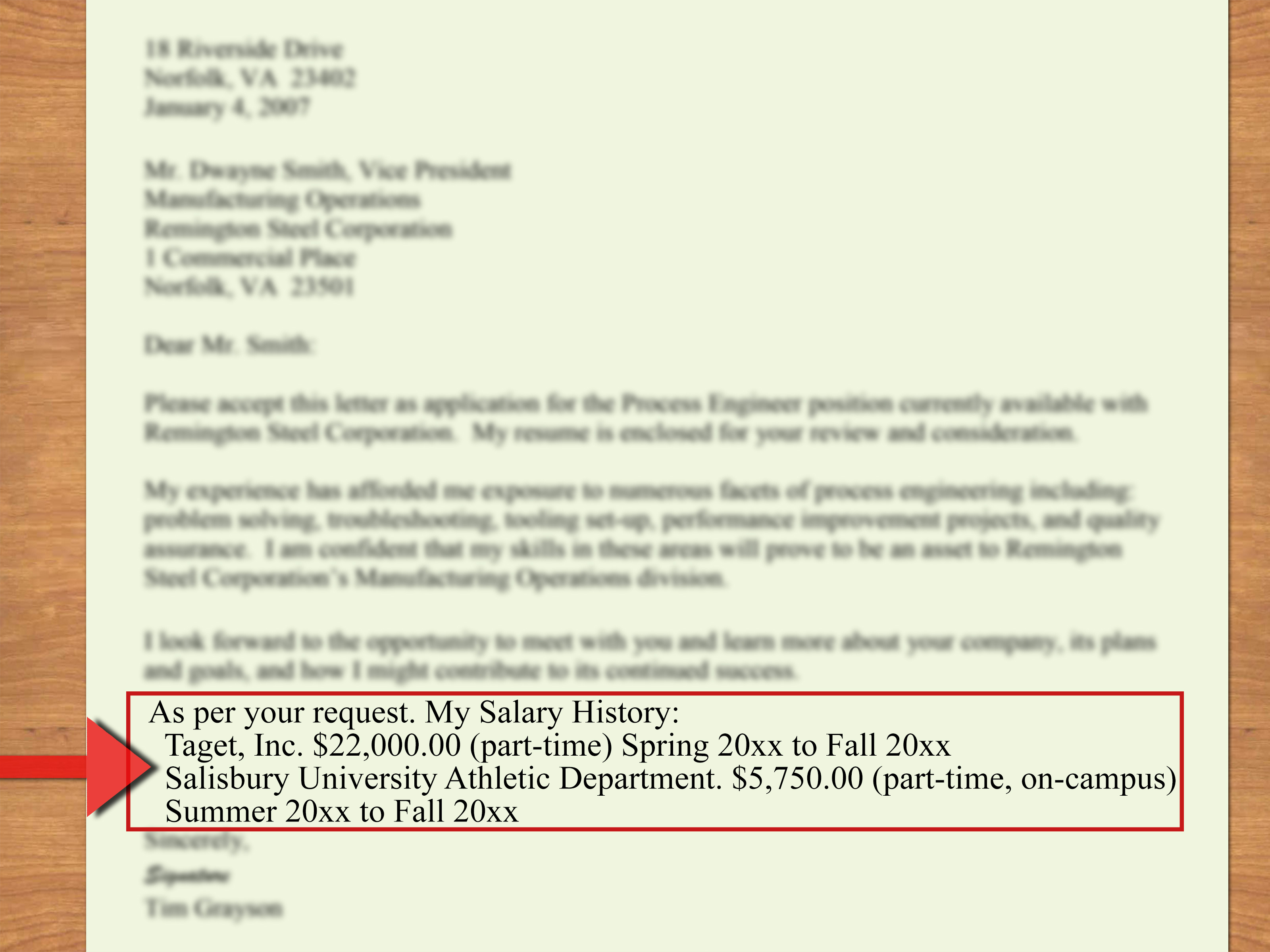
If you must provide salary history, the cleanest approach is typically a separate “Salary History” addendum or a short note in your application materialsnot a bold dollar figure jammed next to your job title like it’s a LinkedIn endorsement.
Why? Because resumes get forwarded, printed, stored, and shared. Salary data is personal, and it can distract from your accomplishments.
-
Step 4: Do market research before you reveal anything
Salary history is backward-looking. Market pay is what matters now. Research typical compensation for the role, level, and location so you don’t accidentally underprice yourself (or overshoot a realistic range without realizing it).
If the employer posts a pay range (in states with pay transparency requirements, many do), use that as a grounding point.
-
Step 5: Define “salary” correctly (base pay vs. total compensation)
If you provide salary history, be clear whether you’re listing base salary only or total compensation (bonus, commissions, overtime, equity, tips, etc.).
Career guidance commonly recommends including other consistent pay componentsor at least noting themso your history isn’t misleading.
Example: “Base $78,000 + annual bonus (avg. $6,000).”
-
Step 6: Use ranges or general language when appropriate
If the request allows flexibility, a range or general phrasing can protect your negotiation position while still answering the question. Some career guidance suggests options like “mid-sixties” or “in the $80Ks,” especially early in the process.
Example: “Current base: mid-$80Ks; total comp: low-$90Ks.”
Avoid ultra-wide ranges that look sloppy (e.g., $50K–$200K). “Good faith” ranges are increasingly expected in transparency contexts.
-
Step 7: Choose a format that’s easy to scan (and doesn’t hijack your resume)
If you’re putting salary history on the resume itself (again: only if required), keep it subtle and consistent:
- Use a small “Compensation (Base)” sub-line under each role, not in the headline.
- Stick to the same units (annual salary vs. hourly).
- Use reverse chronological order, matching your experience section.
Best practice: include it in an addendum instead of the resume when possible.
-
Step 8: Add context for variable pay (commission, bonus, overtime)
If you work in sales, healthcare, hospitality, or roles with significant variable compensation, a single number can misrepresent your earnings. Use averages for consistent variable pay and label them clearly.
Example: “Base $52,000 + commission (3-year avg. $18,000).”
-
Step 9: Be accurateand protect your privacy
Don’t inflate, “round up aggressively,” or guess. If salary history becomes part of negotiations, inconsistencies can damage trust.
Also: you generally don’t need to share pay stubs or documents unless you choose toand you should redact sensitive information if you ever do. If an employer pressures you for documents early, consider it a yellow flag.
-
Step 10: Tie salary history to value (so it doesn’t define you)
Salary is a number; your results are the story. If salary history must appear, pair it with measurable achievements nearby so the reader sees the “why” behind your compensation.
Example: “Grew pipeline by 38% YoY; promoted after 11 months; base increased from $70K to $82K.”
-
Step 11: Redirect the conversation to expectations and fit
Even if you provide history, you’re allowed to steer toward the compensation that makes sense for this role.
- Ask for the range: “Can you share the budgeted range for this position?”
- Anchor to market: “Based on the role scope and market data, I’m targeting $X–$Y.”
- Keep it total-comp: “I’m flexible depending on the full packagebase, bonus, equity, and benefits.”
This approach aligns with mainstream negotiation advice: do your research, communicate a range, and avoid letting old pay set your new value.
Clean templates (copy/paste friendly)
Template A: Salary history addendum (recommended)
Salary History (Base + Notable Variable Pay)
- Senior Project Manager ABC Company (2022–2025): Base $98,000; annual bonus avg. $7,500
- Project Manager XYZ Company (2019–2022): Base $82,000; bonus avg. $5,000
- Coordinator LMN Company (2017–2019): Base $56,000
Note: Shared in response to application request. Open to discussing a market-aligned range for this role.
Template B: Minimal resume sub-line (only if required)
Senior Analyst Delta Health, Chicago, IL (2021–2025)
Compensation (Base): $92,000; Bonus: avg. $6,000
• Built dashboards that reduced reporting time by 40%
• Led cross-functional rollout adopted by 6 departments
Template C: Email response that doesn’t undersell you
“Thanks for asking. My recent compensation has been in the high-$80Ks to low-$90Ks in base pay, with additional bonus depending on performance. For this role, I’m most interested in a market-aligned total compensation package based on scope. Could you share the budgeted range?”
Common mistakes (and how to avoid them)
- Volunteering salary history when nobody asked. If it isn’t required, keep your resume focused on outcomes.
- Listing “take-home pay.” Use gross pay and label the unit (hourly vs. annual).
- Forgetting variable comp. If commissions/bonuses are meaningful, add an average and label it.
- Letting old pay anchor new pay. Always redirect to expectations and market value.
- Ignoring location rules. Salary history restrictions vary widely by jurisdiction.
FAQ
Should I ever include salary history on a resume?
Only when you’re explicitly instructed and you’ve checked that it’s appropriate for the job’s location and hiring context. Otherwise, it’s usually better handled via an application field or an addendum.
What if salary history questions are restricted where I’m applying?
Pivot to expectations and ask for the posted/budgeted range. Many jurisdictions restrict salary history inquiries, and some also limit using past pay to set offers.
Can I refuse to share salary history?
In many situations, yesthere’s often no legal obligation to disclose. But employers may react differently, so weigh your options and your leverage.
Is it better to share salary expectations instead?
Often, yes. Salary expectations keep the discussion focused on what the role is worth now and can support a clearer negotiation.
Real-World Experiences : What Salary History Requests Usually Feel Like
Salary history requests tend to show up in the real world the way surprise potholes do: not on the map, not where you want them, and always when you’re going full speed. Here are a few common, very relatable scenarios job seekers run intoand what tends to work best.
Scenario 1: “The application won’t let me submit without a number.”
This is the classic online portal standoff. You’ve uploaded your resume, answered 47 questions, confirmed you’re not a robot (even though you’re starting to feel like one), and then the form demands: “Enter current salary.” If the field is optional, many candidates leave it blank. If it’s required, some people enter a neutral placeholder or write “negotiable,” but the better approach is to treat this as a signal to move the conversation toward expectations as soon as a human appears.
What tends to work: submit the form as required (without inventing facts), then use your first recruiter conversation to say something like, “I’m targeting a range aligned with the role scope and marketcan you share the budgeted range?” This keeps you from being permanently anchored to a number typed into a little box at midnight.
Scenario 2: “I’m underpaid. If I share, I’ll stay underpaid.”
This is one reason salary history bans exist: using old pay to set new pay can perpetuate pay gaps and past underpayment. In practice, candidates in this situation often feel like they’re being asked to hand over a coupon for a discount they never agreed to.
What tends to work: if you must provide history, keep it factualbut immediately frame it as history, not destiny. Pair it with market context: “My prior role paid $X, but given the scope here and current market ranges, I’m targeting $Y–$Z.” That one sentence can change the entire tone of the negotiation.
Scenario 3: “My pay is complicatedbase is low, commission is huge.”
Sales and performance-based roles can turn salary history into a riddle: “My base is $45K, but my earnings are… it depends… on the quarter… and the product mix… and whether Mercury is in retrograde.” The best outcomes typically happen when candidates translate complexity into a clean, credible snapshot: base + average variable pay over a reasonable period (like the last 2–3 years), clearly labeled.
What tends to work: “Base $52,000; commissions averaged $24,000 over the last three years.” Clean, honest, and it prevents the employer from assuming your total earnings were just your base.
Scenario 4: “Remote job, multi-state company, and nobody agrees on the rules.”
Remote hiring has made compensation conversations both easier (more transparency in some postings) and messier (which location’s rules apply?). Candidates commonly report getting different answers from different people: recruiter A asks for history, recruiter B says they can’t, hiring manager says “just tell us,” and then legal says “please stop saying ‘just tell us.’”
What tends to work: politely keep your message consistent and future-focused. “I’m happy to discuss expectations and the total package. Can you share the role’s pay band?” You don’t have to play referee for their internal policies; you just need to keep your candidacy moving without giving away leverage.
Bottom line: salary history requests are common enough that you should be prepared, but they shouldn’t be scary. Your best “real-world” advantage is having a plan: know the rules, know the market, present numbers clearly (if required), and guide the discussion back to the value you’ll deliver.
Conclusion
If you take one thing from this: salary history is rarely a resume featureit’s a hiring-process detail. When it’s requested, handle it with a calm, structured approach: verify the request, check local rules, use clean formatting, include the right definition of compensation, and redirect the conversation to a market-aligned salary range.
That way, your resume stays what it should be: a highlight reel of resultsnot a price tag.