Dividing whole numbers by fractions sounds like the kind of math topic designed to ruin an otherwise pleasant afternoon. But once you see the pattern, it becomes surprisingly manageable. In fact, this is one of those skills that looks scary for about five minutes, then turns into a reliable little trick you can use over and over again.
If you have ever looked at a problem like 6 ÷ 2/3 and thought, “Why is math doing this to me?” you are in the right place. This guide breaks the process down in a simple, logical way, with sample problems, visual thinking, and common mistakes to avoid. By the end, dividing whole numbers by fractions will feel much less like wizardry and much more like following a recipe.
What Does It Mean to Divide a Whole Number by a Fraction?
When you divide a whole number by a fraction, you are asking how many fractional pieces fit into that whole number. For example, 4 ÷ 1/2 means: how many halves are in 4? Since each whole has 2 halves, 4 wholes contain 8 halves. So the answer is 8.
That idea is the key to understanding fraction division. You are not making the number smaller just because you see division. In fact, dividing by a fraction can make the answer bigger. That is because fractions like 1/2 or 1/4 are smaller than 1, so more of them fit into a whole number.
The Rule: Keep the Whole Number, Flip the Fraction, Multiply
The standard method for dividing a whole number by a fraction is simple:
- Write the whole number as a fraction over 1.
- Flip the divisor fraction to get its reciprocal.
- Change the division sign to multiplication.
- Multiply across.
- Simplify the answer if needed.
In short:
Whole number ÷ fraction = whole number × reciprocal of the fraction
Quick Formula
a ÷ b/c = a × c/b
That formula may look formal, but the actual process is friendlier than it seems. Let’s walk through it step by step.
How to Divide Whole Numbers by Fractions Step by Step
Step 1: Turn the Whole Number into a Fraction
Every whole number can be written as a fraction with a denominator of 1.
- 3 = 3/1
- 8 = 8/1
- 12 = 12/1
This gives both numbers the same “fraction language,” which makes the operation easier.
Step 2: Find the Reciprocal of the Fraction
The reciprocal is just the fraction flipped upside down.
- The reciprocal of 1/2 is 2/1
- The reciprocal of 3/4 is 4/3
- The reciprocal of 5/8 is 8/5
Step 3: Multiply
Once you flip the divisor, you multiply the two fractions.
Step 4: Simplify
Your final answer might be a whole number, a mixed number, or a simplified fraction. If you get an improper fraction, convert it to a mixed number if that format makes the answer easier to read.
Sample Problems
Example 1: 4 ÷ 1/2
Write 4 as a fraction:
4 = 4/1
Flip 1/2 to get 2/1, then multiply:
4/1 × 2/1 = 8/1 = 8
Answer: 8
This makes sense visually too. If you split 4 wholes into halves, you get 8 pieces.
Example 2: 6 ÷ 2/3
Write 6 as a fraction:
6/1
Flip 2/3 to get 3/2:
6/1 × 3/2 = 18/2 = 9
Answer: 9
Translation: there are 9 groups of 2/3 in 6. That checks out nicely.
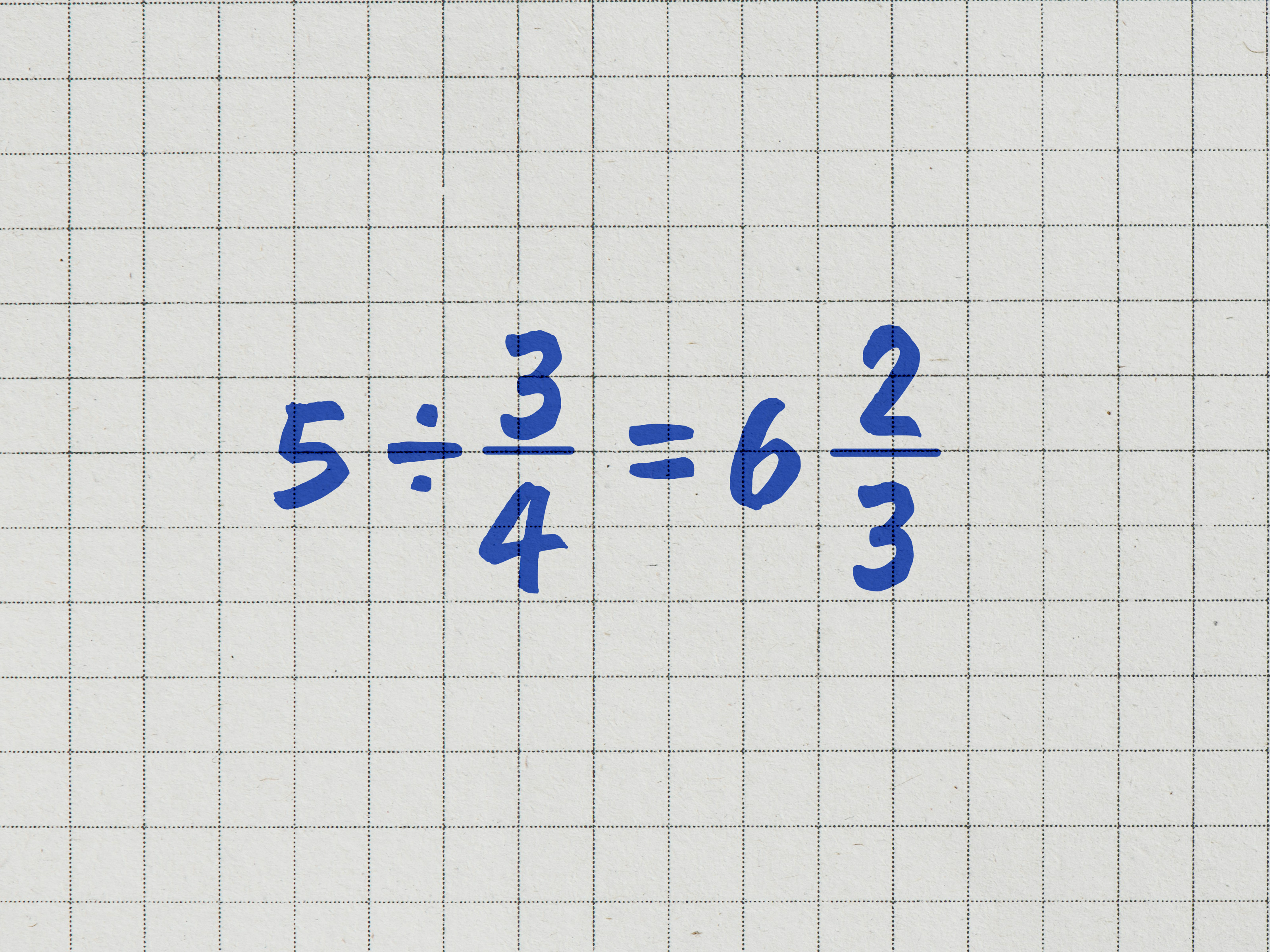
Example 3: 5 ÷ 3/4
Write 5 as a fraction:
5/1
Flip 3/4 to get 4/3:
5/1 × 4/3 = 20/3
Convert to a mixed number:
20/3 = 6 2/3
Answer: 6 2/3
So, 5 contains six full groups of 3/4, with enough left over for another 2/3 of a group.
Example 4: 9 ÷ 5/6
Write 9 as a fraction:
9/1
Flip 5/6 to get 6/5:
9/1 × 6/5 = 54/5 = 10 4/5
Answer: 10 4/5
This is a great reminder that dividing by a fraction can produce a larger number than the original whole number.
Why Does This Work?
Here is the short version: dividing by a fraction is the same as multiplying by its reciprocal.
Think about 8 ÷ 1/2. The question is really asking, “How many one-halves are in 8?” Since each whole contains 2 halves, 8 contains 16 halves. That is why 8 ÷ 1/2 = 16.
Now try 8 ÷ 2/3. If one whole contains 3/2 groups of 2/3, then 8 wholes contain 8 × 3/2, which equals 12. So the reciprocal is not some random math prank. It comes from the actual meaning of division.
Visual Thinking Helps
If the reciprocal rule feels too mechanical, use visual reasoning. Ask yourself:
How many of these fractional pieces fit into the whole number?
For unit fractions like 1/2, 1/3, or 1/4, this is especially easy:
- 3 ÷ 1/2 = 6 because there are 6 halves in 3
- 2 ÷ 1/4 = 8 because there are 8 fourths in 2
- 5 ÷ 1/5 = 25 because there are 25 fifths in 5
For non-unit fractions, you can still think in pieces. It just takes one more step. For example, 4 ÷ 2/3 asks how many groups of 2/3 fit into 4. Since each whole contains 3/2 groups of 2/3, four wholes contain 4 × 3/2 = 6 groups.
Common Mistakes to Avoid
1. Flipping the Wrong Number
Only flip the fraction you are dividing by, not the whole number.
In 7 ÷ 3/5, flip 3/5 to 5/3. Do not flip 7.
2. Forgetting to Change the Whole Number to a Fraction
It helps to write the whole number over 1. Yes, you may know it mentally, but writing it keeps mistakes from sneaking into your work like tiny math goblins.
3. Not Simplifying
If your answer is 18/6, do not stop there. Simplify it to 3.
4. Thinking Division Always Makes Numbers Smaller
That is true when you divide by numbers greater than 1. But dividing by fractions less than 1 often makes the answer larger.
Word Problems with Whole Numbers and Fractions
Problem 1: Ribbon Pieces
You have 3 yards of ribbon. Each piece needs to be 1/3 yard long. How many pieces can you make?
3 ÷ 1/3 = 3/1 × 3/1 = 9
Answer: 9 pieces
Problem 2: Cups of Juice
You have 5 cups of juice. Each serving is 2/5 cup. How many servings can you pour?
5 ÷ 2/5 = 5/1 × 5/2 = 25/2 = 12 1/2
Answer: 12 1/2 servings
That means 12 full servings and half of another one.
Problem 3: Wood Cuts
A board is 8 feet long. You cut it into pieces that are 3/4 foot long. How many pieces can you cut?
8 ÷ 3/4 = 8/1 × 4/3 = 32/3 = 10 2/3
Answer: 10 2/3
In real life, that usually means you can cut 10 full pieces with some board left over, unless partial pieces are allowed.
Practice Problems
Try these on your own before checking the answers:
- 2 ÷ 1/2
- 7 ÷ 1/4
- 3 ÷ 2/5
- 10 ÷ 3/8
- 12 ÷ 4/3
Answers
- 2 ÷ 1/2 = 4
- 7 ÷ 1/4 = 28
- 3 ÷ 2/5 = 15/2 = 7 1/2
- 10 ÷ 3/8 = 80/3 = 26 2/3
- 12 ÷ 4/3 = 12 × 3/4 = 9
Tips for Getting Better at This Skill
- Always rewrite the whole number as a fraction over 1.
- Say the steps out loud: keep, flip, multiply.
- Check whether your answer makes sense. Dividing by a small fraction should usually give you a larger answer.
- Practice with both straightforward equations and word problems.
- Use visual models when the rule feels too abstract.
Conclusion
Learning how to divide whole numbers by fractions is less about memorizing a weird trick and more about understanding what the division is really asking. Once you see that the problem means “how many fractional groups fit into this whole number,” the reciprocal method starts to feel perfectly reasonable.
The basic routine is dependable: write the whole number over 1, flip the fraction, multiply, and simplify. From there, sample problems become much easier, and word problems stop looking like they were written by someone who enjoys confusing students for sport.
With a little practice, this skill becomes one of the easier parts of fraction math. And that is always a nice plot twist.
Experiences Related to “How to Divide Whole Numbers By Fractions: Sample Problems”
One of the most common experiences students have with this topic is that the first example feels completely backward. Many learners grow up with the idea that division always makes a number smaller. Then they see 4 ÷ 1/2 = 8 and immediately suspect foul play. That reaction is normal. It is also a sign that the lesson has reached the exact point where understanding starts to matter more than memorization.
In tutoring sessions and classrooms, the breakthrough often happens when someone asks a practical question like, “How many half-pizzas are in 4 pizzas?” Suddenly the answer 8 does not look strange at all. In fact, it looks obvious. That moment matters because it turns a rule into a reason. Students stop seeing reciprocal multiplication as a random procedure and start seeing it as a shortcut built on logic.
Another common experience is that students can solve the numerical problems but freeze during word problems. Give them 6 ÷ 2/3, and they are fine. Wrap it in a story about cups of flour or pieces of ribbon, and they stare at the page like it personally offended them. Usually, the issue is not the arithmetic. It is translating the situation into the correct operation. Once students practice spotting phrases like “how many groups of” or “how many servings of,” the word problems become much less dramatic.
Teachers also notice that visual models help tremendously, especially for students who dislike abstract rules. Drawing bars, fraction strips, or simple partitioned rectangles gives the math a physical feeling. Instead of hearing “flip the divisor,” students can actually see how many pieces fit into the whole number. For learners who are more visual than symbolic, this can be the difference between confusion and confidence.
There is also a funny pattern with adult learners and parents helping with homework. Many remember being taught the phrase “invert and multiply,” but not why it works. So they can perform the steps, yet feel uneasy explaining them. Revisiting the concept through examples like “How many one-fourths are in 3?” rebuilds that missing foundation. It is proof that math skills are often still there, just hiding under a layer of old school memories and mild panic.
Perhaps the most encouraging experience related to this topic is how quickly confidence can grow. Students who begin by saying, “I’m terrible at fractions,” often improve after just a handful of examples. The process is consistent, the answers are easy to check, and the visual meaning is strong. That combination makes this topic a surprising confidence booster. Once learners realize they can handle whole numbers divided by fractions, they are far less intimidated by fraction operations as a whole.
So yes, this topic may arrive wearing the costume of complicated math. But in real learning experiences, it often turns into a satisfying little win. And honestly, math could use more of those.