At first glance, Hormazd Narielwalla Modernist Love Affair looks like a joyful collision of geometry, fashion, memory, and modern art. Look a little closer, and it becomes something more intriguing: a love letter to the human body, written not with ink, but with color, tailoring lines, paper textures, and a very elegant sense of mischief.
Hormazd Narielwalla is a London-based artist best known for transforming antique, vintage, and bespoke tailoring patterns into intricate collages, prints, assemblages, and artist’s books. His work often begins with something practicala garment pattern once used to shape cloth around a bodyand turns it into something poetic. The result is not just “fashion meets art,” which sounds like a polite museum brochure trying not to spill its coffee. It is closer to fashion’s ghost becoming abstract modernism.
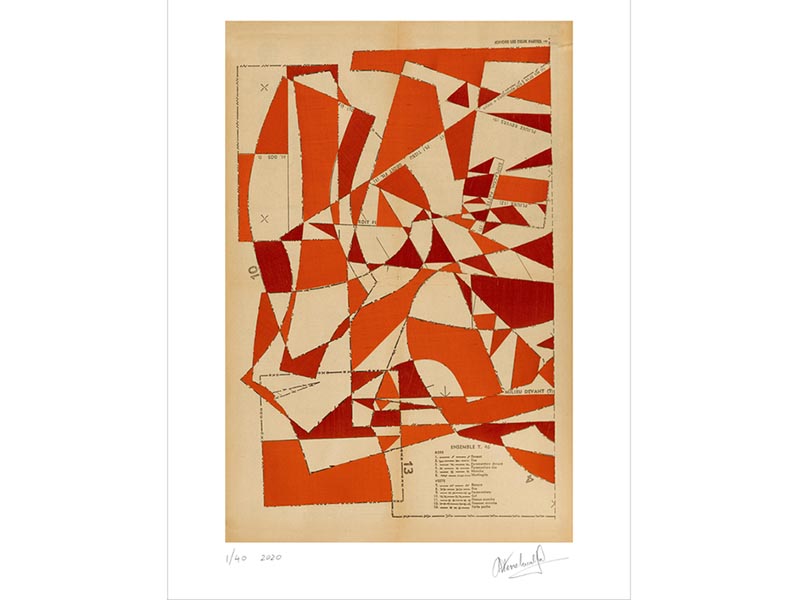
Modernist Love Affair, especially in its Cramer & Bell / C&B Curates print edition, captures many of Narielwalla’s strongest themes: the body as architecture, pattern as memory, collage as reinvention, and color as emotional punctuation. It is refined, playful, and surprisingly warm for a work rooted in grids, geometry, and modernist discipline.
Who Is Hormazd Narielwalla?
Hormazd Narielwalla was born in India and later moved to the United Kingdom, where his background in fashion design helped shape his artistic language. Before becoming widely recognized for collage and printmaking, he studied fashion and became fascinated by the strange beauty of tailoring patterns. These patterns were never intended to be displayed as art. They were working tools, practical diagrams used by cutters and tailors to make garments fit real people.
That practical origin is exactly what makes Narielwalla’s art so compelling. A tailoring pattern contains curves, notches, dotted guides, measurements, and lines that quietly describe a person’s form. When removed from the tailor’s table and placed into an artwork, those lines begin to behave differently. They become abstract drawings. They suggest shoulders, waists, posture, absence, and identity. In Narielwalla’s hands, a pattern is not dead paper. It is a map of someone who once moved through the world.
The Story Behind Modernist Love Affair
Modernist Love Affair exists within Narielwalla’s broader exploration of pattern, abstraction, and the body. The C&B Curates version is an exclusive collaboration between Hormazd Narielwalla and Cramer & Bell. It is presented as a giclée print on 255gsm Somerset paper, hand-signed and numbered by the artist, in an edition of 40. The listed paper size is 55 x 40 cm, with an image size of 45 x 30 cm.
Those details matter because they position the work as both accessible and collectible. It is not a mass-produced poster pretending to be fancy because it once shook hands with a gold frame. It is a limited-edition print connected to a serious contemporary art practice, yet approachable enough to live in a home, studio, reading corner, or design-forward interior.
The title itself does a lot of work. Modernist Love Affair suggests romance, but not the candlelit, violin-heavy kind. This is romance in the language of shape, balance, surface, and structure. It hints at an emotional relationship with modernismits geometry, its confidence, its clean linesbut softens that history with color, texture, and the human traces embedded in tailoring patterns.
Why Tailoring Patterns Are More Than Backgrounds
To understand Narielwalla’s art, it helps to stop thinking of tailoring patterns as background material. In many artworks, the surface is passive. A canvas waits to be painted. A sheet of paper waits to be drawn on. Narielwalla’s surfaces arrive with their own history already stitched into them, metaphorically if not literally.
Tailoring patterns are intimate documents. They record proportions, adjustments, and bodily information. In traditional tailoring, especially in places like Savile Row, a bespoke pattern can represent a unique individual. When that person is gone or the garment is no longer needed, the pattern may be stored, discarded, or destroyed. Narielwalla’s practice grew from recognizing the beauty and emotional weight in these overlooked objects.
In Modernist Love Affair, the pattern is not merely a vintage flourish. It is the skeleton of the composition. The artwork builds on the tension between the measured and the expressive. Crisp geometry meets decorative paper. Modernist restraint meets joyful color. The body is present, but indirectly. You do not see a portrait, yet you feel the human outline behind the arrangement.
A Modernist Work With a Human Pulse
Modernism is often associated with clarity, reduction, abstraction, and a belief that form can carry meaning without unnecessary decoration. That sounds wonderfully noble, though it can also sound like a chair lecturing you about discipline. Narielwalla avoids that coldness by introducing touch, history, and sensuality into his compositions.
His use of color is especially important. In related works from the Modernist Love Affair series, he has discussed using gold striped Japanese woodblock papers and hand-printed washi papers to evoke the changing colors of daylight in a geometric format. That idea is a perfect doorway into the work: modernist order, yes, but modernist order warmed by light.
The result is visual rhythm. Blocks of color feel placed with care, but not overcontrolled. Lines from the tailoring pattern guide the eye. Shapes overlap like fragments of memory. The viewer senses both calculation and improvisation. It is almost musical: a measured beat underneath, a bright melody above, and somewhere in the middle a tailor muttering, “Please do not cut that seam allowance wrong.”
The Role of Collage in Narielwalla’s Art
Collage is not just a technique in Narielwalla’s work; it is a philosophy. Collage allows him to take fragments from different histories and bring them into conversation. Fashion, migration, identity, modernism, memory, craft, and print culture all meet on the same surface.
This is why Modernist Love Affair feels richer than a simple decorative print. It has layers of meaning. The tailoring pattern points to the body. The modernist geometry points to art history. The handmade and printed papers point to craft traditions. The limited-edition format points to collecting and design culture. Together, they create an artwork that can be enjoyed immediately for its beauty and studied slowly for its ideas.
Pattern as Memory
One of Narielwalla’s most powerful ideas is that a pattern can carry memory. A garment pattern does not show a person’s face, but it can suggest their body, their habits, and even their place in a social world. In bespoke tailoring, pattern pieces are made for individual clients. They are technical, but also personal.
Pattern as Abstraction
Once removed from the cutting room, these lines become abstract drawings. Curves that once helped shape a sleeve can become part of a visual rhythm. Darts, seams, and measurement marks become graphic elements. The artwork asks us to see utility as beauty.
Pattern as Transformation
Narielwalla’s art often turns discarded or forgotten materials into something renewed. That transformation is central to Modernist Love Affair. The work does not erase the pattern’s original purpose; it lets that purpose glow through a new visual language.
How Modernist Love Affair Fits Into Contemporary Interiors
Although Modernist Love Affair belongs to the world of contemporary art, it also works beautifully as an interior design piece. Its scale makes it flexible, while its color and geometry give a room energy without shouting across the sofa like an overexcited dinner guest.
In a minimalist room, the print can add warmth and pattern. In a maximalist room, it can hold its own among textiles, books, ceramics, and layered color. In a bedroom or study, it offers visual interest without becoming visually exhausting. This balance is part of its charm: it is sophisticated but not severe, decorative but not shallow, collectible but not intimidating.
The work is especially appealing for people who love fashion history, modernist design, textile art, or abstract collage. It can also attract viewers who simply enjoy art that looks good from across the room and gets better when you walk closer. That is not a small achievement. Many artworks can do one or the other. The best ones manage both.
Specific Examples From Narielwalla’s Wider Practice
To appreciate Modernist Love Affair, it helps to look at Narielwalla’s wider body of work. His early artist’s book Dead Man’s Patterns grew from his engagement with Savile Row tailoring patterns associated with deceased customers. That project established a central concern in his practice: how abandoned garment patterns can become abstract records of bodies and lives.
Other works, such as God Save The Queen, use tailoring patterns and print processes to explore British identity, heritage, and symbolism. His projects have also extended into commissions, artist’s books, and works inspired by figures such as David Bowie and textile designer Althea McNish. Across these projects, Narielwalla repeatedly returns to adornment, transformation, and the performance of identity.
This context makes Modernist Love Affair feel less like a standalone print and more like a chapter in an ongoing artistic investigation. It carries the elegance of fashion, the rigor of abstraction, and the intimacy of personal measurement.
Why the Artwork Feels Romantic
The word “love” in the title is not accidental. There is romance in the way Narielwalla treats material. He does not use old patterns cynically or nostalgically. He treats them as living visual structures. He sees what others might miss: the grace of a curve, the drama of a diagonal, the quiet dignity of paper that once had a job to do.
There is also romance in the artwork’s relationship to modernism. Modernist art and design often seek clarity, but Narielwalla adds tenderness. His compositions suggest that precision and emotion do not have to be enemies. A straight line can still have a heartbeat. A geometric shape can still flirt. A piece of paper can still remember.
Collecting Hormazd Narielwalla Prints
For collectors, Modernist Love Affair offers several attractive qualities. It is connected to a known contemporary artist with a distinctive practice. It is limited, signed, and numbered. It is visually strong enough for display and conceptually rich enough for long-term interest.
When considering a print like this, collectors should pay attention to edition size, paper quality, signature, numbering, condition, framing, and provenance. A limited edition of 40 creates scarcity, while Somerset paper and giclée printing suggest attention to material quality. Proper framing is also important. Works on paper deserve protection from direct sunlight, moisture, and bargain-bin frames that look like they were emotionally assembled in a parking lot.
SEO-Friendly Analysis: Main Themes and Search Intent
Readers searching for Hormazd Narielwalla Modernist Love Affair may have several intentions. Some want product information. Others want to understand the artist. Some are researching contemporary collage art, modernist prints, or fashion-inspired artwork. A strong article should answer all of these needs without turning into a dry catalog entry.
The key themes include Hormazd Narielwalla art, Modernist Love Affair print, tailoring pattern collage, contemporary paper collage, modernist wall art, and fashion-inspired abstract art. These phrases fit naturally because they describe what the work actually is. Good SEO should feel like helpful labeling, not like someone glued keywords to the page with a panic stick.
How to Experience Modernist Love Affair in Person
If you ever encounter Modernist Love Affair in person, give it time. Do not just glance at it and decide whether it matches the cushions. Start from a distance. Notice the overall balance, the color fields, and the modernist structure. Then move closer. Look for the pattern lines underneath. Notice how the artwork uses the old diagram without being trapped by it.
Pay attention to the relationship between surface and depth. Even though the work is flat, it suggests layers of bodily and material history. The original pattern implies a three-dimensional form. The collage or print composition reorganizes that form into abstraction. Your eye moves between function and fantasy, which is exactly where the artwork becomes interesting.
Additional Experience: Living With the Idea of Modernist Love Affair
Spending time with a work like Hormazd Narielwalla Modernist Love Affair can change the way you look at ordinary paper. After learning about Narielwalla’s practice, even a dressmaking pattern, a folded instruction sheet, or a tailor’s chalk line begins to seem less ordinary. You start noticing that practical objects often carry hidden elegance. A sewing pattern is not just a tool; it is a quiet drawing of potential movement.
Imagine placing Modernist Love Affair in a room where you begin your day. At breakfast, the geometry might feel bright and organized, like a visual espresso shot. In the afternoon, the colors may seem warmer, especially if natural light crosses the paper. At night, the pattern lines may become more mysterious, almost architectural. The same artwork can shift mood without changing a single inch, which is one of the secret pleasures of good wall art.
The experience is also intellectual. Narielwalla’s work encourages viewers to think about how identity is constructed. Clothing is one of the first ways people announce themselves to the world. A suit, dress, coat, or costume can express status, taste, gender, profession, rebellion, or belonging. By working with the patterns behind clothing, Narielwalla goes beneath the visible garment and studies the hidden system that makes appearance possible.
There is something deeply human about that. We often think of identity as surface: what we wear, how we look, what colors we choose. Narielwalla reminds us that identity also has structure. It has seams, measurements, adjustments, and histories. Some parts are visible; others are tucked inside. His artwork brings those hidden structures into view with grace and wit.
For artists and designers, Modernist Love Affair can be a lesson in creative reuse. It shows that inspiration does not always require a blank page. Sometimes the most exciting beginning is an old page with marks already on it. The challenge is to listen to what the material wants to become. Narielwalla has said in interviews that he often lets the pattern guide him. That approach feels generous. Instead of forcing an image onto the surface, he collaborates with what is already there.
For collectors, the experience is more tactile and emotional. A limited-edition print can become part of daily life. It can mark a first apartment, a redesigned room, a creative milestone, or a long-standing love of fashion and art. Unlike a purely decorative object, this work has a story you can return to. It invites conversation without needing to shout, “Ask me about my sophisticated taste,” from the wall.
Ultimately, the best way to experience Modernist Love Affair is to let it operate on several levels at once. Enjoy the color. Appreciate the composition. Think about the body behind the pattern. Consider the cultural journey from tailoring table to contemporary print. Smile at the title. It is, after all, a love affairnot a tax audit. The work gives permission to love modernism not as a cold theory, but as a living, breathing relationship between line, memory, and imagination.
Conclusion
Hormazd Narielwalla Modernist Love Affair is a refined and fascinating artwork because it turns technical pattern into emotional abstraction. It speaks to fashion lovers, art collectors, interior design enthusiasts, and anyone drawn to the strange beauty of objects with a past. Through tailoring lines, geometric color, and modernist energy, Narielwalla creates a work that feels both disciplined and romantic.
The piece is not just attractive wall art. It is a meditation on the body, memory, identity, and transformation. It proves that a discarded pattern can become a visual poem, that modernism can have warmth, and that paperhumble, folded, and often overlookedcan still know how to make an entrance.