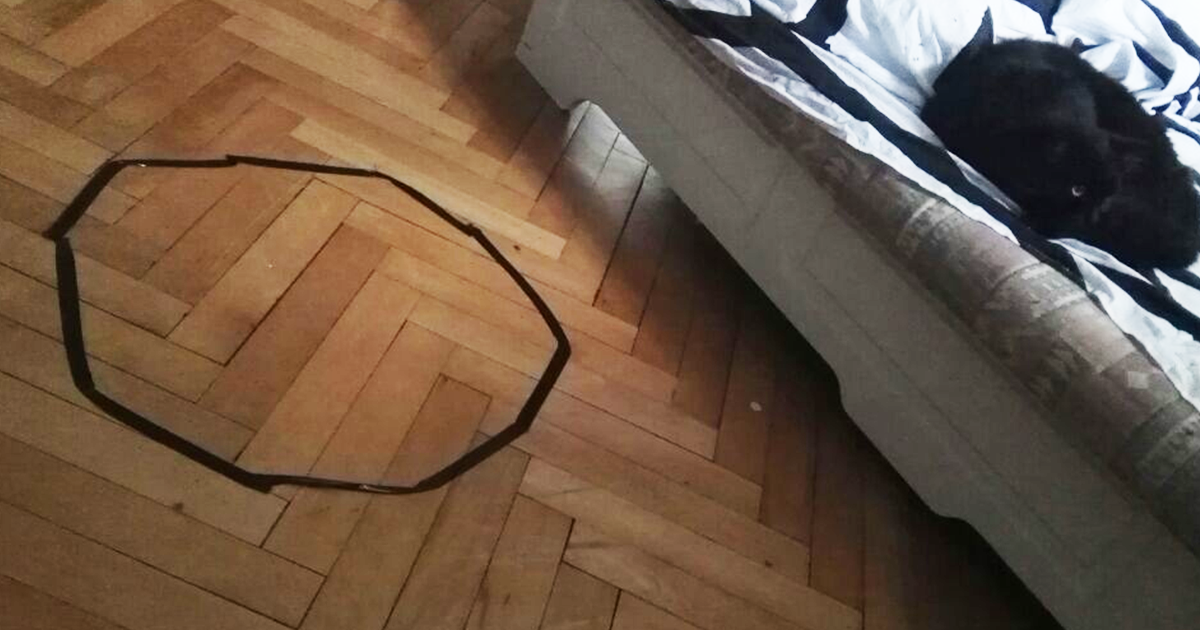
Every so often, the internet gifts us a cat story that feels like it was written by a sleep-deprived wizard with excellent Wi-Fi. This is one of those stories. A guy tries the famous cat-circle trick, expecting his cat to plop obediently into a neat little shape on the floor. Instead, the cat ignores the circle, chooses a shape that looks suspiciously like a pentagram, and suddenly the household vibe shifts from “fun pet experiment” to “do we need holy water or just more treats?”
It is a hilarious setup, and it works because cat owners know one universal truth: cats are tiny chaos consultants wrapped in fur. But beneath the joke is something genuinely fascinating. Why do cats sit in circles, squares, boxes, laundry baskets, laptop sleeves, pizza boxes, and anything else that vaguely suggests a boundary? And why would one cat reject a normal shape only to settle in something that looks like it belongs in a low-budget supernatural thriller?
The short answer is not that your cat is summoning darkness before dinner. The real answer is much more interesting. Cats are highly tuned to contours, enclosed spaces, novelty, comfort, and safety. Their behavior often looks spooky only because humans are experts at turning ordinary feline weirdness into dramatic storytelling. In other words, the “frightening” discovery in this story is not that the cat is evil. It is that cats are far more perceptive, quirky, and stubborn than most people realize.
The Viral Joke Behind the Cat-in-the-Circle Obsession
The joke works because the cat-circle phenomenon has been around for years. Cat owners began noticing that if they placed tape on the floor in the shape of a square or circle, many cats would wander over and sit inside it as if they had been invited to a formal event for geometry enthusiasts. The internet, naturally, did what it always does: it made it bigger, funnier, and much stranger.
That is how you end up with a story like this one. A man tries to get his cat into a simple circle, but the cat bypasses the obvious choice and settles into a pentagram-like pattern instead. Cue the dramatic music. Cue the “I always knew that black cat was up to something” jokes. Cue at least one person in the comments insisting the cat pays rent in curses.
Still, the humor lands because it taps into centuries-old folklore about cats being mysterious, unreadable, and just slightly supernatural. Cats do not help their public image. They stare at walls, sprint through hallways at 3 a.m., and appear from dark corners like furry jump scares. Give a cat one suspicious shape on the floor, and it will turn your living room into a folk tale.
Why Cats Love Circles, Squares, and Other Floor Shapes
Boundaries Feel Safe
One of the most practical explanations is that cats are drawn to spaces that feel defined. A circle, square, or box outline may create the sense of a protected zone. Even if the border is only tape, paper corners, or a loosely arranged cord, a cat may interpret it as a contained area worth investigating. Cats like places that feel sheltered, predictable, and separate from the rest of the room. To a human, it is tape. To a cat, it may read as “small personal kingdom.”
This makes perfect sense when you remember that cats are both predators and prey. They like to stalk, but they also like to feel hidden and secure. A simple shape on the floor can act like a low-budget version of a box: no roof, no walls, but just enough of a boundary to suggest comfort.
Boxes Trained Them to Love Box-Like Things
Cats have a well-documented affection for boxes, and not just because they enjoy making online shoppers feel bad about the money spent on the thing that was inside the box. Boxes provide warmth, shelter, pressure around the body, and a strategic hiding place. They are cozy, enclosed, and excellent for ambushes. Basically, they are the studio apartments of the feline world: compact, practical, and somehow still luxurious.
Once you understand that cats already associate box-like spaces with comfort and safety, the floor-shape phenomenon stops being so mysterious. Many cats do not need a fully built container. A simple outline can be enough to trigger the same interest. If a cat has learned over time that defined spaces equal good naps, better observation points, and fewer unexpected disturbances, it may investigate any shape that gives off those same vibes.
Yes, Optical Illusions Can Fool Cats Too
Here is where the story gets even more delightful. Researchers have found that some cats will sit not only in actual outlined shapes, but also in illusions that merely suggest a square. That means cats may respond to contour cues in ways that are surprisingly similar to humans. If a pattern looks structured enough, a cat may treat it as a real enclosure, even when the “edges” are mostly implied.
So when a cat chooses a pentagram-like arrangement over a plain circle, the answer may be far less paranormal than the headline suggests. The cat may simply be responding to the shape’s visual cues, corners, or contrast. It may also be reacting to novelty. Or it may just be a cat and therefore committed to making every human experiment slightly more ridiculous than intended.
Novelty Matters More Than Owners Want to Admit
Cats are famously observant. Put something new on the floor and many cats will inspect it. A fresh object, unfamiliar texture, or altered layout can be enough to trigger curiosity. This is one reason so many “cat hacks” seem magical: the cat is not necessarily enchanted by the item itself. The cat is often responding to the fact that something in its environment changed.
That is also why the circle trick is not guaranteed to work every single time. Some cats will leap right into the shape. Others will sniff it, judge you, and walk away like the idea insulted their ancestors. Confidence level, personality, prior experience, and stress all matter. The cat is not failing the game. The cat is revising the rules.
So What Was the “Frightening” Discovery, Really?
The frightening discovery was not that the cat had occult hobbies. It was that the cat seemed more interested in a pentagram-looking shape than a normal circle. On the internet, that is enough to build a whole mythology by lunchtime. But in real life, the cat’s choice likely reflects ordinary feline behavior: attraction to boundaries, visual interest in corners and patterns, and the general cat philosophy that if humans expect one thing, the correct response is something else entirely.
There is another layer to the joke, too. If the cat in question is black, the image immediately picks up extra dramatic baggage. Black cats have been saddled with unfair superstitions for centuries. They are still treated as symbols of bad luck in some places, even though shelters and animal welfare groups repeatedly point out that black cats are just as affectionate, playful, and adoptable as any other cat.
So the story is really funny because it plays with an old stereotype while accidentally proving how silly that stereotype is. The cat is not frightening. The human imagination is doing cartwheels again.
What Your Cat’s Body Language Might Reveal in a Moment Like This
If you ever try the circle experiment at home, the most important thing to watch is not whether your cat chooses a circle, square, or suspicious rune. Watch your cat’s body language. That tells the real story.
Signs Your Cat Is Curious and Comfortable
A relaxed cat may approach with ears forward, tail upright, and an easy gait. It might sniff the outline, step into it, circle once, and sit down like it just discovered the best tiny apartment in America. Some cats will loaf. Some will crouch softly. Some will act as though they invented geometry.
Signs Your Cat Is Stressed or Overwhelmed
If your cat’s ears flatten, pupils go wide, tail thrashes, body crouches low, or it darts away and hides, the experiment is no longer fun. Those are signs the cat is uncomfortable, anxious, or overstimulated. A stressed cat may also become more irritable, more withdrawn, or more likely to swat first and explain never.
That matters because unusual behavior is not always a joke. If a cat suddenly begins hiding more, avoiding interaction, showing aggression, urinating outside the litter box, or reacting oddly to familiar surroundings, it can point to stress or a medical issue rather than simple cat weirdness.
When “Weird Cat Behavior” Deserves a Closer Look
Most of the time, sitting in a strange shape is harmless fun. But if a cat consistently seems confused, hesitant, or unusually reactive, it is worth paying attention. Vision problems, pain, neurological issues, chronic stress, and changes in the home can all affect behavior. Cats are masters of subtlety. They often whisper their distress instead of shouting it.
For example, a cat that misjudges distances, startles more easily, bumps into things, or shows changes in pupil appearance may need a veterinary check. A cat that begins hiding constantly or lashing out may also be dealing with something more serious than moodiness. Cat owners often joke that felines are dramatic, but sometimes the “drama” is really communication in disguise.
In other words, the circle test is a fun game, but it should never become a personality quiz with zero context. If your cat refuses every shape, that does not mean your pet lacks magic. It may just mean your cat is uninterested, tired, distracted, or wisely opposed to performing on command.
How to Try the Cat Circle Challenge Without Stressing Your Cat
1. Keep it simple
Use painter’s tape or paper shapes on the floor. Do not use anything sticky, loud, or unstable. This is a curiosity test, not a home renovation project.
2. Let the cat choose
Do not place your cat in the shape. Do not coax excessively. Do not become the overexcited theater director of a one-cat production. The whole point is voluntary behavior.
3. Watch for stress signals
If your cat looks tense, leaves the room, hides, or becomes agitated, stop the activity. Your cat has officially vetoed the geometry.
4. Reward calm curiosity
If your cat explores the shape, offer praise, gentle interaction, or a treat. Positive associations matter. Cats are much more likely to repeat behavior that feels safe and rewarding.
5. Treat the result as entertainment, not diagnosis
If your cat chooses the circle, great. If your cat chooses the pentagram, congratulations: you now own premium internet material. Either way, one quirky choice does not define your cat’s entire personality.
The Bigger Truth About the “Frightening” Cat
The real lesson in this story is that cats are experts at turning ordinary behavior into myth. They are sensitive to patterns, boundaries, textures, and changes in their environment. They seek comfort, safety, warmth, and strategic little hideouts. They communicate constantly through posture, eyes, tail position, and movement. And they remain wildly committed to doing exactly what they want, exactly when it amuses them most.
That is why a cat bypassing a circle for a pentagram-shaped pattern feels so funny. It takes a normal feline preference for defined spaces and collides it with centuries of spooky symbolism. The result is comedy gold. But the cat itself is not scary. It is just being a cat: observant, independent, slightly theatrical, and better at visual mystery than most of us will ever be.
So no, the guy in the headline probably did not discover something demonic about his cat. He discovered something far more believable and, frankly, far more impressive: his cat understands how to steal a scene without saying a word.
Experiences Related to the Topic: When Cats Turn Simple Shapes Into Full-Blown Drama
One of the funniest things about the cat-circle phenomenon is how often owners report the same general pattern. They start with confidence. They lay down a tape circle or square on the floor and wait for the magic. Then the cat strolls in like a tiny building inspector. Sometimes it works immediately. The cat steps in, sits down, and looks so pleased with itself that the owner starts wondering whether the experiment was really the cat’s idea all along.
Other times, the cat turns the challenge into a psychological thriller. It sniffs the shape, walks around it three times, sits exactly next to it, and stares at the human with the kind of expression that says, “You made this? On purpose?” That experience is common, and it perfectly captures why cats are such entertaining companions. They are not just participating in your games. They are grading them.
Many owners also notice that the shape is only half the story. Put a circle on the floor and the cat may ignore it. Put the same circle near a sunny patch, beside a couch, or in a quiet room where the cat already likes to rest, and suddenly the shape becomes irresistible. That suggests environment matters. Cats often respond not just to the boundary itself, but to the location, scent, surrounding noise, and whether the area already feels safe.
Then there are the cats who seem to prefer the weirdest option available. Give them a nice clean circle and they choose the crooked hexagon made from a phone charger. Offer a tidy square and they sit in the one shape that looks like it belongs on the cover of a fantasy novel. Owners describe laughing, taking photos, and immediately texting friends as if they have uncovered evidence of supernatural house leadership. In reality, these moments usually reflect curiosity, visual interest, and that classic feline instinct to choose the unexpected.
Another common experience is that the challenge works better with confident, playful cats than with shy ones. Bold cats are more likely to investigate new objects on the floor. Timid cats may watch from a distance or avoid the setup completely, especially if the household is noisy or the owner is hovering too closely with a camera. That difference matters because it reminds us that personality shapes behavior just as much as the shape on the floor does.
Some owners also say the challenge becomes more successful when they stop trying so hard. The moment the tape goes down and the human backs off, the cat wanders over as if it has a private appointment with the square. That may be the most believable cat behavior of all. Nothing ruins a cat’s interest faster than obvious human enthusiasm.
In the end, these shared experiences all point to the same conclusion. Cats are drawn to spaces that feel defined, safe, interesting, or simply new. But they are also masters of comic timing. They can turn a basic floor experiment into a story, a meme, or a miniature household legend. Which is why the man in the headline did not really discover something frightening about his cat. He discovered what millions of cat owners already know: every cat has the soul of a prankster and the stage presence of a star.
Conclusion
The story of the guy who could not get his cat to sit in the circle is funny because it sounds spooky, but it resonates because it feels true to life. Cats are irresistibly odd. They love boundaries, boxes, visual puzzles, and doing the exact opposite of what you expect. A pentagram-like shape may make for a better punchline than a plain circle, but the real explanation is rooted in normal feline behavior, not dark magic. Your cat is not haunted. Your cat is just extremely committed to the bit.