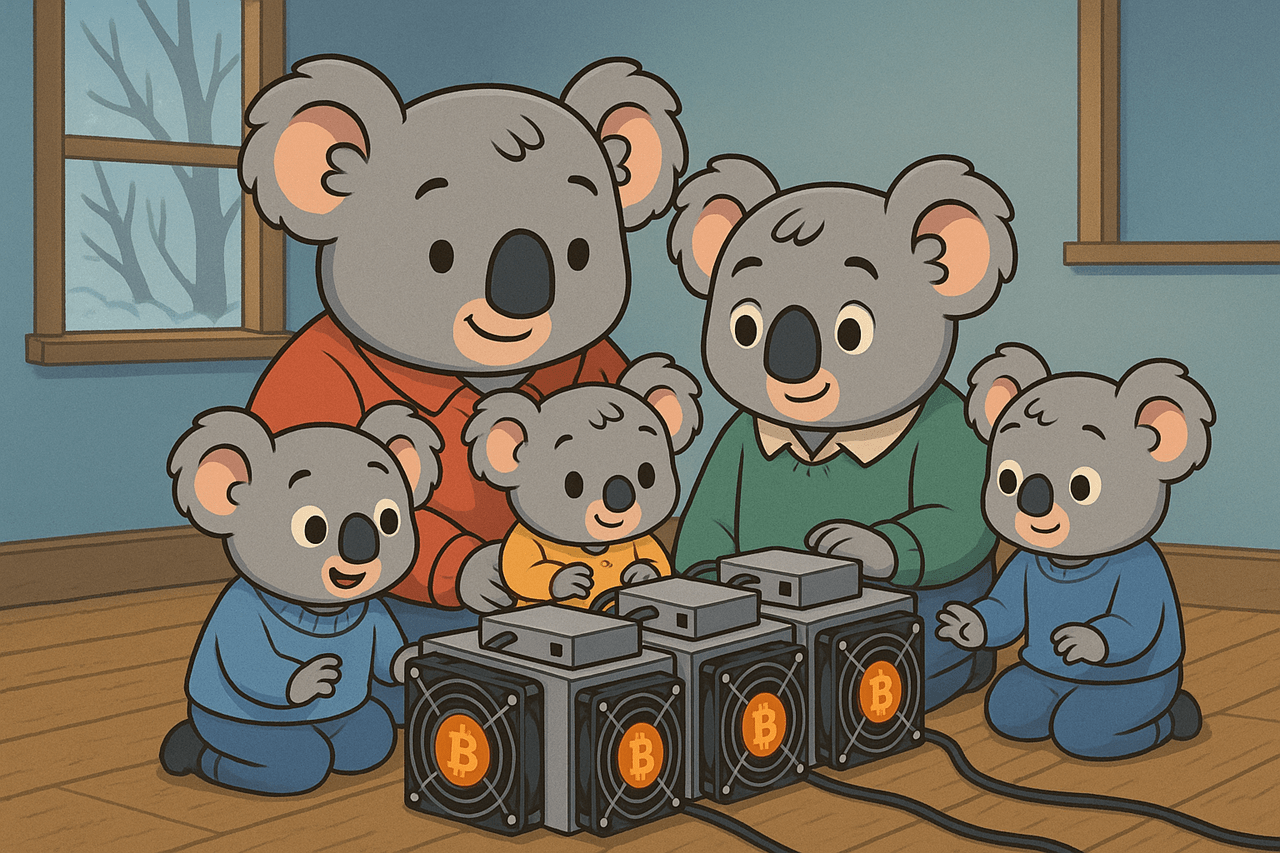
Yes, you can use a Bitcoin miner to heat your home. In fact, a Bitcoin miner is basically a noisy electric heater that occasionally spits out tiny amounts of digital gold. Every watt of electricity that goes into an ASIC miner becomes heat inside your house, just like a space heater. The difference is that a miner also performs calculations for the Bitcoin network, which may earn mining rewards while your living room slowly turns into a miniature data center.
That sounds clever, right? Why pay for heat when your heater can also earn Bitcoin? Unfortunately, the real answer is less “free money furnace” and more “interesting engineering project with spreadsheets, fans, wires, and one very patient spouse.” A Bitcoin miner can absolutely provide supplemental home heating, but whether it makes financial, practical, or domestic sense depends on your electricity rate, climate, hardware, noise tolerance, ventilation, and how much you enjoy explaining to guests why your basement sounds like an airport runway.
This guide breaks down how Bitcoin miner home heating works, what it costs, how much heat it produces, when it makes sense, when it does not, and what homeowners should consider before replacing a cozy fireplace with a screaming metal box named Antminer.
How a Bitcoin Miner Becomes a Heater
A Bitcoin miner uses specialized hardware called an ASIC, short for application-specific integrated circuit. Unlike a regular computer, an ASIC miner is built for one job: solving SHA-256 calculations as fast as possible to participate in Bitcoin mining. The miner consumes electricity, runs chips at high speed, and produces two outputs: hash power and heat.
From a physics perspective, the heating part is beautifully simple. Almost all the electricity consumed by a miner becomes heat. If a miner draws 1,500 watts, it produces about the same room heat as a 1,500-watt electric space heater. If it draws 3,000 watts, it produces about twice as much heat. The standard conversion is 1 watt equals about 3.412 BTU per hour.
That means a 1,500-watt miner produces roughly 5,118 BTU per hour. A 3,010-watt Antminer S19 XP produces about 10,270 BTU per hour. A 3,500-watt machine can approach 11,900 BTU per hour. That is enough to warm a large room, garage, workshop, basement, greenhouse, or part of a small home, depending on insulation and outdoor temperature.
The Big Catch: A Bitcoin Miner Is Not More Efficient Than an Electric Heater
A common myth is that a Bitcoin miner is somehow a magical heater that makes heat “better” than a normal heater. It does not. A miner and an electric resistance heater both convert electricity into heat at nearly 100% efficiency inside the home. If both consume 1,500 watts, both produce about the same heat.
The advantage of a Bitcoin miner is not better thermal efficiency. The advantage is that it may earn Bitcoin while producing heat you already wanted. In winter, that mining revenue can offset part of your electricity bill. In summer, the same heat becomes a problem unless you can exhaust it outside, heat water, warm a pool, or send it somewhere useful.
Compared with a heat pump, a Bitcoin miner is usually much less efficient as a heating strategy. A heat pump moves heat instead of creating it directly, so it can deliver two, three, or even more units of heat for every unit of electricity. A Bitcoin miner behaves like resistance heat: one unit of electricity becomes roughly one unit of heat. The Bitcoin rewards are the wild card, not the heating efficiency.
How Much Heat Can a Bitcoin Miner Actually Provide?
Let’s use a practical example. Suppose you run an ASIC miner that draws 3,000 watts. Multiply 3,000 by 3.412, and you get about 10,236 BTU per hour. That is similar to a strong portable electric heater or a small permanent heating source.
If you run that miner 24 hours a day, it consumes 72 kilowatt-hours per day. At $0.10 per kWh, that costs $7.20 per day. At $0.18 per kWh, it costs $12.96 per day. At $0.30 per kWh, it costs $21.60 per day. Electricity price is the boss battle in Bitcoin heating. The miner may look cool, but your utility bill has the final vote.
In a cold climate with cheap electricity, that heat may replace heat you would have bought anyway. In a mild climate or an area with expensive power, the economics can fall apart quickly. Hawaii, California, New England, and other high-rate regions are very different from areas with low-cost hydro, wind, or off-peak power.
Can Mining Revenue Offset Heating Costs?
Possibly, but do not assume it will. Bitcoin mining profitability changes constantly. The factors include Bitcoin price, network difficulty, block reward, transaction fees, pool fees, hardware efficiency, uptime, and electricity cost. Modern Bitcoin mining is extremely competitive, and industrial miners usually have access to cheaper electricity and better cooling than homeowners.
A home miner might earn a few dollars per day before electricity costs, depending on the machine and market conditions. But if the miner costs $10 to $15 per day to run, the mining income may not cover the power bill. During winter, the calculation changes because the heat has value. If you would have spent $10 per day on electric heat anyway, mining rewards can act like a partial rebate.
Think of it this way: a Bitcoin miner should not be viewed as a guaranteed profit machine. It is better understood as an electric heater that might return some money while heating. That is a much healthier expectation and much less likely to end with you yelling at a profitability calculator at 1:00 a.m.
Best Places to Use a Bitcoin Miner for Heat
Basements
Basements are popular because they often need extra warmth, have more available space, and are somewhat separated from living areas. The downside is noise. If the basement ceiling is thin, your miner may still serenade the entire house with the gentle melody of “industrial fan in distress.”
Garages and Workshops
A garage or workshop can be a good match for Bitcoin miner heating. These spaces often need supplemental heat, and noise may be less annoying. However, dust, humidity, and poor insulation can reduce performance or shorten equipment life.
Greenhouses
Some hobbyists use miners to warm greenhouses in winter. This can work well because plants need heat, and the miner does not care whether the warm air is going to tomatoes or toes. The key is keeping moisture away from the electronics.
Water Heating and Hydronic Systems
More advanced setups use mining heat to warm water. This can involve immersion cooling, heat exchangers, or dedicated Bitcoin water-heater products. These systems are more complex than blowing hot air into a room, but they can use heat more efficiently and reduce noise. They also require more skill, planning, and respect for plumbing. Water and electronics are not natural best friends.
Noise: The First Thing New Home Miners Underestimate
Many ASIC miners are loud. Really loud. Industrial air-cooled units can operate around 75 decibels or more at close range, and some setups can be even louder. That is not “refrigerator hum” loud. That is “why is there a leaf blower in the laundry room?” loud.
Noise can be reduced with ducting, insulated boxes, fan swaps, underclocking, immersion cooling, or placing the miner in a detached area. But every noise solution has trade-offs. Restrict airflow too much and the miner overheats. Use poor materials and you create a fire hazard. Put it too far away and you need longer network and power runs. Silence is possible, but it is rarely free.
Electrical Safety Matters More Than the Bitcoin Part
A powerful ASIC miner can draw as much electricity as several household appliances. Many modern miners require 200–240 volts and dedicated circuits. Plugging one into a random extension cord is not a clever shortcut; it is a dramatic audition for an electrical fire.
Before installing a serious miner at home, check circuit capacity, breaker ratings, outlet type, wire gauge, and local electrical codes. For large miners, hiring a licensed electrician is the boring advice that prevents exciting disasters. Also consider smoke detectors, clear airflow, dust control, surge protection, and manufacturer operating-temperature limits.
Homeowners should also think about insurance. If you modify electrical systems, run high-power equipment continuously, or build custom enclosures, your insurer may care. “But it was mining Bitcoin” is not a universally comforting phrase in a claims department.
Ventilation and Airflow: Heat Is Useful Until It Is Trapped
Bitcoin miners need strong airflow to keep chips within safe operating temperatures. If you use miner heat indoors, you need to move hot air where it is useful and keep intake air clean and cool enough. A typical air-cooled setup pulls cool air in one side and blasts hot air out the other.
For home heating, people often attach ducting to the exhaust side and route the warm air into a room. Others place the miner in a basement and use inline fans to distribute heat. In warmer months, the exhaust may need to go outdoors. Otherwise, you are paying to mine Bitcoin and then paying again to air-condition the heat away. That is not energy strategy; that is financial slapstick.
When Bitcoin Miner Heating Makes Sense
Bitcoin miner heating can make sense when several conditions line up. You live in a cold climate. You already use electric resistance heat or need supplemental heat. Your electricity rate is low or you have off-peak pricing. You can handle noise and airflow. You understand mining profitability is volatile. You are comfortable maintaining hardware. You have a safe electrical setup. You are not expecting guaranteed profit.
It may also make sense for hobbyists who enjoy Bitcoin, home automation, electronics, or energy experiments. For these users, the miner is not just a heater. It is a project. It teaches thermodynamics, networking, power management, market risk, and humility. Lots of humility.
When It Does Not Make Sense
It probably does not make sense if your electricity is expensive, your home already has an efficient heat pump, you live in a warm climate, you cannot tolerate noise, or you need a simple plug-and-play heater. A Bitcoin miner is not a good replacement for a central heating system, especially if you need reliable whole-house comfort.
It also may not make sense if you are buying brand-new hardware only for heating. ASIC miners can cost hundreds or thousands of dollars. They depreciate quickly, become less competitive over time, and may need repairs. A normal heater is cheaper, quieter, safer, and easier. It just has the terrible weakness of not mining Bitcoin.
Simple Cost Example
Imagine a homeowner runs a 3,000-watt miner in winter for 10 hours per day. That uses 30 kWh daily. At $0.16 per kWh, the cost is $4.80 per day. If the miner earns $2.00 per day in Bitcoin, the net cost is $2.80 per day. If the homeowner would have used electric heat anyway, that may be a reasonable deal.
Now imagine the same miner runs 24 hours per day at $0.25 per kWh. That costs $18.00 per day. If it earns $2.00 to $5.00 per day, the net loss is still large unless all the heat is replacing necessary heating. In July, that heat is no longer a feature. It is an indoor weather event.
Practical Tips Before Trying It
Start Small
Do not begin by filling your basement with five industrial ASICs unless you enjoy learning expensive lessons in surround sound. Start with one unit or a purpose-built home mining heater.
Use a Mining Calculator
Estimate revenue with current difficulty, hash rate, pool fees, electricity rate, and hardware efficiency. Then rerun the numbers often. Bitcoin mining math does not sit still.
Measure Real Power Draw
Use proper monitoring equipment to track actual kWh usage. Nameplate ratings are helpful, but real-world consumption varies with settings and environment.
Plan for Summer
A miner that feels brilliant in January may become ridiculous in August. Decide whether you will shut it down, vent outside, heat water, or move it to another use.
Control Dust
Dust reduces cooling efficiency and can damage equipment. Use clean intake air and maintain filters if your setup includes them.
Environmental Considerations
Using miner heat is better than wasting miner heat, but it does not automatically make Bitcoin mining green. The environmental impact depends on the electricity source and whether the heat replaces another heating load. If a miner runs only because you want Bitcoin and the heat is dumped outside, the energy use is harder to justify. If it replaces electric resistance heat during cold months, the case is stronger.
The best environmental argument appears when mining uses low-carbon electricity, surplus power, or heat that would otherwise be wasted. Some larger operations reuse mining heat for greenhouses, pools, buildings, or industrial processes. Homeowners can copy that idea on a smaller scale, but the details matter.
Real-Life Experience: What It Feels Like to Heat With a Bitcoin Miner
The first experience most people have with a Bitcoin miner is surprise. The machine is smaller than expected, heavier than expected, and louder than expected by a margin that can only be described as “marriage-testing.” You plug it in, connect Ethernet, configure the pool, and suddenly the room fills with hot air and the unmistakable sound of tiny jet engines pursuing financial independence.
After the comedy wears off, the heat becomes noticeable. In a cool basement, one ASIC can make the space comfortable within an hour or two. In a garage, it can take the edge off winter cold. In a home office, it may be too much unless the miner is underclocked or ducted away. The warmth is dry, steady, and immediate. Unlike a furnace that cycles on and off, a miner prefers to run continuously.
The second experience is obsession with numbers. You start checking watts, hash rate, accepted shares, rejected shares, Bitcoin price, pool payout, room temperature, and electricity cost. A normal heater has two settings: on and off. A Bitcoin miner has enough variables to make a spreadsheet develop self-awareness.
The third experience is airflow experimentation. You may try pointing the exhaust toward a stairwell, adding ducting, opening a basement door, installing an inline fan, or building a box lined with acoustic material. Some ideas work. Some make the miner run hotter. Some reduce noise but also reduce airflow, which is bad. The best setups usually separate intake and exhaust cleanly, avoid sharp duct bends, and keep maintenance easy.
The fourth experience is seasonal reality. During a cold snap, the miner feels genius. It warms the room and earns small Bitcoin rewards. During mild weather, it becomes awkward. During summer, it becomes a villain. Unless the heat is used for water, a pool, or outdoor exhaust, you will probably shut it down. A Bitcoin miner is most useful as a seasonal supplemental heater, not a year-round comfort appliance.
The fifth experience is explaining it to other people. Friends may ask whether you are “printing money.” The honest answer is: not exactly. You are buying electricity, producing heat, contributing hash power, and receiving uncertain mining revenue. If the heat is useful, the equation can be attractive. If the heat is not useful, you are just operating a small, loud, power-hungry business with questionable interior-design appeal.
For many hobbyists, the best part is not pure profit. It is the satisfaction of capturing waste heat and making a machine do two jobs. A miner-heater setup can turn a chilly workshop into a usable space while teaching practical lessons about energy, Bitcoin, and home systems. It is not for everyone, but for the right person, it is surprisingly fun. For the wrong person, it is an expensive fan club.
Final Verdict: Should You Use a Bitcoin Miner to Heat Your Home?
You can use a Bitcoin miner to heat your home, but you should treat it as supplemental heat with possible mining income, not as a miracle replacement for a furnace or heat pump. The physics are solid: electricity in, heat out. The economics are variable: electricity rates, Bitcoin price, mining difficulty, and hardware efficiency decide whether the idea is clever or costly.
If you have cheap electricity, cold winters, a safe electrical setup, a good location for noise, and a plan for airflow, a Bitcoin miner can be a fascinating way to offset heating costs. If you have expensive electricity, an efficient heat pump, limited space, or zero tolerance for fan noise, a normal heating system will probably keep you warmer, calmer, and more popular with everyone in your household.
In short: a Bitcoin miner can heat your home. It can also heat your patience, your utility bill, and possibly your relationship with your electrician. Use it wisely.