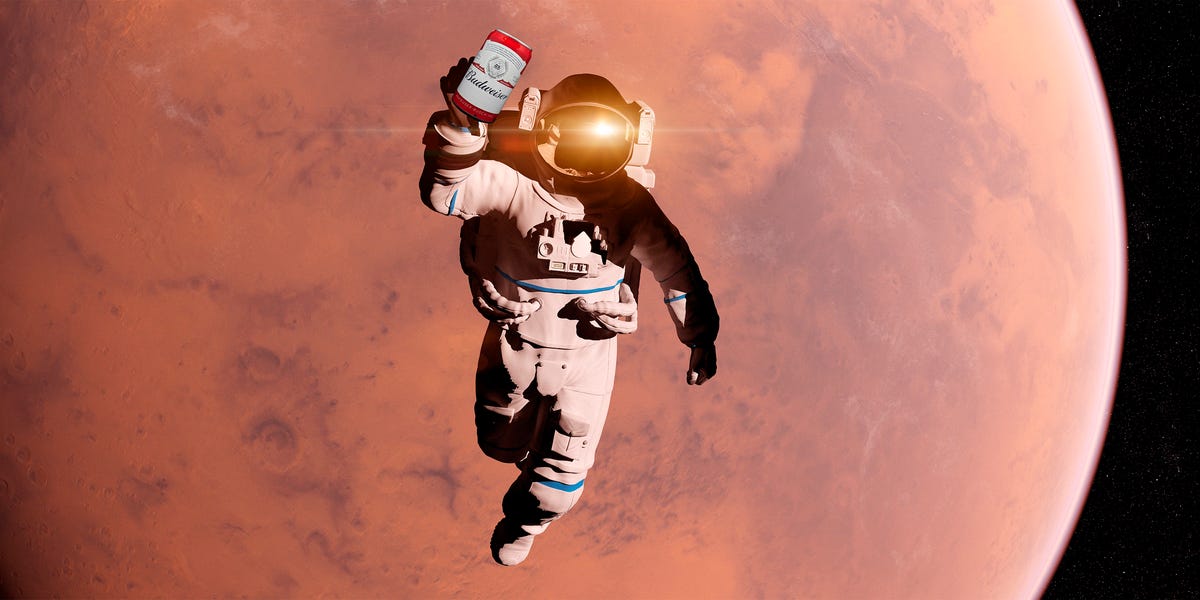
Beer has followed humans into nearly every environment where humans have learned to be slightly uncomfortable: ships, deserts, ski lodges, stadium parking lots, and backyard barbecues where someone insists they are “watching the grill” while holding tongs like a ceremonial sword. So when Budweiser announced a long-term ambition to help make the first beer for Mars, the idea sounded both ridiculous and weirdly inevitable. If people someday live on the Red Planet, they will need water, food, shelter, oxygen, medical systems, reliable power, and, eventually, something that makes a Thursday evening feel less like a survival exercise.
The Budweiser beer experiment in space was not about astronauts cracking open cold cans on the International Space Station. It was about barley, the humble grain behind malt, brewing sugar, and much of beer’s familiar body and flavor. By sending barley seeds and later barley-malting experiments to the ISS, Budweiser and its research partners explored how one of beer’s essential ingredients behaves in microgravity. The project blended branding, agriculture, space science, and the very human question of what comfort might look like beyond Earth.
What Was the Budweiser Beer Experiment?
Budweiser’s space-beer story began publicly in 2017, when the company announced its “Bud on Mars” ambition at South by Southwest. The goal was bold, shiny, and tailor-made for headlines: become the first beer on Mars. But behind the slogan was a practical scientific starting point. Before anyone can brew beer away from Earth, researchers need to understand how beer ingredients grow, germinate, malt, and react under spaceflight conditions.
Barley became the star of the experiment because it is one of Budweiser’s core ingredients. On Earth, barley is grown, harvested, malted, mashed, fermented, conditioned, packaged, shipped, and finally opened by someone who says, “I’ll just have one,” which has been the beginning of many questionable karaoke decisions. In space, every one of those steps becomes harder. There is no ordinary soil bed, no gravity-driven drainage, no easy way for bubbles to rise, and no casual warehouse full of brewing equipment waiting next to a Mars crater.
The First Step: Sending Barley Seeds to the ISS
Budweiser partnered with organizations connected to the International Space Station U.S. National Laboratory and Space Tango, a company that develops automated research hardware for microgravity experiments. Early barley investigations focused on seed exposure and germination. In simple terms, the research asked: What happens when barley seeds spend time in orbit? Do they germinate normally? Do they show physical abnormalities? Are there changes in gene expression? Can some barley cultivars handle stress better than others?
That last question matters far beyond beer. Barley is not only used in brewing; it is also important for food, animal feed, distillation, and broader agriculture. If microgravity exposes how different cultivars respond to stress, the findings may help researchers identify traits useful for growing barley under difficult Earth conditions, including heat, drought, and changing climate patterns. In other words, the experiment was not just “beer in space.” It was crop science wearing a red Budweiser jacket.
Seed Exposure and Germination
The early ISS investigations studied dry barley seeds and germinating barley seedlings. Some samples were kept dry to test the effects of the spaceflight environment, while others were placed with growth media and monitored as they began early development. Automated systems provided lighting, imaging, and preservation steps so scientists could later compare the space-grown samples with ground controls.
Ground controls are essential because space science is not a magic show. If a seed grows strangely in orbit, researchers need to know whether the cause was microgravity, radiation, temperature, handling, moisture, hardware design, or just barley being dramatic. By comparing space samples with similar samples grown on Earth, scientists can isolate the effects of spaceflight more carefully.
The Big Brewing Question: Why Barley Matters So Much
Beer begins with biology. Barley stores starch inside its kernels. During malting, the grain is encouraged to germinate just enough to activate enzymes that convert starches into fermentable sugars. Then the process is stopped by drying the grain. Brewers later mash that malt to extract sugars, feed yeast, and create alcohol, flavor compounds, aroma, and body.
If barley behaves differently in space, the whole brewing chain changes. Germination rate, enzyme activity, starch modification, rootlet growth, moisture movement, and heat transfer can all influence malt quality. A tiny shift at the seed stage can become a major difference later in the glass. Brewing is often romanticized as art, but it is also tightly controlled applied science. The brewer may have a beard and a flannel shirt, but the barley is doing chemistry.
Malting Barley in Microgravity
After the initial barley seed studies, Budweiser’s research moved into a more complex phase: malting barley in microgravity. This was a bigger leap because malting is not just “make seed wet, wait, dry seed.” The process includes steeping, germination, and kilning. Each stage depends heavily on water behavior, oxygen availability, temperature, timing, and physical movement.
Steeping: Hydration Without Gravity
Steeping is the rapid hydration stage. On Earth, water flows downward, drains predictably, and interacts with grain in ways brewers have refined for centuries. In microgravity, fluids do not politely settle where you want them. They cling, bead, float, and form bubbles. If moisture is uneven, some barley may hydrate too much while other kernels remain dry. That is a problem when your goal is consistent malt rather than a tiny orbital swamp.
Germination: Roots Looking for Direction
Plants use gravity as one of their orientation cues on Earth. Roots usually grow downward, shoots grow upward, and everyone behaves like they read the instruction manual. In microgravity, plants rely more on light, moisture, and other environmental signals. NASA’s plant-growth research has shown that space crops can grow, but water and air distribution around roots become major challenges. For barley, germination in microgravity can reveal how seedlings adapt when gravity is no longer the bossy stage manager.
Kilning: Drying the Malt
Kilning stops germination and develops malt characteristics. On Earth, air movement and heat transfer are easier to predict. In space, managing heat, moisture, airflow, and equipment reliability becomes more complicated. Budweiser’s microgravity malting investigation used an automated miniaturized system to test how barley could move through the malting process in orbit and then be compared with Earth-based controls.
Why Brewing Beer in Space Is So Difficult
Growing and malting barley is only part of the problem. Actually brewing beer in space would require solving a long list of engineering puzzles. Beer depends on water, malt, hops, yeast, fermentation vessels, temperature control, sanitation, pressure management, carbonation, packaging, and safe consumption. On Earth, breweries use gravity constantly, even when they are not thinking about it. Liquids flow downward. Sediment settles. Carbon dioxide rises. Foam forms on top. Brewers transfer fluids between vessels. Yeast flocculates. A pint poured at a bar separates into liquid and head because gravity makes bubbles float upward.
In microgravity, bubbles do not rise the same way. Carbon dioxide can remain suspended in liquid, making carbonated drinks awkward and potentially uncomfortable. This is one reason beer in orbit is not as simple as opening a can and saying cheers while floating dramatically past a window. The result could be foam where you do not want it, gas where your stomach does not appreciate it, and liquid behaving like it has joined a circus.
Is This Really About Mars?
Mars is not the same as the International Space Station. The ISS is a microgravity environment, while Mars has gravity, though only about 38 percent of Earth’s. That means Budweiser’s ISS barley experiments do not directly replicate Martian farming or Martian brewing. They are early research steps. If barley can be better understood under the extreme stress of spaceflight, scientists can begin building knowledge for future off-Earth agriculture.
A Mars brewery would face challenges beyond gravity. It would need water recycling, crop-growing systems, power, controlled temperatures, sterile production conditions, yeast management, pressure-safe vessels, and strict rules about alcohol use in a mission environment. Nobody wants a Mars habitat where the main safety protocol is “Dave said he tightened that valve before happy hour.”
The Serious Agricultural Value Behind the Fun Headline
The best part of the Budweiser beer experiment is that the headline is funny, but the science is genuinely useful. Space agriculture is becoming increasingly important as NASA and commercial space companies plan longer missions to the Moon, Mars, and beyond. Prepackaged food loses nutritional quality over time, and resupply missions are expensive. Growing crops in space could help provide fresh food, psychological benefits, and more sustainable life-support systems.
NASA’s plant-growth systems, such as Veggie, have already supported research involving leafy greens and other crops aboard the International Space Station. These systems use controlled lighting, growth media, nutrient delivery, and careful water management. The same broad questions apply to barley: How do plants grow without normal gravity? How should water and air be delivered? Which crop varieties are best suited to controlled environments? Can we make future space agriculture more reliable and less dependent on constant human babysitting?
Budweiser’s barley work fits into that larger research ecosystem. The company may have entered the story with a Mars-beer dream, but the data could help improve barley production on Earth. As climate conditions shift, farmers and food producers need crops that can tolerate stress. If spaceflight studies reveal genetic or physical markers linked to resilience, that knowledge could support breeding programs and controlled-environment agriculture.
Marketing Stunt or Meaningful Science?
The honest answer is: both. Budweiser’s “first beer on Mars” ambition was clearly great marketing. It put a familiar brand into a futuristic conversation and gave journalists a headline they could not resist. Beer plus Mars plus rockets? That is search-engine candy with carbonation.
But calling it only a stunt would be too simple. The experiments involved real hardware, real ISS research pathways, real barley samples, and real scientific questions. Commercial space research often begins with brand visibility, but it can still produce useful data. The ISS National Lab exists partly to help companies, universities, and researchers use microgravity in ways that benefit life on Earth. In that sense, Budweiser’s experiment is a good example of how a playful idea can support serious inquiry.
Could We Actually Drink Beer on Mars Someday?
Technically, yes, but not soon and not casually. A future Mars settlement might eventually produce fermented beverages, especially if it grows grains or other fermentable crops. Humans have made alcoholic drinks for thousands of years because fermentation is practical, social, and sometimes safer than untreated water in historical settings. In a controlled Mars habitat, however, alcohol would be a cultural product, not a survival necessity.
The first Mars beer would probably not resemble a normal Earth lager produced at industrial scale. It might be a small-batch experimental beverage made under strict resource limits. Water would be precious. Carbon dioxide would need to be managed. Yeast behavior would need to be monitored. Sanitation would be critical. Packaging would have to work in lower gravity and a pressurized habitat. And, of course, mission planners would need rules about when and whether crew members could drink alcohol.
Still, the idea matters because it points to a larger truth: permanent human settlement is not only about survival. It is about culture. Bread, coffee, tea, beer, music, celebrations, familiar flavors, and shared rituals help people feel human in unfamiliar places. A Mars colony without small comforts would be technically impressive and emotionally bleak, like a luxury hotel designed by a spreadsheet.
What the Budweiser Experiment Teaches Us
The Budweiser beer experiment teaches several lessons. First, space agriculture is difficult, even for crops we understand well on Earth. Second, microgravity research can reveal how plants respond to stress in ways that may help both astronauts and farmers. Third, brewing is more than a recipe; it is a chain of biological and physical processes that depend on gravity, fluid behavior, temperature, and microbial activity. Finally, big public-facing ideas can draw attention to science that might otherwise remain hidden in technical reports.
It also reminds us that the future of space exploration will not be built only by national space agencies. Commercial companies, universities, food producers, biotech firms, and materials researchers all have reasons to test ideas in orbit. Some projects will sound serious. Others will sound like someone asked, “Can we make beer on Mars?” during a very productive lunch. Either way, the boundary between science fiction and research keeps getting thinner.
Experiences and Reflections: Imagining the First Space Beer
Imagine stepping into a future Mars habitat after a long workday. Outside, the landscape is red, dusty, silent, and deeply uninterested in your comfort. Inside, the air smells faintly of metal, recycled oxygen, warm electronics, and the leafy green corner where the crew is trying to grow dinner. Someone has been checking barley trays for weeks, watching tiny shoots respond to carefully tuned light. Another crew member has been monitoring yeast cultures like they are newborn royalty. The first experimental batch is not glamorous. It is small, heavily documented, and probably surrounded by more sensors than a hospital patient.
The experience of brewing beer in space would be nothing like homebrewing in a garage. There would be no open bucket bubbling in the corner, no sticky floor, no casual “close enough” measurement, and absolutely no dog wandering through the brewing area with suspicious timing. Everything would need to be sealed, controlled, measured, and approved. Even the aroma would be precious. On Earth, malt smells warm and bready, hops smell bright and herbal, and fermentation gives off a living, yeasty energy. In a space habitat, those smells could become emotional landmarks, tiny reminders of Earth packed into a scientific process.
The first sip, if it ever happens, would probably be less about taste scores and more about symbolism. Maybe the beer would be flat by Earth standards. Maybe carbonation would need a new serving method. Maybe the flavor would be slightly odd because ingredients grown off-world rarely behave exactly like their Earth relatives. But the meaning would be enormous. It would say that humans had moved from merely surviving in space to making room for tradition, pleasure, and community.
There is also something charming about barley becoming a space traveler. Barley is ancient. Humans have cultivated it for thousands of years, and it has been part of bread, porridge, beer, animal feed, and agriculture across civilizations. Sending barley to the ISS connects old human habits with new frontiers. A grain once grown in river valleys and farm fields is now being studied in orbit, not because it became fancy, but because humans brought their old questions with them: Can we grow this? Can we use it? Can we share it? Can it make life a little better?
For readers, the Budweiser beer experiment is a fun doorway into serious topics. It makes space agriculture less abstract. Instead of thinking only about oxygen loops and cargo mass, we picture a crop we recognize and a beverage with cultural weight. That is useful storytelling. Science needs accuracy, but it also needs entry points. “Barley gene expression in microgravity” is important, but “beer on Mars” gets people to lean forward.
The most realistic takeaway is not that astronauts will soon be floating around with six-packs. The real takeaway is that future space living will require deep knowledge of plants, microbes, water, pressure, flavor, nutrition, and human psychology. Budweiser’s experiment sits at the intersection of all those things. It is funny, ambitious, slightly theatrical, and scientifically relevant. In other words, it is extremely human.
Conclusion
Brewing beer in space remains far more complicated than a catchy headline suggests. Budweiser’s experiment did not create a ready-to-drink orbital lager, but it did help explore how barley behaves in the unusual environment of space. By studying seed exposure, germination, gene expression, and malting in microgravity, the project contributed to a larger conversation about future agriculture, food production, and human comfort beyond Earth.
The dream of a Budweiser on Mars may still be distant, but the research behind it is grounded in real science. Whether the first Martian toast is made with beer, tea, coffee, or recycled-water lemonade with heroic branding, the Budweiser barley experiments remind us that exploration is not only about reaching new worlds. It is also about learning how to live there.
Note: This article is written for informational and editorial purposes, based on publicly available information from reputable space, science, brewing, and aerospace research sources. It discusses the science and cultural context of space brewing and does not provide operational instructions for producing alcohol aboard spacecraft.