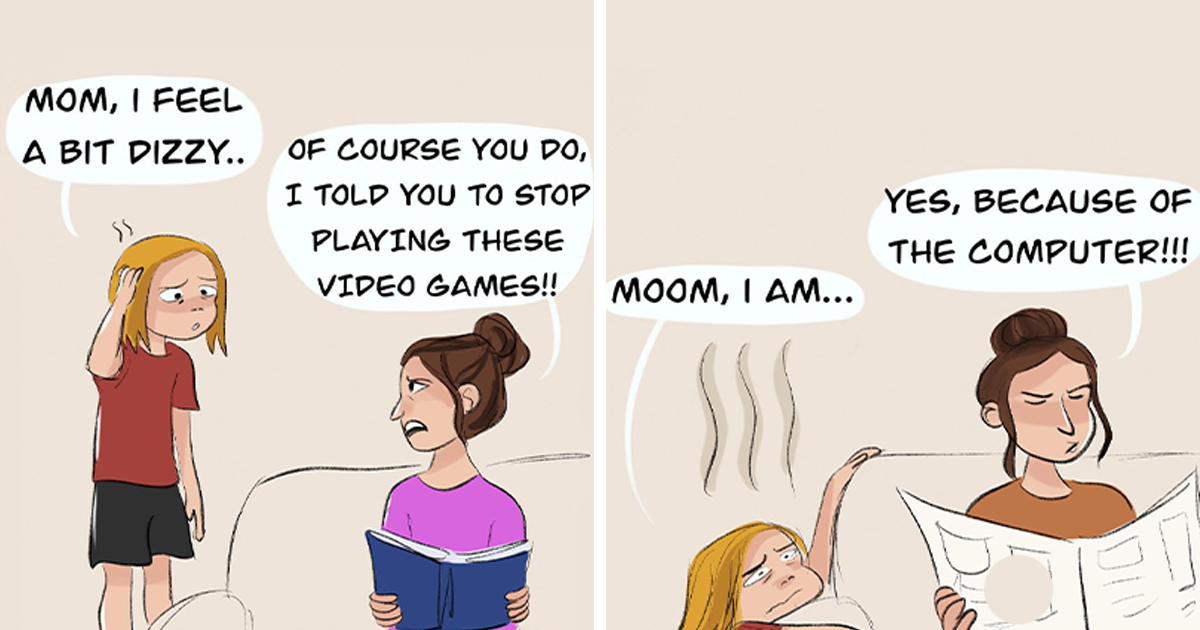
Growing up is a strange business. One minute, you are confidently explaining how the world works. The next, you are calling your parents because the washing machine has started making a noise that sounds vaguely expensive.
That awkward territory between childhood and fully functioning adulthood is exactly where relatable comics thrive. Romanian cartoonist Mary Nicola has built her comic series around the ordinary dramas, embarrassing habits, emotional overreactions, and family conversations that shape teenage and young-adult life. Her collection of 26 comics proves that a moment does not need to be historically important to be painfully familiar.
Arguments with parents, confusing crushes, sibling rivalries, money problems, fitness goals, friendships, texting habits, and childhood memories all become material for her colorful visual jokes. The situations are specific enough to feel genuine yet universal enough to make thousands of readers think, “Wait, did this artist install a camera in my house?”
These funny webcomics are more than a collection of punchlines. They reveal why everyday life comics remain so popular with young readers: they transform private embarrassment into shared entertainment.
Who Is the Artist Behind These 26 Relatable Comics?
Mary Nicola is a Romanian cartoonist who creates short comics inspired largely by her own experiences and observations. Instead of sending her characters on intergalactic missions or giving them capes, she places them in much more dangerous situations, such as talking to a crush, answering a parent’s suspicious questions, or realizing that a monthly budget disappeared during the first week.
Her work focuses heavily on teenage life and early adulthood. Parents misunderstand things. Siblings appear at precisely the wrong moment. Friends exchange brutally honest observations. Romantic expectations collide with reality. Small mistakes produce enormous internal monologues.
The appeal comes from Nicola’s willingness to treat these ordinary moments as worthy of attention. She understands that an awkward conversation can feel like a five-act tragedy when you are living through it. Later, with a little distance, the same situation becomes a perfect comic strip.
Personal Moments Become Universal Stories
Nicola has explained that her ideas come from experiences in her own life. That personal foundation gives the comics their believable details. The characters do not behave like carefully polished fictional heroes. They forget things, overthink messages, make ambitious plans, abandon those plans, and occasionally seek emotional support from snacks.
Readers recognize the emotional pattern even when the exact situation differs from their own. Someone may not share the artist’s family background, hobbies, or daily routine, but they probably understand the feeling of being embarrassed by a parent, ignored by a crush, challenged by a sibling, or betrayed by a pair of jeans that fit perfectly last month.
Why Young People Relate to Mary Nicola’s Comics
Relatability is often mistaken for simplicity. In reality, creating a relatable comic requires precise observation. The artist must identify a feeling people experience but rarely describe, remove unnecessary details, and present it in a form readers understand almost instantly.
Mary Nicola’s comics succeed because they focus on recognizable emotional contradictions. Young people want independence but still need help. They want attention but may panic when they receive it. They make detailed plans for self-improvement and then spend three hours watching videos in bed. They may complain about their families while also calling those same family members whenever life becomes confusing.
Small Problems Feel Enormous in the Moment
Teenage and young-adult experiences often arrive without much perspective. A disagreement with a friend can feel permanent. A bad haircut can appear to threaten an entire social future. An unanswered message can inspire enough theories to fill a detective novel.
Nicola’s relatable comics capture this temporary intensity without mocking the person experiencing it. The humor usually comes from recognition rather than cruelty. Readers laugh because they remember treating a minor event like an international emergency.
Time changes the scale of these memories. A problem that once ruined an afternoon may eventually become a favorite story. The comics compress that transformation, allowing readers to experience the panic and the perspective at the same time.
Family Life Is an Affectionate Battlefield
Parents and siblings provide endless material for comics because family members know exactly how to be supportive and irritating in the same conversation.
A parent may ask where you are going, who will be there, how you will get home, whether you have eaten, whether you brought a jacket, and whether the friend driving has demonstrated adequate respect for traffic laws. To a teenager, this can feel like an interrogation. To the parent, it is Tuesday.
Sibling relationships create another reliable source of humor. Brothers and sisters may compete, borrow possessions without permission, expose embarrassing secrets, and argue over territory measured in inches. Yet they can also become immediate allies when someone outside the family causes trouble.
Mary Nicola’s teenage life humor works because it preserves both sides of these relationships. The characters may be frustrated, but the underlying affection remains visible.
Crushes Turn Everyone Into an Amateur Analyst
Few experiences produce more unnecessary analysis than a new crush. A two-word message can be examined for tone, punctuation, timing, and possible hidden meaning. A period at the end of a sentence may trigger concern. Two exclamation points could indicate excitementor suspicious overcompensation.
Relatable comics about dating and texting expose the enormous distance between what happens externally and what happens inside a person’s mind. Externally, someone receives “Sounds good.” Internally, a committee has been formed, evidence has been reviewed, and three friends have been contacted for expert testimony.
Nicola uses these emotional mismatches to create quick, effective jokes. The reader sees both the ordinary event and the wildly complicated reaction, often within only a few panels.
Friendship Includes Support, Chaos, and Unrequested Honesty
Friendship in young adulthood is rarely presented as a formal relationship, yet it often carries enormous emotional importance. Friends become advisers, witnesses, accomplices, photographers, editors, and emergency providers of screenshots.
A good friend may offer encouragement. A very good friend may tell you that your outfit is questionable before you leave the house. The best friend may laugh first and help second.
Mary Nicola comics capture these informal rules. Her characters do not always deliver inspirational speeches. Sometimes friendship means sharing food, listening to the same complaint for the ninth time, or confirming that a strange social interaction was indeed strange.
The Everyday Themes Hidden Inside the 26 Comics
The 26 comics cover many situations, but several recurring themes give the collection a clear identity. Together, they create a humorous portrait of what it feels like to grow up while pretending to know what you are doing.
Money and the Surprise Cost of Existing
As a child, receiving a little money can feel like instant wealth. As an adult, the same amount seems to evaporate after groceries, transportation, subscriptions, and one coffee purchased during a moment of emotional weakness.
Comics about money are relatable because financial independence rarely arrives with dramatic music. It appears through small realizations: food is expensive, household supplies do not replace themselves, and being able to afford something does not necessarily mean buying it is a brilliant idea.
Nicola finds comedy in the shifting meaning of money. The amount that once funded weeks of excitement may later struggle to survive a trip to the store.
Fitness Goals Versus Human Nature
Exercise offers excellent comic material because motivation changes faster than a gym playlist. On Monday, a person may announce a complete lifestyle transformation. By Wednesday, walking to the refrigerator feels like active recovery.
Mary Nicola’s fitness-related observations touch on gym confidence, appetite, body image, rest days, clothing, and the complicated emotional relationship people form with progress. Her jokes recognize that self-improvement is rarely a smooth upward line. It is more like a confused doodle with several snack breaks.
The humor feels welcoming because the characters are not presented as failures. They are simply human beings trying to maintain ambitious routines while living inside bodies that occasionally request pizza.
Technology Creates New Versions of Old Problems
Young people did not invent insecurity, procrastination, friendship drama, or romantic confusion. Technology simply gave those experiences notifications.
Texting makes communication immediate but not necessarily clearer. Social media connects friends while encouraging comparison. Delivery tracking allows shoppers to monitor a package with the focus of an air-traffic controller. Phones provide endless entertainment and then report, with unnecessary judgment, exactly how many hours were spent enjoying it.
These modern habits fit naturally into funny slice-of-life comics because readers understand them in seconds. A character staring at a screen can communicate impatience, hope, anxiety, boredom, and denial without a long explanation.
Nostalgia Makes Ordinary Memories Valuable
Some of the most effective everyday life comics look backward. Childhood memories gain new meaning when viewed from adulthood. A family routine that once seemed boring may later feel comforting. A childhood fear becomes funny. An argument that appeared catastrophic becomes difficult to explain without laughing.
Nostalgia gives Nicola’s work emotional warmth. The comics are not only saying, “This was ridiculous.” They are also saying, “This mattered because it was part of growing up.”
How the Visual Storytelling Makes the Humor Work
A relatable idea alone does not guarantee a strong comic. The artist must control timing, expression, dialogue, and visual clarity. Mary Nicola’s approachable style supports the humor without overcrowding it.
Simple Setups Keep the Focus on the Joke
Most short webcomics have only a few seconds to win a reader’s attention. Complicated explanations can weaken the punchline, especially on a phone screen. Nicola generally builds her strips around recognizable setups: a conversation, a memory, a comparison, or a sudden realization.
Because the situation is immediately clear, the reader can focus on the emotional turn. One panel establishes confidence. The next introduces reality. The final panel allows reality to win, as it frequently does.
Facial Expressions Carry the Inner Monologue
In relatable comics, a character’s face often does more work than the dialogue. A raised eyebrow can express doubt. A frozen smile can reveal panic. Wide eyes can announce that a simple plan has encountered consequences.
Exaggerated reactions turn private feelings into visible comedy. Readers may maintain a calm appearance in real life, but the comic shows what their emotions would look like if permitted to behave honestly.
Self-Deprecating Humor Keeps the Tone Friendly
Nicola frequently places the central character inside the joke rather than above it. This matters because relatable humor works best when the artist appears to be laughing with readers, not judging them.
The message is not, “Look at these foolish people.” It is, “Apparently, many of us are doing this.” That small difference creates a sense of community. The comic becomes a shared confession with better artwork.
Why Relatable Comics Matter Beyond a Quick Laugh
A four-panel comic cannot solve financial stress, repair a friendship, or answer a confusing text. It can, however, provide a moment of recognition. That recognition is valuable in an online environment where people often see carefully edited versions of everyone else’s lives.
Relatable comics reveal the clutter outside the camera frame. They show abandoned goals, family misunderstandings, social anxiety, laziness, insecurity, impulsive decisions, and ordinary emotional chaos. They remind readers that many people who appear organized are improvising with impressive confidence.
Shared laughter also creates connection. When someone sends a comic to a friend with the message “This is us,” the strip becomes a tiny social bridge. It communicates an experience faster than a long explanation and often with less embarrassment.
This is one reason comics for young people circulate so widely. They are easy to read, easy to share, and emotionally specific. A successful strip gives readers language for something they had felt but never formally named.
What New Comic Artists Can Learn From Mary Nicola
Aspiring creators do not need an extraordinary life to make engaging comics. They need to observe ordinary life closely.
- Write down small moments. Awkward conversations, misunderstood messages, family habits, and failed plans can become excellent material.
- Look for emotional contradictions. Characters who want two incompatible things are naturally funny.
- Remove unnecessary explanation. Let expressions, posture, and visual comparisons carry part of the story.
- Be specific without becoming inaccessible. A precise detail often makes a broad emotion feel more believable.
- Include yourself in the joke. Honest self-observation usually feels warmer than humor aimed entirely at other people.
The strongest lesson is that authenticity can be more memorable than complexity. A reader may admire a technically elaborate drawing, but they will share the comic that accurately depicts how they behave when waiting for a food delivery.
Experiences That Make These Comics Feel So Personal
Imagine being sixteen and preparing to meet friends. You have selected an outfit, changed it four times, returned to the first option, and finally approached the door. A parent asks where you are going. You answer. Then come the follow-up questions: Who is going? Who is driving? When will you return? Does anyone involved have a full name, permanent address, and documented history of responsible decision-making?
At the time, the conversation feels deeply unfair. Years later, you may recognize it as concern wearing an annoying costume. A relatable comic captures both interpretations at once. The younger reader recognizes the frustration, while the older reader may suddenly understand the parent.
Another familiar experience begins with a message to someone you like. The message is casual because you spent forty minutes making it appear casual. After sending it, you place the phone down to demonstrate emotional independence. Seven seconds later, you pick it up again. The message has been delivered but not read. A minute passes. You begin considering whether the person is busy, asleep, traveling through a tunnel, or deliberately creating a psychological experiment.
Nothing significant has happened, yet the emotional experience is enormous. That gap is perfect for visual comedy.
Then there is the first serious attempt at budgeting. You create categories, calculate limits, and promise to become the type of person who understands spreadsheets. For several days, the plan works beautifully. Then a friend suggests dinner. A subscription renews. Something in the apartment breaks. You buy a small treat because financial planning has become stressful. Soon, the budget resembles an archaeological document from a more optimistic civilization.
Fitness offers another shared storyline. You purchase workout clothes and immediately feel healthier. You complete one impressive session and begin imagining a dramatic transformation. The next morning, your muscles file a formal complaint. Stairs become enemies. Sitting down requires strategy. A friend asks whether you are exercising again, and you respond with the cautious dignity of someone negotiating with gravity.
Friendship produces quieter but equally recognizable experiences. A close friend may remember a humiliating event you had successfully erased from your active memory. They may repeat your own advice back to you when you are determined to ignore it. They may respond to a crisis with sincere support, followed by a joke so accurate that being offended becomes inconvenient.
Family memories also change over time. The sibling who once occupied your space, borrowed your belongings, and reported your activities to management may later become the person who understands your childhood without explanation. The parent whose rules seemed unreasonable may become the first person you call when a recipe looks suspicious or an appliance begins blinking.
These experiences explain why Mary Nicola’s 26 relatable comics connect with young people. The situations are funny not because they are completely absurd but because they are almost normal. The artist makes a small adjustment, enlarges the hidden emotion, and reveals the comedy that was present all along.
Readers do not simply recognize the characters. They recognize earlier versions of themselves: the person who overreacted, misunderstood, hoped too much, worried too early, or believed adulthood would involve fewer confusing instructions.
Conclusion: Growing Up Is Better When We Can Laugh at It
Mary Nicola’s collection demonstrates the lasting appeal of relatable comics. Her characters deal with parents, siblings, crushes, friendships, exercise, money, technology, and the many small disappointments that arrive between major life events. Their problems are rarely heroic, but they are honest.
The comics also offer a useful form of perspective. Experiences that feel isolating can become comforting when we discover how many other people share them. An embarrassing habit becomes a joke. A frustrating memory becomes a story. A difficult stage of life becomes something we can view from outside the moment.
That is the quiet strength of funny webcomics about everyday life. They do not insist that growing up is easy. They simply remind us that the confusion is widely distributed.
Note: This article is an original editorial synthesis inspired by Mary Nicola’s published comic series and broader research concerning youth culture, humor, digital life, social connection, and visual storytelling.