Wall Street has never been shy about handing out labels. Professional investors are “smart money.” Individual traders are “dumb money.” Veterans are disciplined. Beginners are reckless. Billionaires are visionariesat least until one of their predictions ages like an open carton of milk.
The phrase “Animal Spirits: Too Young, Too Dumb & Too Inexperienced” comes from a May 2020 episode of the Animal Spirits podcast. Its discussion ranged across pandemic economics, rising home prices, online shopping, unemployment, market valuations and the sudden arrival of young investors on trading platforms. The title captured a popular accusation: inexperienced people were entering one of the strangest markets in history and behaving as though investing were a mobile game.
That accusation was not completely wrong. It was not completely right, either. Young investors made avoidable mistakes, but they also bought during a historic sell-off while many experienced professionals were hiding behind pessimistic forecasts. The lesson is not that youth produces genius or that inexperience is secretly a superpower. The lesson is that markets are humbling enough to make fools of every generation.
What Are “Animal Spirits” in Investing?
Economist John Maynard Keynes used the term animal spirits to describe the instincts, emotions and spontaneous urges that influence economic decisions. People do not calculate every possible outcome before starting a business, hiring an employee or buying a stock. They act partly because they feel hopeful, frightened, ambitious, impatient or unwilling to be left behind.
Modern research continues to connect economic activity with waves of optimism and pessimism. Stories matter because people use narratives to make sense of uncertainty. When a compelling story spreads“technology will change everything,” “housing never falls,” “cash is trash” or “this company is going to the moon”confidence can become contagious.
Animal spirits are not automatically irrational. Optimism encourages investment, entrepreneurship and calculated risk-taking. Without confidence, almost nobody would launch a company or hold stocks through a recession. Trouble begins when confidence stops asking questions.
The Market Laboratory of 2020
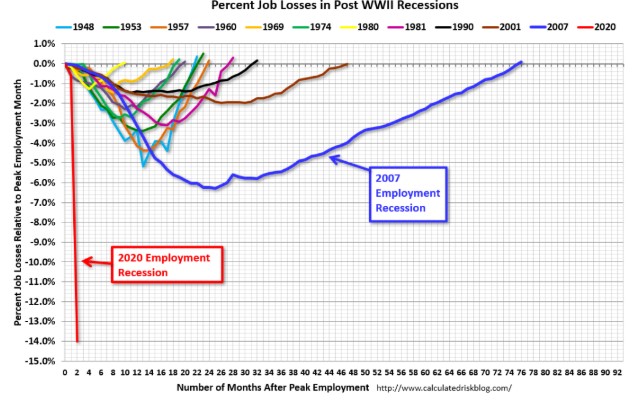
The spring of 2020 created an extraordinary experiment in investor behavior. The pandemic closed businesses, interrupted travel, pushed millions of people out of work and produced one of the fastest market crashes on record. Stocks then began an equally remarkable recovery, even while economic conditions remained painful.
The apparent disconnect between markets and daily life confused experienced investors as much as beginners. Stock prices respond to expectations about future profits, interest rates, government policy and financial conditionsnot merely to today’s economic headlines. Massive fiscal support, emergency Federal Reserve action and hopes for eventual reopening helped improve expectations before the real economy had fully recovered.
At the same time, consumer behavior changed at warp speed. Online sales surged as households bought groceries, furniture, electronics and enough home-office equipment to make every spare bedroom look like a struggling technology startup. U.S. Census Bureau data later showed that e-commerce sales increased sharply during the first pandemic year.
Many people also had more time at home, fewer entertainment options and easy access to commission-free brokerage apps. Sports were canceled, casinos were closed and trading offered a constantly moving scoreboard. Opening an account took minutes. Buying a fraction of a share took seconds. Developing sound judgment remained inconveniently slower.
Were Young Investors Really Too Young?
Being young creates financial disadvantages. Younger adults generally have less capital, lower incomes and limited experience with recessions. They may also carry student loans, expensive credit-card balances or unstable employment. Losing $5,000 can hurt more when it represents most of a person’s savings rather than a rounding error in a large portfolio.
Yet youth also provides the most valuable asset in long-term investing: time. A person who begins investing in their twenties may have several decades for contributions and compounded returns to accumulate. That long horizon can make temporary volatility more tolerable, provided the investor is diversified and does not need the money next Tuesday.
Young investors may also be more comfortable with digital tools, online research and rapidly changing business models. In 2020, many quickly understood why cloud computing, digital payments, streaming entertainment and e-commerce might gain importance. Some experienced investors dismissed these developments because the stocks looked expensive according to traditional measurements. The beginners sometimes recognized behavioral change before the spreadsheets caught up.
Of course, recognizing a trend does not automatically reveal what a company is worth. “Everyone uses the app” is a business observation, not a valuation model. Popular products can belong to disappointing investments, while boring companies can quietly produce excellent returns.
Were They Really Dumb Money?
The expression dumb money is mostly a marketing slogan for people who prefer being described as smart money. Retail investors can behave irrationally, but institutions are staffed by humans who also panic, chase performance and fear looking wrong in front of committees.
Research on Robinhood investors during the 2020 crash found that the group collectively increased its holdings during the bear market rather than collapsing into widespread panic. Their aggregate portfolio was not simply a collection of random lottery tickets; it leaned toward actively traded, widely recognized companies. In that important moment, buying while prices were falling proved more useful than delivering a beautifully formatted bearish presentation.
That does not mean every purchase was intelligent. Some traders chased bankrupt companies, leveraged exchange-traded products, short-dated options and stocks that were popular mainly because strangers posted rocket emojis beside them. But the worst examples should not define millions of individuals. Judging all retail investors by the wildest social-media account is like judging professional money management by its largest hedge-fund explosion.
Inexperience Is the Real Vulnerability
Youth and intelligence are not the central issues. Experience is more relevant because markets contain lessons that are difficult to absorb through reading alone.
A Rising Market Can Teach the Wrong Lesson
Suppose a beginner buys a speculative stock and it rises 80% in three weeks. The investor may conclude that the research was brilliant. Perhaps it was. More often, the result reflected a favorable market, lucky timing or a popular narrative. Profits can reinforce weak decisions just as easily as strong ones.
This is why early success can be dangerous. It encourages larger positions, faster trading and greater confidence. After several wins, an investor may feel prepared to manage options, margin and concentrated bets. The market has effectively handed a teenager the keys to a race car because they successfully rode a bicycle down the driveway.
Volatility Feels Different When Real Money Is Involved
Everyone believes they can tolerate risk while prices are rising. Genuine risk tolerance appears when a portfolio falls 30%, frightening headlines arrive hourly and friends begin sending messages that contain only the words, “Are you selling?”
Investors who have never experienced a prolonged bear market may assume every decline will produce a rapid rebound. History does not promise that outcome. Some stocks recover quickly, some require many years and some never return to their previous highs.
Social Media Confuses Confidence With Competence
Online communities can make investing education more accessible. They can also reward certainty, outrage and spectacular predictions. “This company has strengths and weaknesses, so its future depends on several variables” is responsible analysis, but it is not likely to become a viral video.
Younger investors frequently use social media to obtain financial information. Regulators have noted that these channels can expand participation while also exposing users to hidden promotions, fraud and advice from people whose primary qualification is owning an expensive microphone.
Where Animal Spirits Help
Healthy animal spirits encourage people to act despite uncertainty. Waiting for perfect clarity usually means waiting until attractive prices have disappeared. A sensible investor understands that every purchase could decline after it is made, yet still invests according to a long-term plan.
Optimism also helps investors remain consistent during frightening periods. Contributing to a retirement account during a recession can feel foolish because bad news is visible while future recovery is not. The willingness to keep buying requires confidence that businesses, workers and consumers will eventually adapt.
The best form of optimism is not blind faith. It is disciplined optimism: acknowledging that recessions, crashes and failed companies are unavoidable while recognizing that productive enterprises can create wealth over long periods.
Where Animal Spirits Become Expensive
Animal spirits become dangerous when excitement replaces process. Warning signs include borrowing money to trade, buying because an asset is trending, increasing a position solely because its price fell and assuming popularity guarantees future profits.
Another warning sign is treating a portfolio as entertainment. Investing should occasionally be interesting, but it does not need to provide a dopamine delivery every twelve seconds. A diversified portfolio may be boring precisely because it was designed to avoid financial catastrophe.
Frequent trading can also create the illusion of productivity. Pressing buttons feels like work. In reality, an investor’s most valuable decisions may involve saving more, reducing fees, diversifying and doing absolutely nothing during market noise.
A Better Framework for Inexperienced Investors
Build a Financial Foundation First
Before making aggressive investments, establish an emergency fund and address high-interest debt. Money needed for rent, medical expenses or near-term goals should not depend on whether technology stocks have a cheerful afternoon.
Separate the Core Portfolio From Speculation
A broad, diversified collection of investments can form the core of a long-term plan. Investors who enjoy selecting individual stocks may reserve a smaller portion for experimentation. This structure allows curiosity without forcing retirement savings to participate in every internet adventure.
Write Down the Reason for Every Purchase
A simple investment journal can include the reason for buying, expected holding period, major risks and conditions that would change the thesis. Written reasoning makes it harder to rewrite history after a trade succeeds or fails.
Control Position Size
No investment thesis is guaranteed. Limiting the size of a single position prevents one mistake from becoming a financial identity crisis. Diversification cannot eliminate market losses, but it can reduce the damage caused by one failed company or sector.
Treat Social Media as a Starting Point
A video, podcast or discussion board can introduce an idea. It should not complete the analysis. Review financial statements, understand the business model, investigate the speaker’s incentives and seek evidence that challenges the exciting story.
Measure Progress in Years
A portfolio is not a daily intelligence test. One month of outperformance proves almost nothing, and a temporary loss does not automatically make a sound plan defective. Long-term goals require long-term measurement.
Experiences Behind “Too Young, Too Dumb & Too Inexperienced”
The following experiences are representative illustrations of patterns commonly seen among new investors rather than claims about one specific person.
The First Winning Trade
Imagine a 23-year-old opening a brokerage account during the 2020 shutdown. After watching several videos, the investor buys shares of a company benefiting from remote work. The stock rises almost immediately. A second purchase rises too. Within a month, the investor believes markets are surprisingly easy and wonders why everyone wastes time discussing risk.
The early profits feel like proof of skill. The investor begins checking prices during breakfast, meetings and conversations with relatives. Position sizes grow. A risky options trade produces a fast gain, confirming the new theory that leverage is simply confidence wearing business clothes.
Then one earnings report disappoints. The stock drops sharply after hours, the option loses most of its value and the investor discovers that a 70% loss requires a gain of more than 200% merely to recover. This is the first useful lesson: percentages are cheerful on the way up and deeply uncooperative on the way down.
The Stock That Became a Personality
Another investor finds a company through an online community. The original position is small, but the surrounding story is irresistible. Supporters describe the company as a revolution. Critics are accused of corruption, ignorance or suspiciously insufficient enthusiasm.
As the price rises, the investor joins the community more deeply. Selling becomes emotionally difficult because ownership now represents loyalty. When the business reports weak results, supporters insist the market does not understand. When executives sell shares, the decision is described as strategic. When the price falls, the decline is considered a gift.
The investor eventually realizes that a stock certificate is not a friendship bracelet. A company does not know who owns it, and a portfolio does not owe loyalty to a narrative. The experience teaches a second lesson: never allow an investment to become part of your identity.
The Boring Portfolio That Quietly Wins
A third beginner takes a less exciting route. Most savings go into diversified, low-cost funds through automatic monthly contributions. A small separate account is used for individual stocks. Some picks perform well, several disappoint and one produces the financial equivalent of stepping on a rake.
Because the speculative account is limited, none of the mistakes threaten essential goals. Over time, the investor notices that the boring portfolio requires less attention and causes fewer emotional emergencies. The automatic contributions continue through rallies, corrections and headlines announcing that markets have permanently changed for the seventh time that year.
This investor still follows business news and occasionally buys individual companies. The difference is that excitement no longer controls position size. The goal shifts from proving intelligence to building wealth. That change is a sign of genuine experience.
The Most Valuable Experience: Surviving
Market experience is not simply the number of years since someone opened an account. An investor can repeat the same bad habits for twenty years and become highly experienced at making avoidable mistakes.
Useful experience comes from observing personal behavior. Did fear cause selling at the bottom? Did excitement encourage buying without research? Did a lucky profit create unjustified confidence? Did an investment plan survive contact with an actual crisis?
Survival matters because investors cannot benefit from long-term compounding after taking risks that remove them from the game. The objective is not to avoid every loss. That is impossible. The objective is to keep mistakes small enough that learning can continue.
Conclusion: Young Investors Are Not the Problem
Young investors are not automatically brilliant, reckless, informed or foolish. They are simply investors with more time and fewer market memories. That combination can produce courage, creativity and dangerous confidencesometimes in the same afternoon.
The 2020 retail-investing boom demonstrated that beginners could buy when professionals were afraid, recognize important consumer trends and challenge the tired idea that individuals must remain outside financial markets. It also showed how frictionless trading, leverage and social-media hype could transform education into speculation.
The most productive response is not to mock inexperienced investors or celebrate every rebellion against Wall Street. It is to help new participants convert enthusiasm into durable habits. Start early, diversify, control position sizes, question exciting narratives and give compounding enough time to perform its slow magic.
Animal spirits will always influence markets because markets are made of people. The goal is not to eliminate emotion. It is to prevent emotion from gaining access to the entire account balance.
Note: This article is for educational and informational purposes only. It does not provide personalized investment, tax or financial advice.