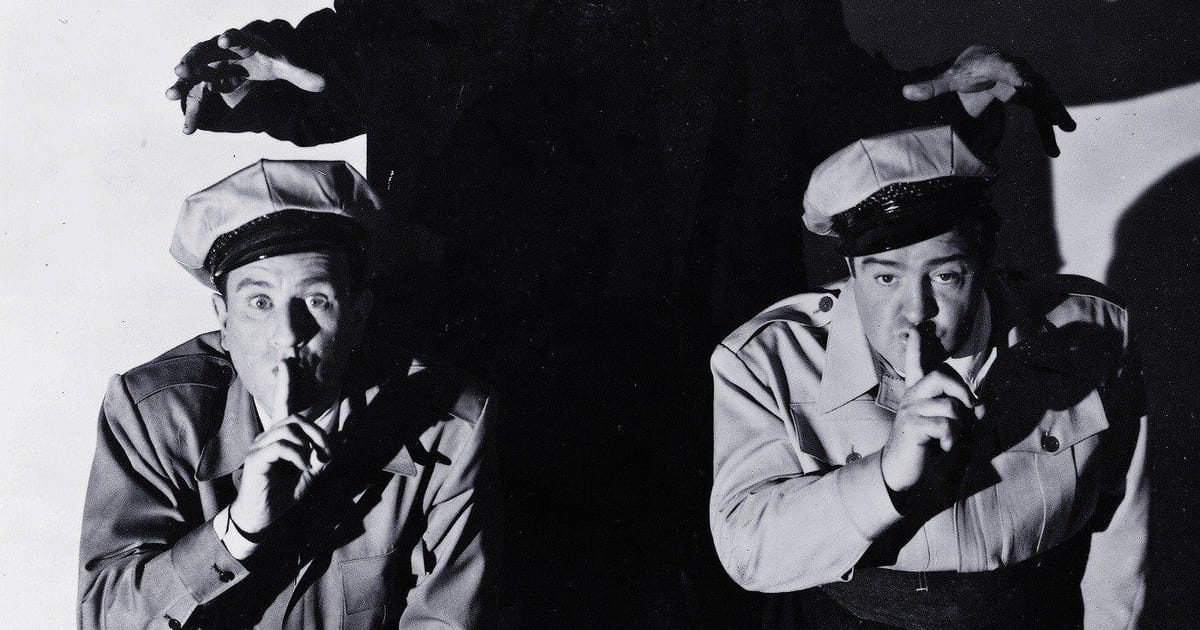
Abbott and Costello Meet Frankenstein is the kind of movie that sounds like a joke before it even starts: two fast-talking comedians walk into Universal’s monster universe, accidentally unpack Dracula, annoy Frankenstein’s Monster, and somehow make the Wolf Man look like the reasonable adult in the room. Yet the miracle of this 1948 horror-comedy is that it is not merely a spoof. It is a surprisingly respectful monster movie that also happens to be very, very funny.
Directed by Charles Barton and starring Bud Abbott as Chick Young and Lou Costello as Wilbur Grey, the film brings together Bela Lugosi’s Count Dracula, Lon Chaney Jr.’s Lawrence Talbot, Glenn Strange’s Frankenstein Monster, and a deliciously wicked mad-science plot involving brain swapping. That premise alone deserves a trophy shaped like a lightning bolt. But the real reason fans still rank the movie so highly is its balance: the monsters are treated seriously, while Abbott and Costello are allowed to panic, misunderstand, bicker, and run for their lives like two deliverymen who definitely did not read the fine print.
Below is a ranking-style breakdown of the movie’s best elements, strongest opinions, funniest moments, and lasting appeal. Is it Abbott and Costello’s best film? Is it the best Universal monster crossover? Is it one of the greatest horror comedies ever made? My opinion: yes, yes, and please pass the garlic.
Why Abbott and Costello Meet Frankenstein Still Ranks So High
The film works because it never winks so hard that the monster makeup falls off. Dracula is still dangerous. The Wolf Man is still tragic. Frankenstein’s Monster is still a lumbering symbol of laboratory regret. Abbott and Costello are the comedy engine, but the horror world around them is not treated like cardboard scenery.
This is crucial. Many later parody films mock the genre from a distance. Abbott and Costello Meet Frankenstein steps inside the haunted house, turns off the lights, and lets Lou Costello discover that coffins are not decorative storage units. The comedy comes from his fear, not from making the monsters ridiculous.
That is why the film has aged better than many broad comedies of its era. The jokes are physical, the structure is clean, and the monster mythology has enough weight to keep the story from becoming a sketch stretched to feature length. The result is a movie that can satisfy classic horror fans, comedy lovers, and anyone who thinks “brain transplant” is an excellent reason to leave work early.
Overall Ranking: A Classic Horror-Comedy Masterpiece
On an all-time horror-comedy list, Abbott and Costello Meet Frankenstein belongs near the top. It may not be as modernly self-aware as Shaun of the Dead or as chaotic as Ghostbusters, but it helped build the road those movies later drove down in a hearse with a functioning horn.
Final Overall Score: 9.5/10
The movie loses a tiny half-point only because a few comic rhythms belong very specifically to the 1940s, and some viewers raised on rapid-fire editing may need a few minutes to adjust. Once the crates arrive, though, the movie snaps into place. It becomes a haunted carnival of mistaken identities, monster reveals, and Costello reactions that still land beautifully.
Ranking the Best Performances
1. Lou Costello as Wilbur Grey
Lou Costello gives the film its heartbeat, and that heartbeat is usually pounding because something with fangs is standing behind him. Wilbur is not brave in the traditional sense. He squeaks, stammers, sweats, and points at danger while everyone else treats him like a malfunctioning doorbell. Yet his fear is so sincere that the audience immediately sides with him.
Costello’s timing is extraordinary. His pauses stretch just long enough for dread to creep in, then collapse into comic panic. The famous moments where he sees Dracula or Frankenstein’s Monster while Chick sees nothing are classic examples of comic suspense. The viewer knows Wilbur is right, Wilbur knows Wilbur is right, and Chick is busy being wrong with professional confidence.
2. Bela Lugosi as Count Dracula
Bela Lugosi’s return as Dracula is one of the movie’s greatest gifts. He does not play the Count as a clown. He brings elegance, menace, and a calm theatrical authority that makes the absurd brain-transplant plot feel almost reasonable. Almost.
Lugosi’s Dracula is smooth enough to sell evil with a smile. He glides through the film like a supernatural real estate agent showing everyone the castle’s worst features: basement laboratory, hypnotism room, and absolutely no tenant protections. His seriousness is the secret ingredient. If Dracula had been silly, the entire movie would have floated away like a rubber bat.
3. Lon Chaney Jr. as Lawrence Talbot
Lon Chaney Jr. gives the film genuine emotional gravity. His Lawrence Talbot is desperate, exhausted, and doomed to become the Wolf Man whenever the moon decides to ruin everyone’s evening. He functions as both warning system and tragic hero.
Talbot’s presence keeps the story from becoming pure farce. He understands the danger. He knows Dracula’s plan matters. He also knows that turning into a werewolf is not a convenient social skill. Chaney’s sincerity helps ground the monsters in the same universe that made them famous.
4. Bud Abbott as Chick Young
Bud Abbott has the less flashy role, but he is essential. Chick’s disbelief gives Wilbur something to bounce against. Abbott plays irritation like a musical instrument: clipped, impatient, and perfectly tuned to Costello’s panic.
Without Chick’s stubborn skepticism, the comedy would not work. Every time Wilbur tries to explain that a vampire just walked out of a coffin, Chick reacts like he has heard one too many lunch-break excuses. Abbott turns disbelief into structure, and that structure lets the horror gags repeat without feeling repetitive.
Ranking the Monsters
1. Dracula
Dracula ranks first because he drives the plot. He is not just wandering around for brand recognition. He has a plan, a disguise, a laboratory connection, and enough hypnotic confidence to make everyone around him look underqualified. His goal of putting Wilbur’s brain into the Monster is both terrifying and hilarious, mostly because the movie treats it with complete seriousness.
2. The Wolf Man
The Wolf Man ranks second because he brings urgency. Talbot is the rare monster figure who is also trying to stop the other monsters. His transformations create suspense, and his final conflict with Dracula gives the movie a satisfying monster-versus-monster payoff.
3. Frankenstein’s Monster
Glenn Strange’s Monster is visually powerful and physically imposing, but he ranks third because he is more of a looming threat than an active schemer. Still, when he starts moving, everyone else suddenly remembers urgent appointments elsewhere. His presence gives the film its iconic title power, even if Dracula is the real mastermind.
Best Scenes, Ranked
1. The Crate Delivery Scene
The wax museum delivery sequence is the movie at its best. Wilbur discovers Dracula’s coffin, sees the vampire emerge, and tries to alert Chick, who keeps missing every supernatural clue by a fraction of a second. This scene is a masterclass in timing. It uses the audience’s knowledge as a spring-loaded trap: we know the monster is real, and we know Chick will not believe it until it is far too late.
2. The Monster Reveal
When Frankenstein’s Monster is revealed, the film becomes more than a comedy setup. The lighting, makeup, and staging all belong to classic Universal horror. Costello’s reaction adds humor, but the reveal itself is played with enough atmosphere to feel legitimate.
3. Dracula’s Hypnosis
Dracula hypnotizing Wilbur is wonderfully strange because it combines old-school vampire menace with pure comic helplessness. Wilbur is not exactly the ideal candidate for a master villain’s grand experiment, which is what makes the plan so funny. Dracula looks at this nervous little man and thinks, “Yes, that brain will do.” Villainy has standards, apparently, but not high ones.
4. The Masquerade Confusion
The costume-party material adds another layer of comic misunderstanding. When people are dressed as monsters, actual monsters have excellent camouflage. It is the kind of social event where the guest list should really include a silver-bullet check at the door.
5. The Invisible Man Tag
The final Invisible Man gag is a perfect closing wink. After surviving Dracula, the Wolf Man, and Frankenstein’s Monster, Chick and Wilbur think they are finally safe. Then Vincent Price’s voice enters the boat, and the boys immediately choose water over conversation. It is quick, elegant, and exactly the right final button.
Opinion: Is It Abbott and Costello’s Best Movie?
For many viewers, yes. Abbott and Costello made several beloved films, but Abbott and Costello Meet Frankenstein has the strongest combination of story, atmosphere, guest stars, and cultural staying power. It is not simply a vehicle for routines; it is a real movie with stakes, pacing, and memorable set pieces.
Some fans may prefer earlier Abbott and Costello films for purer examples of the team’s verbal comedy. That is fair. But as a complete entertainment package, this one is hard to beat. It gives Abbott and Costello a world big enough to challenge them, and it gives classic monsters comic foils without stripping away their dignity.
Opinion: Does the Movie Respect the Universal Monsters?
Absolutely. This is the reason the film remains beloved instead of merely remembered. The monsters are not reduced to punchlines. Dracula remains manipulative and elegant. The Wolf Man remains tortured. Frankenstein’s Monster remains dangerous. The comedy happens around them and because of them, but not at the total expense of their identities.
That balance is harder than it looks. Too much horror, and the comedians feel trapped in the wrong movie. Too much comedy, and the monsters become Halloween props. The film walks the line with surprising grace, like a tightrope walker carrying a coffin.
How It Compares to Modern Horror Comedies
Modern horror comedies often rely on self-awareness. Characters comment on genre rules, mock clichés, or behave as if they have already watched the movie they are in. Abbott and Costello Meet Frankenstein comes from an earlier tradition. Its characters are not analyzing horror tropes; they are being chased by them.
That innocence gives the film a different charm. Wilbur is not saying, “This is just like a vampire movie.” He is saying, in effect, “There is a vampire, why are you not listening, and can we please resign from this job?” The humor is immediate and human. Fear makes him funny, and the monsters make that fear believable.
Family-Watch Opinion: Still Fun, But Know Your Audience
For families, the movie can be a terrific introduction to black-and-white comedy and classic monsters. There is no modern gore, and the scares are softened by Costello’s reactions. However, younger children who are sensitive to coffins, transformations, old castles, and looming monster faces may still find a few moments spooky.
That is part of the appeal. The film offers safe scares. It gives viewers the fun of being frightened without dragging them into nightmare territory. It is a cinematic haunted house where the exit sign is always visible, even if Lou Costello is currently blocking it while yelling.
Biggest Strengths
Perfect Genre Balance
The movie’s strongest quality is its balance between comedy and horror. The horror gives the comedy weight, and the comedy gives the horror warmth. Neither side feels like an afterthought.
Iconic Casting
The presence of Bela Lugosi and Lon Chaney Jr. gives the movie authenticity. These are not random actors pretending to be monster legends. They are deeply connected to the legacy of Universal horror, which makes the crossover feel historically important as well as entertaining.
Excellent Physical Comedy
Costello’s reactions, Abbott’s timing, and the repeated near-misses are still funny because they are built on clear visual logic. You do not need a lecture to understand the joke. A monster appears, Wilbur panics, Chick misses it, and comedy science does the rest.
Weaknesses Worth Mentioning
The film is not flawless. Some supporting characters are more functional than memorable. The romantic and mad-scientist subplots mainly exist to keep the monster machinery running. Also, viewers who dislike older comedy rhythms may find the early scenes a little slower than expected.
Still, these are minor complaints. The movie knows what it is doing, and once the supernatural business begins, it moves with impressive confidence. At just over 80 minutes, it does not overstay its welcome. In modern terms, that alone deserves applause and possibly a fruit basket.
Legacy Ranking: Why It Matters
Abbott and Costello Meet Frankenstein matters because it preserved the Universal monsters at a moment when their original cycle was fading. Instead of burying them, the movie gave them one last glorious group appearance in the classic style. It also proved that horror and comedy could share the same screen without canceling each other out.
The film’s influence can be felt in later horror-comedy hybrids that mix real stakes with big laughs. It showed that audiences could laugh and shiver in the same scene, sometimes in the same breath. That is a difficult trick, and this movie performs it with a straight face, a rubbery scream, and a very suspicious shipping crate.
Personal Viewing Experiences and Opinions
Watching Abbott and Costello Meet Frankenstein today feels like opening an old Halloween decoration box and discovering that everything inside still works. The cobwebs are charming, the rubber bats have personality, and somehow the old flashlight gives better atmosphere than an expensive modern lighting rig. The movie has that rare comfort-food quality: familiar, warm, spooky around the edges, and fun in a way that does not require homework.
One of the best viewing experiences is watching it with someone who has never seen a classic Universal monster movie. At first, they may expect a dusty old comedy. Then Dracula appears with real presence, the Wolf Man brings genuine urgency, and the Monster rises with enough old-school menace to change the mood in the room. Suddenly, the viewer realizes this is not just a parody. It is a gateway into an entire era of horror cinema.
The movie also plays beautifully as a Halloween watch. It is light enough for a party but structured enough to reward attention. You can enjoy it with popcorn, candy corn, or whatever snack you bought “for guests” and then quietly opened before they arrived. The jokes are broad enough for casual viewers, while film fans can appreciate the craft: the lighting, the blocking, the timing, and the way the script keeps Dracula’s plan moving forward.
My favorite thing about the film is how seriously Wilbur’s fear is treated. He is funny because he is right. He sees the danger before Chick does, and the audience becomes his only ally. That creates a special bond between viewer and character. We laugh at Wilbur, but we also believe him. In a strange way, he becomes the emotional center of the movie. He is the child in the audience pointing at the screen and saying, “No, really, the monster moved!”
Another rewarding experience is rewatching the film after seeing earlier Universal monster classics. The crossover becomes richer. Lugosi’s Dracula feels like a legend stepping back into the spotlight. Chaney’s Talbot carries the sadness of his earlier appearances. Glenn Strange’s Monster connects the movie to the later Frankenstein cycle. The comedy does not erase that history; it lightly rearranges the furniture and then runs through the room screaming.
For modern viewers, the film is also a reminder that horror comedy does not need to be cynical. It can be affectionate. It can laugh because it loves the genre, not because it thinks the genre is foolish. That affection is why the movie still feels alive. It has jokes, monsters, atmosphere, and a surprisingly durable sense of joy. Many films try to combine scary and funny. Few make the mixture look this effortless.
Conclusion: Final Ranking and Opinion
Abbott and Costello Meet Frankenstein deserves its reputation as one of the greatest horror comedies ever made. It is funny without being careless, spooky without being cruel, and nostalgic without feeling frozen in a museum case. The movie ranks at or near the top of Abbott and Costello’s filmography because it gives their comedy a perfect playground: a haunted Universal monster world where every shadow might contain a legend.
As a monster crossover, it remains one of the most satisfying. As a comedy, it still delivers. As a Halloween movie, it is practically mandatory viewing. And as an example of how to blend tones, it remains a small miracle in black and white. The final opinion is simple: Abbott and Costello Meet Frankenstein is not just a funny old movie. It is a classic that understood something timelesssometimes the best way to honor monsters is to let them scare a comedian half to death.