The solar system is not exactly a calm neighborhood. Sure, from a backyard telescope it may look peaceful: planets hanging politely in the dark, moons circling like obedient pets, and Saturn wearing its rings as if it dressed for a gala. But zoom in a little and the place becomes a cosmic weather channel with no commercial breaks. There are storms wider than Earth, winds faster than fighter jets, lightning in alien clouds, dust storms that swallow planets, and solar eruptions that can rattle technology from 93 million miles away.
When we talk about the solar system’s most intense storms, we are not just talking about hurricanes with better publicity. Planetary storms form under wildly different conditions: hydrogen-helium atmospheres on gas giants, carbon dioxide skies on Mars and Venus, methane rain on Titan, and charged plasma blasting from the Sun. Each world has its own recipe. Some use heat. Some use rotation. Some use chemistry so strange it sounds like a prank from a very nerdy magician.
This tour explores the most extreme storms in our solar system, from the Sun’s explosive temper to Neptune’s disappearing dark vortices. Buckle up. The forecast calls for giant red spots, sulfuric acid clouds, ammonia-water lightning, global dust, and one hexagon that seems to have been designed by a planet with a geometry degree.
What Makes a Storm “Intense” in Space?
On Earth, storm intensity is often measured by wind speed, pressure, rainfall, storm surge, or damage. In the wider solar system, the checklist gets more interesting. A storm can be intense because it is huge, like Jupiter’s Great Red Spot. It can be intense because it lasts for decades or centuries. It can be intense because its winds are unbelievably fast, as on Neptune. It can also be intense because it affects technology and magnetic fields, as solar storms do when they reach Earth.
Another key difference is the surface. Earth hurricanes feed on warm ocean water and lose strength over land. Gas giants such as Jupiter and Saturn do not offer storms a nice continent to crash into. With no solid surface to break them apart, atmospheric vortices can survive for a very long time. That is one reason the outer planets host weather systems that make Earth storms look like short-term drama queens.
The Sun: The Solar System’s Original Storm Machine
The Sun is not a planet, but it deserves the first warning label. Solar storms are eruptions of particles, radiation, magnetic fields, and plasma that burst outward into the solar system. A powerful solar flare can release astonishing energy, and a coronal mass ejection can fling billions of tons of charged material into space. When that material is aimed at Earth, it can disturb our planet’s magnetic field and trigger a geomagnetic storm.
Solar storms are beautiful and inconvenient, which is a classic cosmic combination. They can paint the sky with auroras, but they can also interfere with radio communications, satellite operations, GPS signals, and power grids. NOAA classifies space weather events with scales for geomagnetic storms, solar radiation storms, and radio blackouts, making the Sun one of the few weather sources that can mess with both astronauts and your phone signal.
Why Solar Storms Matter
The most intense solar storms remind us that space weather is not science fiction. Modern society depends on electronics, satellites, aviation communication, navigation, and power infrastructure. A severe geomagnetic storm does not need to blow down trees to cause trouble. It can disturb systems quietly, invisibly, and very expensively. In other words, the Sun can throw a tantrum without ever leaving its seat.
Venus: A Pressure Cooker Wrapped in Acid Clouds
Venus looks soft and glowing from far away, but that is just excellent branding. Beneath its bright cloud cover is one of the harshest environments in the solar system. The atmosphere is mostly carbon dioxide, the surface pressure is about 93 times Earth’s sea-level pressure, and the clouds are made of sulfuric acid. If Earth is a spa day, Venus is the spa after the boiler exploded.
Venus does not have Earth-style oceans to power hurricanes, but its atmosphere is a monster of circulation. High-altitude winds race around the planet much faster than the planet itself rotates, a behavior called super-rotation. The result is a world where the sky moves with alarming confidence over a surface hot enough to melt lead. Venusian weather is less about dramatic spiral storms and more about an entire atmosphere acting like a hostile industrial machine.
Mars: Dust Storms That Swallow a Planet
Mars is famous for being dusty, rusty, and photogenic in a lonely sort of way. Its storms are not powerful like Earth hurricanes because the Martian atmosphere is thin. A windy day on Mars would not throw a person across the landscape like a Hollywood scene. But Martian dust storms have a terrifying advantage: scale.
Some Mars dust storms grow until they surround the entire planet. In 2018, a global dust storm blocked sunlight from reaching NASA’s solar-powered Opportunity rover. The rover went silent, and the mission eventually ended after about 15 years of exploration. That storm showed how dangerous dust can be for robotic missions and why future human explorers will need to take Martian weather seriously.
Why Martian Dust Is So Dangerous
Dust affects visibility, solar panels, instruments, mechanical parts, and potentially astronaut health. Fine particles can cling to surfaces and sneak into equipment. Even when the wind itself is not brutally forceful, the dust can turn the atmosphere into a reddish haze and reduce sunlight enough to create major operational problems. Mars proves that a storm does not need ocean waves or thunder to be mission-ending.
Jupiter: The Great Red Spot and Monster Lightning
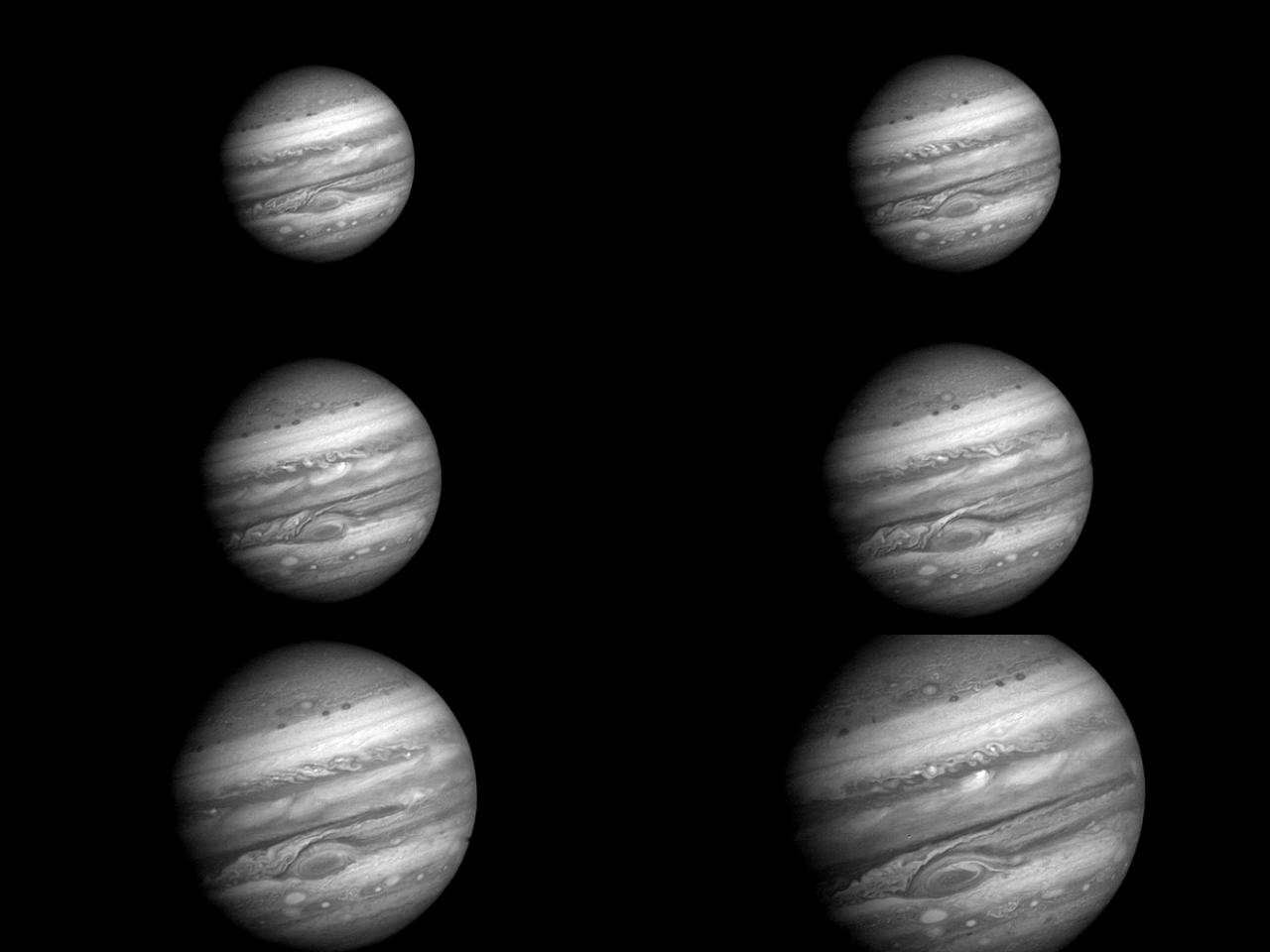
Jupiter is the heavyweight champion of planetary weather. Its most famous storm, the Great Red Spot, is a gigantic high-pressure anticyclone in the planet’s southern hemisphere. It is large enough to fit about 1.3 Earths across and has winds that can peak around 400 miles per hour. The storm has been observed for at least 150 years, and possibly much longer, although scientists still debate the history of earlier sightings.
The Great Red Spot is not just big; it is deep and stubborn. NASA’s Juno spacecraft has helped reveal that the storm extends far below the visible cloud tops. Its reddish color remains a scientific mystery, possibly related to chemical reactions involving sunlight and compounds in Jupiter’s upper atmosphere. Basically, the solar system’s most famous storm is also keeping its beauty routine secret.
Jupiter’s Shallow Lightning and “Mushballs”
Jupiter also hosts violent thunderstorms with exotic lightning. Unlike Earth lightning, which forms in water clouds, some Jovian lightning appears to originate in clouds containing an ammonia-water solution. Juno observations led scientists to propose the existence of “mushballs,” slushy ammonia-rich hailstones that form in Jupiter’s turbulent atmosphere and carry ammonia and water downward. It is like hail, except the sky is made of gas giant chaos and the hailstones sound like something from a cafeteria on another planet.
Saturn: The Hexagon, the Great White Spots, and Storms That Chase Themselves
Saturn may be famous for its rings, but its weather deserves a dramatic soundtrack. At the north pole, Saturn has a six-sided jet stream known as the hexagon. The structure is roughly 20,000 miles across, with winds around 300 miles per hour. In the center sits a hurricane-like polar vortex with an eye far larger than typical Earth hurricanes.
Then there are Saturn’s Great White Spots, enormous thunderstorm outbreaks that appear roughly every 20 to 30 years. These storms can grow until their clouds wrap around the planet. The 2010–2011 storm was studied by NASA’s Cassini spacecraft and became one of the best-observed giant storms in Saturn’s history. Scientists think these outbreaks may be linked to deep atmospheric water and long cycles of cooling and convection.
The Storm That Ran Into Its Own Tail
Saturn’s 2010 storm became so large that it eventually circled the planet and interacted with its own wake. Imagine chasing yourself around the world and then getting annoyed when you catch up. That is Saturnian weather: majestic, baffling, and slightly ridiculous.
Titan: Methane Rain on a Strange Orange Moon
Titan, Saturn’s largest moon, is one of the strangest weather worlds we know. It is the only moon in the solar system with a dense atmosphere, and it has rivers, lakes, seas, clouds, and rain. The twist is that Titan’s liquid cycle is based not on water, but on methane and ethane. At Titan’s frigid temperatures, water behaves more like rock, while methane can fall from clouds and flow across the surface.
Titan’s storms matter because they shape the landscape. Methane rainfall can carve channels, feed lakes, and move surface material. Cassini observations also suggested dust storms in Titan’s equatorial regions, placing Titan among the few worlds where dust storms have been observed. It is both familiar and alien: a place with rain, shorelines, haze, and weather reports that would make no sense on Earth.
Uranus: A Tilted World With Surprising Storms
Uranus often gets treated as the quiet oddball of the solar system, mostly because it rotates on its side and has a name people cannot discuss maturely for more than twelve seconds. But Uranus has dynamic weather too. Hubble observations have revealed bright stormy cloud features and a changing polar region, especially as the planet moves through its long seasons.
Because Uranus takes 84 Earth years to orbit the Sun, its seasons are extreme and slow. A single season lasts more than two decades. That gives atmospheric circulation plenty of time to shift in unusual ways. The planet’s clouds likely involve methane ice, and observations suggest that its atmosphere can become far more active than early Voyager 2 images once implied.
Neptune: The Windiest Planet and Vanishing Dark Storms
Neptune may be far from the Sun, but it did not get the memo about calming down. It is the windiest planet in the solar system, with winds that can whip frozen methane clouds at more than 1,200 miles per hour. That is roughly nine times faster than the strongest winds we usually associate with Earth weather.
Neptune also produces enormous dark vortices, including the famous Great Dark Spot seen by Voyager 2 in 1989. When Hubble looked for it years later, it had vanished. New dark storms have appeared since, suggesting that Neptune’s giant storms form, drift, and disappear over years. These systems are still mysterious, partly because Neptune is so far away that even our best telescopes have to work hard for details.
Why Neptune Is So Weird
The puzzle is energy. Neptune receives very little sunlight compared with Earth, yet its atmosphere remains incredibly active. Internal heat, rapid rotation, methane chemistry, and atmospheric layering likely all play roles. Neptune proves that distance from the Sun does not automatically mean boring weather. Sometimes the coldest neighborhoods have the wildest parties.
Which Solar System Storm Is the Most Intense?
The answer depends on how you define intensity. For size and fame, Jupiter’s Great Red Spot is hard to beat. For speed, Neptune’s winds dominate the leaderboard. For structure, Saturn’s hexagon is the weirdest and most elegant. For global reach, Mars dust storms can engulf an entire planet. For direct impact on Earth technology, solar storms are the most relevant. For sheer environmental hostility, Venus might win the “absolutely not” award.
Instead of naming one champion, it is more useful to see these storms as different categories of extreme weather. The solar system is a laboratory where nature runs experiments under conditions Earth cannot provide. Thick atmospheres, thin atmospheres, no solid surfaces, deep cloud decks, exotic chemistry, weak sunlight, strong magnetic fields, and rapid rotation all create different kinds of storms.
What These Storms Teach Us About Planets
Studying extreme storms is not just about collecting cosmic trivia, although cosmic trivia is a noble public service. Storms reveal how atmospheres move heat, chemicals, and energy. They show how planets evolve over time. They help scientists understand climate, circulation, magnetic fields, and even the potential habitability of moons and exoplanets.
For example, Jupiter’s storms teach us about deep atmospheric layers on gas giants. Mars dust storms help engineers design better missions. Titan’s methane rain shows that liquid cycles can exist with chemistry very different from Earth’s. Solar storms remind us that a star’s activity can shape the space environment around every planet. The more we learn about these storms, the better we understand not only our neighbors, but also Earth itself.
Experience Section: Imagining a Journey Through the Solar System’s Wildest Weather
Picture yourself as a storm chaser with a spacecraft, a strong coffee, and a survival instinct that should probably be stronger. Your first stop is the Sun, though “stop” is a generous word because parking near a star is generally considered poor planning. From a safe distance, you watch loops of magnetic energy twist and snap. A flare flashes across the solar surface, and a coronal mass ejection blooms outward like a glowing storm cloud made of plasma. It is beautiful in the way a dragon breathing fire is beautiful: impressive, bright, and best admired from very far away.
Next, you swing toward Venus. At first, it looks calm, almost elegant, wrapped in pale clouds. Then the instruments start screaming. The surface pressure is crushing, the clouds are acidic, and the heat is outrageous. You do not see a hurricane eye or a dramatic spiral, but the whole atmosphere feels like one giant warning sign. The experience is less “storm chasing” and more “trying not to become a footnote in a spacecraft manual.” Venus teaches you that weather does not need drama to be deadly. Sometimes the atmosphere itself is the villain.
Mars feels friendlier at first. The horizon is dusty, the sky is tinted butterscotch, and the landscape looks quiet. Then the dust begins to rise. At first it is local, then regional, then suddenly the planet looks like someone shook a rusty snow globe. Sunlight fades. Solar panels struggle. Cameras see less. You realize that a Martian dust storm is not scary because it punches hard; it is scary because it gets everywhere and stays too long, like glitter at a birthday party but with mission-ending consequences.
Jupiter is where your sense of scale breaks. The Great Red Spot fills the view, a colossal oval of rotating clouds with bands flowing around it like traffic near a cosmic stadium. It is not a storm you fly into; it is a storm you respect from orbit while whispering, “Nope.” Nearby, lightning flickers in deep clouds, and the idea of ammonia-water hailstones tumbling through an atmosphere thousands of miles deep makes Earth weather feel almost polite.
Saturn delivers the most surreal moment. The north polar hexagon appears, sharp and geometric, like someone stamped a six-sided symbol onto a planet. In the middle, a vortex spins with hurricane-like structure. It is organized, beautiful, and deeply strange. Then you remember Saturn also produces planet-wrapping thunderstorms, and the elegance becomes more intimidating. Saturn is not just wearing rings; Saturn is wearing rings while hosting a meteorological opera.
Finally, Neptune greets you with deep blue cold and impossible wind. Methane clouds race through the atmosphere at speeds that make Earth hurricanes look sleepy. Dark storms appear and vanish across the years, like bruises forming in the planet’s atmosphere and then fading away. From that distance, the Sun is small, but Neptune’s weather is enormous. The lesson is clear: the solar system is not quiet. It is alive with motion, energy, and storms that stretch the imagination until it squeaks.
Conclusion
The solar system’s most intense storms show that weather is not an Earth-only story. From the Sun’s magnetic eruptions to Venus’s acid clouds, Mars’s global dust storms, Jupiter’s Great Red Spot, Saturn’s hexagon, Titan’s methane rain, Uranus’s seasonal cloud activity, and Neptune’s supersonic winds, every world has its own atmospheric personality. Some are violent. Some are mysterious. Some are oddly stylish. Looking at them together helps us understand how planets work, how atmospheres evolve, and how extreme nature can become when it gets a whole planet to play with.
Note: This article is written for educational web publication and synthesizes real planetary science information from authoritative U.S.-based sources, including NASA, NOAA, JPL, and Caltech materials on solar storms, planetary atmospheres, Jupiter, Saturn, Neptune, Mars, Venus, Titan, and space-weather impacts.