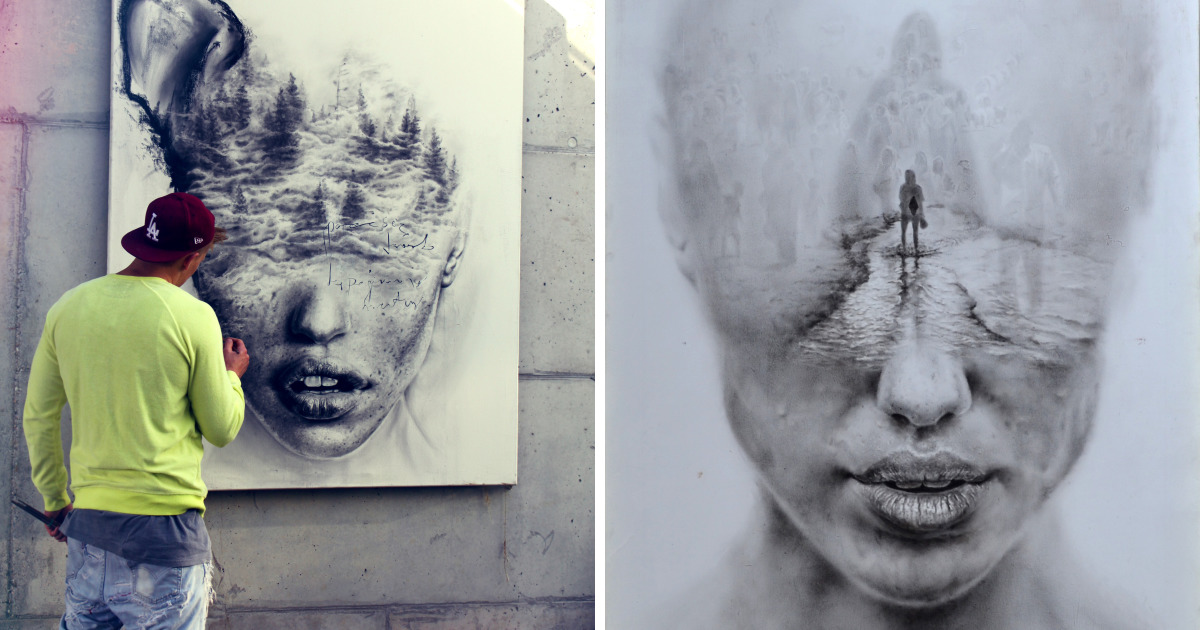
Some paintings are designed to brighten a room. Mine occasionally make people reconsider every life decision they have made since breakfast.
I do not say that proudly or dramatically. I say it because my work begins with subjects that are difficult to look at and even harder to discuss: death, depression, children living through war, poverty, homelessness, addiction, narcissism, isolation, and the slow disappearance of empathy. These are not decorative themes. Nobody looks at a painting about human suffering and says, “Perfectthe gray tones match my new couch.”
Yet I continue returning to these subjects because silence has a visual language too. It appears in a lowered face, an unfinished gesture, an empty chair, or a pair of hands that seem to have forgotten what they were reaching for. Painting gives me a way to make that silence visible.
My purpose is not to convince viewers that life is hopeless. It is almost the opposite. I want to show how cruel life can become while preserving a small but stubborn particle of hope. That fragile contrast matters. Without darkness, hope becomes a slogan. Without hope, darkness becomes spectacle.
Why I Paint What People Would Rather Avoid
Human beings are skilled at looking away. We scroll past suffering, change the channel, cross the street, or tell ourselves that someone else understands the problem better. Modern life gives us endless opportunities to stay informed while remaining emotionally untouched.
A painting interrupts that habit.
It does not disappear after five seconds unless the viewer chooses to leave. A painted face remains in the room. Its eyes do not refresh into another headline. Its body cannot be minimized into a notification. The stillness of the image creates a confrontation, although I prefer to think of it as a meeting.
Artists have long used images to preserve grief, protest violence, and give form to experiences that ordinary language struggles to contain. American mourning pictures transformed private loss into symbolic scenes, while modern artists have continued to examine death, memory, war, racial violence, and social injustice through deeply personal visual languages.
My paintings belong to that broad tradition of witnessing. I cannot repair every tragedy I depict. Paint is famously bad at negotiating peace treaties or fixing housing policy. What it can do is demand a moment of attention.
The Tragedies Behind the Faces
Death and the Weight of Absence
Death is one of the oldest subjects in art because it is one of the few experiences that is universal and still feels impossible to understand. It creates an absence that somehow occupies space. A missing person can become the loudest presence in a room.
When I explore death in a painting, I am rarely interested in presenting the event itself. I am more interested in the emotional weather afterward: the confusion, guilt, silence, anger, and strange practical details that continue while a person’s world has stopped. Someone still has to answer the telephone. The dishes remain in the sink. Morning arrives with absolutely no respect for anyone’s grief.
Pablo Picasso’s The Tragedy, painted almost entirely in blue, shows three barefoot figures gathered near the water. Their postures carry the emotional force of loss without explaining exactly what occurred. Its power comes partly from what remains unknown, allowing viewers to recognize their own emotional histories within the scene.
That restraint is important to me. Tragedy does not always require graphic detail. Sometimes a turned shoulder says enough.
Depression and Invisible Collapse
Physical wounds are understood quickly because they provide evidence. Depression is often less cooperative. It can hide behind clean clothing, polite conversation, professional success, or a perfectly timed joke.
In paintings about depression, I use faces, fragmented bodies, distorted proportions, obscured eyes, and areas of unresolved space. These visual choices reflect the feeling of being present but disconnected, visible but unreachable. A figure may occupy most of the canvas and still appear to be vanishing.
I do not want to romanticize depression as the mysterious fuel of creative genius. Suffering does not automatically produce good art. Sometimes suffering produces nothing except suffering, unanswered messages, and a heroic collection of unwashed coffee cups.
The goal is to acknowledge an internal reality that outsiders may not see. When viewers recognize that emotional state, they often realize that their private experiences are not as isolated as they believed.
War Seen Through Children
War is frequently represented through machinery, uniforms, leaders, maps, and statistics. Those elements may explain how conflicts are organized, but they do not always reveal what violence feels like to a child.
Children do not choose borders, ideologies, or military strategies. Nevertheless, they inherit the explosions, displacement, hunger, fear, and memories created by adults. In my work, a child’s face can represent both extreme vulnerability and the shameful failure of the grown-up world.
The most effective anti-war art often avoids presenting victory as clean or heroic. Jacob Lawrence wanted his war images to communicate the emotions experienced by both civilians and fighters, while works associated with artists such as Käthe Kollwitz transformed grief and resistance into images that continue to carry messages of human dignity and hope.
When painting war-affected children, I try to resist turning pain into theatrical scenery. The child must remain a person, not a symbol conveniently arranged to make an audience feel noble for thirty seconds.
Poverty, Homelessness, and Social Invisibility
Poverty is often discussed as a number, an economic condition, or an unfortunate background problem. Painting forces the subject back into human scale.
A person without stable housing still has habits, memories, humor, pride, irritations, preferences, relationships, and plans. Homelessness is a condition someone experiences; it is not the total definition of that person.
That distinction guides my approach. I do not want to paint “the homeless” as an anonymous category. I want to depict individuals whom society has trained itself not to see. The challenge is to show vulnerability without removing dignity.
Art therapists working in homeless shelters have described creative work as a way for people processing trauma, grief, substance-use recovery, and housing instability to preserve their stories and take pride in something they have made. My paintings are not art therapy, but that work reinforces an essential principle: people experiencing hardship should never be reduced to their hardship.
Addiction, Narcissism, and the Loss of Connection
Addiction is another tragedy that spreads beyond one body. It affects families, friendships, work, trust, memory, and time. The person struggling may feel trapped between craving, shame, denial, and the exhausting promises of “never again.” Those nearby may alternate between anger, fear, compassion, and emotional fatigue.
In contrast, narcissism and lack of empathy interest me because they reveal suffering from another direction. Instead of showing someone crushed by pain, these subjects explore what happens when people become unableor unwillingto recognize pain in others.
A narcissistic figure may be beautifully presented but emotionally hollow. A polished surface can be paired with damaged forms underneath. The face may appear confident while its surroundings show the cost of treating other people as mirrors, tools, or background characters.
These paintings ask uncomfortable questions. How much harm begins with the inability to imagine another person’s inner life? How often do we mistake confidence for character, visibility for value, or attention for love?
How My Visual Language Carries Emotion
Monochrome Is More Than an Absence of Color
Many of my realistic works rely heavily on black, white, and gray. A limited palette removes distractions and creates a psychological atmosphere similar to memory, documentary photography, or a dream that has forgotten how color works.
Monochrome also allows small changes in light, texture, and expression to become more noticeable. A pale mark can resemble a wound, reflection, tear, or opening. A deep black area can become hair, clothing, shadow, or emotional weight.
When color appears, it can behave like an interruption. Bright marks may suggest childhood, hope, danger, consumer culture, or the chaotic energy of a world continuing around someone’s pain. My paintings have often combined realistic monochrome faces or silhouettes with sudden colored elements and marks that resemble spontaneous drawings.
Faces, Fragments, and Unfinished Stories
I often focus on faces because viewers instinctively search them for information. We look at the eyes, mouth, forehead, and tension in the jaw. We ask what has happened, even when the painting refuses to provide a complete answer.
Fragments are equally important. A cropped body or partially hidden face suggests that viewers are seeing only part of the person’s experience. That is usually true outside art as well. We meet people in the middle of stories we do not know and judge them using the emotional equivalent of three sentences and a blurry photograph.
Leaving parts unresolved gives viewers room to participate. The painting does not hand them a finished moral lesson wrapped in a bow. It asks them to remain present with uncertainty.
The Ethical Problem of Painting Suffering
There is a danger in making art about tragedy. Pain can be exploited. A dramatic image may attract attention while doing nothing for the people whose experiences inspired it. The suffering of strangers can become visual material consumed by comfortable audiences.
I have to question my own intentions repeatedly. Am I creating empathy or merely shock? Am I respecting the subject’s humanity? Does the image invite reflection, or does it turn a person into emotional decoration?
Ethical art cannot guarantee an ethical response, but the artist can avoid unnecessary sensationalism. I try to focus on emotional truth rather than graphic spectacle. I also avoid pretending that a single painting can fully explain war, addiction, poverty, or mental illness. These subjects are larger than any canvas and much larger than the person holding the brush.
The distinction between socially conscious art and clinical art therapy also matters. Art therapy is a mental health profession conducted within a therapeutic relationship by trained practitioners. A gallery painting may provoke recognition or conversation, but it should not be presented as a substitute for professional care.
Why Every Painting Needs a Particle of Hope
Hope in my work is rarely cheerful. It does not arrive wearing a cape. It may be a narrow area of light, an unfinished gesture, a childlike color, two figures standing close together, or a person who remains upright despite everything trying to erase them.
That small sign matters because tragedy is not the only truth about a person. Someone may be grieving and still capable of love. Someone may live with depression and still laugh. Someone may experience homelessness and still make plans. Someone recovering from addiction is more than the worst moment of that addiction.
Art does not have to deny darkness to resist it.
MoMA’s exploration of art and grief emphasizes the ways images can create space for feelings, memory, bodily response, and conversation. Research highlighted by the National Endowment for the Arts has also found positive relationships between arts engagement and social connectedness. These findings do not mean every sad painting heals every viewer. Human beings are not flat-pack furniture; the same instructions do not work for everyone. They do suggest that art can help people encounter difficult emotions together rather than carrying them entirely alone.
What I Hope Viewers Carry Away
I do not expect my paintings to save the world. That is too large a job for canvas, oil, charcoal, metal, or one exhausted artist staring suspiciously at a brush at two in the morning.
I hope for something smaller and more realistic.
I hope a viewer pauses before judging someone whose life looks unfamiliar. I hope a person recognizes hidden suffering in a friend. I hope someone appreciates an ordinary evening, a safe room, a shared meal, a working body, or the presence of a loved one.
Most of all, I hope the paintings strengthen empathy. Empathy is sometimes treated as softness, but it requires discipline. It asks us to look beyond our own comfort and accept that another person’s pain remains real even when we do not fully understand it.
A painting cannot force that realization. It can only open the door and make leaving slightly more difficult.
Extended Studio Experience: Living With Difficult Images
The experience of creating paintings about tragedy begins long before paint reaches the surface. It often starts with a photograph, a remembered expression, a news story, an encounter in the street, or an uncomfortable question that refuses to leave. Some ideas arrive with complete visual clarity. Others remain for months as little more than emotional pressure.
When an image begins to form, I think first about the person rather than the tragedy. This sounds obvious, but it changes everything. If I begin with “war,” the subject becomes enormous and abstract. If I begin with one child trying to sleep while adults argue about borders, the emotional scale becomes human. If I begin with “homelessness,” I risk painting a category. If I begin with one tired face, one weathered coat, or one hand protecting a small personal object, I begin to see an individual.
The first stages can be technical: choosing proportions, building values, correcting anatomy, and deciding which details deserve attention. Yet technical control is only part of the process. A perfectly painted eye can still communicate nothing. Sometimes the more accurate a face becomes, the less truthful it feels. Then I scrape, blur, cover, or fracture what I have made.
That destruction can be useful. Tragedy rarely leaves a person’s identity neatly outlined. It interrupts. It removes. It creates versions of “before” and “after” that cannot be fitted together without visible seams. Layering, erasure, scratches, drips, and broken contours allow the physical surface to carry some of that disruption.
There are days when working on a painful subject creates emotional distance. The studio becomes quiet, analytical, and almost surgical. I study edges, shadows, and composition. On other days, the subject feels uncomfortably close. A minor detaila child’s sleeve, an empty background, the tension around a mouthcan suddenly hold the weight of the entire painting.
When that happens, I step away. Distance is part of the work. Staring continuously does not guarantee deeper understanding; sometimes it only guarantees terrible posture.
Returning later allows me to ask whether the painting still respects its subject. I examine what has become too beautiful, too dramatic, too obvious, or too emotionally convenient. Beauty is not forbidden, but it must not make suffering easy to consume. A visually attractive surface can draw someone closer, yet what they discover there should resist becoming entertainment.
The final stage is rarely a feeling of completion. It is closer to recognizing that further changes would begin to weaken the image. I stop when the painting can hold silence without appearing empty and when hope is present without behaving like a commercial.
Then the work leaves the studio and becomes something I can no longer control. One viewer may see grief. Another may see a parent, a childhood memory, a fear, or a part of themselves they have avoided. Someone else may see only gray paint and wonder why artists cannot produce more cheerful pictures of fruit.
All of those responses belong to the life of the work. My responsibility is not to dictate one emotion. It is to create an honest place where emotion can occur.
Final Thoughts
My paintings explore different tragedies because tragedy reveals how connected human lives really are. War reaches families. Addiction reshapes relationships. Poverty affects dignity. Depression can hide inside success. Death changes the meaning of ordinary objects. A lack of empathy allows every other tragedy to grow.
But suffering is not the final subject of my work. The final subject is our response to it.
We can look away, or we can look carefully. We can reduce people to problems, or we can recognize their complexity. We can treat empathy as a pleasant idea, or we can practice it when it becomes inconvenient.
I paint because careful looking is a beginning.
Note: This article synthesizes the artist’s published statements and current multidisciplinary practice with research and interpretation from American museums, arts organizations, psychology resources, and art-therapy professionals.