Editorial note: This article is based on Popular Mechanics’ 2025 remote-control-car roundup, along with product documentation, hobby-industry guidance, toy-testing coverage, and battery-safety resources. Model availability, inc pricing can change, so verify the current package before publishing or buying.
Remote control cars have come a long way from the days when “high performance” meant a plastic buggy that could make one heroic left turn before meeting the living room wall. Today’s best RC cars can scramble over rocks, slide across pavement, sprint through grass, and turn a quiet afternoon into a very small but very intense motorsports event.
Popular Mechanics’ 2025 testing roundup makes one thing clear: there is no universal “best” RC car. The ideal choice depends on whether you want to blast across a backyard, crawl over landscaping rocks, learn controlled drifts, collect a detailed miniature, or simply keep a kid happily occupied without donating your furniture to the crash-test program.
The strongest models in the roundup range from compact, affordable beginner trucks to serious hobby-grade machines with brushless power and upgrade potential. Here is a closer look at the best remote control cars of 2025, what makes each one stand out, and how to choose an RC vehicle that fits your space, budget, and appetite for tiny tire tracks.
How Popular Mechanics Evaluated the Best RC Cars
Finding the right remote control car is not just about locating the highest top-speed number on a product page and shouting “sold.” Fast is fun, but usable speed, stable handling, strong suspension, responsive steering, battery life, and durability matter far more once the car meets grass, gravel, a curb, or the family dog’s suspiciously placed tennis ball.
Popular Mechanics evaluated its hands-on selections on indoor flooring and uneven outdoor terrain, paying attention to acceleration, handling, remote response, range, setup difficulty, and everyday durability. The test environments included smooth indoor surfaces, park terrain, hills, rocks, dirt, and backyard obstacles. That matters because an RC car that looks fantastic on a tabletop may become dramatically less impressive when asked to cross actual grass.
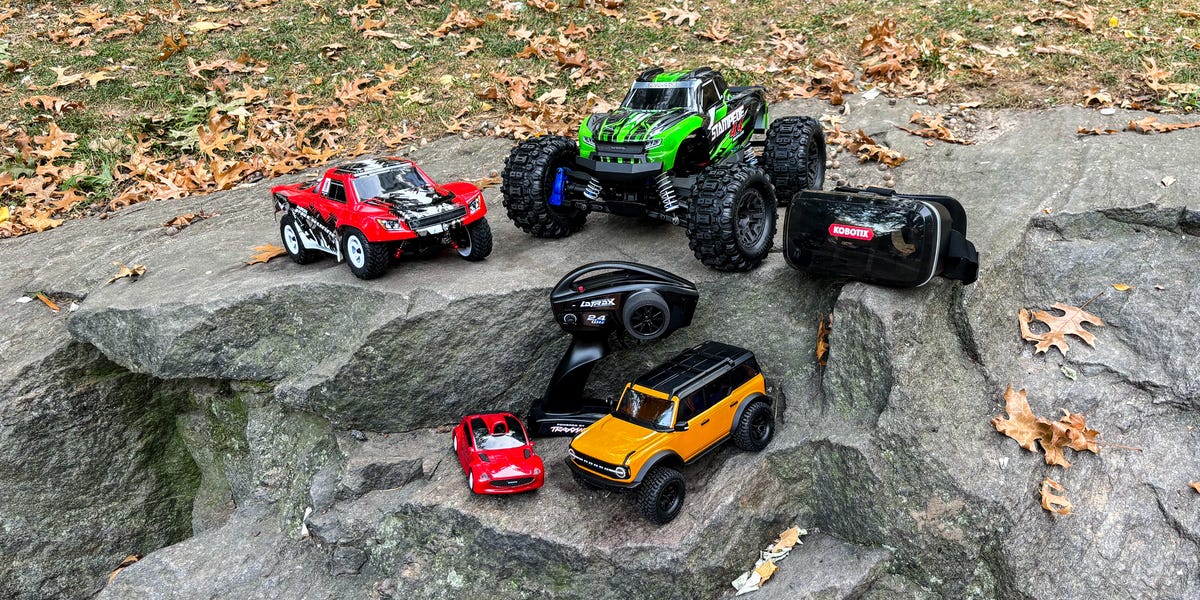
The 2025 list also covers several RC categories: monster trucks, off-road racers, rock crawlers, drift cars, and mini cars. Some were tested directly, while a couple of specialty recommendations were included after reviewing enthusiast feedback and product research. That is a useful distinction for shoppers because a rugged ready-to-run truck and an advanced assembly kit serve completely different kinds of drivers.
The Best Remote Control Cars of 2025
Best Overall: Traxxas Stampede 4×4 VXL Brushless Monster Truck
The Traxxas Stampede 4×4 VXL earned the overall title because it delivers the blend most shoppers actually want: quick acceleration, stable handling, real off-road capability, and the confidence to survive a few embarrassing driving mistakes. In other words, it is fast enough to feel exciting but sturdy enough to forgive the driver who suddenly remembers that steering exists halfway through a sprint.
This 1:10-scale monster truck uses oversized tires, four-wheel drive, responsive suspension, and a brushless power system. Those features help it stay composed on dirt, concrete, rocky terrain, and uneven grass. During testing, its handling stood out as much as its power. A high-speed RC vehicle is only enjoyable when it goes where you point it, rather than interpreting every turn as a creative suggestion.
The Stampede also makes sense for hobbyists who want a vehicle they can keep for years. Traxxas has a broad ecosystem of replacement parts, batteries, upgrades, tires, bodies, and accessories. That support matters. RC cars are fun because they move, jump, slide, and occasionally collide with objects that did not agree to participate. A repairable car is usually a better long-term purchase than a cheaper model that becomes a decorative shelf resident after one broken suspension arm.
Best for: Drivers who want a high-performance all-terrain RC truck with serious hobby-grade potential.
Best Value: Bezgar Off-Road Monster Truck 2WD
The Bezgar Off-Road Monster Truck 2WD is the approachable option for buyers who want more than a basic toy without immediately entering the world of premium batteries, performance tuning, and phrases like “differential gear ratio.” It offers an off-road monster-truck look, a compact 1:14-scale footprint, all-terrain tires, and a beginner-friendly setup.
As reviewed, the truck offers a claimed top speed of about 12 mph, approximately 20 minutes of drive time, and a 2.4 GHz controller with a range beyond 160 feet. That may not sound outrageous next to full hobby-grade speed machines, but for a first RC vehicle, it is plenty. Twelve mph becomes surprisingly dramatic when it is happening at ankle height and heading directly toward a garden hose.
Its aluminum body, spare tire detail, working roll-bar lights, and rugged styling give it more personality than a typical entry-level toy. The two-wheel-drive layout also keeps the experience less intimidating for new drivers. It will not match the Traxxas Stampede’s power, suspension, or upgrade path, but it can introduce kids, casual users, and budget-minded shoppers to outdoor RC driving without demanding a second mortgage.
Best for: Beginners and families seeking an affordable off-road RC truck with more capability than a basic department-store toy.
Best Replica and Rock Crawler: Traxxas TRX-4M Ford Bronco
The Traxxas TRX-4M Ford Bronco is proof that slow does not mean boring. It is a 1:18-scale crawler designed for control, traction, and detail rather than top-speed drama. Instead of racing down a driveway, this RC vehicle invites you to build a tiny expedition route over stones, branches, bricks, books, and any landscaping feature that suddenly looks like a mountain range.
The scaled Ford Bronco body is the main attraction. It gives collectors and automotive fans a miniature that looks impressively close to the full-size SUV, complete with realistic body details and working headlights. Beneath the shell, the vehicle uses a flexible chassis and suspension designed to maintain tire contact on uneven terrain.
That slow, torque-focused setup makes the TRX-4M especially satisfying for rock crawling. You are not trying to set a speed record; you are trying to place each wheel carefully, select a smart line, and avoid rolling backward into your own shoe. It becomes a small challenge course that rewards patience, precision, and an oddly intense amount of concentration for something smaller than a laptop.
Best for: Collectors, scale-model fans, and drivers who enjoy technical crawling instead of flat-out speed.
Best for Racing: Traxxas LaTrax Desert Prerunner
The LaTrax Desert Prerunner is the pick for drivers who want a quick, sporty RC truck that feels lively without requiring the full commitment of a high-end racing build. Its compact 1:18-scale size makes it easier to store and transport, while its suspension and grippy tires help it remain entertaining on dirt, gravel, small hills, and packed outdoor surfaces.
Popular Mechanics found the Desert Prerunner quick to accelerate, sharp in turns, and capable of keeping momentum across uneven ground. It also proved durable during ordinary wipeouts, which is welcome news for anyone whose first instinct is to aim for the most exciting-looking patch of terrain rather than the safest one.
It is not a professional competition machine, and it does not need to be. Its appeal is that it offers hobby-grade responsiveness in a package that remains manageable for newer drivers. The quick steering can take a little practice, but that is part of the fun. You start by making wide, wobbly turns; then, twenty minutes later, you are attempting a dirt-slide maneuver around a tree like you have a sponsorship deal.
Best for: Drivers who want nimble off-road speed and a compact hobby-grade RC racer.
Best for Drifting: Tamiya RC Nismo R34 GT-R Z-Tune
The Tamiya RC Nismo R34 GT-R Z-Tune is for people who see a smooth garage floor, empty parking lot, or polished indoor surface and immediately imagine a miniature drift course. Unlike monster trucks and crawlers, this 1:10-scale model is designed to slide, rotate, and make stylish controlled turns on hard surfaces.
Its drift-focused TT-02D chassis uses four-wheel drive, drift tires, oil-filled shocks, ball bearings, and a sport-tuned brushed motor. The model recreates the iconic Nismo R34 GT-R Z-Tune with a detailed polycarbonate body, LED light capability, and a chassis made for tuning as skills improve.
There is one important caveat: this is not a grab-it-and-go toy. It is an assembly kit. Buyers need to provide additional components such as a radio system, steering servo, battery, charger, and paint. Building it requires time, patience, and the ability to accept that one small screw will inevitably disappear into another dimension.
That extra effort is also the point. The Tamiya kit offers a more hands-on hobby experience, allowing owners to learn how an RC car works before learning how to make it drift around a corner with maximum style.
Best for: Builders, car-model fans, and drivers who want an on-road RC drift car they can customize.
Best Mini RC Car: Hot Wheels Remote-Control Lamborghini Revuelto
The Hot Wheels Remote-Control Lamborghini Revuelto brings RC fun down to desktop scale. It is tiny, rechargeable, and designed to run on compatible Hot Wheels tracks as well as flat surfaces. That makes it a great choice for younger kids, collectors, or anyone who wants remote-control fun without needing a backyard, a tool kit, or a designated pit crew.
The little Lamborghini will not conquer a rock garden or launch across a dirt ramp, but it does not pretend to. Its job is to bring quick, simple fun in a compact package. The rechargeable design is convenient, and track compatibility adds replay value for families who already own Hot Wheels loops, ramps, and launchers.
Think of it as an appetizer for the RC hobby. It is small, simple, and much less likely to knock over a flowerpot. It may also quietly convince a future hobbyist that they need a larger car, a stronger motor, and perhaps a garage-sized test track. That part is between them and their budget.
Best for: Young drivers, Hot Wheels fans, collectors, and compact indoor play.
How to Choose the Right RC Car
Start With Where You Plan to Drive
Your driving location should guide your choice more than maximum speed. A monster truck or basher makes sense for grass, dirt, pavement cracks, and backyard terrain. A rock crawler is ideal for low-speed technical routes over stones and obstacles. An on-road drift car belongs on clean, hard surfaces where its slick tires can slide predictably.
Buying a drift car for thick grass is like buying ice skates for a hiking trail. It may technically move, but nobody is going to have a great time.
Understand Hobby-Grade Versus Toy-Grade RC Cars
Toy-grade RC cars prioritize simple controls, lower prices, and easy play. They are often great for younger children or occasional indoor use. Hobby-grade RC cars usually offer stronger motors, better suspension, replaceable parts, more precise steering, longer-term upgrade potential, and better capability outdoors.
The trade-off is that hobby-grade models can require more upkeep, more careful battery management, and more spending on accessories. They can also be dramatically faster. For a first serious RC purchase, a durable ready-to-run truck is often a smarter choice than the fastest model you can afford.
Know What RTR Actually Means
RTR means “ready to run” or “ready to race,” depending on the brand’s wording. In practice, it means the vehicle comes largely assembled with a controller and electronics installed. However, do not assume every RTR box includes every last item. Some models still require separate batteries, chargers, or transmitter batteries.
Before buying, check for four things: the vehicle, the remote controller, the vehicle battery, and the charger. A car that is “ready to run” but missing the battery is technically ready in the same way a pizza is ready if you still have to make the dough.
Brushed or Brushless Motor?
Brushed motors are generally more affordable, easier for beginners to understand, and well suited to casual driving, crawlers, and lower-speed vehicles. Brushless motors are usually more efficient, more powerful, longer-lasting, and better suited to high-speed bashing or racing.
For most beginners, brushed power is perfectly respectable. For drivers who know they want speed, performance upgrades, and more aggressive outdoor driving, a brushless system is often worth the added investment. Just remember that more power requires more space, more control, and more respect for the fact that your little truck now has opinions about velocity.
Do Not Ignore Battery Safety
Many hobby-grade RC cars use lithium polymer batteries, often called LiPo packs. These batteries provide strong performance, but they must be charged, stored, and handled according to the manufacturer’s instructions. Use the correct charger, inspect batteries for visible damage or swelling, keep them away from extreme heat, and avoid leaving charging batteries unattended.
For younger drivers, adult supervision is sensible when charging and operating faster RC models. The goal is simple: keep the fun in the driveway, not in a cautionary family group chat.
What Driving the Best RC Cars Feels Like: A Real-World Experience
The best remote control cars are not just miniature vehicles; they create miniature stories. A serious RC session usually begins with optimism, a fully charged battery, and a vague promise to “just drive around for ten minutes.” That promise lasts until someone finds a curb that looks like a ramp, a pile of mulch that resembles a desert course, or a stack of books that clearly needs to become a rock-crawling obstacle.
With a monster truck like the Traxxas Stampede 4×4 VXL, the experience is loud in the best possible way. The truck’s size, tire grip, and power make every patch of uneven ground feel full of possibilities. A lawn stops being a lawn and becomes a rally stage. A driveway turns into a launch strip. A low landscaping border becomes a dramatic obstacle that deserves a slow-motion replay, even if the only camera available is a phone held by someone laughing too hard to keep it steady.
The fun is not just in speed. It is in learning how the vehicle reacts. At first, a new driver tends to use the throttle as an on-off switch: full speed or total confusion. Then the controls start to make sense. Gentle throttle inputs help the truck stay planted. Small steering corrections become smoother. The driver begins to understand that the fastest route is not always the wildest route. This revelation is usually followed immediately by trying the wildest route anyway.
A rock crawler offers a completely different experience. With a model such as the Traxxas TRX-4M Bronco, every small obstacle becomes a puzzle. You begin noticing tire placement, ground clearance, and the angle of a climb. A decorative stone that once served no purpose beyond looking nice suddenly becomes the final boss of the backyard. The reward is not a dramatic burst of speed; it is the quiet satisfaction of watching the crawler grip, flex, and inch over a surface that initially looked impossible.
Drift cars bring another kind of personality. On a smooth surface, the Tamiya Nismo R34 GT-R Z-Tune can turn simple circles into a skill challenge. The goal is not merely to get from one side of the room to the other. The goal is to link turns, control slides, and make the car look deliberate instead of accidental. There is a fine line between a clean drift and spinning in a circle while pretending it was planned. Fortunately, both are entertaining.
Mini RC cars add social energy to the hobby. A small Hot Wheels RC Lamborghini can be raced around furniture, sent through compatible track sections, and shared with younger drivers who may not yet be ready for a powerful off-road truck. Its small scale lowers the stakes but not the excitement. A tiny car zipping under a chair can produce the same cheers as a bigger model launching over a ramp because the core thrill is the same: you make something move, steer, recover, and succeed through your own inputs.
The best RC-car experiences usually happen when people stop treating the vehicle like a product and start treating it like a game. Set up cones. Use chalk to draw a course. Create a crawler route with safe household objects. Time laps. Challenge a friend to reverse through a narrow path. Practice smooth driving instead of maximum throttle. The car becomes more interesting when there is a goal beyond “see how fast it can hit the fence.”
That is why RC cars remain timeless. They combine technology, skill, creativity, and a little bit of chaos. Whether you are eight years old, forty-eight years old, or merely claiming you bought the car “for the kids,” a good RC vehicle can turn an ordinary space into a tiny world of speed, control, and triumph.
Final Verdict: Which Remote Control Car Should You Buy?
For most serious RC fans, the Traxxas Stampede 4×4 VXL is the standout choice because it balances speed, toughness, off-road ability, and long-term upgrade potential. It is the remote control car most likely to satisfy a beginner who wants room to grow and an experienced hobbyist who wants an all-terrain machine that can take a beating.
Buyers who want a more affordable first step should look at the Bezgar Off-Road Monster Truck 2WD. The Traxxas TRX-4M Ford Bronco is the better fit for scale realism and rock crawling. The LaTrax Desert Prerunner works well for compact off-road racing, while the Tamiya Nismo R34 GT-R Z-Tune is the rewarding choice for builders and drift enthusiasts. For small-scale indoor fun, the Hot Wheels Lamborghini Revuelto makes a charming entry point.
The winning move is not to chase the highest number on the box. Choose an RC car that matches your terrain, experience level, available space, and willingness to learn. Then charge the battery, clear the course, and try not to let the smallest vehicle in the yard become the most confident driver.