Note: The “$1 billion” headline describes the maximum potential value of the Rhode acquisition. E.L.F. Beauty paid $800 million at closing, while up to $200 million more depends on Rhode’s future performance over three years.
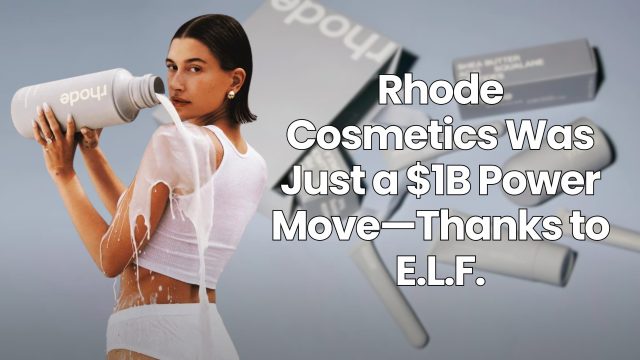
Beauty brands are usually sold with a press release, a photo of someone holding a serum, and enough corporate enthusiasm to moisturize the Mojave. Rhode’s sale to E.L.F. Beauty, however, was a different animal. This was not just a celebrity skincare brand getting acquired. It was a modern beauty power move worth up to $1 billion, involving viral lip treatments, direct-to-consumer obsession, a carefully cultivated “glazed” aesthetic, and one very strategic buyer that understood what it was really purchasing.
On the surface, E.L.F. Beauty bought Hailey Bieber’s Rhode. In reality, it bought a highly focused beauty brand with cultural relevance, unusually strong customer demand, a tightly managed product assortment, and a founder who can turn a pocket-sized lip treatment into a social media event. Rhode did not win because it launched a warehouse full of products. It won because it built desire before it built clutter.
That is why the Rhode Cosmetics acquisition matters beyond celebrity gossip or stock-market headlines. It is a case study in brand discipline, consumer psychology, creator marketing, retail expansion, and the growing financial value of internet-native beauty companies. Somewhere, a boardroom accountant probably had to explain why a phone case designed to hold lip balm was part of a billion-dollar conversation. Welcome to beauty in the 2020s.
Rhode Was Not a Random $1 Billion Purchase
E.L.F. Beauty announced its agreement to acquire Rhode on May 28, 2025, and completed the transaction on August 5, 2025. The deal included $600 million in cash, approximately $200 million in E.L.F. stock, and a possible $200 million earnout tied to Rhode’s performance over the following three years. That structure matters because it means the headline value was not simply a giant check dropped on a conference-room table with a dramatic “ta-da.”
The earnout gave E.L.F. a reason to reward continued Rhode growth while keeping the founding team motivated after the sale. Hailey Bieber remained involved as Rhode’s Chief Creative Officer and Head of Innovation, while also serving as a strategic adviser to E.L.F. Beauty. That arrangement protects one of Rhode’s most valuable assets: its founder-led point of view.
Rhode’s growth was not theoretical. Before the deal, the company reported roughly $212 million in net sales during the 12 months ending March 31, 2025, despite operating primarily through direct-to-consumer channels and offering a small number of products. It is hard to overstate how unusual that is. Many beauty brands throw dozens of launches at consumers, hoping one becomes a hit. Rhode built a compact menu and made people care about nearly every item on it.
In the beauty world, where new brands appear faster than limited-edition lip glosses disappear from shelves, simplicity can be a superpower. Rhode showed that a smaller assortment can make a brand feel more intentional, easier to understand, and more collectible. Instead of sending consumers on a scavenger hunt through 40 moisturizers, it gave them a short, recognizable lineup built around skin comfort, lip care, and soft-focus glow.
That clarity made Rhode easier to market, easier to remember, and easier to share. It also made the brand easier for E.L.F. to scale.
Why E.L.F. Wanted Rhode So Badly
E.L.F. Beauty was already known for accessible cosmetics, viral launches, affordable pricing, and its ability to move quickly in a market where trends can explode overnight. Its core brand had long benefited from social media buzz and “dupe culture,” where consumers search for wallet-friendly alternatives to prestige beauty products.
Rhode brought a different but complementary set of strengths. It had a more premium image, a celebrity founder with serious beauty influence, a direct relationship with younger consumers, and a brand identity that felt aspirational without becoming intimidating. Rhode did not scream luxury in the old-school, marble-counter, velvet-chair sense. It felt more like the beauty shelf of someone who owns a really good robe and somehow always has a clean phone case.
For E.L.F., Rhode created a bridge between mass beauty and prestige beauty. That bridge is valuable because consumers increasingly shop across price points. Someone may buy an affordable mascara, a mid-priced skin tint, and a premium lip treatment during the same shopping trip. Beauty shoppers are not loyal to one price tier; they are loyal to products that make them feel like they made a smart choice.
Rhode also gave E.L.F. more room to expand in skincare and hybrid makeup, categories where ingredients, textures, packaging, and lifestyle branding can command higher price points. E.L.F. did not need Rhode to become another version of itself. It needed Rhode to remain Rhode while gaining access to more capital, more retail reach, more operational support, and more international possibilities.
That is the sweet spot in a smart acquisition: do not sand off the interesting edges of the company you bought. Build around them.
The Real Product Was More Than Peptide Lip Treatment
Rhode’s products mattered, of course. Its Peptide Lip Treatment, Pocket Blush, Barrier Restore Cream, Glazing Milk, and other skin-focused launches became recognizable because they fit a larger beauty story. The brand sold a visual language: hydrated skin, soft lips, minimal effort, and the kind of glow that says, “Yes, I drink water,” even when the truth is mostly iced coffee.
The magic was not just in the formulas. It was in how the products fit into everyday content. Rhode products photographed well, traveled well, and made sense in short-form videos. A lip treatment could be clipped into a phone case. A blush could be applied in a car mirror. A skincare product could appear in a “get ready with me” video without feeling like an interruption.
That matters because modern beauty marketing is increasingly about usability in real life and visibility online. Consumers do not only ask whether a product works. They ask whether it looks good on a bathroom counter, whether it is easy to carry, whether it fits into their routine, and whether it gives them something fun to post.
Rhode understood that product design and social media design are no longer separate jobs. A product can be technically excellent and still struggle if it has no personality. Rhode’s packaging, color palette, campaign imagery, and product names made the brand instantly recognizable. That recognition lowered the amount of explanation required. When people see the product, they know what world it belongs to.
Celebrity Beauty Is Growing Up
For years, celebrity beauty brands had a reputation problem. Some were brilliant businesses. Others felt like a logo rental agreement with extra highlighter. Consumers learned to be skeptical, and they had every reason to be. Fame can generate awareness, but it cannot force people to repurchase a moisturizer that feels like candle wax.
Rhode succeeded because it did not depend entirely on Hailey Bieber appearing in every campaign and shouting, “Buy this, please.” Her influence was clearly important, but the brand also built credibility through product focus, packaging, creator seeding, pop-ups, and a consistent aesthetic. The goal was for Rhode to become recognizable beyond its founder, and that is exactly the kind of evolution a buyer wants to see.
NielsenIQ has reported that celebrity-founded beauty brands collectively surpassed $1 billion in sales in 2023, growing faster than the overall beauty category. The lesson is not that every celebrity should launch a serum tomorrow morning. The lesson is that celebrity brands can work when they have a clear identity, credible products, consistent storytelling, and a real reason for customers to return.
Rhode’s acquisition gave the market another important signal: celebrity-led brands are no longer automatically dismissed as vanity projects. When the operation is disciplined and the product-market fit is real, a celebrity can function as a cultural accelerator rather than the entire business model.
Sephora Was the Next Logical Level
Before E.L.F. acquired Rhode, the brand had already proven that it could generate major demand online. The next opportunity was retail expansion. Rhode’s move into Sephora gave consumers a chance to touch products, test shades, smell formulas, and make those small but important in-person decisions that online beauty cannot always replicate.
Retail also changes a brand’s scale. A direct-to-consumer business can build a devoted audience, but physical distribution can introduce the brand to shoppers who have never watched a Hailey Bieber skincare video or searched for “glazed donut skin” at 1:00 a.m. Retail gives a brand discovery. It gives it legitimacy. It gives it impulse-buy potential, which is a very fancy way of saying people may walk in for eyeliner and leave with three lip products they absolutely did not plan to buy.
Rhode’s Sephora debut was reported as a major success, reinforcing the idea that the brand’s demand extended beyond social media hype. E.L.F. benefited from that momentum because it could combine Rhode’s desirability with a larger company’s experience in distribution, marketing, manufacturing, and retailer relationships.
The expansion also created international opportunity. Rhode already had a significant social following outside the United States, making international beauty retail a logical next chapter rather than a random map-pin exercise.
What Happened After the Acquisition
The strongest evidence that E.L.F. did not simply buy a beautiful mood board came later. In its fiscal 2026 reporting, E.L.F. said Rhode contributed $293.5 million in net sales from the acquisition date through March 31, 2026. The company also recorded a $57.6 million increase in the fair value of Rhode’s contingent consideration because Rhode’s revenue performance outpaced the earnout thresholds.
That accounting detail may sound like something designed to make normal people gently close a spreadsheet. But it carries a simple message: Rhode performed strongly enough that the potential additional payout became more valuable. In plain English, the earnout was looking less hypothetical.
E.L.F. also reported fiscal 2026 net sales of more than $1.6 billion, showing the larger company was still growing while integrating Rhode. That does not mean the acquisition came without risk. Large deals can create pressure, especially when a buyer faces tariff costs, changing consumer demand, and the challenge of protecting a smaller brand’s identity inside a larger corporate structure.
Still, Rhode gave E.L.F. something many public beauty companies desperately want: a fast-growing, culturally relevant brand with product momentum and a founder who remains active in the creative engine.
The Risks Behind the Glow
No acquisition is automatically a fairy tale with lip balm. E.L.F. must prove that Rhode can grow without becoming overexposed, over-distributed, or over-launched. Beauty consumers are incredibly loyal until they are not. The same audience that makes a product viral can move on the moment a newer, shinier, slightly weirder brand appears in their feed.
Rhode also faces the classic challenge of every founder-led business: how do you scale while preserving the original taste level? Once a brand enters larger retail networks and more markets, it can be tempting to launch too many products, chase every trend, or blur the identity that made it special.
The answer is likely restraint. Rhode should continue behaving like a tightly edited brand, not a beauty vending machine. It needs product launches that feel earned, not panic-driven. Consumers can smell desperation faster than they can smell a new peptide formula.
E.L.F. must also balance Rhode’s premium positioning with its own reputation for accessible value. The brands can complement each other, but they should not become confusing cousins borrowing each other’s clothes without asking.
Experience-Based Lessons From Rhode’s $1 Billion Beauty Playbook
The Rhode story offers useful lessons for founders, marketers, small business owners, and anyone trying to sell something on the internet without becoming allergic to their own branding. The first lesson is that a narrow focus can create more power than a giant catalog. Rhode did not try to solve every skincare concern from acne to existential dread. It built a concise lineup around skin barrier support, lip care, glow, and easy everyday beauty.
That approach creates a stronger customer experience. When people land on a website and immediately understand what a brand is about, they are more likely to remember it. A clear brand is easier to buy from because it reduces decision fatigue. Instead of making customers compare 17 nearly identical products, it gives them a small collection with obvious roles. This is especially important for new brands that do not have unlimited budgets for education or advertising.
The second lesson is that packaging is part of the product experience. Rhode’s design language helped transform ordinary beauty categories into social objects. The products did not merely sit in a drawer; they appeared in videos, photos, bags, cars, bathrooms, and mirror selfies. That visibility created free cultural distribution. Every consumer post became a tiny piece of advertising, often more persuasive than a polished campaign.
The third lesson is that founder visibility works best when it feels integrated rather than forced. Hailey Bieber did not need to behave like a late-night infomercial host. Her role was more effective because Rhode felt connected to her personal beauty aesthetic and routine. Consumers could see the relationship between founder, product, and brand world. That makes the endorsement feel less like a paycheck and more like a point of view.
The fourth lesson is operational. A brand can be cool and still need grown-up business systems. Rhode’s success was not built only on celebrity. It also relied on experienced operators, disciplined launches, direct-to-consumer infrastructure, marketing execution, and the ability to turn demand into actual sales. Viral attention is fun. Fulfilling orders, managing inventory, handling customer service, and planning retail expansion are less glamorous, but they are where companies either become real businesses or turn into cautionary TikTok threads.
The fifth lesson is that an acquisition should accelerate a company, not erase it. E.L.F. did not buy Rhode because it wanted another copy of E.L.F. Cosmetics. It bought Rhode because the brand brought a different consumer, a different aesthetic, and a different level of prestige. Businesses considering partnerships or acquisitions should ask one simple question: does the larger company make the smaller company stronger without making it unrecognizable?
Finally, Rhode proves that social media is not merely a marketing channel. For modern beauty brands, it is market research, product testing, community building, brand storytelling, customer service, and distribution all packed into one very chaotic feed. The brands that win are not always the loudest. They are the ones that know how to turn attention into trust, trust into repeat purchases, and repeat purchases into a business someone is willing to value at nine or ten figures.
Conclusion: E.L.F. Bought More Than a Beauty Brand
The Rhode Cosmetics acquisition was a $1 billion power move because it combined the things beauty buyers value most: growth, community, cultural relevance, focused products, retail potential, and a founder whose influence still matters after the deal closes.
E.L.F. did not simply purchase a celebrity skincare company. It acquired a high-growth platform that understands modern beauty behavior. Rhode knows that consumers want products that perform, look good, travel well, photograph well, and feel like part of a larger lifestyle. That may sound like a lot to ask from lip treatment, but apparently it is worth a lot of money.
For entrepreneurs, the message is encouraging. You do not need 500 products, a giant corporate office, or an army of celebrity friends to build value. You need a clear idea, excellent execution, recognizable branding, real customer demand, and enough patience to avoid launching a “hydrating glow mist” every time the internet gets bored.
Rhode’s story is proof that in modern beauty, the smallest product can carry the biggest business idea.
Reporting note: Deal mechanics, Rhode’s sales performance, E.L.F.’s fiscal results, retail expansion, and wider celebrity-beauty market context were reviewed against E.L.F. Beauty disclosures, SEC filings, Reuters, AP, Vogue, Glossy, Allure, Forbes, The Washington Post, Business of Fashion, NielsenIQ, Sephora, and WWD reporting.