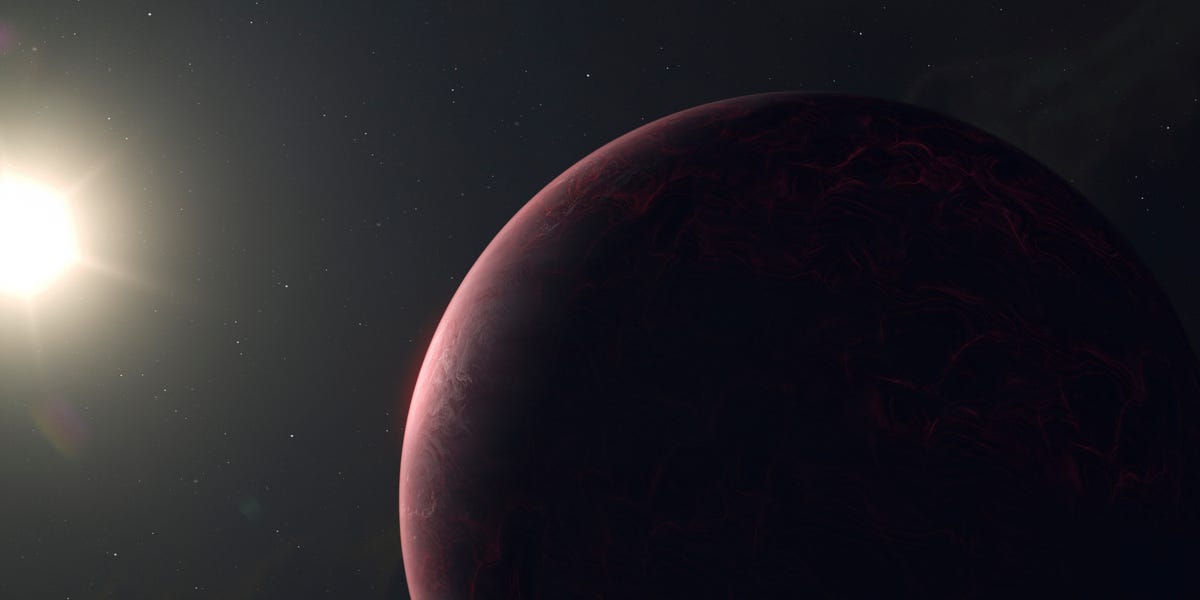
Somewhere far beyond Neptune, in the dim suburbs of the solar system, astronomers may be chasing a giant hidden planet. Or they may be chasing a crack in our understanding of gravity. Either way, the story has everything a good cosmic mystery needs: invisible suspects, weird orbital behavior, heated academic disagreement, and enough math to make your calculator quietly resign.
The question sounds like science fiction, but it is very real: could Planet 9 actually just be controversial physics? More specifically, could the strange motion of distant objects in the Kuiper Belt be explained not by an undiscovered planet, but by a modified theory of gravity known as MOND, or Modified Newtonian Dynamics?
Planet 9, sometimes called Planet X, has not been directly observed. No telescope has snapped a triumphant “there it is” image. Instead, the case for it comes from patterns in the orbits of distant trans-Neptunian objects, icy bodies that travel far beyond Neptune. Some of these objects appear to have orbits that cluster in unusual ways, as if something massive and unseen is shepherding them from the darkness.
But in astronomy, an invisible object is not the only possible explanation for a visible pattern. Sometimes the pattern is caused by selection bias. Sometimes it is caused by ancient stellar encounters. Sometimes it is caused by the fact that the universe enjoys making scientists sweat. And sometimes, just sometimes, it may mean the rules of gravity behave differently in extreme environments.
What Is Planet 9 Supposed to Be?
Planet 9 is a hypothetical large planet thought to orbit the Sun far beyond Neptune. In popular terms, it is the solar system’s most elusive roommate: it may be huge, it may influence everything around it, and yet somehow it has never shown up when anyone looks directly.
The modern Planet 9 hypothesis gained major attention in 2016 when researchers Konstantin Batygin and Michael Brown argued that the unusual orbital alignment of several distant Kuiper Belt objects could be explained by a large planet on a faraway, elliptical orbit. Early estimates suggested a world several times more massive than Earth, perhaps somewhere between a super-Earth and a mini-Neptune, moving hundreds of astronomical units from the Sun. One astronomical unit, or AU, is the average distance between Earth and the Sun. So yes, this is not exactly next door. Neptune orbits at about 30 AU; Planet 9, if real, may be hundreds of AU away.
The reason such a planet could remain hidden is simple: distance is brutal. At those ranges, sunlight is faint, reflected light is weaker still, and a planet moving slowly against the background stars can look like an extremely shy dot. Finding it would be less like spotting Jupiter and more like trying to find a charcoal marble in a football stadium at midnight.
The Evidence: Strange Orbits in the Kuiper Belt
The strongest argument for Planet 9 comes from the outer solar system, especially the Kuiper Belt and related populations of distant objects. These icy bodies are leftovers from planetary formation, like cosmic crumbs from the solar system’s messy construction project.
Several extreme trans-Neptunian objects have large, elongated orbits. Some never come close enough to Neptune for Neptune’s gravity to easily explain their behavior. Their orbits appear to share suspicious alignments, including clustering in the direction of their closest approach to the Sun and similarities in orbital plane orientation. In a random solar system, astronomers might expect these objects to point every which way, like a drawer full of tangled charging cables. Instead, some seem to be arranged with a kind of gravitational choreography.
The Planet 9 model says that a massive unseen planet could nudge these objects over long timescales. It would not need to crash into them or yank them dramatically like a villain in a space opera. Gravity works with patience. Over millions or billions of years, small repeated tugs can sculpt orbits into recognizable patterns.
Supporters of Planet 9 also point out that the hypothesis makes testable predictions. A good scientific idea should not merely explain the data already sitting on the table; it should also predict what might be found next. Planet 9 models have been used to explain detached objects like Sedna, unusual high-inclination bodies, and other orbital oddities in the distant solar system.
Why Some Astronomers Are Not Convinced
Planet 9 has a problem common to many dramatic scientific ideas: the evidence is intriguing, but the main character has not appeared onstage. Until a telescope directly detects it, Planet 9 remains a hypothesis.
One major concern is observational bias. Distant Kuiper Belt objects are very faint. Astronomers usually discover them near perihelion, when they are closest to the Sun and therefore brightest. Surveys also do not cover every part of the sky equally. Weather, telescope schedules, galactic background brightness, and survey design all influence what gets discovered. That means apparent clustering might partly reflect where and how humans have looked, rather than how the solar system is truly arranged.
This is not a small detail. In outer solar system astronomy, the known sample is tiny compared with the vast population likely waiting to be discovered. Imagine trying to understand the layout of a city after seeing only six porch lights through fog. You might be right about the neighborhood. You might also be confidently wrong in high definition.
Other explanations have also been proposed. Some researchers have explored whether a massive disk of small bodies, past stellar flybys, or the migration history of the giant planets could produce similar patterns. None has completely ended the debate. That is why Planet 9 remains both exciting and controversial: it is plausible enough to be taken seriously, but uncertain enough to keep everyone arguing politely through journal articles.
Enter MOND: The Controversial Physics Candidate
Now for the spicy part. MOND, short for Modified Newtonian Dynamics, is a theory that suggests gravity or inertia may behave differently at extremely low accelerations. It was originally proposed to address the mystery of galaxy rotation curves. In many galaxies, stars at the outer edges move faster than expected based on visible matter alone. The mainstream explanation is dark matter: an invisible form of matter that adds gravitational pull without emitting light.
MOND offers a different approach. Instead of adding unseen matter, it modifies the rules. Under MOND-like ideas, Newtonian gravity works extremely well in ordinary settings, such as falling apples, orbiting planets, and that coffee mug you definitely placed somewhere sensible. But at very low accelerations, like those found at the outskirts of galaxies, the effective behavior of gravity may shift.
This is controversial because dark matter is deeply woven into modern cosmology. It helps explain galaxy clusters, the cosmic microwave background, large-scale structure, and many observations beyond simple galaxy rotation. MOND has had notable success in some galactic contexts, but it struggles to replace dark matter across the entire universe. That makes it scientifically interesting but not the consensus view.
How Could MOND Explain the Planet 9 Puzzle?
The MOND alternative to Planet 9 asks a bold question: what if the strange alignments in the outer solar system are not caused by an unseen planet, but by the way gravity behaves when the Sun’s weak pull interacts with the gravitational field of the Milky Way?
In the inner solar system, Newtonian gravity and Einstein’s general relativity work magnificently. Spacecraft navigation, planetary ephemerides, eclipses, and satellite operations all depend on these theories being extremely accurate. But the outer solar system, especially the region hundreds of AU from the Sun, is a different environment. The Sun’s gravitational acceleration is much weaker there. MOND predicts that in such weak-acceleration regimes, an external field effect from the galaxy may become important.
Researchers studying MOND as an alternative to Planet 9 have argued that the same orbital anomalies used to motivate the search for a hidden planet could arise from modified gravitational behavior. In this view, the distant objects may align not because a large planet is pushing and pulling them, but because the combined effect of the Sun and the Milky Way’s gravitational field organizes their long-term motion.
That is a remarkable idea. It would mean the outer solar system is not just a planetary graveyard full of frozen leftovers; it could be a natural laboratory for testing physics usually discussed on galactic scales. Instead of needing a galaxy to study MOND, scientists might look to the farthest icy bodies orbiting our own Sun.
Why the MOND Idea Is Fascinatingand Difficult
The MOND explanation is attractive because it connects two big mysteries: the behavior of distant solar system objects and the behavior of galaxies. Scientists love unifying ideas. A theory that explains two puzzles with one framework is the academic equivalent of finding a coupon that actually works.
But attractive does not automatically mean correct. MOND must clear several hurdles. First, it has to reproduce the observed orbital clustering in detail. Second, it must explain why the inner solar system shows no obvious violation of established gravitational physics. Third, it must make predictions that differ from the Planet 9 model and can be tested with new observations.
This last point is crucial. A scientific debate cannot be settled by which theory sounds cooler at a dinner party. Planet 9 and MOND must predict different patterns in the distribution, orientation, and long-term motion of distant objects. If future observations find a massive planet in the predicted region, MOND will not be needed to explain that particular mystery. If no planet appears and the orbital patterns match MOND predictions, the conversation becomes much more interesting.
Planet 9 vs. MOND: What Would Each Predict?
The Planet 9 hypothesis predicts that a real, massive object exists and should eventually be detectable. Its gravity should shape distant trans-Neptunian objects in ways that depend on its mass, orbit, inclination, and location. If astronomers find Planet 9, it would likely appear as a faint moving object across multiple images taken at different times.
MOND, by contrast, does not predict a hidden planet. It predicts that certain orbital alignments may reflect modified gravitational behavior in the weak-field outer solar system. Some MOND-based models suggest that the major axes of certain distant orbits should show alignment related to the direction of the galactic center or the external gravitational field of the Milky Way.
That difference matters. A planet is a thing. Modified gravity is a rule change. If the mystery is solved by finding a physical world, astronomers get a new planet and textbook publishers get a stressful week. If the mystery points to modified physics, the implications could be much larger, touching debates about dark matter, galaxy formation, and the limits of Newtonian gravity.
The Role of the Vera C. Rubin Observatory
The coming years may be decisive because of the Vera C. Rubin Observatory in Chile. Rubin is designed to scan the sky repeatedly with extraordinary depth and coverage. Its Legacy Survey of Space and Time will discover and track enormous numbers of solar system objects, including asteroids, comets, and trans-Neptunian objects.
For the Planet 9 debate, Rubin’s importance is hard to overstate. More distant objects mean better statistics. Better statistics mean astronomers can separate real orbital structure from observational bias. If the current clustering is caused by where previous surveys happened to look, Rubin should reveal a broader, less clustered distribution. If the clustering is real, Rubin should strengthen it and help narrow the search zone.
Rubin may also directly detect Planet 9 if it is bright enough and located in the surveyable sky. But even if it does not find the planet, that absence will be valuable. A carefully measured non-detection can rule out parts of the predicted parameter space and force models to adapt.
Science often advances this way. Not with one dramatic “Eureka!” but with a slow squeeze: more data, fewer hiding places, sharper predictions, and less room for wishful thinking.
Could Both Ideas Be Wrong?
Absolutely. That may be the least glamorous but most honest answer. The outer solar system is difficult to observe, and the sample of extreme objects remains limited. It is possible that Planet 9 does not exist and MOND is not needed. The apparent patterns could weaken as more objects are discovered. Other mechanisms, such as early solar system dynamics, stellar encounters, or collective gravitational effects, may end up explaining some of the weirdness.
This is not a failure of science. It is science doing its job. The point is not to crown the most dramatic theory but to keep testing until the universe stops being coy. Sometimes the answer is a planet. Sometimes it is physics. Sometimes it is “we accidentally built a theory on incomplete data,” which is less cinematic but very educational.
Why This Debate Matters Beyond One Missing Planet
At first glance, Planet 9 might seem like a local housekeeping issue. Are there eight major planets or nine? Did Pluto get demoted only for another distant world to stroll in wearing a crown? But the deeper significance is broader.
If Planet 9 exists, it could tell scientists how the giant planets formed and migrated. It may be a leftover planetary core ejected outward during the chaotic youth of the solar system. Its existence would make our solar system look more like many exoplanet systems, where super-Earths and mini-Neptunes are common. In that sense, Planet 9 could be the missing family member that explains why our planetary lineup looks a bit unusual.
If MOND or another modified-gravity idea explains the data, the implications would be even more dramatic. It would suggest that the outer solar system contains evidence relevant to one of the biggest debates in modern physics: whether the universe is dominated by invisible matter or whether gravity itself needs revision under certain conditions.
Either outcome would be profound. One adds a new world. The other challenges assumptions about the force that holds worlds together. Not bad for a few icy objects minding their own business beyond Neptune.
Field Notes: The Experience of Following the Planet 9 Mystery
Following the Planet 9 debate feels a little like watching a detective story where every suspect is invisible, ancient, and located billions of miles away. The clues are not fingerprints or security camera footage. They are orbital angles, perihelion distances, survey biases, and computer simulations that run for longer than most people keep a gym membership.
The first experience is wonder. There is something deeply charming about the idea that the solar system may still be hiding a major planet. We grow up seeing tidy diagrams of Mercury through Neptune, all lined up like classroom name tags, and it creates the illusion that the inventory is complete. Then the Kuiper Belt reminds us that the map is not the territory. The outer solar system is huge, dark, cold, and only partly explored. It is not a finished chapter; it is a draft with suspicious blank spaces.
The second experience is humility. Planet 9 teaches that data can be real and still be difficult to interpret. The distant objects are out there. Their orbits can be measured. But what those measurements mean is another question. A pattern may signal a planet, or it may reveal how human surveys accidentally favor certain parts of the sky. This is where astronomy becomes less like stargazing and more like forensic accounting, except the receipts are frozen rocks and the accountant needs a supercomputer.
The third experience is appreciation for disagreement. The Planet 9 debate is not a simple fight between brave visionaries and stubborn skeptics. It is a serious scientific argument among researchers trying to explain limited evidence with the best tools available. The Planet 9 camp has models, predictions, and a plausible gravitational mechanism. The skeptics have valid concerns about bias and sample size. The MOND researchers bring a provocative physics-based alternative that may be wrong, but is not silly. Good science needs these tensions. Without them, every exciting idea would become a headline before it became a result.
The fourth experience is patience. Space does not care about our content calendar. A distant planet, if it exists, moves slowly. Faint Kuiper Belt objects require repeated observations. Survey pipelines need time to confirm discoveries and calculate reliable orbits. The Vera C. Rubin Observatory may transform the field, but even Rubin will not turn the outer solar system into a neatly labeled museum overnight.
Finally, there is the odd joy of uncertainty. Planet 9 may be real. Modified gravity may be relevant. The current pattern may dissolve under better data. Any of these outcomes would teach us something. That is what makes the topic so addictive: the answer is not merely waiting at the end of the telescope; it is also waiting inside the assumptions scientists bring to the search. The mystery asks us to look outward toward the edge of the solar system and inward at the rules we use to explain it.
Conclusion: Planet, Physics, or Both a Little Too Weird?
So, could Planet 9 actually just be controversial physics? Yes, it could be. But “could be” is doing a lot of work here. The MOND explanation is fascinating because it turns a planetary search into a possible test of gravity in the weak-field frontier of the solar system. Yet the Planet 9 hypothesis remains compelling because a massive distant planet can naturally explain several orbital oddities and makes concrete predictions that telescopes can test.
The smartest answer for now is not to pick a team too aggressively. Planet 9 is not confirmed. MOND is not established as the solution. Observational bias has not been eliminated. The outer solar system still has plenty of room to embarrass everyone equally.
What makes this debate powerful is that it is testable. New surveys, especially the Vera C. Rubin Observatory’s deep and repeated mapping of the sky, will expand the known population of distant solar system objects. More data will reveal whether the orbital clustering grows stronger, fades away, points toward a planet, or hints at something stranger in the laws of gravity.
Until then, Planet 9 remains one of astronomy’s best cliffhangers: maybe a hidden world, maybe a controversial physics clue, and maybe the universe’s way of reminding us not to laminate the solar system chart just yet.
Note: This article synthesizes publicly available astronomy research and institutional science reporting, rewritten in original language for web publication without external source links.

