Note: This article is written in a web-ready, family-safe style. It discusses widely reported adult innuendo in children’s movies and TV without using graphic descriptions or source-link clutter.
Children’s movies and TV shows are supposed to be bright, silly, comforting, and safe enough to watch while eating cereal in dinosaur pajamas. And most of the time, they are. But then you grow up, rewatch a favorite cartoon, and suddenly realize the writers were not just entertaining kidsthey were also tossing a wink to the adults stuck on the couch.
That is the secret sauce behind many classic family films and animated series. Kids laugh at the slapstick. Parents laugh at the double meanings. Nobody has to pause the movie, and everyone gets something out of the ride. The best “dirty jokes” in children’s movies are rarely graphic; they are usually clever bits of wordplay, blink-and-you-miss-it visual gags, or adult references that float safely over a child’s head like a very sneaky balloon.
Below are 16 famous examples of adult jokes in kids’ movies and TV shows that many viewers only caught years later. Consider this your nostalgia tourwith a raised eyebrow.
Why Do Children’s Movies Include Adult Jokes?
Family entertainment is built for mixed audiences. A five-year-old may be watching for talking animals, bright colors, songs, and flying objects. A parent may be watching because the child has demanded the same movie for the 47th time that week. Writers know this. So they often include layered humor: simple jokes for kids, sharper jokes for adults, and emotional themes for everyone.
These jokes usually work because they are deniable. A child hears a funny phrase. An adult hears the second meaning. The line stays within a PG-friendly boundary, but the grown-ups in the room still get a tiny reward for paying attention.
Of course, not every joke ages perfectly. Some feel clever. Some feel surprisingly bold. Some make you wonder how a network censor missed it while approving a cartoon about a sea sponge, a wallaby, or a talking ogre. Either way, these moments have become part of pop-culture memory.
16 Dirty Jokes In Children’s Movies And TV That Slipped Past Us
1. “Frozen” and the Ballroom Line
Disney’s Frozen looks like pure princess magic on the surface: snowflakes, sisterhood, power ballads, and a snowman with alarming confidence. But during Anna’s excited song about the castle reopening, she wonders why there is a ballroom with no balls. As kids, most viewers heard a complaint about empty royal dances. As adults, the double meaning is hard to miss.
What makes the joke funny is how smoothly it fits the song. It is playful, fast, and wrapped in Anna’s chaotic enthusiasm. The line works as innocent palace logic and as a cheeky wink, which is exactly why it became one of Disney’s most discussed modern adult jokes.
2. Shrek’s “Compensating” Castle Joke
Shrek built its reputation by poking fun at fairy-tale perfection, and Lord Farquaad’s enormous castle is one of the movie’s sharpest visual jokes. When Shrek sees the absurdly large structure, he wonders if Farquaad is “compensating for something.”
Kids probably read the joke as a jab at Farquaad’s height or oversized ego. Adults understand the extra layer: a classic joke about someone using grand displays to hide insecurity. It is short, savage, and very Shrek. The movie may have been marketed to families, but its sense of humor was wearing grown-up boots from the start.
3. Buzz Lightyear’s Wings in “Toy Story 2”
In Toy Story 2, Buzz Lightyear develops a very obvious crush on Jessie. After she performs an impressive move, Buzz’s wings suddenly pop open. Children see a space ranger being amazed. Adults see a joke about being a little too impressed.
The gag works because it uses toy mechanics instead of saying anything direct. Pixar often relies on visual comedy, and this moment is a perfect example of how animation can deliver an adult joke while staying technically innocent. Buzz is still Buzz. Jessie is still heroic. But the timing of those wings? Suspiciously perfect.
4. Mater Mishears “Piston Cup” in “Cars”
Pixar’s Cars gives us one of the simplest wordplay jokes on this list. Lightning McQueen talks about the Piston Cup, and Mater mishears the phrase in a way that sounds like something far less trophy-like.
For kids, it is just Mater being confused. For adults, it is a quick bathroom-style pun disguised as racing terminology. The joke is not sophisticated, but it is effective because it arrives so casually. Nobody in the scene stops to explain it, which is why it probably zoomed right past younger viewers.
5. The Pollination Pickup Line in “A Bug’s Life”
A Bug’s Life is full of insect puns, circus chaos, and tiny characters with huge personalities. One of its cheekier jokes happens when Francis the ladybug is mistaken for female and receives a flirty “pollination” remark from another bug.
Children hear a bug joke about flowers and nature. Adults hear a pickup line dressed in biology vocabulary. It is clever because the insect world gives the writers perfect cover. Pollination is a real natural process, but in this scene, it is clearly being used as a playful romantic come-on.
6. The Garden Tool Joke in “The Cat in the Hat”
The 2003 live-action The Cat in the Hat is famous for being much more chaotic than the original Dr. Seuss book. One of its most eyebrow-raising moments involves the Cat addressing a dirty garden hoe, then acting like he has offended it.
Kids likely saw a silly cat talking to a tool. Adults immediately caught the wordplay. The scene is absurd, loud, and very Mike Myers, which makes it feel less like a hidden whisper and more like a joke wearing a neon hat. Still, because the literal object is a garden hoe, the movie had just enough cover to let the line slide.
7. Genie’s Honeymoon Joke in “Aladdin and the King of Thieves”
Robin Williams’ Genie was famous for rapid-fire jokes, impressions, and references that children could not possibly understand all at once. In Aladdin and the King of Thieves, the Genie makes a honeymoon-related joke during a chaotic wedding sequence.
To younger viewers, it is just another Genie one-liner during a noisy action moment. To adults, the joke is clearly about newlywed expectations. The humor slips through because Williams’ delivery moves at cartoon speed. By the time your brain catches up, the movie is already on to the next gag.
8. Miss Piggy’s “Long John” Moment in “Muppet Treasure Island”
The Muppets have always been family entertainment with a vaudeville soul, so it is no surprise that Muppet Treasure Island contains a cheeky name joke involving Long John Silver. Miss Piggy stretches the name with unmistakable theatrical flair, and Kermit reacts like a frog who has just seen the script go off-road.
Children may only hear a funny pirate name. Adults catch the suggestive rhythm and the characters’ reactions. The Muppets specialize in that kind of layered humor: technically clean, socially mischievous, and delivered with enough felt-covered confidence to get away with it.
9. Grandpa Lou’s Movie Rental in “Rugrats”
Rugrats often worked because it showed adult life from a baby’s point of view. One memorable joke involves Grandpa Lou renting kid-friendly Reptar movies for the childrenand then mentioning a very adult-sounding space movie for himself after the kids go to bed.
As children, viewers focused on Reptar. As adults, the title of Grandpa’s personal rental makes the joke obvious. It is funny because the show does not explain it. Lou simply says it, chuckles, and moves on, trusting that the youngest viewers will remain blissfully focused on dinosaurs.
10. “Rocko’s Modern Life” and the Fast-Food Restaurant Name
Rocko’s Modern Life may be one of the most famous examples of adult humor hiding in plain sight on children’s television. The show’s fast-food restaurant was originally called Chokey Chicken, a name many kids accepted as random cartoon nonsense.
Adults recognized the phrase as a risky bit of slang-adjacent wordplay. Later, the restaurant name was softened, which only made fans more aware of how bold the original joke had been. Rocko’s Modern Life was packed with surreal satire, office jokes, consumer-culture jabs, and adult references. The restaurant name was just the crispy fried tip of the iceberg.
11. SpongeBob’s “Don’t Drop Them” Soap Gag
In the SpongeBob SquarePants episode “Gary Takes a Bath,” SpongeBob tries to lure Gary into the tub by pretending bars of soap are treasure. He hands them over and warns Gary not to drop them.
Kids hear a goofy bath-time trick. Adults hear the familiar phrase that gives the joke its edge. Like many early SpongeBob gags, it is brief, weird, and delivered with total innocence. That innocence is exactly what makes it work. SpongeBob is not being knowingly inappropriate; the writers are.
12. “Animaniacs” and the Fingerprints Joke
Animaniacs was practically built on jokes that kids and adults experienced differently. In one famous scene, the characters are told to look for fingerprints. Dot misunderstands and returns with the musician Prince. When corrected, she reacts to the phrase in a way that tells adult viewers the joke has taken a sharp turn.
The genius of the gag is that it depends entirely on sound. “Fingerprints” becomes “finger Prince,” and the joke is over almost as soon as it begins. Kids may laugh because Prince randomly appears. Adults laugh because the wordplay is far less innocent than it first sounds.
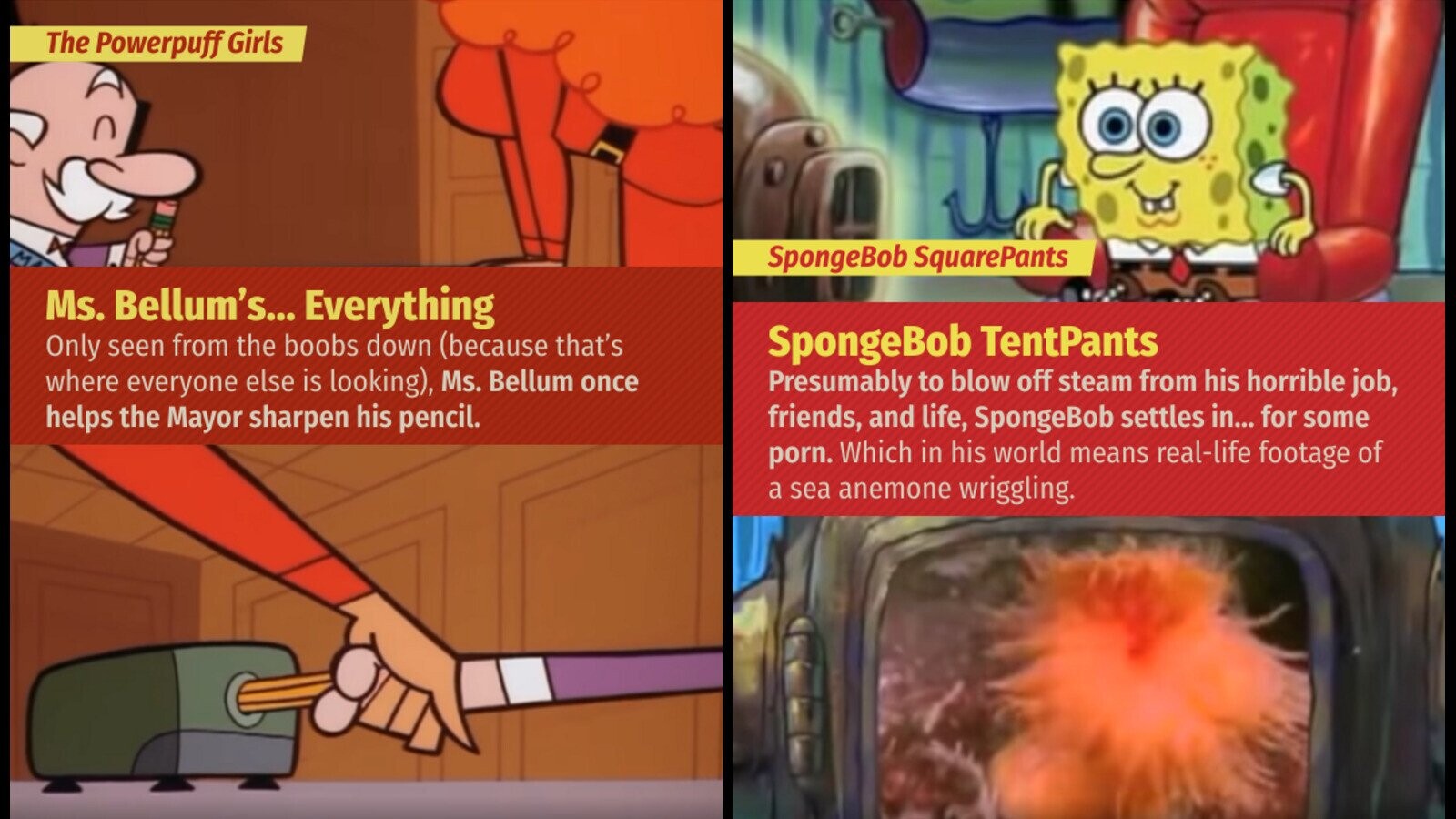
13. The Pencil Sharpener Scene in “The Powerpuff Girls”
The Powerpuff Girls mixed superhero action, kindergarten sweetness, and surprisingly sharp satire. One of the show’s most discussed adult jokes involves Sedusa disguising herself as Ms. Bellum and helping the Mayor with a pencil sharpener in a way that feels far more suggestive than office supplies should ever feel.
Children may see a broken pencil and a silly Mayor. Adults recognize the visual metaphor immediately. The scene is not explicit, but it is staged with enough exaggerated reaction shots to make the joke obvious once you are old enough to understand it.
14. Mr. Potato Head’s Line in “Toy Story 3”
Toy Story 3 is mostly remembered for emotional devastation disguised as a movie about plastic toys. But it also has a quick joke involving Mr. Potato Head reacting when another character removes Mrs. Potato Head’s mouth.
The line can be read innocently as a possessive husband upset about his wife’s missing piece. Adults, however, hear a more suggestive marital joke beneath the toy-part logic. Pixar again uses the physical rules of the toy world as cover, making the gag technically about detachable accessories while letting grown-ups hear the second meaning.
15. “Zootopia” and the Naturalist Club
Zootopia is a smart Disney mystery with jokes about prejudice, bureaucracy, and modern city life. One of its more adult-friendly scenes takes Judy Hopps and Nick Wilde to a naturalist club where animals embrace a “natural” lifestyle.
For children, the joke is mostly visual awkwardness: Judy is embarrassed, Nick is amused, and the animals are acting casual. Adults understand that the scene is a carefully sanitized version of a grown-up social concept. The movie keeps everything animal-appropriate and non-graphic, but the humor clearly relies on adult recognition.
16. Lord Farquaad’s Name in “Shrek”
Yes, Shrek earns two spots. Lord Farquaad’s name has long been discussed as a rude-sounding joke hidden behind a medieval villain title. Children hear a funny fantasy name. Adults notice that it sounds suspiciously close to an insult you would not expect in a family movie.
The brilliance is that the name also fits the character. Farquaad is tiny, pompous, power-hungry, and extremely easy to dislike. Even if you never catch the adult sound-alike joke, the name still feels ridiculous. If you do catch it, the movie becomes even more mischievous.
What Makes These Jokes So Memorable?
They Reward Rewatching
The best adult jokes in children’s movies are not random. They are built into scenes that already work for younger viewers. That is why they survive repeated watching. A child can enjoy Cars because Mater is funny. An adult can enjoy the same scene because the wordplay is doing extra work.
They Make Family Movies Less Painful for Parents
Parents often watch the same movies again and again. A tiny adult joke can feel like a life raft in a sea of sing-along choruses. It tells grown-ups, “Do not worry. The writers know you are here too.”
They Stay Funny Because They Are Brief
Most of these jokes last only a few seconds. That is part of the magic. They do not hijack the story or change the tone. They appear, wink, and disappear before anyone has time to ask too many questions.
They Prove Animation Is Not Just for Kids
Animation has always had layers. Classic theatrical cartoons were originally made for mixed audiences, and modern family films continue that tradition. The medium can be colorful and silly while still being smart, satirical, or a little cheeky.
Rewatch Experience: Why These Jokes Feel So Different As Adults
Rewatching childhood movies as an adult is a strange experience. At first, you expect pure nostalgia. You remember the songs, the characters, the snacks, maybe even the carpet pattern from the living room where you first watched the VHS. Then, suddenly, a line lands in a completely new way. You pause. You rewind. You stare at the screen and think, “Wait. Was that always there?”
That is the fun of discovering dirty jokes in children’s movies and TV shows. It feels like finding a secret note from the writers decades after they slipped it into your lunchbox. The joke was not meant to corrupt your childhood. It was meant to entertain the adults in the room while kids enjoyed the simpler version of the same scene.
There is also something fascinating about how cleanly these jokes divide audiences by experience. A child watching Frozen hears Anna being excited about a party. An adult hears wordplay. A child watching SpongeBob sees a snail avoiding a bath. An adult hears a line with cultural baggage. The exact same scene creates two different reactions, and both reactions are valid for the age of the viewer.
Streaming has made this even more noticeable. In the old days, people might catch these jokes only when a movie aired on TV or when a sibling replayed a tape. Now, clips circulate online, fans compare notes, and entire lists are built around “things we missed as kids.” That does not mean every fan theory is true. Sometimes people overanalyze clouds, castle towers, and background shapes until everything looks suspicious. But the examples that rely on actual dialogue, timing, or character reaction are harder to dismiss.
The best rewatch experience is not about ruining childhood. It is about appreciating craft. Writers had to make jokes that passed standards departments, fit the characters, and stayed invisible to younger viewers. That takes skill. A lazy adult joke would feel awkward. A clever one blends into the scene so naturally that it only activates years later.
Watching these moments now can also make you appreciate how much family entertainment has changed. Some jokes from older cartoons feel surprisingly bold by modern standards. Others still feel harmless because they are quick and playful. The key difference is context. A joke that is subtle, non-graphic, and character-driven can add flavor. A joke that feels mean, creepy, or forced can age badly.
Ultimately, these hidden jokes remind us that childhood favorites were often smarter than we realized. They were not just colorful distractions. They were carefully layered comedies designed to survive in living rooms full of different ages. Kids got the adventure. Adults got the wink. Years later, we get both.
Conclusion
Dirty jokes in children’s movies and TV shows are not new, and they are not always as scandalous as the internet makes them sound. Most are brief, suggestive, and clever rather than graphic. They work because they sit on the border between innocent and adult, letting younger viewers enjoy the story while older viewers catch the extra layer.
From Shrek and Toy Story to Rugrats, Animaniacs, SpongeBob SquarePants, and The Powerpuff Girls, these jokes prove that family entertainment has always been more layered than it looks. Sometimes the funniest part of growing up is realizing the cartoons grew up with youor maybe they were already grown-up the whole time.
So the next time you revisit a childhood classic, pay attention. Somewhere between the talking animals, musical numbers, and heroic life lessons, there may be a tiny joke waving politely at the adults in the room.