Note: This article uses “over” to describe the F-35’s long-delayed formal development and operational-testing milestone. It does not mean the aircraft has stopped receiving upgrades, software fixes, maintenance improvements, or new capabilities.
After more than two decades of engineering drama, schedule slides, software bugs, redesigns, and enough oversight reports to wallpaper a Pentagon hallway, the F-35 Lightning II finally cleared one of its biggest remaining hurdles. In March 2024, the program reached Milestone C and entered full-rate production.
That may sound like ordinary acquisition paperwork. It was not. For the F-35, it was the equivalent of finally receiving a diploma after spending ten extra years in a group project where the group kept changing, the assignment kept growing, and the printer caught fire every few months.
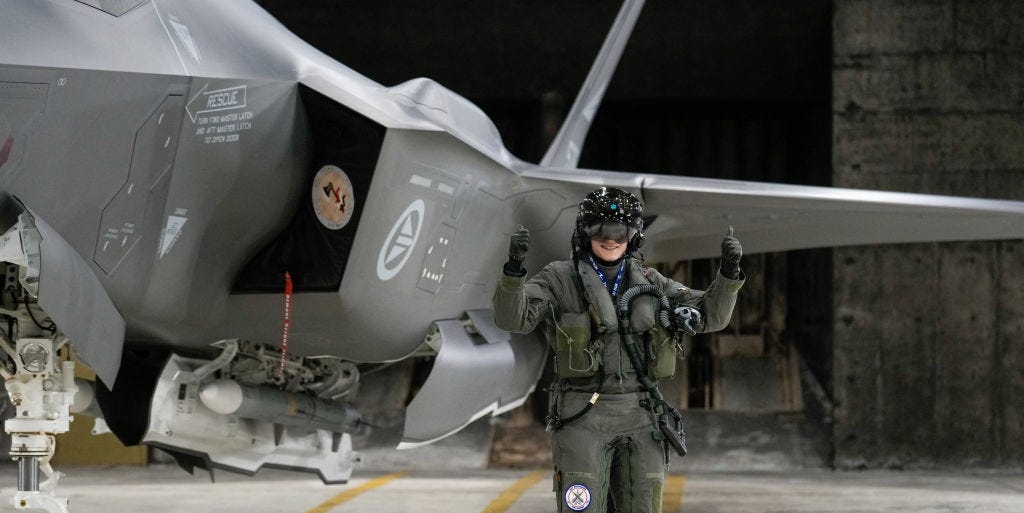
The full-rate production decision marked the end of the aircraft’s formal development-and-test road, a milestone that had originally been expected more than a decade earlier. The F-35 had already been flying with U.S. and allied forces, deploying aboard ships, and rolling off the assembly line in large numbers. Yet the program could not officially close its development chapter until it completed critical operational testing, including sophisticated simulator-based evaluations.
So yes, the F-35’s torturous development road is mercifully over. But this is not a story about a perfect aircraft emerging from a cloud of patriotic fog. It is a story about what happens when a country tries to build one family of advanced aircraft for multiple military branches, several allies, and an ever-changing technological futureall while producing jets before testing is fully finished.
What Actually Ended in 2024?
The milestone reached in March 2024 was not the end of all F-35 work. It was the end of the program’s long journey toward full-rate production, also known as Milestone C. In Pentagon acquisition language, that means the aircraft completed the testing needed to demonstrate an acceptable level of performance, reliability, and suitability for large-scale production.
For most defense programs, this checkpoint comes before production reaches full speed. The F-35, however, took a more unusual route. Large numbers of aircraft had already been produced and delivered while testing continued. That meant the formal decision arrived after the factory had already been operating at or near its planned production pace for years.
It was a bit like receiving a restaurant’s grand-opening certificate after the restaurant had already served thousands of customers. The kitchen is open, the menu is real, and people are eating. But someone still has to confirm that the fire alarm works.
Why the Delay Mattered
Full-rate production was delayed repeatedly because the F-35 had to complete Initial Operational Test and Evaluation, including demanding scenarios in the Joint Simulation Environment. The simulator allowed evaluators to test complex situations that would be difficult, expensive, or impractical to recreate in live exercises.
The simulation environment itself became one of the program’s most stubborn obstacles. The F-35 was not simply being tested as an airframe with an engine and wings. It was being tested as a software-heavy, sensor-rich system designed to process data, share information, and operate as part of a larger network.
That made the final test gate harder than many people expected. Building a highly capable aircraft is difficult. Building the digital environment required to test that aircraft against highly complex threats is difficult in a completely different, equally annoying way.
The F-35 Was Trying to Be Three Aircraft at Once
One reason the F-35 program became so complicated is that it was never meant to be just one airplane. The family includes three primary variants: the conventional-takeoff F-35A for the U.S. Air Force and several allied air forces; the short-takeoff and vertical-landing F-35B for the Marine Corps; and the carrier-capable F-35C for the Navy and Marine Corps.
That shared-family concept offered obvious appeal. Common parts, common training systems, common software, and a larger production base sounded like a sensible way to reduce duplication. In theory, one broad program could replace or supplement several aging aircraft across multiple services.
In practice, commonality is only simple until different users need different things. The Air Force wanted a conventional land-based aircraft. The Marine Corps needed an aircraft that could operate from amphibious ships and shorter landing areas. The Navy needed a carrier-capable model built for the special demands of shipboard operations.
Those requirements produced variations in structure, landing gear, internal systems, and flight characteristics. The result was not three unrelated aircraft, but it also was not one easy design with a few decorative stickers. The F-35 became a family project with three cousins, all insisting they needed different seating arrangements for Thanksgiving dinner.
Ambition Became a Schedule Problem
The program also aimed to deliver stealth characteristics, advanced sensors, data fusion, electronic systems, modern software architecture, and interoperability across U.S. and allied forces. Each feature made sense on its own. Together, they created an enormous integration challenge.
The toughest work was often not visible from the outside. A new aircraft can look finished long before its software, maintenance tools, mission systems, testing infrastructure, spare-parts ecosystem, and training systems are truly mature. The F-35 taught that lesson repeatedly.
It is much easier to admire a sleek aircraft in a photo than to understand the thousands of technical dependencies behind it. A single delayed software update can affect testing. Delayed testing can affect delivery acceptance. Delayed acceptance can affect training plans, deployment schedules, budgets, and spare-parts planning. Complex programs do not fail one screw at a time. They often stumble like a line of dominoes wearing expensive neckties.
Concurrency: The Choice That Made Everything Harder
One of the defining features of the F-35 program was concurrency: producing aircraft while development and testing were still underway. The strategy was intended to get advanced aircraft into service sooner and sustain production momentum. But it also created risk.
When testing reveals a flaw after aircraft have already been built, the answer is not simply, “Well, we will do better next time.” Existing aircraft may need modifications, software changes, replacement components, or additional maintenance work. Those retrofits can become expensive, time-consuming, and disruptive.
Concurrency did not invent the F-35’s troubles, but it amplified them. The program was trying to build, test, train, maintain, upgrade, and export a complex aircraft family at the same time. That is less like repairing a bicycle while riding it and more like redesigning a subway system while the trains are still carrying commuters.
Over time, the program improved production processes, increased deliveries, and built a large global fleet. But the basic lesson remains important: large-scale manufacturing is much less forgiving when the design is still changing underneath it.
The Software Was Never a Side Character
Earlier generations of combat aircraft certainly relied on software, but the F-35 made software central to how the aircraft functions. Its sensors, processing systems, maintenance support, mission systems, and upgrades all depend heavily on software stability and integration.
That meant software delays were not a minor inconvenience. They affected what could be tested, what could be delivered, and when newer capabilities could enter service. The F-35’s story is partly an aviation story, but it is also one of the world’s biggest software integration storieswith jet fuel, titanium, and congressional oversight added for flavor.
Why Full-Rate Production Was Still a Big Deal
Critics understandably asked why the full-rate production decision mattered when so many F-35s had already been built. The answer is that the decision was not just ceremonial. It signaled that the Pentagon had completed a major statutory and acquisition checkpoint tied to operational testing, live-fire evaluation, documentation, and future production planning.
For U.S. services, international partners, and foreign customers, the decision also offered a clearer statement that the aircraft had passed through the formal test gate required for large-scale procurement. The F-35 was no longer a program waiting to prove that it could finish development. It became a production-and-modernization program with a growing global fleet.
That distinction matters because the aircraft is now deeply embedded in long-term force plans. The Air Force, Navy, Marine Corps, and numerous allied countries have invested in training pipelines, maintenance facilities, simulators, supply chains, and basing infrastructure connected to the F-35.
By the middle of the 2020s, the F-35 had become far too widespread to evaluate as a simple “success” or “failure.” It is a major operational system, an industrial network, an international partnership, and a long-term modernization project all at once.
Development Is Over. Modernization Is Not.
The most important caveat is also the simplest: reaching full-rate production did not freeze the F-35 in time. The aircraft is still receiving modernization work, including hardware and software improvements associated with Technology Refresh 3 and Block 4.
Technology Refresh 3, often called TR-3, is intended to provide more processing power, memory capacity, and updated displays needed for future capabilities. Think of it as an effort to give the aircraft a stronger digital foundation before asking it to run more demanding software.
Block 4 is the next large modernization effort. It is intended to add and improve a range of capabilities through software, hardware, sensor, and systems updates. But Block 4 has faced its own delays, changing plans, technical risks, and rising costs.
That is why it would be misleading to say the F-35 is “finished.” No advanced aircraft is ever truly finished. But the F-35 has moved from its original development phase into a new era defined by production, sustainment, modernization, and readiness.
The New Challenge Is Readiness
Today, the question is less “Can the F-35 complete its original development program?” and more “Can the fleet be maintained, upgraded, and made available at the rate users need?”
That is not a small question. Public oversight reports have highlighted challenges involving spare parts, supply chains, software stability, maintenance capacity, engine wear, cooling requirements, and the cost of operating the fleet. In fiscal year 2025, overall mission-capable and fully mission-capable rates were below desired levels across the fleet.
Availability numbers can sound dry until they are translated into plain English: an aircraft is most valuable when it can fly when needed. A fleet can be large on paper yet still struggle if too many aircraft are waiting for parts, inspections, repairs, or software fixes.
The F-35’s future reputation will depend heavily on how well the Pentagon and industry handle that next chapter. Development milestones make headlines. Reliable aircraft availability wins the long game.
What the F-35 Story Means for Future Defense Programs
The F-35 program offers a useful warning for future high-tech defense projects. Ambition is not the enemy. Nations need advanced systems, particularly when older aircraft, networks, and infrastructure are approaching the end of their useful lives.
But ambition must be matched by realistic testing plans, mature technology, stable requirements, transparent cost estimates, and a willingness to slow down before production races ahead of design maturity. Otherwise, the government may save time on the calendar only to spend years paying for corrections later.
The F-35 also shows that software is no longer a supporting feature. In modern aircraft, it is part of the machine’s core identity. Program managers cannot treat software schedules as flexible footnotes while treating airframe production as the main event. The code, the sensors, the maintenance systems, and the supply chain all matter.
There is another lesson for the public: major weapons programs should not be judged only by their purchase price or their first flight. The true test includes how long they take to mature, how expensive they are to maintain, how quickly upgrades can be delivered, and how reliably they can perform once they become part of everyday operations.
Conclusion: A Long Road Finally Reaches Its Official Finish Line
The F-35’s development road was long, costly, and often painful to watch. It missed timelines, accumulated criticism, and became a favorite example whenever people wanted to explain how hard modern defense acquisition can be.
Still, the March 2024 full-rate production decision mattered. It closed the formal development-and-testing chapter that had lingered for far too long. The aircraft family is now firmly in its production and modernization era, with a worldwide fleet, major allied participation, and a long list of responsibilities still ahead.
The F-35 has not escaped its problems. It has simply graduated into a new set of them. The next challenge is ensuring that the aircraft’s maintenance, software, spare parts, upgrades, and operating costs become as mature as its production line.
For a program that spent years crawling through a maze of delays, that is progress. Not a ticker-tape parade, perhaps. More like a cautious exhale from everyone who has ever had to explain another revised schedule.
Experience: What Living With the F-35 Teaches Everyone Around It
The F-35 experience is not just about engineers, generals, lawmakers, or defense contractors. It is also about the many people who have to live with the consequences of a massive program after the headlines fade. Pilots train on it. Maintainers troubleshoot it. Supply specialists chase parts. Budget officials calculate costs. Allied governments make long-term commitments. Taxpayers wonder why a program can be both impressive and exhausting at the same time.
For personnel working around the aircraft, the experience is likely a reminder that advanced technology is rarely effortless. A modern aircraft may offer impressive computing power and sophisticated sensors, but those features create a maintenance environment that depends on diagnostics, software updates, support equipment, trained technicians, accurate data, and a dependable supply chain. The glamorous image is the aircraft in the sky. The practical image is a team on the ground trying to make sure the next flight happens on time.
For program managers, the F-35 provides a master class in the danger of optimism. Optimism is useful when it motivates innovation. It becomes expensive when it assumes that difficult engineering problems will politely solve themselves before the next budget deadline. The program’s history shows why realistic schedules are not a lack of ambition. They are a form of respect for the people who will eventually have to maintain, operate, and fund the system.
For allies, the F-35 experience is a lesson in partnership at industrial scale. Countries are not merely purchasing aircraft; many are building training relationships, investing in facilities, participating in sustainment arrangements, and integrating the platform into broader defense planning. That creates advantages through shared standards and interoperability, but it also means delays or software issues can ripple across many national fleets at once.
For the public, the biggest lesson may be patience mixed with skepticism. It is possible to recognize that the F-35 represents a major technological achievement while also demanding better accountability for cost, readiness, upgrades, and maintenance. Those ideas are not opposites. In fact, serious oversight is one of the best ways to protect the value of a long-term investment.
The experience also reveals a broader truth about modern technology: completion is often a moving target. Smartphones update. Cars receive software patches. Industrial systems evolve. The F-35 simply operates at a much larger scale, with much higher stakes and much less forgiveness for an inconvenient bug. Its development road may be over, but the daily work of making the fleet reliable, maintainable, and affordable is still underway.
That is why the F-35 story should not end with one production milestone. The real measure of success will be whether the program turns hard-earned lessons into better availability, smoother upgrades, stronger sustainment, and fewer moments when someone has to announce that a “minor technical issue” has become a very expensive calendar event.