There is a funny moment every new synth explorer experiences. You sit in front of a keyboard covered in knobs, sliders, tiny labels, blinking lights, and possibly one button labeled “global,” which sounds less like music gear and more like a secret government office. You press a key. The machine growls, sparkles, burps, or produces a sound best described as “robot whale in a rainstorm.” Congratulations: you have entered the beautiful, ridiculous, endlessly creative world of synthesizers.
Synth Secrets Exposed! is not about turning music technology into a cold engineering lecture. It is about revealing how synthesizer sound design actually works, why analog synths still make producers grin like kids near a cookie jar, how digital synthesis changed pop music forever, and why the best patches often come from simple moves made with taste. The secret is not that professionals know one magic setting. The secret is that synthesis is a language. Once you understand the alphabetoscillators, filters, envelopes, LFOs, modulation, effects, and performanceyou can stop scrolling through presets and start building sounds that feel like they belong to you.
What Is a Synth, Really?
A synthesizer is an electronic instrument that generates or shapes audio signals to create musical sound. Unlike a traditional piano or guitar, a synth does not need strings, hammers, reeds, or a heroic amount of finger calluses. It can imitate familiar instruments, but its real superpower is inventing tones that never existed before: glassy pads, thunderous basses, laser leads, cinematic drones, metallic bells, warm brass-like swells, and textures that sound like a spaceship learned jazz.
Most synthesizers work by creating a source sound, shaping its tone, controlling how it changes over time, and adding movement. That basic idea applies whether you are using a vintage-style analog synth, a modern software instrument, a wavetable monster, an FM classic, or a modular system that looks like a telephone switchboard had a baby with a science fair.
The First Big Secret: Oscillators Are the Raw Ingredients
The oscillator is where many synth sounds begin. It generates a waveform, which is the basic shape of the sound. Think of it as flour before you bake bread, except this flour can become a bass line, a sci-fi alarm, or a lead sound that makes your neighbor wonder whether aliens have excellent timing.
Sawtooth, Square, Sine, and Noise
A sawtooth wave is bright and harmonically rich, making it excellent for basses, leads, brass-like tones, and big stacked chords. A square wave has a hollow, buzzy character that works beautifully for retro leads, pulse-width movement, and chiptune-style sounds. A sine wave is pure and smooth, often used for sub-bass, FM synthesis, bells, and gentle tones. Noise is not a mistake; it is a tool. White or pink noise can create snares, wind, risers, breathy pads, ocean-like textures, and the tiny burst at the front of a pluck that makes it feel alive.
Here is the practical secret: the waveform already tells you where the patch wants to go. A bright saw does not need ten effects to become exciting. A clean sine does not need to apologize for being simple. Pick the source that points toward the sound in your head, then sculpt it.
The Filter: Where the Sculpting Gets Delicious
If the oscillator is a block of marble, the filter is the chisel. In subtractive synthesis, you start with a harmonically rich sound and remove frequencies until the tone feels right. This is why filter cutoff is one of the most important controls on many synths. Turn it down and the sound gets darker. Open it up and the sound becomes brighter, sharper, and more energetic.
Low-Pass, High-Pass, Band-Pass, and Resonance
A low-pass filter lets low frequencies through while reducing higher ones, which is why it is the classic choice for warm pads, rounded basses, and dramatic filter sweeps. A high-pass filter removes low frequencies and can thin a sound so it sits better in a mix. A band-pass filter focuses on a narrow frequency range, useful for nasal leads, vocal-like sweeps, and effects. Resonance boosts frequencies around the cutoff point. Add a little and the sound gains character. Add too much and your synth may start whistling like a tea kettle with a record deal.
The secret is movement. A static filter can be useful, but a moving filter creates emotion. Slowly opening a filter over four bars can turn a plain chord into a sunrise. Snapping it shut with a fast envelope can turn a simple oscillator into a rubbery bass. Small changes often beat dramatic ones, especially when the mix is busy.
Envelopes: The Shape of Time
An envelope controls how a sound changes after you press a key. The classic envelope is ADSR: attack, decay, sustain, and release. It sounds technical, but it is really just a story about time.
Attack controls how quickly the sound starts. A short attack gives you plucks, basses, and sharp leads. A slow attack gives you pads, strings, and dreamy swells. Decay controls how quickly the sound falls from its peak. Sustain is the level held while your finger remains on the key. Release controls how long the sound fades after you let go.
The Envelope Cheat Sheet
For a punchy bass, use fast attack, short decay, low-to-medium sustain, and short release. For a soft pad, use slow attack, high sustain, and longer release. For a pluck, use fast attack, quick decay, low sustain, and just enough release to avoid a dry click. For brass-like swells, use a moderate attack and a filter envelope that opens the cutoff as the note blooms.
One major synth secret is that envelopes are not only for volume. Route an envelope to filter cutoff, pitch, wavetable position, pulse width, FM amount, or effects depth. Suddenly, the patch breathes. It has a beginning, middle, and end. It stops sounding like a held button and starts sounding like a performance.
LFOs and Modulation: The Wobble Department
An LFO, or low-frequency oscillator, is an oscillator that usually moves too slowly to be heard as a pitch. Instead, it controls another parameter. Assign an LFO to pitch and you get vibrato. Assign it to volume and you get tremolo. Assign it to filter cutoff and you get movement, pulse, wobble, shimmer, or chaos, depending on how brave you are feeling before breakfast.
Modulation is the art of making one part of a synth control another. This is where sound design becomes expressive. A slight LFO on pitch can make a lead feel human. A slow LFO on filter cutoff can keep a pad from becoming wallpaper. A random sample-and-hold pattern can make a sequence feel unpredictable and alive.
Subtle Modulation Wins More Often Than You Think
Beginners often turn modulation up until the sound becomes a cartoon. That is fun for five minutes and sometimes perfect for experimental music. But in most tracks, subtle motion is the professional move. Add just enough movement that the listener feels the patch shifting without immediately thinking, “Ah yes, LFO number two is having a very busy afternoon.”
Analog vs Digital: Stop Fighting and Start Listening
The analog-versus-digital debate is one of music technology’s favorite campfires. Analog synthesizers use electronic circuits to generate and shape sound. They are loved for warmth, immediacy, slight instability, and hands-on control. Digital synthesizers use mathematical processes, samples, or digital signal processing. They can deliver precision, huge polyphony, complex modulation, wavetable motion, FM tones, physical modeling, granular textures, and recallable presets without requiring a notebook full of knob positions.
The real secret is that neither side automatically wins. A great analog monosynth can make a bass line feel like it is wearing expensive boots. A digital wavetable synth can create evolving pads that sound like frozen light. FM can produce bells, electric pianos, metallic hits, and cutting basses that analog subtractive synthesis may struggle to create. Hybrid instruments often combine analog-style warmth with digital flexibility, which is a polite way of saying, “Why choose one dessert?”
FM Synthesis: The Beautiful Beast
FM synthesis, short for frequency modulation, became famous through instruments such as the Yamaha DX7. Instead of simply filtering harmonics away, FM uses one oscillator to modulate another, creating complex tones from relatively simple sources. It can sound glassy, metallic, percussive, bright, elegant, or, when pushed too far, like a robot dropped a kitchen cabinet down the stairs.
The key to FM is ratio and level. The relationship between carrier and modulator frequencies affects the harmonic character, while modulation depth controls intensity. Small changes can produce big results. That is why FM programming can feel mysterious, but it is also why it remains powerful. For practical use, start simple: two operators, clean ratios, controlled envelopes, and careful brightness. Build complexity slowly. Your ears will thank you, and so will any pets in the room.
Wavetable Synthesis: Motion in a Bottle
Wavetable synthesis uses collections of waveforms that can be scanned or morphed over time. Instead of staying on one basic waveform, the sound can evolve from smooth to gritty, vocal to metallic, hollow to bright, or calm to outrageous. This is why wavetable synths are popular in modern electronic music, pop production, film scoring, ambient music, and any genre where movement matters.
A good wavetable patch often uses modulation to move through the table gradually. Assign an envelope, LFO, velocity, or mod wheel to wavetable position. Then control the filter, amplitude envelope, and effects so the sound still feels musical. The secret is not to animate everything at once. When every parameter is doing backflips, the listener cannot find the groove. Let one or two elements move with purpose.
Modular and Semi-Modular Synths: Cables With Consequences
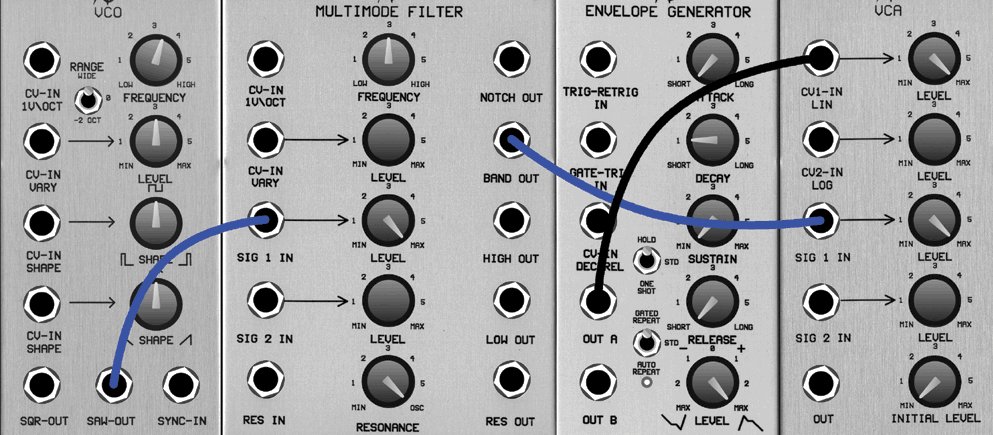
Modular synthesis looks intimidating because it is basically synthesis with the training wheels, seatbelt, and polite user interface removed. You connect modules with patch cables: oscillator to filter, envelope to amplifier, LFO to cutoff, sequencer to pitch, random voltage to something that probably should not have been random but now sounds amazing.
Semi-modular synths provide a friendly bridge. They can work without patch cables, but they also allow rerouting. This teaches one of the deepest synth secrets: synthesis is about signal flow. Once you understand where sound starts, where it goes, and what controls it along the way, every synth becomes less confusing. Different interfaces, same family drama.
How to Build Classic Synth Sounds From Scratch
Fat Analog Bass
Start with a sawtooth or square wave. Add a second oscillator slightly detuned if available. Use a low-pass filter with cutoff lowered and a touch of resonance. Set the amp envelope with fast attack, short decay, medium sustain, and short release. Add a filter envelope with quick decay so the note opens with a bite and then settles. Keep effects minimal. Bass needs confidence, not a spa day.
Dreamy Pad
Use two or more oscillators, detuned gently. Choose saws, triangles, or wavetables with soft harmonic content. Set slow attack and long release. Use a low-pass filter to remove harshness. Add slow LFO movement to cutoff or wavetable position. Finish with chorus, delay, or reverb, but leave room for the rest of the track. A pad should feel like atmosphere, not fog machine revenge.
Expressive Lead
Choose a saw, square, or blend. Add portamento for sliding notes if the style fits. Use a medium-bright filter setting and shape the amp envelope with fast attack and moderate release. Add vibrato controlled by the mod wheel. A great lead patch should respond to performance, not just sit there wearing sunglasses.
Electronic Drum Hit
For a kick, start with a sine wave and use a fast pitch envelope dropping downward. Add a short amp envelope and subtle drive. For a snare, combine noise with a short tonal body. For hi-hats, use filtered noise with a very short envelope. Synth drums are proof that noise can be productive, despite what your parents may have said about your first beat tape.
Effects: The Spice Rack, Not the Meal
Effects can transform synth patches. Chorus widens. Delay adds rhythm and space. Reverb creates atmosphere. Distortion adds harmonics and aggression. Compression controls dynamics. EQ carves room in the mix. But effects cannot rescue a patch with no clear purpose. Build the core sound first. Then use effects to place it in a world.
A smart producer checks the patch dry before drowning it in reverb. If the dry sound has character, the processed version will usually shine. If the dry sound is weak, adding a cathedral reverb may simply create a weak sound in a very large imaginary building.
Presets Are Not Cheating
Some synth purists act as if using presets is a moral failure. Relax. Presets are learning tools, starting points, and productivity boosters. The problem is not using presets; the problem is never editing them. Open a preset you like and inspect it. Which waveform does it use? How is the filter set? What does the envelope do? Where is modulation routed? Turn off effects and listen again. You will learn faster by reverse-engineering strong patches than by staring at an initialized saw wave wondering why it lacks emotional depth.
The best workflow is simple: choose a preset close to your goal, change the envelope, adjust the filter, modify modulation, tune effects, and save your own version. After a while, you will stop hunting for perfect presets and start hearing what needs to change.
Mixing Synths Without Making Sonic Soup
Synths can fill a lot of frequency space. That is wonderful during solo playback and dangerous in a mix. A huge pad may sound glorious alone but smother vocals, guitars, drums, and the emotional hopes of your arrangement. Use EQ to remove unnecessary lows from pads and leads. Keep sub-bass focused and controlled. Avoid stacking too many bright parts in the same octave. Pan supporting textures carefully. Let the most important element own the spotlight.
Velocity, aftertouch, mod wheel movement, and automation help synth parts feel performed. Even a simple two-chord pad can become compelling when the filter opens slightly into the chorus, the reverb blooms at transitions, or the oscillator mix changes during a breakdown.
The Biggest Synth Secret: Limitation Creates Style
Modern synths can do almost anything, which is exactly why people get stuck. Too many options can turn creativity into menu tourism. Limit yourself. Use one synth for a week. Build every sound from one oscillator. Make a track using only sine waves and noise. Create five bass patches without effects. These constraints force decisions, and decisions create style.
The musicians who sound unique are not always using the most expensive gear. They understand their tools deeply. They know how a filter reacts, how much detune is enough, how envelopes create groove, and when to stop adding layers. That final skillknowing when to stopis rarer than a vintage synth listed online at a reasonable price.
Real-World Experience: What Synths Teach You After the Manual Gives Up
My first real experience with synthesis was not elegant. I expected instant cinematic magic. Instead, I got a single raw waveform buzzing at me like an irritated refrigerator. I turned knobs randomly, discovered resonance, overdid it immediately, and created a tone so sharp it could probably slice tomatoes. At first, I thought I was bad at sound design. Later, I realized this is how almost everyone begins: by making fifty terrible noises and one interesting accident.
The first lesson was that a synth rewards listening more than guessing. Turning a filter cutoff knob slowly teaches more than reading ten dramatic forum arguments about which ladder filter is “creamier.” Changing an envelope while playing short notes teaches you why some basses feel punchy and others feel lazy. Detuning two oscillators by a tiny amount teaches width. Detuning them too much teaches comedy.
The second lesson was that simple patches often work best in real music. A massive solo sound can collapse once drums, vocals, guitars, and bass enter the mix. Some of my favorite parts came from humble patches: one saw wave, one low-pass filter, a quick envelope, and a little saturation. Nothing fancy. Nothing that would impress a gear wizard on a message board. But in the track, it worked.
The third lesson was to record automation like performance. A synth part becomes more human when someone shapes it in real time. Opening the filter during a chorus, pushing the mod wheel on a lead note, fading in vibrato, or increasing delay feedback for one transition can make a loop feel alive. These moves are small, but they are the difference between “nice sound” and “I want to hear that again.”
The fourth lesson was that organization saves creativity. Naming patches, saving versions, and writing quick notes may sound boring, but future-you will be grateful. There is no tragedy quite like creating the perfect bass at 1:00 a.m., failing to save it, and then trying to recreate it the next day while your synth stares back silently like it has signed a nondisclosure agreement.
The fifth lesson was that gear matters less than curiosity. Hardware synths are inspiring because they invite touch. Software synths are powerful because they offer speed, recall, and huge sonic range. Modular systems teach signal flow. Digital synths teach precision. Analog synths teach interaction. Each has a personality, but the real instrument is your decision-making. Ask better questions: What role should this sound play? Should it be bright or dark? Fast or slow? Stable or moving? Wide or focused? Clean or dirty?
That is the experience behind the phrase Synth Secrets Exposed! The secrets are not hidden in one legendary preset bank or one rare machine guarded by studio goblins. They are in the relationships between source, shape, motion, space, and performance. Learn those relationships and every synth becomes less of a mystery box and more of a conversation partnerone that occasionally makes laser noises, but still a partner.
Conclusion: The Knobs Were Friendly All Along
Synthesizers can look complicated, but their core logic is beautifully understandable. Oscillators create raw tone. Filters sculpt brightness. Envelopes shape time. LFOs and modulation add movement. Effects create space and character. Analog, digital, FM, wavetable, modular, and software synths all offer different paths to the same goal: making sound feel intentional.
The real secret is practice with attention. Do not twist knobs randomly forever, but do not be afraid of accidents either. Study classic patches, edit presets, build from scratch, listen in context, and save your discoveries. Great synth sound design is part science, part taste, part habit, and part joyful nonsense. And when your machine suddenly produces the exact sound you imagined, you will understand why so many musicians fall in love with these blinking boxes of electricity.