Some fan art makes you nod politely. Some fan art makes you whisper, “Okay, I need this on a mug, a sticker sheet, and possibly a throw pillow.” The series “My Husband Recreated 16 Star Wars Characters As Chibis, And The Result Is Adorable” belongs firmly in the second category. It takes the galaxy’s most dramatic heroes, villains, droids, and smugglers, then shrinks them into tiny, round, big-eyed versions of themselves. Suddenly, Darth Vader looks less like he is about to command an Imperial fleet and more like he needs someone to help him reach the top shelf.
That is the magic of Star Wars chibis. The chibi art style, popularized through Japanese anime and manga, exaggerates cuteness by giving characters oversized heads, small bodies, simplified features, and a playful emotional punch. Apply that to a universe full of lightsabers, helmets, royal gowns, stormtrooper armor, and space capes, and you get a fan-art collection that feels both instantly recognizable and wonderfully silly.
This adorable Star Wars fan art works because it does not erase what fans love about the characters. Instead, it translates them. Chewbacca is still furry and loyal. Leia is still regal and fierce. Yoda is still wise enough to ruin your grammar and your bad decisions in one sentence. But now they all look like they could fit in your pocket, which is probably against several galactic safety regulations.
Why Star Wars Characters Work So Well As Chibis
Star Wars is built on silhouettes. Darth Vader’s helmet, C-3PO’s golden body, R2-D2’s dome, Yoda’s ears, Leia’s hair, and Kylo Ren’s mask are recognizable even when reduced to simple shapes. That is perfect for chibi art. A good chibi design depends on picking the most important visual cues and making them bold, soft, and readable.
In other words, chibi art asks a funny but useful question: “What is the smallest, cutest version of this character that still makes fans yell the name immediately?” The answer, in this collection, is apparently “very small, very cute, and dangerously collectible.”
The style also creates a charming contrast. Star Wars often deals with destiny, family legacy, rebellion, temptation, courage, and galactic-scale conflict. Chibi art takes those heavy themes and gives them marshmallow cheeks. The result is not mockery; it is affection. It is the visual equivalent of seeing a serious movie villain wearing fuzzy slippers.
The 16 Star Wars Chibis That Stole The Show
The original collection features a lineup that spans the prequel trilogy, original trilogy, sequel trilogy, and fan-favorite creatures. Each design highlights a different reason Star Wars characters remain so visually powerful.
1. Chewbacca & Porg: Maximum Fluff Per Square Inch
Chewbacca already has a head start in the cuteness department because he is essentially a walking mountain of loyalty and hair. Add a porg, and the design becomes almost unfair. As a chibi, Chewie’s size and strength turn into cuddly roundness, while the porg adds the kind of tiny sidekick energy that makes viewers instinctively say, “Aww,” even if they planned to act mature today.
2. C-3PO: Anxiety, But Make It Shiny
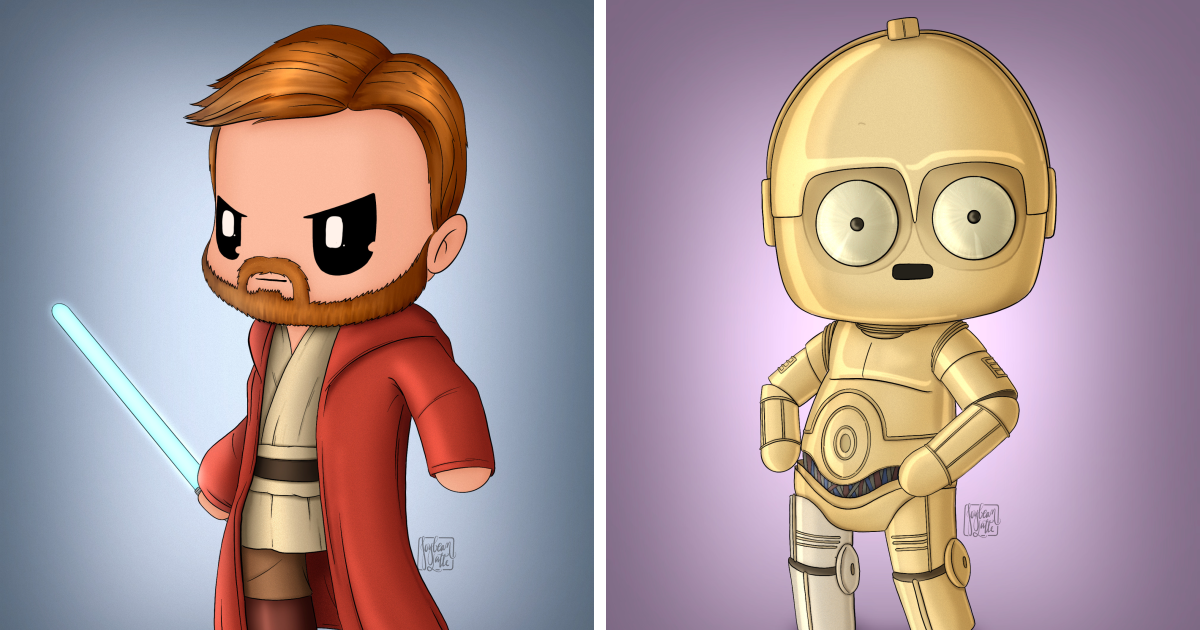
C-3PO is the galaxy’s most elegant panic button. His golden plating, stiff posture, and worried personality make him ideal for a chibi makeover. In a simplified style, his formal body language becomes even funnier. He looks like he is about to translate six million forms of communication and complain politely about every single one.
3. Stormtrooper: Galactic Henchman, Pocket Edition
Stormtroopers are usually designed to look uniform, faceless, and intimidating. Chibi proportions flip that energy completely. The helmet becomes rounder, the armor becomes toy-like, and the once-imposing soldier starts looking like a lost mascot at a space convention. It is a great reminder that simple shapes can change the entire mood of a design.
4. Han Solo: Smuggler Swagger In Miniature
Han Solo is all confidence, quick wit, and “trust me” energy, even when trusting him is clearly a questionable business plan. A chibi Han keeps the vest, the blaster-holster silhouette, and the casual stance, but softens the rogue attitude into something more playful. He still looks ready to fly the Millennium Falcon. He also looks like he might ask for extra snacks before takeoff.
5. Leia Organa: Royal, Rebellious, And Ridiculously Cute
Leia is one of the strongest visual icons in Star Wars. Her white dress, confident posture, and famous hairstyle are instantly recognizable. As a chibi, she becomes adorable without losing authority. That balance matters. Good fan art does not reduce Leia to cuteness alone; it keeps her intelligence, courage, and leadership at the center while adding a softer visual charm.
6. Padmé Amidala: Galactic Fashion Meets Chibi Drama
Padmé is a dream character for artists because her costumes are practically their own space opera. From royal gowns to battle-ready outfits, she brings elegance and detail. In chibi form, those complex designs have to be simplified carefully. The trick is keeping the regal impression while making the shapes readable and charming. Done well, Padmé becomes a tiny queen of style.
7. Emperor Palpatine: Somehow Cute, Which Feels Illegal
Turning Emperor Palpatine into a chibi is one of the funniest ideas in the collection. He is known for manipulation, dark robes, and a face that says, “I definitely have a secret plan.” A chibi version turns that menace into cartoon mischief. He still looks suspicious, but now he looks suspicious in the way a cat looks suspicious near a broken vase.
8. Yoda: Already Halfway There, Honestly
Yoda may be the easiest Star Wars character to imagine as a chibi because his original design already uses small stature, expressive eyes, and a memorable silhouette. The chibi version leans into his oversized ears and wise little face. He becomes the kind of character who could deliver ancient wisdom and then immediately be turned into a plush toy. Strong with this one, the cuteness is.
9. Obi-Wan Kenobi: The High Ground, But Lower To The Floor
Obi-Wan brings calm Jedi energy, beard recognition, and robe-based elegance. In chibi form, his composed personality becomes especially charming because the tiny proportions make his seriousness look gently comedic. He appears ready to offer wise advice, defend the innocent, and make a dry joke so subtle that only half the room catches it.
10. Darth Maul: Tiny Horns, Big Attitude
Darth Maul has one of the boldest designs in the franchise: red-and-black markings, horns, intense eyes, and a double-bladed lightsaber. Chibi art softens him, but it cannot erase the drama. Instead, it turns his fierce design into a stylized burst of color and attitude. He becomes cute in a “do not touch my crayons” kind of way.
11. Darth Vader: The Dark Side Gets Squishy
Darth Vader is the ultimate test for cute fan art. His helmet, cape, and black armor are built to dominate the screen. As a chibi, those same elements become adorable because they are compressed into a small, rounded shape. The helmet still says “Sith Lord,” but the proportions say “limited-edition desk buddy.” It is impossible not to smile.
12. Luke Skywalker: Farm Boy Hero Energy
Luke Skywalker’s chibi design works because his story is rooted in sincerity. He starts as a hopeful farm boy and grows into a legendary Jedi. A cute version can highlight that openness and optimism. Whether holding a lightsaber or looking ready for adventure, chibi Luke captures the spirit of someone who believes the galaxy can be better, even when the galaxy is being extremely dramatic about it.
13. Kylo Ren: Moody, Masked, And Mini
Kylo Ren is all conflict, dark outfits, and emotional thunderclouds. Chibi art turns his brooding presence into something unexpectedly funny. The mask remains recognizable, the dark costume still signals danger, but the smaller proportions make him look like he is about to stomp away because someone moved his favorite cape. It is character design comedy at its finest.
14. Poe Dameron & BB-8: Pilot Charm With Droid Bonus Points
Poe Dameron and BB-8 are a perfect chibi pair because their friendship already has a lively, animated quality. Poe brings confident pilot energy, while BB-8 is practically a rolling ball of personality. Together, they create a design that feels energetic, bright, and easy to love. BB-8 in particular feels born for cute stylization; the droid is basically chibi geometry with beeps.
15. Finn: Courage In A Small Package
Finn’s journey from stormtrooper to hero gives his character emotional depth. A chibi version can focus on his expressive face, heroic posture, and sense of movement. The cuteness does not cancel out his courage; it makes that courage feel more approachable. He looks like someone who is scared, brave, and still willing to do the right thing, which is honestly one of the most relatable combinations in Star Wars.
16. Rey: Scavenger Spirit, Jedi Spark
Rey’s chibi design benefits from strong visual details: wrapped clothing, staff, determined expression, and desert-survivor practicality. As a chibi, she becomes bright and adventurous while keeping the independence that defines her. She looks ready to repair a ship, rescue a droid, discover mysterious powers, and somehow still make the whole thing look adorable.
What Makes This Fan Art Feel So Adorable?
The charm of this collection is not just that the characters are small. It is that the artist understands what each character needs. Chibi art can go wrong when every character becomes the same round face with different hair. Here, the appeal comes from preserving identity. Chewbacca needs texture. Vader needs helmet drama. Leia needs poise. C-3PO needs awkward stiffness. BB-8 needs cheerful motion.
That attention to character is what separates strong fan art from generic cuteness. The best chibi designs are not random baby versions; they are clever summaries. They capture personality, costume, posture, and emotional tone in fewer lines. It is visual editing, and when it works, it feels effortless.
There is also something wonderfully democratic about chibi art. Heroes, villains, droids, royalty, pilots, and space wizards all get the same cute treatment. The style lowers the emotional volume without removing the fandom. It invites longtime Star Wars fans, casual viewers, kids, collectors, artists, and meme lovers to enjoy the same gallery from different angles.
Why Fans Love Cute Versions Of Serious Characters
Fans often enjoy seeing familiar characters in unexpected styles because it refreshes the way we look at them. A terrifying villain becomes funny. A noble hero becomes huggable. A polished droid becomes even more awkward. This is why Star Wars fan art has such staying power: the universe is large enough to support endless reinterpretation.
Chibi Star Wars art also fits naturally into today’s internet culture. Small, expressive characters are perfect for stickers, avatars, reaction images, enamel pins, prints, and collectibles. They communicate quickly on social media, where a single cute expression can do the work of an entire paragraph. A tiny Darth Vader with a giant helmet is not just art; it is a mood.
At the same time, this style respects nostalgia. Many fans grew up with Star Wars, then later discovered anime, manga, collectible art, or digital illustration communities. A chibi Star Wars series brings those interests together. It says, “Yes, you can love epic space mythology and tiny adorable doodles. You contain multitudes. Also probably too many stickers.”
The Design Lessons Hidden Inside The Cuteness
Artists can learn a lot from a collection like this. First, recognizable silhouettes matter. If a character can be identified even after major simplification, the original design is strong. Second, accessories should be chosen carefully. Not every buckle, seam, or gadget needs to stay. Chibi art rewards clarity over clutter.
Third, expression does a lot of heavy lifting. With small bodies and simplified features, the eyes, eyebrows, mouth, and posture become essential. A tiny tilt of the head can make Yoda look wise, Han look smug, or Palpatine look like he just hid the TV remote for political reasons.
Finally, color is storytelling. Vader’s black, C-3PO’s gold, Rey’s desert tones, Leia’s white, and Maul’s red-and-black palette all help the viewer recognize the character instantly. Even when proportions change, color keeps the connection strong.
Experience: What It Feels Like Watching Star Wars Become Chibi
There is a special kind of joy in watching someone you love disappear into a creative project. The room gets quiet, the tablet comes out, and suddenly the person who was just asking where the charger went is now making detailed artistic decisions about whether a chibi Chewbacca needs softer eyebrows. For the record, he absolutely does. Eyebrow softness is serious business in the adorable arts.
The most fun part of a project like “My Husband Recreated 16 Star Wars Characters As Chibis” is seeing how each character becomes a tiny design puzzle. Some are easy at first glance. Yoda already has the ears, the robe, the wise expression, and the compact frame. BB-8 is basically a cute shape with a heroic résumé. But others require more thought. How do you make Darth Vader adorable without making him unrecognizable? How do you simplify Padmé’s elaborate style without losing her elegance? How do you make Palpatine cute without accidentally creating the most suspicious baby in the galaxy?
That process is where fan art becomes personal. It is not just copying a character; it is choosing what matters most. One artist might emphasize Leia’s confidence. Another might focus on Han’s grin. Someone else might make Kylo Ren’s mask enormous because, frankly, the drama demands square footage. Every choice reveals how the artist sees the character.
There is also a funny household rhythm that comes with this kind of creative marathon. One person draws; the other becomes the unofficial focus group. You hear questions like, “Does this look like Obi-Wan?” and you answer with the seriousness of a museum curator, even though you are holding a snack and wearing pajamas. You debate whether the stormtrooper is too round. You discover that “too round” is not actually a problem when the goal is maximum cuteness. You learn that tiny capes are powerful.
The finished set feels satisfying because it turns fandom into something warm and shareable. Star Wars can be intense, emotional, and mythic, but chibi art makes it cozy. It gives fans permission to enjoy the galaxy without needing to argue timelines, rankings, or who had the best lightsaber technique. Sometimes the best way to celebrate a beloved franchise is simply to make everyone small, cheerful, and a little bit squishy.
And that may be why this collection works so well. It captures the heart of fan creativity: affection plus imagination. A husband sits down, reimagines 16 Star Wars characters, and suddenly the internet gets a gallery full of tiny heroes, pocket-sized villains, and droids that look like they belong on a sticker sheet. It is adorable, yes, but it is also a reminder that fandom is at its best when it is playful. The Force may be mysterious, ancient, and powerful, but apparently it also looks excellent with oversized eyes.
Conclusion
“My Husband Recreated 16 Star Wars Characters As Chibis, And The Result Is Adorable” is more than a cute fan-art headline. It is a celebration of how flexible and beloved Star Wars characters really are. When redesigned as chibis, they remain recognizable, expressive, and full of personality, but they also become softer, funnier, and easier to love in a new way.
The collection succeeds because it combines strong character design with genuine affection. From Chewbacca and Porg to Rey, Finn, Vader, Leia, Yoda, and BB-8, each piece keeps the visual clues fans know while adding the irresistible charm of chibi art. The result is a gallery that feels nostalgic, funny, creative, and extremely dangerous to anyone trying not to start another collectible habit.
In a galaxy full of epic battles, ancient wisdom, daring escapes, and family drama, sometimes all we need is a tiny Darth Vader with a giant helmet. Balance restored.