Most weekend treasure hunts end with a rusty nail, a bottle cap, or the kind of mysterious farm metal that makes you say, “Well, that was technically a signal.” But in January 2019, seven friends walking across a field in southwest England heard a beep that changed everything.
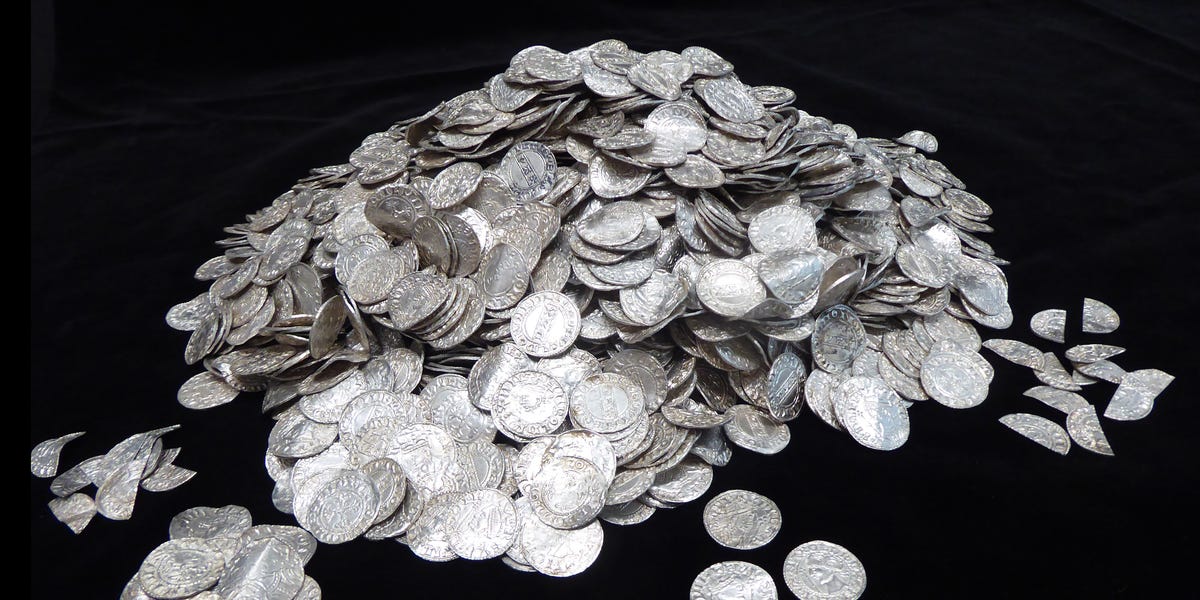
They were metal detecting in the Chew Valley, near Bath in Somerset, when one signal became another, then another, then an entire chorus of history shouting from beneath the soil. What they uncovered was not a misplaced tractor bolt or somebody’s Victorian spoon. It was the Chew Valley Hoard: 2,584 silver pennies dating from around 1066 to 1068, the chaotic years immediately after the Norman Conquest of England.
Later valued at £4.3 millionabout $5.6 millionthe hoard became the highest-value treasure find on record in Britain. Not bad for a day out with friends, a few detectors, and probably more mud than anyone had planned for.
What Was the Chew Valley Hoard?
The Chew Valley Hoard is a massive collection of nearly 1,000-year-old silver coins from one of the most dramatic moments in English history. These were not random pocket change dropped by a distracted medieval shopper. The coins were likely buried for safekeeping during the violent political turbulence that followed the Battle of Hastings in 1066.
The hoard includes silver pennies connected to Harold II, the last crowned Anglo-Saxon king of England, and William I, better known as William the Conqueror. Some reporting and museum interpretation also highlight an Edward the Confessor coin among the group, tying the treasure even more tightly to the royal power struggle of the 11th century.
For historians, the Chew Valley Hoard is more than a pile of shiny old money. It is a snapshot of a country being remade. In 1066, William of Normandy defeated Harold II at Hastings and began reshaping England’s government, land ownership, language, architecture, and culture. The coins in this hoard sit right at that turning point, like tiny silver witnesses to a national identity crisis.
How Seven Friends Found Britain’s Most Valuable Treasure
The story began on January 26, 2019. Seven metal detectorists were searching farmland in the Chew Valley area. Some were experienced, while others were reportedly learning how to use new equipment. That detail makes the story even better: imagine trying to teach someone the basics of metal detecting and accidentally discovering the treasure equivalent of a medieval jackpot.
One of the first coins found was linked to William the Conqueror. A single coin from that period would have been exciting enough. Then more signals appeared. The group found another coin, and another, and then the field seemed to transform into a silver vending machine operated by history.
By the end of the search, thousands of coins had emerged from the ploughsoil. The finders reported the hoard properly, and the coins were examined, conserved, and cataloged by experts. That process took years, because a discovery of this size is not handled like someone turning in a lost wallet. Every coin matters. Every design, mint mark, and fragment can help scholars understand how money, power, and loyalty moved through England after the Norman Conquest.
Why the Coins Matter So Much
The Chew Valley Hoard matters because it comes from an unusually narrow and important historical window. The coins date to roughly 1066–1068, just after William’s invasion and victory. That was a time when England was not simply changing kings; it was changing systems.
Before the conquest, Harold II’s coins circulated in a familiar Anglo-Saxon monetary world. After the conquest, William’s new coinage entered circulation, but the designs did not instantly erase the past. Some coins looked strikingly similar in format: a ruler’s profile on one side, symbolic designs or inscriptions on the other. This continuity complicates the simple schoolbook version of history in which one regime suddenly switches off and another switches on like a light.
The hoard also dramatically increased the number of known coins from this period. For researchers, that is like going from a blurry photograph to a high-resolution scan. More coins mean more evidence about mints, distribution, political messaging, and economic activity. In other words, the hoard helps historians ask better questionsand occasionally answer them without needing to squint quite so hard.
A Treasure Buried in a Time of Rebellion
Why would someone bury so many valuable coins and never return? The leading explanation is fear. The late 1060s were unstable, especially in the southwest of England. Rebellions against William’s rule broke out, and Harold’s sonsexiled after their father’s defeatlaunched attacks in the region.
In that environment, burying wealth may have seemed practical. If soldiers, raiders, political enemies, or tax collectors were nearby, a person with a large amount of silver might have decided the safest bank was a hole in the ground. Unfortunately for the original owner, the “quickly hide it and come back later” plan appears to have failed. Nearly a millennium later, seven friends became the unexpected beneficiaries of that unfinished errand.
The hoard may have belonged to a wealthy landowner, merchant, or someone connected to the movement of money during the upheaval. Scholars cannot say for sure. But the amount was enormous. In the 11th century, silver pennies had serious purchasing power. This was not lunch money. It represented real wealthenough to suggest a person or institution with substantial resources.
From Muddy Field to Museum Display
After the discovery, the Chew Valley Hoard entered Britain’s treasure process. Under the Treasure Act, finds made of precious metal and meeting certain historical criteria must be reported. If declared treasure, museums can acquire the find, and a valuation committee determines its market value. Rewards are generally shared between the finders and the landowner.
In this case, the hoard was valued at £4.3 million. The South West Heritage Trust acquired it for the nation with support from major heritage funders. The plan includes public display, educational programming, and eventually a permanent home at the Museum of Somerset in Taunton.
That outcome matters. A treasure like this could easily become a private collector’s trophy, admired by a few people in a locked room. Instead, it is being preserved and interpreted for the public. The coins can now help museum visitors, students, local communities, and history lovers understand a turning point that shaped Britain for centuries.
Why This Discovery Captured the Public Imagination
The Chew Valley Hoard has everything a great treasure story needs: ordinary people, a muddy field, a dramatic historical backdrop, and a number so large it makes everyone suddenly interested in metal detecting. But its appeal goes deeper than money.
People love stories where the past breaks into the present. One minute, you are walking across farmland. The next, you are holding an object that passed through human hands during the age of Harold and William. That kind of moment shrinks time. It reminds us that history is not only stored in libraries and castles. Sometimes it is sleeping just below the grass, waiting for a beep.
There is also something charmingly democratic about the discovery. Professional archaeology is essential, but many important finds are first spotted by members of the public. When responsible detectorists report finds properly, they help expand historical knowledge. The Chew Valley Hoard shows what can happen when curiosity, good practice, and a little luck meet in the same field.
The SEO-Friendly History Lesson: What Is the Norman Conquest?
To understand why the Chew Valley Hoard is so important, it helps to revisit the Norman Conquest. In 1066, King Edward the Confessor died without a direct heir. Harold Godwinson became king, but William, Duke of Normandy, claimed the English throne. After William defeated Harold at the Battle of Hastings, he became William I of England.
That victory changed the country. Norman elites replaced many Anglo-Saxon landholders. Castles rose across the landscape. French influenced English vocabulary. Legal, religious, and administrative systems shifted. Even the Domesday Book, completed in 1086, reflected William’s determination to measure and control his new kingdom.
The coins in the Chew Valley Hoard belong to the tense early years of that transformation. They are small, but they carry big questions. Who accepted William’s rule? Who resisted? How quickly did money change? How did ordinary people experience political upheaval? A coin cannot answer everything, but 2,584 coins can start a very interesting conversation.
Metal Detecting, Treasure Laws, and Doing It the Right Way
The Chew Valley story also highlights the importance of responsible metal detecting. In countries with treasure laws, finders must know what to do before they dig up something important. Reporting a major find protects historical context, prevents illegal sale, and allows experts to conserve fragile artifacts properly.
That “context” part is crucial. A coin by itself is valuable. A coin found with thousands of others, in a specific place, arranged across a specific area of soil, is far more informative. Archaeologists are not only interested in the object; they are interested in the story around the object. Where it was found, how deep it was, what else was nearby, and how it was scattered can all matter.
So yes, treasure hunting can be exciting. But the best detectorists are not just chasing payday fantasies. They work with landowner permission, follow local rules, report significant finds, and understand that history is a shared inheritance. In short: bring batteries, bring patience, and please do not treat a thousand-year-old artifact like a souvenir from a theme park gift shop.
What the Chew Valley Hoard Teaches Us About Value
At first glance, the value of the Chew Valley Hoard seems obvious: £4.3 million. That is a headline-friendly number, and it certainly gets attention. But the deeper value is historical.
The hoard gives experts more evidence about early Norman coinage, mint activity, political continuity, and regional unrest. It also gives the public a vivid way to connect with the past. A textbook can say England changed after 1066. A museum case filled with silver pennies can show it.
There is emotional value, too. For the seven finders, the discovery was life-changing. For the landowner, it was a once-in-several-lifetimes surprise. For Somerset, it became a local story with national importance. And for anyone who has ever looked at a field and wondered what lies beneath, it is proof that the ground still has secrets.
Experiences and Lessons Inspired by the Chew Valley Treasure Hunt
The Chew Valley Hoard also offers a few practical and personal lessons for anyone fascinated by metal detecting, lost treasure, or hands-on history. The first lesson is simple: most great discoveries do not begin with dramatic music. They begin with preparation, permission, and patience. The seven friends were not storming a castle or following a pirate map with a giant red X. They were searching a field with metal detectors, learning equipment, and paying attention to signals that many beginners might have dismissed.
That experience mirrors what many hobby detectorists describe. A day in the field often starts slowly. You adjust your settings. You listen for tones. You dig up ordinary objects. You get mud on your boots, your gloves, your sleeves, and somehow your face, even though your face was not involved. Then, occasionally, the ordinary rhythm changes. A signal sounds different. The soil gives way. Something appears that does not belong to the modern surface world.
The second lesson is that teamwork matters. In treasure stories, people often imagine one lone explorer making the discovery. The Chew Valley find was different. It involved a group. That group dynamic likely helped keep the search organized as the scale of the discovery became clear. When one coin turns into dozens and dozens turn into thousands, excitement can quickly become chaos. Having several people present can help with careful recovery, communication, and decision-making.
The third lesson is emotional: history feels different when you hold it. Reading about the Norman Conquest is one thing. Touching a coin from the years just after 1066 is another. Suddenly, names like Harold and William stop sounding like distant exam answers and start feeling like real figures whose decisions affected real people. The person who buried those coins may have been afraid, rushed, hopeful, or desperate. That human uncertainty is what makes the hoard so compelling.
The fourth lesson is ethical. Discovering treasure is exciting, but it comes with responsibility. The right response is not to hide it, sell it quietly, or clean it with kitchen chemicals while announcing, “I saw this on the internet.” The right response is to report it, preserve it, and let experts help. Because the Chew Valley Hoard was handled through proper channels, it became part of public history rather than disappearing into private hands.
Finally, the story reminds us that adventure is not always far away. Sometimes it is under a familiar landscape, in a field that has been walked across for generations. The extraordinary may be buried beneath the ordinary. That does not mean every beep is worth millionsmany beeps are still bottle caps living their best afterlifebut it does mean curiosity has value. The Chew Valley Hoard is not just a treasure story. It is a reminder to pay attention, ask questions, respect the past, and never underestimate a muddy field.
Conclusion: A Beep Heard Across History
The story of seven friends finding the most valuable treasure in Britain sounds almost too cinematic to be real. Yet the Chew Valley Hoard is very real: 2,584 silver pennies from the age of Harold II and William the Conqueror, buried during one of England’s most turbulent eras and uncovered nearly 1,000 years later.
Its financial value is spectacular, but its historical value is even richer. The hoard helps scholars study the aftermath of the Norman Conquest, gives museums a powerful public teaching tool, and reminds all of us that history is not dead and dusty. Sometimes it is alive in the soil, waiting for the right people, the right equipment, and one very persuasive beep.