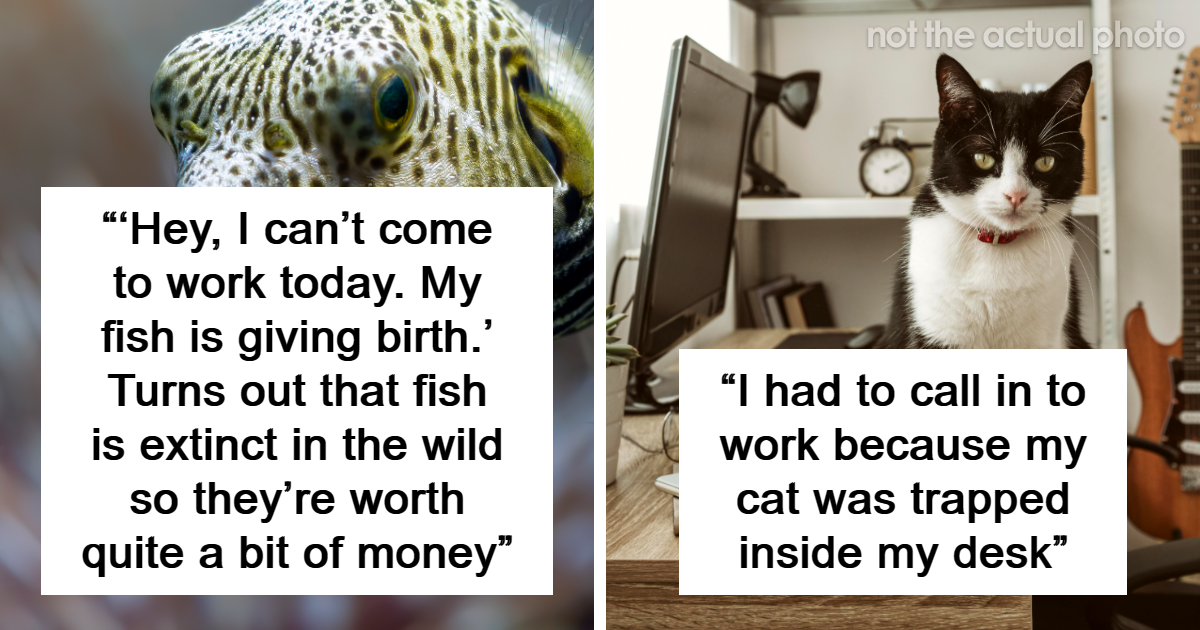
Every workplace has two kinds of stories: the official ones told in onboarding, and the legendary ones whispered near the coffee machine. The second group is much more entertaining. Somewhere in America, a manager has received a message that began, “I’m sorry, I can’t come in today,” and ended with a cat inside a dashboard, a casserole in the oven, or the universe apparently sending attendance instructions.
Missing work is not always funny, of course. People get sick. Kids get sick. Cars quit dramatically. Pipes burst with the emotional timing of a soap opera villain. Mental health days, family emergencies, medical appointments, and unsafe travel conditions are all legitimate reasons to call out. But then there are the excuses so odd that they sound fake until you remember that real life has no editor.
This article gathers 47 weird but surprisingly true excuses for missing work, then looks at why some strange excuses are still believable, why others damage trust, and how employees can call out professionally without writing a three-act tragedy in text-message form.
Why Weird Work Excuses Go Viral
Unusual work excuses go viral because they sit right between two very human reactions: sympathy and disbelief. A flat tire is ordinary. A flat tire allegedly caused by “ozone” is a sitcom. A pet emergency is understandable. A llama with mystery symptoms is a farm-based cliffhanger.
HR surveys and manager anecdotes often reveal the same pattern. Most absences are normal: illness, family needs, transportation problems, home emergencies, and appointments. But when employees are embarrassed, anxious, burned out, or worried their boss will not approve time off, they sometimes over-explain. That is when a simple “I’m unable to come in today” turns into “My dog is having an emotional crisis because the blender looked at him wrong.”
The funny part is the absurdity. The serious part is the workplace lesson: a clear, timely, honest explanation almost always works better than a dramatic one.
47 Weird But Surprisingly True Excuses For Missing Work
The “Home Became a Trap” Excuses
- The employee was stuck under the bed. Not metaphorically. Physically. This is the kind of excuse that makes a boss pause, blink, and ask whether furniture has unionized.
- A cat was trapped inside the car dashboard. This is weird, but pet owners know animals specialize in choosing impossible locations at the worst possible time.
- A water pipe burst at home. Common, believable, and deeply inconvenient. Water damage does not politely wait until after lunch.
- The front door lock broke from the inside. Being trapped in your own home sounds like a low-budget escape room, but it happens.
- A raccoon got into the attic. Nobody wants an employee answering emails while negotiating with a masked trash goblin overhead.
- A child hid the car keys. Toddlers are tiny chaos interns. The keys may be in a shoe, a cereal box, or another dimension.
- The dog ate something dangerous. This is a real emergency, especially because dogs believe socks are a food group.
- A pet funeral caused the absence. Some managers may laugh at first, but anyone who has loved an animal understands grief does not check the PTO calendar.
- A fish tank cracked overnight. Suddenly the living room is a lake, the fish are confused, and work becomes priority number four.
- A spider caused an emotional shutdown. Not everyone handles eight-legged visitors with dignity. Some people choose relocation.
The “Body Betrayed Me” Excuses
- An employee broke an arm reaching for a falling sandwich. Lunch fought gravity. Gravity won.
- Someone poked herself in the eye while combing her hair. It sounds ridiculous until you remember morning routines are performed half-awake.
- Legs fell asleep in the bathroom, followed by an injury. Awkward? Yes. Possible? Also yes. The human body is a poorly supervised machine.
- Too much birthday cake caused sickness. Celebrations sometimes become dairy-based regret.
- Hair removal cream caused chemical burns. A beauty routine can become a medical issue faster than anyone expects.
- A hair dye disaster turned hair orange. Not always a medical emergency, but definitely a video-call emergency for some people.
- Plastic surgery needed a correction. It may sound vain to outsiders, but post-procedure complications can be real and urgent.
- A gallstone required “holistic healing.” The phrasing is odd. The pain is not.
- A migraine made screens impossible. This is a legitimate reason, even if coworkers who have never had migraines underestimate it.
- Food poisoning struck at sunrise. Few excuses are more believable than “I cannot be more than eight feet from a bathroom.”
The “Transportation Went Full Cartoon” Excuses
- The employee accidentally got on a plane. This sounds impossible until you remember airports are designed like psychological experiments.
- A car broke down on the way to work. Ordinary, yes. But still one of the most accepted short-notice reasons.
- All tires were mysteriously flat. The “mysterious” part may raise eyebrows, but car trouble itself is believable.
- A bee swarm got into the car. Nobody should be expected to commute inside a mobile beehive.
- A duck bite delayed the morning. This one sounds fake until you meet an angry duck and realize it has the confidence of a tax auditor.
- A bird attack caused an injury. Birds are beautiful, majestic, and occasionally absolute menaces.
- Police activity blocked the neighborhood. A legitimate delay, especially when roads are closed and nobody is allowed out.
- A train delay turned into a half-day absence. Public transportation can transform punctual adults into helpless philosophers.
- A ride-share app failed at the worst time. Technology is wonderful until it becomes your entire commute plan.
- Bad weather made roads unsafe. This is not weird, but it becomes memorable when the employee sends photos of a driveway pretending to be an ice rink.
The “Personal Life Exploded” Excuses
- A spouse discovered cheating, and belongings had to be rescued from a dumpster. This is less an excuse and more a dramatic limited series.
- All underwear was in the wash. Not the strongest excuse, but unforgettable. Also, a reminder to own more than one laundry cycle of basics.
- The employee forgot they had been hired. This is either terrible organization or the most peaceful onboarding experience ever.
- The universe said to take the day off. Inspirational? Maybe. Useful for payroll? Not particularly.
- The employee woke up in a good mood and did not want to ruin it. Emotionally honest, professionally risky.
- A “lucky night” ended in an unknown location. This excuse belongs in the museum of oversharing.
- A casino weekend was still going well. At least it was honest. Unfortunately, honesty does not make it responsible.
- A family emergency required immediate care. Often valid, but best communicated with simple details rather than a full family documentary.
- A child’s school closed unexpectedly. Modern parents know this one too well. One email from school can destroy a perfectly planned workday.
- An elderly relative needed urgent help. Caregiving responsibilities are one of the most common real reasons employees miss work.
The “Objects, Food, and Animals Won” Excuses
- Grandmother allegedly poisoned someone with ham. It is bizarre, specific, and oddly hard to forget.
- A casserole was in the oven. This is not a crisis unless the casserole has legal representation, but it made the excuse hall of fame.
- A uniform caught fire in the microwave. Drying clothes in a microwave is not a plan. It is a lesson with smoke.
- A toe got stuck in a faucet. Nobody wants to explain this to a manager, which almost makes it more believable.
- The employee ate cat food by accident. A terrible breakfast, a worse confession, and a truly historic call-out.
- A sick llama needed care. It sounds like nonsense until you remember some people live on farms and llamas do, in fact, have schedules of their own.
- The employee got sick from reading too much. Book lovers may object, but eye strain, exhaustion, and bad posture can turn a reading marathon into a recovery day.
What Makes a Weird Excuse Believable?
The strangest excuses are not always the least believable. A manager may doubt “the universe told me not to come in,” but accept “my cat is stuck in my dashboard” because the second problem has practical urgency. It is specific, time-sensitive, and difficult to ignore.
A believable reason usually has three qualities. First, it is unavoidable. You cannot safely drive with a medical emergency, a sick child, or a burst pipe at home. Second, it is timely. You notify your workplace as early as possible instead of disappearing until noon. Third, it is not over-performed. The more theatrical the story, the more it sounds like a magician is trying to distract the audience.
That is why the best call-out messages are often boring. “I’m unwell and won’t be able to work today. I’ll update you by 4 p.m. about tomorrow and have asked Jordan to cover the client report.” That message may not win comedy awards, but it protects trust.
The Difference Between Funny and Unprofessional
There is a fine line between memorable and career-limiting. A one-time strange emergency can become office folklore in a harmless way. Repeated bizarre absences, however, create a pattern. If every Monday brings a new wildlife encounter, appliance fire, cosmic sign, or laundry tragedy, managers stop laughing and start documenting.
Employees do not need to reveal every private detail. In fact, oversharing often makes things worse. If you need a mental health day, a simple “I’m not well enough to work today” may be enough, depending on company policy. If you have a family emergency, you can say so without naming every cousin and describing every symptom. Professional communication is not about hiding the truth; it is about sharing the necessary truth.
Employers also have a responsibility here. When workers feel they will be punished for ordinary human problems, they may invent extraordinary stories. A healthy leave culture makes it easier for employees to say, “I’m sick,” “I need to handle a family issue,” or “I need a personal day,” without feeling forced to produce a circus.
How to Call Out Without Becoming the Office Legend
If you need to miss work, keep the message short, honest, and useful. Tell your manager you cannot work, give the general reason if appropriate, share whether you are available for urgent questions, and explain how immediate tasks will be handled. Follow your company’s attendance policy, especially if documentation is required.
A strong message might look like this: “Hi, I’m dealing with a home emergency this morning and won’t be able to come in. I’ve sent the project notes to Maya and will update you later today.” That is much better than, “A raccoon has entered my ceiling and seems politically motivated,” even if the second version is more fun.
The goal is not to sound perfect. The goal is to be responsible. Life happens. Good managers know that. But trust is built when employees communicate early and avoid turning every absence into a mystery podcast.
Personal Experiences: What These Excuses Teach Us About Real Work Life
Anyone who has worked long enough has seen at least one excuse that sounds fake but turns out to be absolutely real. A coworker says they cannot come in because their apartment ceiling collapsed. Everyone assumes exaggeration until photos appear, showing drywall on the couch like a sad indoor snowfall. Another person calls out because their dog swallowed a toy. It sounds dramatic until the vet bill arrives with enough zeros to make everyone sit down.
The funniest work absence stories often become funny only after the panic is over. In the moment, the person is not thinking, “This will be great content one day.” They are thinking, “Why is there water coming through the light fixture?” or “How did the cat get behind the speedometer?” Real emergencies are rarely elegant. They are messy, oddly specific, and inconvenient in ways no employee would choose.
There is also a social lesson hiding inside these stories. Workers want to be believed. Managers want to keep the business running. The conflict begins when trust is already weak. In a supportive workplace, a person can say, “I have an emergency,” and the team adjusts. In a suspicious workplace, employees feel pressure to prove the emergency with extra details. That is when messages become too long, too strange, and sometimes too funny.
One common experience is the guilt of calling out, even for a valid reason. Many employees have stared at their phone while sick, rehearsing a message as if they were preparing for court. They worry about sounding lazy. They worry someone will think they are lying. They worry the team will suffer. This guilt is especially strong for hourly workers, caregivers, and employees in understaffed workplaces. So they add details. Then more details. Suddenly, “I’m sick” becomes “I have a fever, my left ear is making a clicking sound, and my soup betrayed me.”
Another experience is the manager’s side of the story. A good manager has to balance compassion with consistency. One bizarre excuse may be true. Five bizarre excuses in six weeks may signal a bigger issue: burnout, personal instability, poor planning, disengagement, or a need for formal leave support. The best response is not public shaming. It is a private conversation: “Is everything okay, and is there something we need to plan for?”
That is why these 47 excuses are more than office comedy. They reveal how unpredictable life can be, how awkward communication can become, and how much workplaces depend on trust. Yes, the sandwich injury is funny. Yes, the casserole excuse deserves a tiny trophy. But behind the laughter is a practical reminder: when people have clear leave policies, reasonable flexibility, and managers who act like adults, they do not need to blame the universe for a day off.
Conclusion
Weird excuses for missing work are hilarious because they remind us that real life is stranger than any sitcom. Cats get trapped in dashboards. Ducks bite. Hair dye rebels. Sandwiches become orthopedic hazards. But the best workplace lesson is simple: strange things happen, and honest communication matters.
If your reason is real, say enough to be clear and professional. If your reason is not real, do not build a fictional universe around it. A good reputation is much harder to repair than a missed shift. And if the universe truly does tell you to take a day off, maybe check your PTO balance first.