For decades, the sonic boom has been aviation’s loudest party crasher. Engineers could build aircraft that sliced through the sky faster than sound, but the ground below had a complaint department, and it was very busy. Windows rattled. Dogs objected. Humans wondered why the sky had suddenly developed a percussion section.
Now, Lockheed Martin’s legendary Skunk Works and NASA are testing an experimental aircraft that could change that story. The aircraft is the X-59, the centerpiece of NASA’s Quesst mission, and its job is wonderfully specific: fly faster than sound without producing the thunderclap that made overland supersonic travel politically, legally, and socially unpopular.
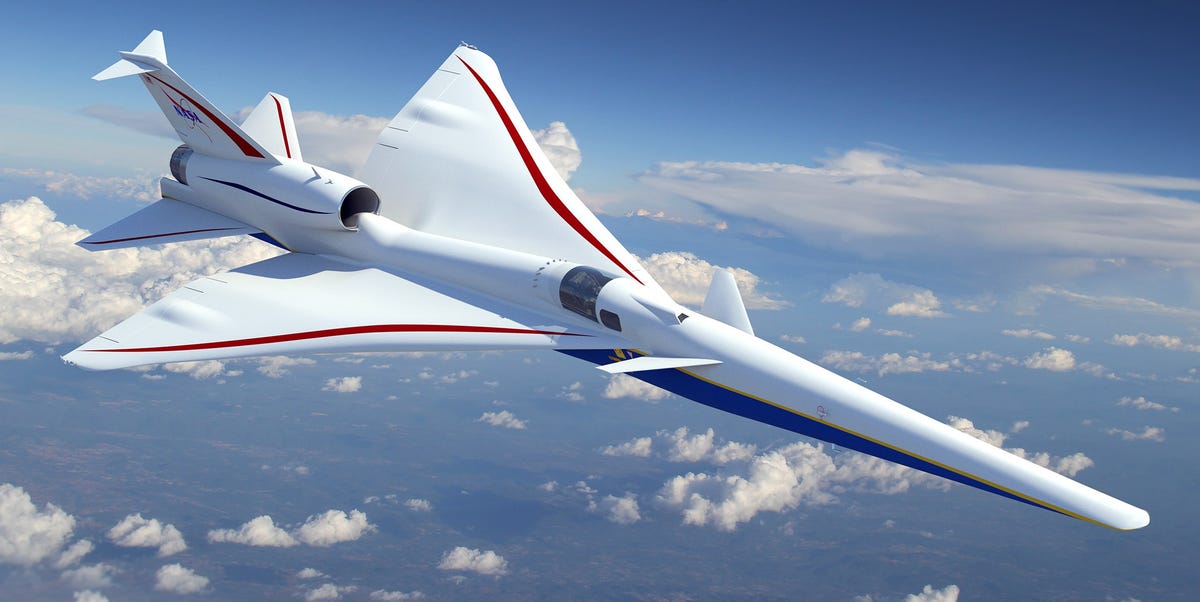
Calling it a “secret plane” is only half true. The X-59 is not a black-budget mystery hiding in a desert hangar behind twelve suspicious fences and a sign that says “Definitely Nothing Cool Here.” NASA has publicly revealed it, photographed it, explained it, and flown it. But it does come from Skunk Works, the same innovation shop associated with some of America’s most famous advanced aircraft. It also looks like something that escaped from a science-fiction storyboard: a needle-nosed, single-seat jet with no forward-facing windshield, a top-mounted engine, and a mission that sounds almost impossible.
The goal is not to make supersonic flight silent. Physics has not been fired from the project. Instead, the X-59 is designed to reshape shock waves so the familiar boom becomes a much softer “sonic thump.” If that thump proves acceptable to people on the ground, regulators could eventually rethink rules that have kept civil supersonic aircraft from routinely flying over land in the United States.
What Is the X-59, and Why Is Skunk Works Involved?
The X-59 is a one-of-a-kind experimental aircraft built by Lockheed Martin Skunk Works for NASA. It is not a passenger jet, not a fighter, and not a prototype airliner that will someday carry vacationers to Las Vegas in the time it takes to finish a snack bag. It is a flying research instrument.
NASA describes the aircraft as its first purpose-built supersonic X-plane in decades. The X-59 is about 99.7 feet long, has a wingspan of about 29.5 feet, and is designed to cruise at Mach 1.4, or roughly 925 miles per hour, at about 55,000 feet. Those numbers matter because they represent the mission conditions NASA wants to test before flying the aircraft over selected communities for public response studies.
Skunk Works is involved because the aircraft’s entire shape is the technology. This is not a case of bolting a magic muffler onto a jet and calling it a day. The long nose, slender fuselage, swept wings, smooth underside, and engine placement all work together to manage how pressure waves form around the aircraft. The X-59 is basically an aerodynamic negotiation with the speed of sound.
Why Sonic Booms Became the Villain
A sonic boom happens when an aircraft travels faster than the speed of sound. As it moves through the air, pressure waves form around it. At subsonic speeds, those waves can move away. At supersonic speeds, they pile together into shock waves. When those shock waves reach the ground, people hear a boom.
That boom is not simply “a loud airplane.” It can feel sudden, sharp, and intrusive. During the early decades of supersonic experimentation, military aircraft created enough public frustration that overland commercial supersonic flight became a regulatory nonstarter. In 1973, the United States banned routine civil supersonic flight over land, largely because of sonic-boom concerns.
That rule helped define the fate of commercial supersonic travel. The Concorde could cross the Atlantic at remarkable speed, but it was largely restricted to routes over water when flying faster than sound. It became an icon, then a museum piece. For travelers, the dream of faster-than-sound trips over land quietly taxied back to the gate.
The Big Idea: Turn the Boom Into a Thump
The X-59’s mission is not to defeat sound. It is to rearrange the noise problem. Traditional supersonic aircraft tend to create shock waves that combine into a strong boom. The X-59’s design spreads those shock waves out so they do not merge into the same violent pressure signature.
That is why the aircraft looks so unusual. Its nose makes up a large portion of its length. The cockpit sits low in the body. The engine is mounted on top and toward the rear, helping preserve a smoother underside. Every curve is there for a reason. This is what happens when engineers tell an aircraft, “Please be fast, but also use your indoor voice.”
On the ground, NASA hopes the result will be more like a gentle thump than a startling boom. The difference is important. If people barely notice the sound, or notice it but do not find it disruptive, future aircraft designers and regulators may have data to support a new generation of quieter supersonic aircraft.
A Plane Without a Front Window Sounds RidiculousUntil It Makes Sense
One of the X-59’s strangest features is its cockpit. The pilot does not have a conventional forward-facing windshield. That sounds alarming until you understand the aerodynamic problem. A normal cockpit canopy would interrupt the carefully shaped airflow and could create shock waves that ruin the low-boom design.
So NASA developed the eXternal Vision System, or XVS. Instead of looking through a front window, the pilot uses camera feeds and a high-resolution display to see forward. The system gives the pilot a view of the airspace ahead, with added flight information. In other words, the X-59’s cockpit is less “look out the window” and more “fly with a very serious aviation-grade screen.”
This is not a gimmick. NASA has tested the system to make sure it can provide performance and safety comparable to, or better than, a traditional forward view. The XVS is one of the technologies that makes the X-59 possible, because without it, the aircraft’s long, shock-shaping nose would be far less practical.
Testing: From First Flight to Supersonic Milestones
The X-59 completed its first flight on October 28, 2025, departing from Lockheed Martin’s Skunk Works facility in Palmdale, California, and landing at NASA’s Armstrong Flight Research Center near Edwards, California. Like most first flights of experimental aircraft, the mission was cautious. The landing gear stayed down, speeds remained subsonic, and the main objective was beautifully simple: prove the aircraft could fly safely and come home in one piece.
After that first flight, the test program moved into envelope expansion. That means engineers gradually pushed the aircraft higher, faster, and through a wider range of conditions. By spring 2026, NASA reported flights reaching around 43,000 feet and near-supersonic speeds of about Mach 0.95. The team also tested systems such as landing gear, hydraulics, fuel, avionics, environmental controls, and the XVS.
The next big step is supersonic flight. NASA has indicated that early supersonic testing is not yet the final public “quiet thump” demonstration. Chase aircraft and specialized instruments will be involved, and traditional sonic booms from accompanying aircraft may obscure the X-59’s own sound signature. That may sound like bringing a marching band to test a whisper, but the point of early testing is measurement, safety, and aircraft validation.
Why the X-59 Is Not Really a Passenger Jet
It is tempting to look at the X-59 and imagine boarding one at JFK with a latte, a laptop, and unrealistic expectations about airline legroom. But NASA is clear: the X-59 will never carry passengers. It is an experimental aircraft built to collect data.
That data could help future manufacturers design commercial aircraft that fly faster than sound over land without causing disruptive booms. The X-59 is the laboratory, not the airline product. Think of it as a very expensive, very fast question mark.
The question is this: Can supersonic aircraft be quiet enough for everyday communities to accept? If the answer is yes, the aviation industry could eventually explore faster domestic routes, shorter coast-to-coast flights, and new aircraft designs that do not repeat Concorde’s limitations.
The Community Test: Where the Public Becomes Part of the Mission
The most important X-59 testing may not happen in a wind tunnel or even over the desert. It may happen over ordinary communities, with ordinary people answering surveys about what they heard.
NASA’s Quesst mission includes a community response phase. The agency plans to fly the X-59 over selected U.S. communities and ask residents how they perceive the sound. Did they hear it? Was it annoying? Did it interrupt a conversation, startle a pet, or vanish into the background noise of everyday life?
This human response data is the missing ingredient in the future of overland supersonic travel. Regulators do not only need to know that an aircraft can produce a lower sound level. They need to know whether that sound is acceptable to the public. A thump that looks good in a chart but annoys entire neighborhoods would not be a victory. It would be a very fast way to create angry town-hall meetings.
Regulations Are Moving Too
For decades, U.S. rules have focused on speed. Civil aircraft generally cannot operate over land above Mach 1 unless they meet specific authorization conditions. The X-59 is part of a broader push to shift the conversation from speed-based restrictions to noise-based standards.
That distinction is huge. A speed-based rule says, “Do not go faster than sound.” A noise-based rule asks, “How loud is the aircraft on the ground?” If low-boom technology works, the second approach could allow aircraft that fly supersonically without creating unacceptable noise.
Recent federal policy has also pushed the FAA toward modernizing supersonic rules and developing noise standards. But policy enthusiasm does not replace engineering proof. The X-59 still has to generate reliable data, and future commercial aircraft would still need to satisfy safety, environmental, certification, and economic requirements.
What Quiet Supersonic Flight Could Change
If the X-59 helps unlock practical quiet supersonic travel, the most obvious benefit is shorter flight time. A future aircraft inspired by this research could make coast-to-coast trips faster and possibly reshape premium business travel. New York to Los Angeles in under four hours is the kind of phrase that makes frequent flyers sit up straighter.
But speed is not just about executive convenience. Faster aircraft could help in urgent transport, disaster response, medical logistics, and time-sensitive cargo. A quieter supersonic aircraft that can fly over land would open route possibilities that Concorde never had.
There are still hard questions. Supersonic aircraft must deal with fuel burn, emissions, airport noise, operating costs, ticket prices, maintenance demands, and certification. A quiet boom does not automatically create a profitable airline. Aviation history is filled with brilliant machines that were too expensive, too complex, or too early for the market.
Why This Plane Looks Like the Future but Carries the Past
The X-59 belongs to a long line of American experimental aircraft. The X-1 broke the sound barrier in 1947. The X-15 pushed speed and altitude records. Other X-planes tested lifting bodies, unusual wings, advanced controls, and new ideas that later influenced mainstream aerospace design.
The X-59 continues that tradition, but with a different personality. Older X-planes often asked, “How fast can we go?” or “How high can we fly?” The X-59 asks, “Can we go fast without making everyone below us hate the idea?” That is a more modern question, and maybe a more difficult one.
It reflects how aerospace innovation has changed. Performance still matters, but public acceptance matters too. A technology that works only when nobody lives under the flight path is not enough for modern transportation. The future of flight has to be fast, efficient, safe, and socially tolerable. That last part is where the X-59 earns its weird shape.
Experiences and Reflections: What the X-59 Story Feels Like From the Ground
Imagine standing outside on a quiet afternoon and hearing something overhead that is not quite thunder, not quite a car door, and not quite the neighbor dropping a trash can again. That small moment is what makes the X-59 so interesting. The aircraft is not only testing aerodynamics; it is testing the relationship between technology and daily life.
Most people do not experience aviation as equations. They experience it as noise over a backyard, a contrail above a commute, a boarding pass, a delay, or a suitcase that somehow went to Denver without them. Supersonic flight has always had glamour, but it also had a public-relations problem. The boom made people feel like speed was being imposed on them from above.
The X-59 changes the emotional equation. Instead of asking communities to tolerate a boom for the sake of faster travel, NASA is trying to find out whether the sound can be reduced enough that people barely mind it. That is a more respectful approach. It treats the public not as an obstacle, but as part of the test.
There is also something charmingly human about the X-59’s design. It looks futuristic because it is shaped by compromise. The long nose helps manage shock waves, but then the pilot cannot see forward. The solution creates the XVS. The smooth underside helps reduce boom intensity, so the engine goes on top. Every answer creates another question, and every question creates another clever piece of engineering. This is less like building a normal aircraft and more like solving a crossword puzzle at Mach 1.4.
For aviation fans, the X-59 also brings back the wonder of experimental flight. Modern airliners are marvels, but they are designed to be familiar. The X-59 is not familiar. It is odd, elegant, and a little theatrical. It reminds people that aircraft can still look surprising. It gives the aerospace world a main character with a nose long enough to enter the room before the rest of the plane has finished parking.
From a traveler’s perspective, the dream is easy to understand. Nobody loves losing an entire day to cross a continent. A quieter supersonic future could make distance feel different. Business trips could shrink. Emergency response could speed up. Families separated by geography could spend less time in transit and more time actually being together. The appeal is not simply “faster planes.” It is more usable time.
Still, the X-59 should be admired with realistic expectations. It will not instantly bring back affordable supersonic vacations. It will not solve airport security lines, boarding chaos, fuel economics, or the mysterious law of nature that makes someone recline their seat the moment your laptop opens. It is a research aircraft, and research moves step by step.
That is exactly why the project matters. The X-59 is not promising magic. It is collecting evidence. It is asking whether better shape, better simulation, better sensors, and better community data can reopen a door that has been closed for more than half a century. In an age when many technologies arrive with loud marketing and vague proof, the X-59 is refreshingly old-school: build the thing, fly the thing, measure the thing, then let the data speak.
If it works, the sonic boom may not disappear from history, but it could lose its veto power. The sound barrier would still be real, but it might stop acting like a “Do Not Enter” sign over land. That is a big deal. The sky does not need to be silent to be smarter. Sometimes it only needs to learn how to thump politely.
Conclusion: A Quieter Boom Could Be a Louder Breakthrough
The X-59 is one of the most fascinating aircraft in modern aviation because it is not chasing speed alone. It is chasing permission. Permission from physics, permission from regulators, and most importantly, permission from the people who live under the flight paths of the future.
Lockheed Martin Skunk Works and NASA have built a machine that looks strange because the problem is strange. Supersonic flight has been technically possible for generations, but acceptable overland supersonic travel has remained out of reach. The X-59 is an attempt to bridge that gap with data, design, and a lot of patient testing.
If the aircraft can prove that a sonic boom can become a gentle thump, it may help rewrite aviation rules that have shaped commercial flight since the 1970s. That does not mean supersonic airliners will appear overnight. But it does mean the old argumentfast equals loud, loud equals bannedmay finally have a serious challenger.
The X-59 may never carry passengers, but its influence could travel far. It could give future aircraft designers a cleaner path toward faster routes, quieter skies, and a new era of high-speed flight that does not announce itself like a skyborne drum solo. For a plane built to be heard less, that would be a very loud achievement.