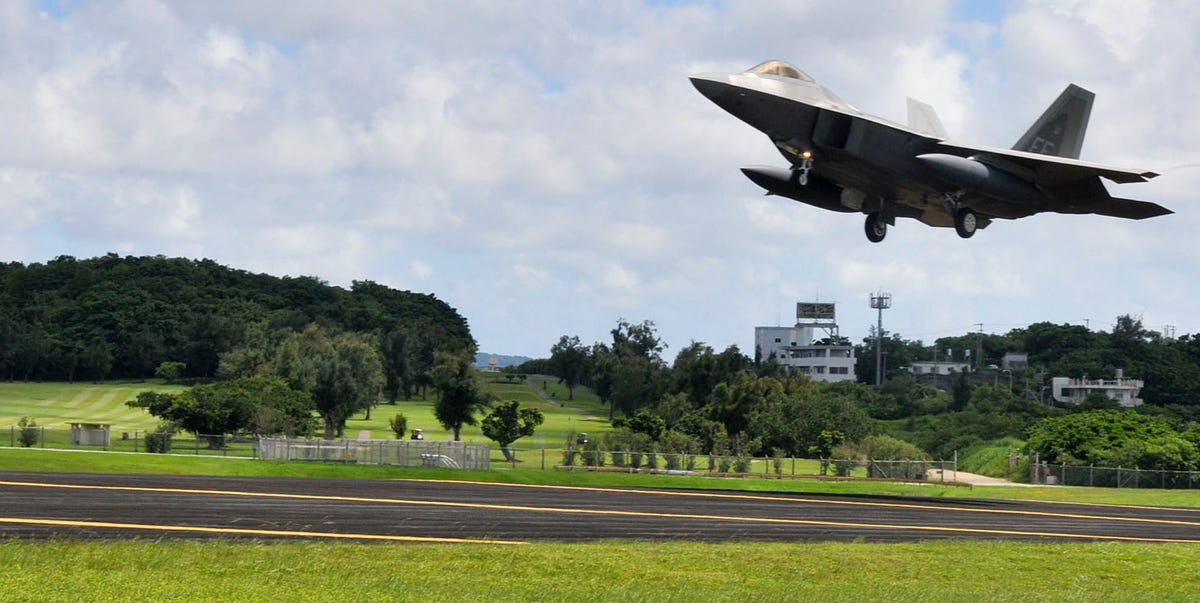
When F-22 Raptors show up at Kadena Air Base, the message is rarely subtle. The sleek, angular stealth fighters are not the kind of aircraft Washington moves casually, like office chairs in a conference room. Their arrival in Okinawa in May 2026 reflects a larger shift in U.S. airpower strategy across the Indo-Pacific: keep the fighter presence credible, keep allies reassured, and keep potential adversaries guessing just enough to think twice.
The U.S. Air Force confirmed that F-22 Raptors from the 90th Fighter Squadron at Joint Base Elmendorf-Richardson, Alaska, and the 27th Fighter Squadron at Joint Base Langley-Eustis, Virginia, arrived at Kadena Air Base for a fighter rotation supporting operations across the Indo-Pacific. Kadena, often called the “Keystone of the Pacific,” sits in Okinawa, closer to Taiwan, the East China Sea, and key regional sea lanes than any Pentagon planner would describe as “boring.” In military geography, boring is rare; at Kadena, it is practically extinct.
Why Kadena Matters So Much
Kadena Air Base is one of the most important U.S. military hubs in East Asia. It hosts the 18th Wing and supports a mix of fighter, reconnaissance, refueling, and support aircraft. Its position makes it a forward operating location for U.S. and allied forces across the first island chain, the arc of territory running from Japan through Taiwan and the Philippines. That chain is not just a map feature; it is the strategic front porch of the Western Pacific.
For decades, Kadena was associated with the F-15C/D Eagle, a fourth-generation fighter that played the air superiority role with impressive longevity. But even legendary aircraft age. The F-15C/D fleet became increasingly expensive to maintain, and the Air Force began withdrawing those aircraft from Kadena while planning for the future arrival of the F-15EX Eagle II. Until that permanent transition is complete, the Air Force has relied on rotations of advanced fighters, including the F-22, F-35, F-15E, and F-16, to maintain a steady fighter presence.
What the F-22 Brings to the Region
The F-22 Raptor is the U.S. Air Force’s premier fifth-generation air superiority fighter. It combines stealth, supercruise, advanced sensors, integrated avionics, and high maneuverability. In plain English: it is built to see first, move fast, remain difficult to detect, and dominate the airspace around it. It is not simply a fast jet with a dramatic silhouette; it is a flying information machine designed to give pilots a clearer picture of the battlespace.
That matters in the Indo-Pacific because distance is brutal. Airfields, sea lanes, islands, and refueling points are spread across vast stretches of ocean. The F-22’s presence at Kadena does not solve every problem, but it strengthens the U.S. ability to respond quickly, train with allies, and maintain pressure on any actor considering coercive moves around Taiwan, Japan, or the South China Sea.
A Deterrence Signal, Not Just a Deployment
Military deployments are partly about capability and partly about communication. The F-22 rotation tells allies that the United States is still investing in forward presence. It tells China that U.S. airpower in the region is not standing still during the F-15EX transition. And it tells regional observers that Kadena remains a key node in America’s Indo-Pacific posture.
Deterrence is often misunderstood as chest-thumping. In reality, it is more like leaving the lights on, locking the doors, and making sure everyone knows the security system works. The goal is not to start a conflict. The goal is to make aggression look too costly, too risky, and too uncertain to attempt.
Rising Tensions With China
The F-22 deployment comes against a backdrop of increased Chinese military activity across the Indo-Pacific. China has expanded its air and maritime operations around Taiwan, increased pressure in the East and South China Seas, and continued to modernize the People’s Liberation Army. Taiwan has reported frequent Chinese aircraft and warship activity near the island, while analysts have tracked a higher baseline of PLA operations compared with previous years.
The Taiwan Strait remains the central flashpoint. Beijing claims Taiwan as part of China, while Taiwan’s government rejects Beijing’s sovereignty claims. The United States does not maintain formal diplomatic relations with Taiwan, but it is legally committed under the Taiwan Relations Act to help Taiwan maintain a sufficient self-defense capability. That delicate arrangement has worked for decades, but the margin for error appears thinner as military activity increases.
Japan is also directly affected. Okinawa and Japan’s southwestern islands sit near the areas where Chinese aircraft, drones, and naval forces have become more active. Japan’s defense community has repeatedly noted increased Chinese operations through nearby waters and airspace, including routes between Okinawa and Miyakojima and areas closer to Taiwan. In this environment, Kadena is not a distant rear-area base. It is close to the action.
The U.S.-Japan Alliance at the Center
The F-22 rotation also reinforces the U.S.-Japan alliance, one of the cornerstones of Indo-Pacific security. U.S. officials describe the Kadena fighter rotations as part of a broader commitment to defend Japan and maintain a free and open Indo-Pacific. That phrase may sound like diplomatic wallpaper, but it points to practical goals: open sea lanes, stable borders, credible deterrence, and resistance to coercion.
Japan has been increasing its own defense focus, especially in the southwest island chain. U.S. and Japanese leaders have emphasized more realistic joint training, stronger readiness, and deeper coordination. The F-22s at Kadena fit into that larger picture. They are not operating in isolation; they are part of a network that includes Japanese forces, U.S. naval power, reconnaissance aircraft, refueling assets, and other allied capabilities.
The F-15EX Transition Problem
One reason the Kadena F-22 rotation matters is the gap between old and new fighter forces. The F-15C/D Eagles that once formed Kadena’s permanent fighter backbone have been phased out. Their planned replacement, the F-15EX Eagle II, is expected to bring modern radar, electronic systems, weapons capacity, and longer-term sustainability. But transitions in military aviation are rarely as neat as PowerPoint slides suggest.
When new aircraft arrive later than planned, commanders still need credible capability today. That is where rotational fighter deployments come in. F-22s can help maintain high-end air superiority while the base prepares for its next permanent fighter era. The arrangement is not perfect; rotations require logistics, maintenance teams, spare parts, planning, and coordination with host communities. Still, they give the Air Force flexibility during a complicated modernization cycle.
Local Impact in Okinawa
No discussion of Kadena is complete without mentioning Okinawa’s local community. The island hosts a heavy concentration of U.S. military facilities, and residents have long raised concerns about aircraft noise, safety, land use, and daily disruption. The Air Force has said visiting aircrews are briefed on local noise abatement procedures and that mission planners consider local impacts. That is important, because deterrence abroad must coexist with responsibility on the ground.
For Okinawans, a fighter rotation is not an abstract geopolitical symbol. It may mean more aircraft noise, more visible military activity, and more debate about the island’s role in regional security. For U.S. and Japanese officials, the challenge is balancing strategic necessity with public trust. A stealth fighter may be hard to detect on radar, but it is not hard to hear when it takes off.
Why the F-22 Still Has Strategic Weight
The F-22 is no longer the newest fighter in America’s inventory, and production ended years ago. Yet it remains one of the most capable air superiority aircraft in the world. Its rarity actually increases the significance of its deployment. The United States has only a limited number of Raptors, so sending them to Kadena signals that the mission is important enough to justify the use of scarce high-end assets.
The Raptor’s value is not only in what it can do alone. It can also strengthen the broader force by operating alongside fourth- and fifth-generation aircraft, reconnaissance platforms, tankers, and allied units. Modern airpower is not a solo guitar performance; it is an orchestra. The F-22 may play first chair, but the music only works when every section is coordinated.
What This Means for China
For Beijing, the F-22 presence at Kadena is likely viewed through the lens of U.S. containment and alliance strengthening. China routinely criticizes U.S. military activity near its periphery, especially when it involves Taiwan, Japan, or the South China Sea. From Washington’s perspective, however, forward deployments are defensive measures designed to preserve regional stability and prevent unilateral changes to the status quo.
The difference in interpretation is exactly why tensions remain high. The same aircraft can be described by one side as a stabilizing deterrent and by the other as a provocative deployment. Strategic messaging is rarely received exactly as it is sent. That is why communication channels, crisis management, and predictable military behavior matter so much in the Indo-Pacific.
Could This Increase the Risk of Conflict?
The arrival of F-22 Raptors at Kadena does not mean conflict is imminent. Military rotations happen regularly, and the Air Force has emphasized readiness, interoperability, and deterrence. However, the deployment does reflect a region where leaders are planning for higher risk. More aircraft, more ships, more patrols, and more exercises can strengthen deterrence, but they can also increase the chance of miscalculation if forces operate too close to one another.
This is the uncomfortable paradox of deterrence: the tools used to prevent conflict are often the same tools that make the environment look more militarized. The solution is not weakness. It is discipline, communication, alliance coordination, and clear signaling. In that sense, the F-22 rotation is less about dramatic confrontation and more about controlled readiness.
Experiences and Observations: What a Kadena F-22 Rotation Feels Like
To understand the human side of this story, imagine Kadena not as a dot on a defense map but as a living, breathing air base. A fighter rotation begins long before aircraft appear over Okinawa. Maintenance crews prepare equipment, logisticians track parts, planners coordinate schedules, and host units make room for visiting aircraft and personnel. By the time the first Raptor taxis onto the flight line, hundreds of quiet tasks have already happened behind the scenes.
For airmen, a Kadena rotation is both routine and intense. The routine part comes from checklists, inspections, briefings, and training schedules. Military aviation runs on repetition because repetition keeps people alive. The intense part comes from the location. Everyone understands that Okinawa is close to several of the world’s most sensitive security issues. Even routine training can carry strategic meaning when it happens near Taiwan, the East China Sea, and major Chinese air and naval routes.
For maintainers, the F-22 is a demanding aircraft. Stealth fighters require careful handling, specialized support, and disciplined maintenance procedures. The public often sees the dramatic takeoff photo, the sharp wings, and the “wow, that looks expensive” silhouette. What it does not see is the long workday under hangar lights, the tool accountability, the technical checks, and the constant push to keep aircraft mission-ready. Airpower is glamorous from a distance; up close, it is mostly sweat, planning, and people who know exactly where the torque wrench went.
For pilots, Kadena offers a training environment that is hard to duplicate in the continental United States. The airspace, weather, distance, and proximity to allied forces create realistic conditions for high-end readiness. Training with Japanese and U.S. joint partners helps build habits that would matter in a crisis: communication, timing, identification, refueling coordination, and shared understanding. The goal is to make cooperation feel normal before stress levels rise.
For local residents, the experience is more complicated. Some people see the U.S. presence as necessary for regional security. Others see it as a daily burden that Okinawa carries more heavily than mainland Japan. Both views can exist at the same time. The roar of jet engines may sound like reassurance to one person and disruption to another. Any serious analysis of Kadena has to respect that reality.
For regional observers, the F-22 rotation feels like a reminder that the Indo-Pacific is no longer a slow-moving strategic theater. China’s military modernization, Taiwan’s uncertain future, Japan’s defense reforms, and U.S. alliance commitments are all moving at once. The Raptor’s arrival is not the whole story, but it is a visible chapter. It says the United States wants to keep advanced airpower close enough to matter, flexible enough to move, and credible enough to deter.
That experience-based view makes the deployment easier to understand. It is not merely about a stealth fighter parked on a runway. It is about the people maintaining it, the allies training beside it, the residents hearing it, the commanders planning around it, and the governments reading meaning into it. The F-22 at Kadena is a machine, yesbut it is also a message with wings.
Conclusion
The stationing of U.S. F-22 Raptors at Kadena Air Base highlights a crucial moment in Indo-Pacific security. The deployment supports the transition away from aging F-15C/D Eagles, reinforces the U.S.-Japan alliance, and signals that Washington intends to maintain credible airpower near the region’s most sensitive flashpoints. With China increasing military activity around Taiwan and across nearby waters, Kadena’s strategic value is only growing.
Still, the most important purpose of the F-22 rotation is not escalation. It is deterrence. The Raptors are there to strengthen readiness, reassure allies, and reduce the temptation for coercive action. In a region where geography is tight, politics are tense, and military technology moves fast, the quiet logic of deterrence may be the most important mission of all.
Note: This article is written for general public information and analysis using publicly available reporting. It avoids operational guidance and does not include source links in the publishable body copy.