After more than three decades of chaos, satire, exploding appliances, questionable parenting, and Springfield citizens surviving things that would make an emergency room doctor quietly change careers, The Simpsons has found a surprisingly sweet way to honor one of its strangest running jokes. The character in question is not Homer, Bart, Mr. Burns, or even Hans Moleman, the human embodiment of “wrong place, wrong time.” It is Lenny Leonard, Homer’s lovable coworker, Carl’s best friend, and Springfield’s unofficial patron saint of eye injuries.
The title “‘The Simpsons’ Honors This Character’s Bizarre Medical Trend” points to a gag that has been quietly building for years: Lenny’s repeated, weirdly specific, and increasingly ridiculous eye trauma. In the Season 37 episode “Guess Who’s Coming to Skinner,” the show nods to that history by placing Principal Skinner at Springfield’s Eye Trauma Center, where viewers briefly see the “Lenny Leonard Wing.” It is a small joke, but for longtime fans, it lands like a snow globe to the facepainful, absurd, and oddly satisfying.
That is the magic of The Simpsons. A throwaway injury from years ago can become a miniature piece of Springfield history. A side character’s suffering can be immortalized in hospital architecture. And a gag about pudding, springs, soap, and general eyeball misfortune can suddenly feel like a cultural artifact. Only in Springfield could a medical center wing feel less like a tribute and more like a warning label.
What Happened in “Guess Who’s Coming to Skinner”?
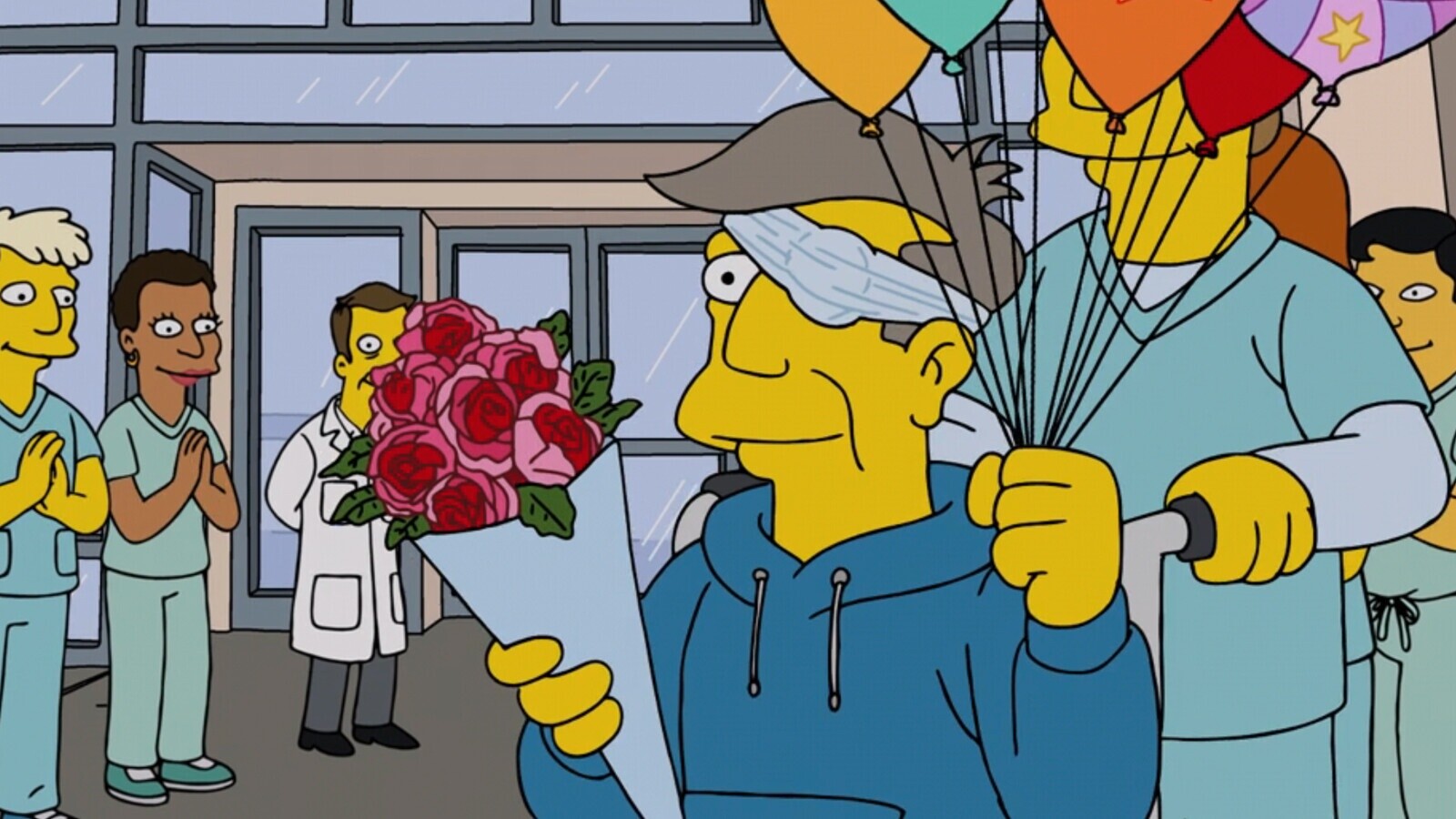
In “Guess Who’s Coming to Skinner,” Principal Seymour Skinner becomes the center of an unusually emotional story. During a school field trip, Bart helps create the kind of disaster that only Bart Simpson can create without even needing a detailed business plan. A snow globe mishap injures Skinner’s eye, sending him into a medical spiral that includes multiple eye surgeries and a heavily bandaged recovery.
The episode’s main story later shifts toward Skinner discovering a runaway student named Hub living in the school library. Skinner, a man whose emotional operating system appears to have been installed by Agnes and never updated, is forced into a temporary parental role. That plot gives the episode its heart. But before the emotional lesson arrives, the show sneaks in a brilliant bit of background comedy: Skinner leaves the Eye Trauma Center, and the building includes the “Lenny Leonard Wing.”
For casual viewers, it is a funny sign. For die-hard fans, it is a full-circle joke. Lenny has suffered so many bizarre eye-related injuries over the years that Springfield naming an eye trauma wing after him feels both absurd and completely reasonable. Honestly, if Lenny had a punch card, he would have earned a free cornea by now.
Why Lenny Leonard Is the Perfect Character for This Joke
Lenny Leonard has always been one of Springfield’s most quietly funny characters. He works at the Springfield Nuclear Power Plant with Homer and Carl, drinks at Moe’s Tavern, and often appears as part of the town’s blue-collar chorus. He is not usually the main driver of the plot, but he is often the perfect delivery system for a strange punchline.
Part of Lenny’s charm is that he feels ordinary by Springfield standards, which means he is only mildly impossible. He is loyal, slightly fragile, emotionally available in unexpected ways, and somehow always close enough to Homer’s nonsense to become collateral damage. His friendship with Carl gives the series one of its funniest background dynamics, while his soft-spoken personality makes his sudden medical disasters even more ridiculous.
That contrast is important. If Homer gets hurt, it is expected. Homer has eaten, fallen into, or been crushed by more dangerous objects than most cartoon families own. If Mr. Burns suffers an odd medical condition, the joke usually comes from his supernatural old age. But when Lenny gets something in his eye, the joke feels oddly personal. He does not deserve it. He rarely causes it. He simply exists in Springfield, which is medically unwise.
The Running Gag That Turned Into a “Medical Trend”
Lenny’s eye-injury history appears to trace back at least to Season 10’s “The Old Man and the ‘C’ Student,” when Homer tries to sell spring-loaded novelty items. One of those springs ends up in Lenny’s eye, creating the kind of wince-laugh that The Simpsons has always done well: cartoonish enough to be funny, specific enough to be horrifying.
From there, the joke expanded. Lenny has been shown getting pudding in his eye, dealing with objects and substances that should never be anywhere near a human eyeball, and generally becoming Springfield’s most consistent ocular disaster. The famous pudding line“My eye, I’m not supposed to get pudding in it!”became one of those tiny quotes fans remember because it sounds both medically specific and totally unexplained. Why is Lenny not supposed to get pudding in his eye? What previous pudding-related consultation happened? Did a doctor write this down? Is there a chart?
That mystery is part of the joke. The more specific Lenny’s warning sounds, the funnier it gets. It implies a whole unseen medical file labeled “Leonard, Lenny: eyemiscellaneous disasters.” The show does not need to explain it. In fact, explaining it would ruin the fun. Springfield’s comedy often works best when it gives the audience one absurd detail and lets imagination do the rest.
Why the “Lenny Leonard Wing” Joke Works So Well
The “Lenny Leonard Wing” is not just a random background sign. It is a reward for viewers who remember the show’s long history. The Simpsons has survived for so long because Springfield feels cumulative. Small details return. Minor characters have histories. Weird jokes become civic institutions. The town has memory, even when Homer does not.
By naming a hospital wing after Lenny, the show turns a recurring gag into world-building. Suddenly, Lenny’s injuries are not just isolated punchlines. They are frequent enough to shape Springfield’s infrastructure. That is excellent sitcom escalation. A joke begins with one injury, repeats across years, becomes part of a character’s identity, and eventually receives a building plaque. That is the American dream, if the American dream involved a disturbing number of ophthalmology appointments.
The gag also works because it is quick. Modern Simpsons episodes often balance emotional storytelling with fast background humor, and this moment does exactly that. Skinner’s injury drives the plot forward, but the sign quietly links his trauma to Lenny’s legacy. It says, “Yes, we remember. Yes, we know fans remember. And yes, Springfield has apparently monetized the problem.”
The Simpsons and the Art of Long-Term Payoff
Few shows can make a joke that depends on decades of accumulated memory. The Simpsons can, because it has been on television long enough for some viewers to have watched Lenny injure his eye as children and then later develop their own back pain, mortgage stress, and opinions about fiber supplements.
This longevity creates a special kind of comedy. A newer sitcom might repeat a gag across one season. The Simpsons can repeat a gag across generations. That changes how the joke feels. Lenny’s eye injuries are not just running jokes; they are fossil records. They remind viewers of earlier episodes, older animation styles, past eras of television, and the strange comfort of returning to Springfield year after year.
The show’s writers understand that nostalgia works best when it is not too loud. The “Lenny Leonard Wing” does not stop the episode for applause. It does not include a montage of every time Lenny screamed about his eye. It simply appears, trusting the audience to connect the dots. That confidence makes the joke sharper.
Is the “Bizarre Medical Trend” a Real Medical Issue?
In real life, repeated eye injuries are not funny. Eye trauma can include scratches, foreign objects, blunt-force injuries, chemical exposure, burns, and penetrating wounds. Some injuries heal quickly, but others can lead to lasting vision problems. Medical experts generally advise people to avoid rubbing an injured eye, flush certain irritants with clean water when appropriate, and seek urgent care for sharp objects, chemical exposure, severe pain, vision changes, or trauma.
That real-world seriousness is part of why the Lenny joke feels so outrageous. The show treats his eye as a magnet for absurd objects, but viewers understand the mismatch. We know pudding is not supposed to be in anyone’s eye. We know springs are not recommended eyewear. We know “buttons held with hot wax” sounds less like acting and more like a lawsuit wearing a tiny hat.
The comedy comes from cartoon exaggeration, not medical advice. In Springfield, a character can take years of eye damage and return to Moe’s by the next episode. In the real world, the correct response to repeated eye trauma is not to laugh, shrug, and name a hospital wing after yourself. It is to wear protective eyewear, get proper medical care, and avoid standing near Homer when he announces a new business idea.
How Lenny’s Eye Injuries Reflect Springfield’s Larger Chaos
Springfield is not just a town. It is a machine that turns ordinary situations into disasters. A field trip becomes emergency surgery. A novelty spring becomes an ocular incident. A bowl of pudding becomes a threat. A workplace becomes a nuclear hazard with doughnuts. Lenny’s eye injuries fit perfectly into this world because Springfield treats danger like weather: unpredictable, constant, and somehow everyone still goes outside.
Lenny is funny because he absorbs the randomness of the town. He is not as reckless as Homer, not as evil as Burns, not as scheming as Bart, and not as dramatic as Krusty. He is simply there. That makes him an ideal victim of Springfield logic. The universe does not hate Lenny. It merely keeps throwing objects at face level.
There is also a strange affection in the joke. The show clearly likes Lenny. His injuries are exaggerated, but they are not cruel in the way some comedy can feel cruel. He remains part of the community. People care when he is hurt. Fans remember his lines. And now, within the fictional world, he has a wing named after him. That is a bizarre honor, but an honor nonetheless.
Why Fans Love Deep-Cut Simpsons References
Part of being a Simpsons fan is carrying around a mental junk drawer full of lines, signs, side characters, and background gags. The show has created so many memorable details that fans can bond over references most casual viewers may miss. A name like Lenny Leonard instantly brings up Carl, Moe’s Tavern, the power plant, and at least one medical bill that probably caused a small earthquake in his wallet.
Deep-cut references make fans feel seen. They reward attention without punishing newcomers. A new viewer can laugh at the “Lenny Leonard Wing” because naming a trauma center wing after a random guy is funny. A longtime viewer can laugh harder because they understand why Lenny earned it. That layered humor is one reason the series remains culturally durable.
It also shows how valuable side characters are to The Simpsons. Springfield works because it is crowded with oddballs who feel like they have lives beyond the main family. Lenny, Carl, Moe, Skinner, Chalmers, Willie, Comic Book Guy, and dozens of others give the town texture. The main family may be the heart of the show, but the supporting cast is the bloodstream, even if Lenny’s bloodstream should probably be checked for trace amounts of pudding.
Specific Examples That Make Lenny’s Eye Legacy So Memorable
- The spring incident: Lenny’s eye trouble became strongly associated with Homer’s failed spring-selling scheme in “The Old Man and the ‘C’ Student.”
- The pudding moment: His panicked warning about pudding in his eye remains one of the most quoted examples of the gag.
- Random foreign objects: The character has been linked to eye injuries involving strange items such as puzzle pieces, soap, and other Springfield-level hazards.
- The movie-within-the-show gag: In a horror-film scene, Lenny’s eyes are subjected to theatrical punishment that is funny mainly because it sounds wildly unnecessary.
- The Eye Trauma Center tribute: The “Lenny Leonard Wing” turns the recurring joke into a fictional civic landmark.
What This Moment Says About Modern The Simpsons
Modern The Simpsons often gets discussed through the lens of whether it can still surprise viewers after hundreds of episodes. The answer, at least in moments like this, is yes. Not every surprise needs to be a massive plot twist or celebrity cameo. Sometimes the best surprise is a tiny sign that tells longtime viewers the writers remember the same weird things they do.
The show has also become more openly reflective about its own history. It knows fans track continuity, quote obscure lines, and debate whether a background gag counts as canon. Instead of ignoring that, the series occasionally plays with it. The “Lenny Leonard Wing” is a perfect example because it does not overexplain the joke. It simply places a decades-old pattern into the physical world of Springfield.
That self-awareness can be risky if it becomes too cute, but here it works because it serves the episode’s tone. Skinner’s eye injury is part of the plot. Lenny’s history adds an extra comic layer. The result feels organic rather than forced. It is a wink, not a speech.
Experience Section: Why This Joke Feels So Rewarding to Watch
Watching The Simpsons honor Lenny Leonard’s bizarre medical trend feels like finding an old joke tucked inside a new episode and realizing it still has batteries. Many viewers have a personal history with this show. They remember watching episodes after school, catching reruns late at night, or quoting random lines with friends who somehow understood exactly what “pudding in the eye” meant without anyone needing context. That is the strange power of The Simpsons: it turns nonsense into shared language.
The “Lenny Leonard Wing” joke works especially well because it captures the experience of being a long-term viewer. You see the sign, pause for half a second, and your brain opens a dusty file cabinet labeled “Lenny’s eye problems.” Suddenly, memories of old episodes come rushing back. There is the spring. There is the pudding. There is the sense that Lenny’s face has lived a harder life than most action heroes. The joke is quick, but the reaction is layered. It is not just laughter; it is recognition.
There is also something oddly comforting about a show remembering its minor characters. In real life, people often feel like background characters in someone else’s main story. Lenny is not usually Springfield’s hero. He is not the smartest, loudest, richest, or most dramatic person in town. Yet the show gives him a tiny monument. Yes, it is a monument to repeated eye trauma, which is not exactly a marble statue in the town square, but it still says: this character matters. His weird history matters. The audience’s memory matters.
From a viewing experience, this is the kind of joke that makes fans feel rewarded without being excluded. A first-time viewer can still understand that the sign is silly. A longtime fan gets the deeper pleasure of knowing it connects to years of accumulated chaos. That balance is difficult. Too many references can make a show feel like homework. Too few can make a long-running series feel disconnected from itself. This moment hits the sweet spot: fast, funny, specific, and gone before it overstays its welcome.
It also reminds viewers why background jokes are one of The Simpsons’ strongest traditions. Some of the show’s best humor has always lived on signs, labels, business names, posters, and quick visual details. The “Lenny Leonard Wing” belongs in that tradition. It is a joke you could miss if you look away, which makes catching it feel like a tiny victory. In a world of streaming, second-screen viewing, and distracted watching, a joke like this rewards attention. It gently says, “Hey, put down your phone. Springfield is still weird.”
Finally, the joke lands because it transforms pain into absurd legacy. Lenny’s injuries are ridiculous, but the tribute is affectionate. It suggests that even Springfield’s most unlucky citizens leave a mark on the town. In Lenny’s case, that mark is apparently on an ophthalmology department. It is funny, a little gross, and surprisingly sweetexactly the emotional cocktail The Simpsons has been mixing for decades.
Conclusion
The Simpsons honoring Lenny Leonard’s bizarre medical trend is a reminder that the show’s smallest jokes can have the longest lives. What began as a simple eye-injury gag has grown into a piece of Springfield folklore, complete with a hospital wing bearing Lenny’s name. The moment is funny because it is absurd, but it is also satisfying because it rewards memory, loyalty, and attention to detail.
In a series packed with famous characters and headline-grabbing episodes, Lenny’s “honor” proves that supporting players often carry some of the best comedy. He may not be Springfield’s loudest resident, but his eye has endured enough punishment to qualify for landmark status. If nothing else, the “Lenny Leonard Wing” teaches one important lesson: keep pudding, springs, snow globes, and Homer Simpson’s ideas far away from your face.