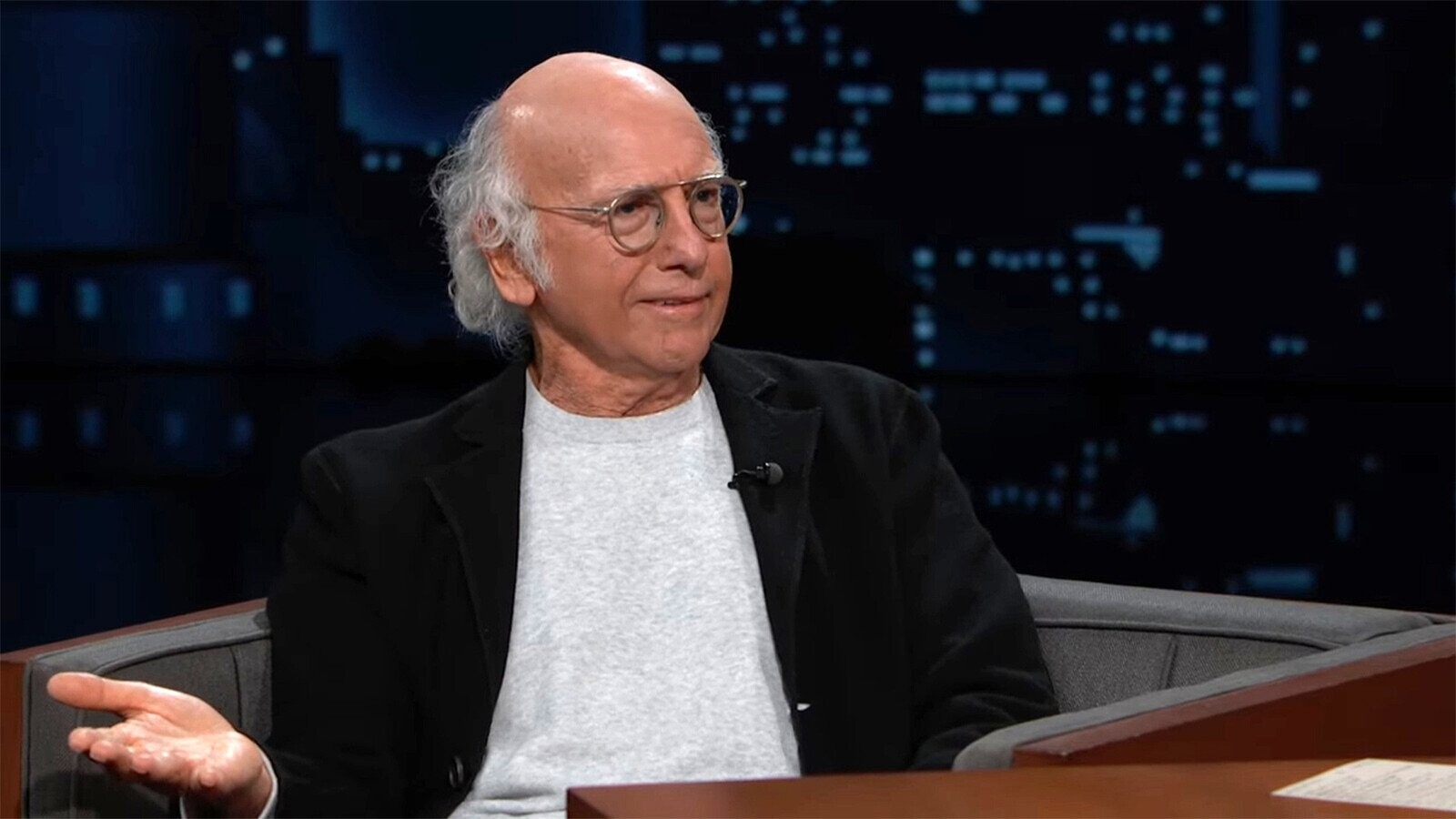
Larry David getting into an actual fight at the supermarket sounds less like a celebrity news headline and more like a lost episode of Curb Your Enthusiasm. There is almost no setup required. A grocery store. A checkout lane. A tiny social rule. A man who believes civilization depends on whether six ketchup bottles count as six items or one. Cue the tuba music.
The story surfaced when Larry David appeared on Jimmy Kimmel Live! and Kimmel noticed that David seemed to be walking with a slight limp. David, never one to decorate a sentence with unnecessary sunshine, explained that he had been in “a little altercation” at a supermarket. The alleged spark? A shopper ahead of him in an express checkout lane had more than the allowed number of items. Worse, in David’s view, the shopper had multiple bottles of ketchup and seemed to be counting them as one item because they were identical.
For most people, this would be a mildly annoying grocery store moment. For Larry David, it was a constitutional crisis with condiments.
The Supermarket Incident: What Actually Happened?
According to David’s own telling, he was standing behind a customer in a “less than 10 items” checkout line. The problem was that the customer appeared to have around 12 items, including six bottles of ketchup. David argued that six bottles should count as six separate items. Jimmy Kimmel, playing the voice of grocery-store pragmatism, suggested that if all six bottles are the same, a cashier could simply scan one and multiply it by six. That, to Kimmel, sounded like one type of item.
To Larry David, that sounded like the first crack in the dam before society floods itself with coupon fraud, shopping-cart chaos, and people who say “quick question” before asking a 14-minute question.
David said he did not like what he saw and, in classic Larry fashion, apparently made that displeasure known. He described the other shopper as having a bad temper and said the man lashed out physically. David ended up hurting his knee, which explained the limp. When Kimmel asked about the aftermath, David joked in the spirit of an old-school tough guy, essentially suggesting that the other guy had it worse.
Was this a heavyweight title bout next to the frozen peas? Probably not. But as a cultural moment, it was perfect: Larry David, the patron saint of petty grievances, allegedly defending the sacred math of the express lane.
Why This Story Feels Like a Real-Life Curb Your Enthusiasm Episode
The reason the Larry David supermarket fight became so instantly funny is that it fits the Larry David brand almost too neatly. Curb Your Enthusiasm, which ran for 12 seasons on HBO, made an art form out of microscopic social disputes. The show often begins with a tiny irritationa tip jar, a dinner invitation, a parking space, a thank-you noteand then turns it into a full-scale social disaster.
The supermarket story has every ingredient of a great Curb premise. There is an unwritten rule. There is a public setting. There is a stranger doing something technically debatable. There is Larry noticing. There is Larry deciding not to let it go. Then, naturally, there are consequences.
That structure is why the story feels less like celebrity gossip and more like comedy physics. Larry David sees the world as a place full of broken micro-contracts. People cut lines. People overstay visits. People ask for favors at the wrong time. People treat “10 items or fewer” as if it were a gentle poem rather than a binding social agreement. In his comedy universe, these small violations matter because they reveal something larger about human behavior: we all want rules, but most of us also want exceptions when the rule becomes inconvenient.
The Express Lane Debate: Was Larry David Right?
Now we reach the legal portion of the ketchup trial. Should six identical bottles count as one item or six? This is where America divides itself into two proud, mildly unbearable camps.
Team Larry: Six Bottles Means Six Items
Team Larry believes the express lane is not about barcode diversity. It is about physical items. If you place six bottles of ketchup on the belt, the cashier still has to handle six bottles. They have to move them, bag them, and possibly judge your relationship with tomato-based sweetness. Under this view, six bottles are six items because there are six objects. Simple. Brutal. Mathematical.
This interpretation values fairness. The person behind you may have a sandwich, a bottle of water, and the emotional fatigue of a Tuesday. They chose the express lane because the sign promised speed. If everyone starts grouping identical items together, the 10-item limit becomes a loophole large enough to drive a Costco cart through.
Team Kimmel: Identical Items Can Count as One Type
Team Kimmel argues that the checkout process is about scanning efficiency. If the cashier scans one ketchup bottle and enters quantity six, the transaction may not take much longer than scanning a single bottle. From this perspective, the spirit of the express lane is speed, not object-counting purity. Six identical items may be annoying, but they are not the same as 12 unrelated products requiring 12 separate scans.
This view values practicality. It says the real question is not “How many objects exist?” but “How long will this take?” A dozen greeting cards, each with a different barcode, could be more painful than six identical ketchup bottles. Anyone who has waited behind a person buying produce without stickers understands this deeply.
The Verdict
Larry David was not completely wrong. Kimmel was not completely wrong either. That is exactly why the story works. It lives in the gray area where social rules become comedy fuel. If the customer had 47 items, everyone would agree he was wrong. If he had nine items, there would be no story. But 12 items, six of them ketchup? That is where civilization starts squinting.
Larry David’s Comedy Is Built on Everyday Conflict
Larry David co-created Seinfeld with Jerry Seinfeld and later created and starred in Curb Your Enthusiasm. Both shows changed television comedy by focusing less on dramatic plots and more on everyday irritations. Instead of asking, “What huge thing happens today?” David’s comedy asks, “What tiny thing is everyone pretending not to care about?”
That question is powerful because most people do care. We care when someone cuts the line. We care when a person takes too long at the ATM. We care when a friend says they are “five minutes away” while clearly still deciding which socks to wear. The difference is that most people swallow the complaint. Larry David builds a career out of saying it aloud.
The supermarket incident is funny because it blurs the line between Larry David the performer and Larry David the public figure. In Curb, he plays a fictionalized version of himself: socially blunt, rule-obsessed, allergic to fake enthusiasm, and constitutionally unable to ignore bad behavior. So when the real Larry David tells a story about confronting someone over checkout lane etiquette, the audience instantly recognizes the rhythm.
It is not simply, “Celebrity gets into argument.” It is, “Larry David finds a rule violation in its natural habitat and approaches.” That is a whole genre.
Why Supermarkets Are Perfect Comedy Settings
Supermarkets are comedy laboratories. Everyone is trying to complete a basic task, but the environment is packed with opportunities for low-grade conflict. People abandon carts in the middle of aisles. Someone always blocks the olive oil section with the intensity of a museum curator. A shopper samples grapes like they are conducting agricultural research. The self-checkout machine accuses you of unexpected bagging-area activity, which is the closest modern technology comes to calling you a criminal.
Because grocery shopping is so ordinary, every tiny violation becomes relatable. You do not need to be famous to understand the irritation of choosing the express lane and then realizing the person ahead of you has brought a small pantry. You do not need to be a comedy writer to wonder why someone is paying with coins, coupons, a return receipt, and possibly a handwritten letter from 1998.
Larry David’s supermarket fight went viral because it tapped into this shared experience. We may laugh at him for caring so much, but part of us understands. The express lane is one of the few places where society posts a clear rule in large font. When even that rule becomes negotiable, what is next? People reclining their airplane seats during takeoff? Guests arriving early to a party? Someone saying “no worries” when there are, in fact, several worries?
The Public’s Reaction: Laughing Because It Feels True
Fans reacted to the story because it felt almost too perfectly Larry David. Many people online treated it as a bonus scene from Curb Your Enthusiasm. The image is irresistible: Larry standing in line, silently counting items, noticing the ketchup cluster, calculating injustice, and deciding that this cannot stand.
What makes the story especially amusing is that David’s outrage is both ridiculous and understandable. That is the sweet spot of his comedy. He often takes positions that begin with a reasonable point and then pursues them with unreasonable intensity. Yes, the express lane should be respected. No, it may not be worth a knee injury. Yes, six ketchup bottles probably count as six items. No, the supermarket is not a courtroom, even if the fluorescent lighting gives it a grim institutional atmosphere.
This tension is why audiences keep returning to Larry David. He says the quiet part loudly, then pays for it. In a world where many people avoid confrontation, Larry confronts too much. That makes him both cathartic and cautionary. He is the person we secretly want to be for 15 seconds and then absolutely do not want to be when security arrives.
Celebrity, Persona, and the Larry David Effect
Not every celebrity could tell this story and receive affectionate laughter. If a different famous person admitted to arguing in a grocery store, the reaction might be concern, criticism, or a publicist releasing a statement with the phrase “learning and growing.” With Larry David, the story becomes part of the mythology.
That is because his public persona has been consistent for decades. He is not selling polish. He is selling irritation with excellent timing. His comedy is built around the idea that social life is full of absurd customs, fake politeness, and tiny hypocrisies. The supermarket fight fits neatly into that worldview.
It also arrived after the end of Curb Your Enthusiasm, which concluded in 2024. Fans who missed seeing David turn small inconveniences into major disasters suddenly received a real-life substitute. The show may have ended, but the Larry David operating system was apparently still running in the checkout aisle.
What the Ketchup Fight Says About Modern Etiquette
The deeper question is not really about ketchup. It is about how people interpret shared rules. The express lane is a tiny social contract. No police officer stands there. No judge rules on borderline baskets. The system works only if people agree not to abuse it.
Modern life is full of these soft rules. Hold the door if someone is close behind you. Do not take a phone call on speaker in a quiet waiting room. Return your cart. Let people exit the elevator before entering. Do not treat the office microwave like a seafood sauna. None of these rules is complicated, yet each one can become a small test of public decency.
Larry David’s supermarket altercation is funny because it exaggerates a real frustration: people often bend rules while expecting everyone else to remain polite about it. Most of us respond by sighing internally. Larry David, at least in this story, chose the external sigh with commentary.
Experiences Related to “Larry David Got Into An Actual Fight at the Supermarket”
Anyone who has spent enough time in supermarkets knows that the grocery store is where patience goes to be gently tenderized. The Larry David supermarket fight may involve a famous comedian, but the emotional setting is painfully familiar. We have all been there: standing in line with two items, watching someone ahead of us unload enough groceries to restock a cabin during a blizzard. At first, you try to be generous. Maybe they did not see the sign. Maybe they are having a hard day. Maybe those 11 cans of soup are part of a deeply moving soup emergency.
Then the internal courtroom opens.
You count the items. You recount because you are fair. You notice duplicates. You begin debating whether duplicates count separately. Suddenly, you are not just buying bananas; you are interpreting supermarket law. This is exactly why David’s story resonated. The experience is universal, but most people do not act on it. Instead, they perform the ancient ritual of public restraint: tight smile, deep breath, eyes forward, silent rage.
One useful lesson from the story is that being technically right does not always make confrontation worthwhile. Suppose Larry was correct that six ketchup bottles count as six items. What then? The reward for winning that argument is maybe 90 seconds saved, followed by a knee injury and a story that entertains millions. For Larry David, that trade has brand value. For the rest of us, it may simply mean limping to the parking lot while holding melting ice cream.
A second lesson is that public spaces run better when people consider the people behind them. If you have a full cart, do not use the express lane just because your items are emotionally lightweight. If you have duplicates, ask yourself whether your purchase will slow down the line. If the answer is yes, choose a regular lane and preserve the fragile peace of the cereal aisle.
A third lesson is that humor can turn irritation into insight. Larry David’s gift is not that he gets annoyed. Everyone gets annoyed. His gift is that he identifies the comic architecture of annoyance: the rule, the violation, the rationalization, the confrontation, and the absurd consequence. The supermarket story is memorable because it transforms a mundane checkout dispute into a miniature moral drama. It reminds us that comedy is often hiding in the places we visit when we are tired, hungry, and holding a loyalty card that never seems to work.
So the next time you are in a supermarket express lane, remember the ketchup incident. Count your items honestly. Respect the sign. And if someone ahead of you appears to be abusing the system, consider the Larry David method carefully. You may be right, but ask yourself one question before speaking: is this worth becoming a story on late-night television?
Conclusion
Larry David’s actual supermarket fight is funny because it is specific, petty, and strangely philosophical. On the surface, it is a story about checkout etiquette and ketchup math. Underneath, it is about fairness, public manners, and the tiny rules that keep strangers from turning everyday errands into combat sports.
The incident works as entertainment because it captures everything audiences associate with David’s comic genius. He notices what others ignore. He objects when others stay quiet. He turns an ordinary moment into a social referendum. Whether you think he was right, wrong, or right in the least efficient way possible, the story proves that Larry David does not need a writers’ room to create a perfect Larry David scenario. Sometimes all he needs is a supermarket, an express lane, and too much ketchup.
Note: This article is written in original language for web publication and is based on publicly reported interviews, entertainment coverage, and verified career information about Larry David. No source-code references or contentReference tags are included.