Note: This article is based on real information synthesized from reputable technical, standards, grid-operator, and electronics sources, including U.S. timekeeping, energy, and power-system references. Source links are intentionally not inserted so the HTML remains publication-ready.
Some household mysteries arrive with dramatic music. Others arrive when your microwave says it is 8:13, your stove says it is 8:18, your phone says it is 8:21, and you begin wondering whether breakfast has become a multiverse event. The question behind this very practical confusion is surprisingly deep: is your clock tied to mains frequency?
The short answer is: maybe. Some plug-in clocks, especially older alarm clocks, ovens, microwaves, timers, and inexpensive appliances, can use the frequency of the AC power grid as their timing reference. In North America, that means counting the cycles of the 60 Hz mains supply. In many other regions, it means counting the cycles of a 50 Hz supply. If the grid frequency averages exactly where it should, the clock keeps good time. If it drifts for long enough, the clock may drift too. Suddenly, your oven is not broken; it is just taking a very literal interest in power-system engineering.
This topic became famous in maker and electronics circles because it connects kitchen appliances, electric utilities, vintage clock chips, grid reliability, and the ancient human desire to know whether we are late. It is also a perfect “Ask Hackaday” style question: ordinary object, hidden engineering, and just enough weirdness to make you want to open the plastic case and look for a crystal oscillator.
What Is Mains Frequency?
Mains frequency, also called power line frequency or utility frequency, is the rate at which alternating current changes direction in the electrical grid. In the United States and most of North America, the nominal value is 60 hertz, meaning 60 cycles per second. In much of Europe, Asia, Africa, and Australia, the nominal value is 50 hertz.
That number is not just trivia for people who enjoy reading the back of power adapters at parties. Grid frequency is a live indicator of the balance between electricity supply and demand. When demand rises faster than generation, frequency tends to fall. When generation exceeds demand, frequency tends to rise. Grid operators work constantly to keep that number close to its target because motors, generators, industrial processes, and protection systems all expect the grid to behave predictably.
For a clock designer, a stable 60 Hz signal looks like a gift. Why pay for a precise oscillator if the wall outlet is already delivering a rhythmic signal? Count 60 cycles and call it one second. Count 3,600 groups of 60 cycles and call it one hour. Congratulations: you have built a timekeeper, and it did not need a tiny quartz tuning fork to do the job.
How a Clock Can Use the Power Grid as a Timebase
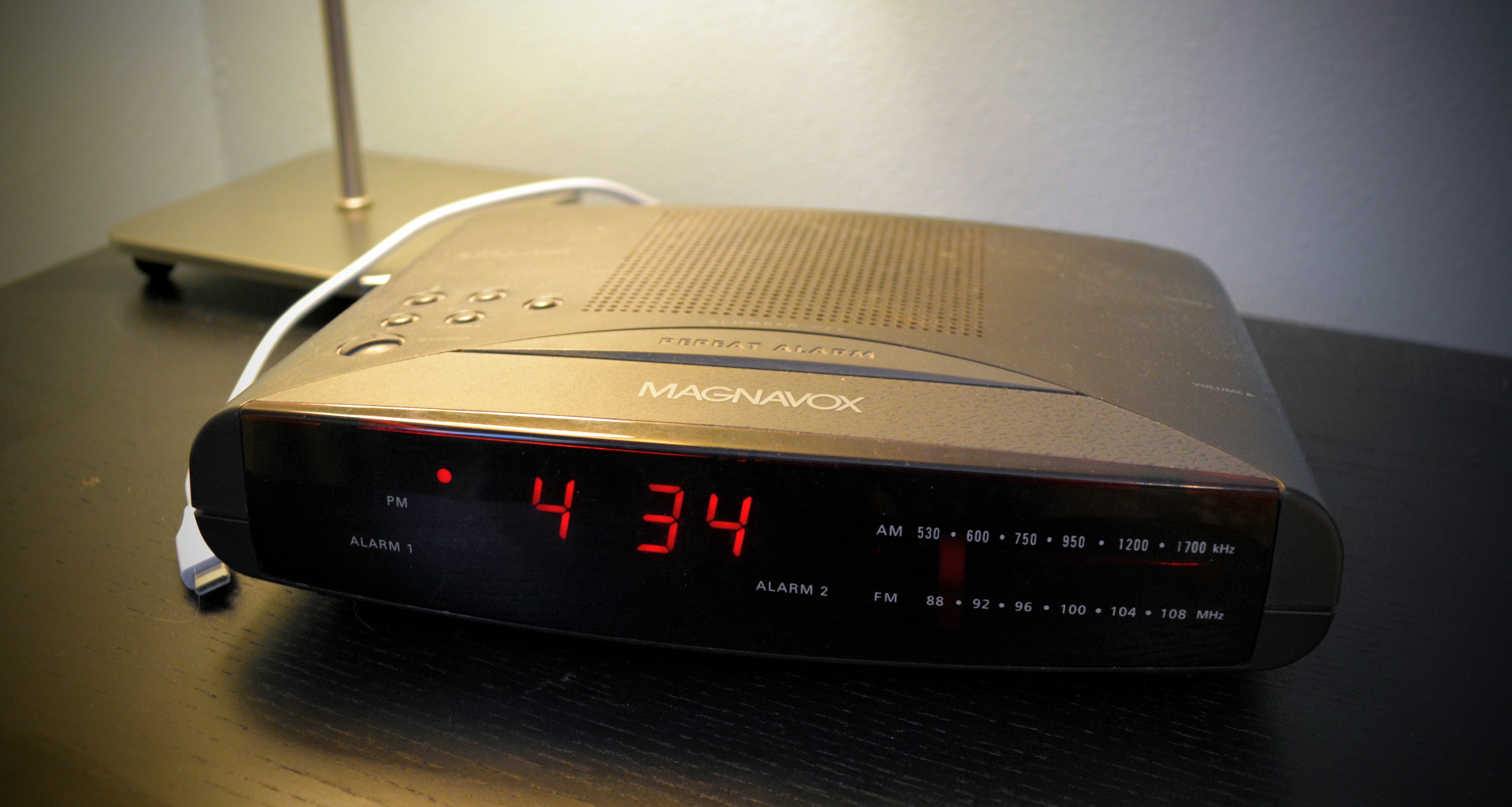
A mains-synchronized clock uses the AC waveform as a reference. Older electric clocks often used synchronous motors. These motors rotate at a speed locked to the line frequency, so gears can turn clock hands at the correct rate. Many appliance clocks and older digital alarm clocks use electronics instead: they detect zero crossings or pulses derived from the AC line and count them.
Imagine a simple digital clock chip connected to circuitry that senses the incoming AC. Every cycle is a tiny vote for time moving forward. After the correct number of cycles, the chip advances the seconds display. It is a beautifully cheap trick. No quartz crystal, no radio receiver, no internet connection, no subscription plan called “Clock Premium Plus.” Just the grid doing grid things.
This is why some old digital alarm clocks had 50/60 Hz selection options. A clock sold in a 60 Hz country needed to count differently from one sold in a 50 Hz country. If the wrong setting was used, the clock could run hilariously fast or slow. A 60 Hz clock operating on a 50 Hz reference would not be slightly wrong; it would be “miss your flight and blame the toaster” wrong.
Why the Grid Can Be a Surprisingly Good Clock
At first glance, using the power grid as a time reference sounds reckless. The grid is full of refrigerators, factories, air conditioners, elevators, data centers, and people making toast at inconveniently synchronized moments. Yet historically, utility frequency has often been controlled well enough that synchronous clocks stayed accurate over long periods.
The key phrase is over long periods. Grid frequency can wander slightly above or below nominal from second to second. However, many power systems have used long-term correction practices so the total number of cycles over a day remains close to the ideal count. In a 60 Hz system, a perfect day contains 5,184,000 cycles. In a 50 Hz system, it contains 4,320,000 cycles. If the grid runs a little slow for a while, operators can run it slightly fast later to reduce accumulated time error.
That long-term averaging is why a synchronous clock may look impressively accurate in normal service. It might wobble by a few seconds during the day, but it does not necessarily accumulate minutes of error week after week. In practical household terms, this made mains-based clocks “good enough” for decades, especially before every pocket contained a phone synchronized to network time.
The Telechron Legacy: When Clocks Helped Tame the Grid
The relationship between clocks and power frequency is older than many people realize. Henry E. Warren, the inventor associated with the Telechron electric clock, helped popularize the idea that electric power companies could provide not just energy but also a usable time reference. Early electric clocks exposed a problem: if power frequency was not well regulated, the clocks drifted. That drift made frequency error visible to customers in the most annoying possible place: the living room clock.
In a wonderful engineering feedback loop, clocks encouraged utilities to regulate frequency more carefully, and better frequency regulation made electric clocks more useful. The power grid and the household clock became unlikely dance partners. One spun turbines; the other told Aunt Linda when to stop roasting the chicken. Civilization advances in strange ways.
Over time, electronics and atomic time standards replaced electromechanical master clocks in grid operations. Still, the old idea survived in millions of consumer devices. The grid remained a convenient timebase hiding behind appliance displays, clock radios, central-heating programmers, and other wall-powered gadgets.
So, Is Your Clock Tied to Mains Frequency?
There is no universal answer, but there are good clues. If a clock plugs directly into the wall, does not set itself automatically, and is built into an appliance, there is a decent chance it uses mains frequency or a circuit derived from it. Ovens, microwaves, older VCRs, plug-in alarm clocks, programmable outlet timers, and some heating controllers are classic suspects.
If the clock runs from batteries only, it is almost certainly not using mains frequency. It usually relies on a quartz oscillator. If it uses a DC wall adapter, especially a modern switching power supply, it probably does not see the AC waveform in a useful timing form. If it sets itself by radio, GPS, Wi-Fi, cellular network, or internet time servers, it is not depending on mains frequency for accuracy, although it may still use an internal oscillator between updates.
Signs a clock may use mains frequency
- It is built into a wall-powered appliance such as an oven or microwave.
- It does not automatically set the date or time.
- It has no visible quartz crystal on the circuit board.
- It loses time after long generator use, inverter use, or grid-frequency issues.
- Its clock chip or service manual mentions 50/60 Hz operation.
Signs a clock probably does not use mains frequency
- It runs on batteries.
- It uses Wi-Fi or Bluetooth setup.
- It receives WWVB radio time in the United States.
- It has a quartz crystal oscillator, often 32.768 kHz.
- It keeps time normally during power outages with only a coin cell.
Quartz Clocks: The Tiny Tuning Fork Inside Modern Timekeeping
Most modern clocks use quartz crystal oscillators. A common watch crystal vibrates at 32,768 Hz, a convenient frequency because it is 215. That means simple digital divider circuits can repeatedly divide the frequency by two until they get one pulse per second. The number looks nerdy because it is nerdy, and also because it is brilliant.
Quartz clocks are cheap, compact, and independent of power-grid behavior. Their accuracy depends on crystal quality, temperature, circuit design, and aging. A basic quartz clock may gain or lose seconds per day or seconds per month. A temperature-compensated oscillator can do much better. For consumer products, quartz became the default because it works nearly anywhere and does not care whether the wall outlet is having a moody afternoon.
However, quartz is not magic. Cheap crystals drift. Temperature changes matter. That is why some battery clocks slowly wander away from your phone’s time. The difference is that quartz drift is local to the clock, while mains-frequency drift can affect many grid-synchronized devices across a large area.
Radio-Controlled and Internet-Synchronized Clocks
Some clocks avoid the whole “counting the wall outlet” debate by asking a better source. In the United States, radio-controlled clocks commonly receive timing information from WWVB, a NIST radio station near Fort Collins, Colorado, transmitting at 60 kHz. These clocks are sometimes marketed as “atomic clocks,” although the atomic clock is not inside the plastic case on your wall. The clock receives a signal derived from official time and uses its internal oscillator between updates.
Internet-connected devices often use network time protocols to synchronize with time servers. Phones, laptops, smart speakers, routers, and many smart appliances can correct themselves automatically. This is why your smartphone usually knows the correct time after a power outage, a daylight saving change, or a red-eye flight that left your brain in three time zones at once.
The tradeoff is complexity. A mains-clock circuit can be cheap and durable. A radio-controlled clock needs a receiver and decent signal conditions. An internet clock needs software, configuration, and connectivity. Timekeeping, like coffee, becomes more complicated the more features humans demand from it.
The Famous European Clock Drift Example
One of the best real-world examples happened in Europe in 2018, when a frequency deviation in the Continental European power system caused some electric clocks to lose several minutes. The average grid frequency was only slightly below the 50 Hz target, but the small error accumulated over weeks. Clocks that counted mains cycles, such as those in ovens, radios, and heating systems, began running slow.
The important lesson is not that the grid was collapsing. The deviation was small enough that most electrical equipment continued working normally. The lesson is that timekeeping by cycle counting is cumulative. A tiny frequency difference, applied long enough, becomes visible on the clock face. Your oven does not care that 49.996 Hz is “close enough” in casual conversation. It counts cycles with the grim dedication of an accountant during tax season.
What Happens During Power Outages?
A mains-based clock obviously cannot count grid cycles when the power is out. Some clocks simply reset and blink 12:00, the universal household symbol for “we have surrendered.” Others use a battery backup. But battery backup does not always mean quartz accuracy.
Some older digital clock chips used the mains signal during normal operation and a crude RC oscillator during outages. The backup oscillator preserved the time display and alarm settings, but it might not be very accurate. That was acceptable because it only had to survive short outages. If the power failed for ten minutes, the clock would not forget your alarm. If it failed all weekend, the clock might come back with the confidence of a liar and the accuracy of a sleepy raccoon.
Modern devices may use nonvolatile memory, supercapacitors, real-time clock chips, or network synchronization. A microwave may still forget everything because appliance designers enjoy keeping us humble.
Generators, Inverters, and Off-Grid Power
The mains-frequency question becomes more interesting when a clock is powered by a generator, inverter, UPS, or off-grid system. Utility grids are carefully managed. A portable generator may not maintain exactly 60 Hz under changing load. Some inexpensive inverters may produce a waveform or frequency that is good enough for basic loads but not ideal for timekeeping. If a mains-synchronized clock runs from such a source, it may gain or lose time depending on the actual output frequency.
This matters in cabins, workshops, RVs, boats, backup-power setups, and laboratories where equipment may run from non-utility AC. If your appliance clock is drifting only during generator operation, the clock may be revealing frequency error. In that sense, the humble kitchen clock becomes a diagnostic instrument wearing a cheap plastic disguise.
How to Test Your Own Clock
You do not need a full electronics bench to investigate. Start with a safe, non-invasive test. Set the suspect clock exactly to your phone or computer time. Watch it over several days during normal utility power. If it stays close, that does not prove it is mains-based, because quartz and radio-controlled clocks can also stay close. Next, observe what happens during a power outage or when unplugged. Does it reset? Does it keep time? Does it keep settings but drift badly?
For makers who know how to work safely around electronics, a teardown may reveal more. Look for a 32.768 kHz watch crystal, usually a small metal cylinder or tiny rectangular component. Look up the clock IC markings. If the chip datasheet mentions 50/60 Hz input, line-frequency timebase, or zero-crossing detection, there is your answer. If the device has a radio module, Wi-Fi module, GPS receiver, or real-time clock chip, it may use another reference.
Important safety reminder: mains voltage can injure or kill. Do not open wall-powered appliances while plugged in, and do not probe live circuits unless you are trained and properly equipped. Curiosity is excellent. Becoming part of the circuit is not.
Why Manufacturers Still Use Mains Frequency
The reason is simple: cost. In mass-produced appliances, saving even a few cents matters. If the appliance is already connected to AC power, the manufacturer can derive timing pulses from the line with minimal extra hardware. For a microwave or oven, the clock is often a secondary feature. It needs to be useful, not laboratory-grade.
There is also a durability argument. A mains-derived clock has no crystal to source, place, or calibrate. In a stable grid environment, it can perform quite well over the long term. For products expected to spend their lives plugged into utility power, the approach makes economic sense.
Still, the trend is moving away from purely mains-based timing in many categories. Smart appliances, network-connected devices, cheaper microcontrollers, and inexpensive crystal oscillators have changed the design equation. Today, a digital device may already include a microcontroller that can run a software clock, talk to Wi-Fi, or sync from a server. The wall outlet is no longer the only cheap rhythm in town.
Why This Topic Still Matters
At first, “Is your clock tied to mains frequency?” sounds like a niche question for people who keep oscilloscopes near the cereal. But it reveals something bigger: our homes are full of hidden dependencies. A clock display may depend on grid frequency. A smart speaker may depend on cloud servers. A thermostat may depend on firmware updates. A phone may depend on network time. Modern life is a stack of assumptions, and every now and then one of them blinks 12:00.
It also reminds us that the electrical grid is not just a giant battery in the sky. It is a real-time machine. Generation and load must be balanced moment by moment. Frequency is one of the grid’s vital signs. When a clock uses mains frequency, it is quietly listening to that vital sign and converting it into minutes.
Practical Experiences: Living With Mains-Tied Clocks
If you have ever lived in a house with several appliance clocks, you may have noticed that they disagree in charmingly passive-aggressive ways. The microwave says one thing, the oven says another, the coffee maker lives in its own timezone, and the old bedside alarm clock behaves like it was educated by a railway timetable from 1974. This is the everyday laboratory where mains-frequency timekeeping becomes visible.
One common experience is the post-outage reset ritual. The power flickers during a storm, and the entire kitchen begins blinking. The oven demands attention. The microwave demands attention. The coffee maker demands attention. Nobody wants to set the coffee maker because its buttons were apparently designed by someone who believed “hour” and “minute” should be a puzzle. If the clock is mains-based and has no proper backup, it forgets everything the instant the AC disappears.
Another experience appears during generator use. In a home running on backup power, some clocks may drift noticeably over several hours. The refrigerator stays cold and the lights work, so everything seems fine. But the oven clock may slowly gain or lose time because the generator speed is not holding the exact frequency under changing loads. When a well pump starts, the engine slows slightly. When the load drops, the engine recovers. Those tiny changes can accumulate in clocks that trust the AC waveform completely.
People with RVs and boats sometimes see similar behavior. Shore power, inverter power, and generator power can all behave differently. A clock that is steady at home may become unreliable in a mobile setup. This does not always mean the appliance is defective. It may simply be using a timing method that assumes a stable utility grid. In other words, the clock is not adventurous. It was born for suburbia and is doing its best in the wilderness.
Old alarm clocks provide another fun case. Many plug-in digital clocks from past decades used clock chips designed around 50/60 Hz line timing. They often included a battery backup, but the backup was not necessarily a precision timekeeper. The battery might keep the display memory alive and run a basic oscillator until power returned. During a short outage, that was fine. During a long outage, the clock might drift enough that your “6:30 a.m.” alarm becomes a philosophical suggestion.
For electronics hobbyists, the most satisfying experience is opening a clock and finding the evidence. A quartz-based clock usually has a small 32.768 kHz crystal. A mains-based design may instead route a line-derived pulse into a clock IC. Finding a chip datasheet that says “50/60 Hz selectable” feels like solving a tiny detective story. The suspect was the wall outlet all along, wearing a trench coat made of sine waves.
There are also cultural habits around these clocks. Many people trust their phone as the final authority, while appliance clocks become approximate decorations. The oven clock might be five minutes fast on purpose because someone in the house believes it prevents lateness. The microwave might be wrong because nobody remembers how to set it. The old alarm clock might be kept because its buzzer could wake a hibernating bear. Accuracy is only one part of household timekeeping; convenience, habit, and emotional attachment are also in the circuit.
My favorite practical takeaway is this: a drifting clock is a clue. If only one battery clock drifts, suspect its quartz oscillator or battery. If several plug-in appliance clocks drift together, consider the power source. If a clock loses its mind after every outage, look at its backup design. If it sets itself overnight, it may be radio-controlled or internet-synchronized. The clock is not just telling time; it is telling you what it depends on.
So the next time someone asks why the oven clock is wrong, you can answer with confidence: “It may be counting power-line cycles.” This will either impress them or guarantee you are never asked about the oven again. Both outcomes are useful.
Conclusion
Is your clock tied to mains frequency? If it is an older plug-in alarm clock, appliance clock, oven timer, microwave display, or simple wall-powered controller, it might be. These devices can use the 50 Hz or 60 Hz AC power frequency as a timebase, counting cycles to measure seconds. When the grid’s long-term frequency is well managed, that method can be surprisingly accurate. When frequency errors accumulate, or when the device runs from a generator or unstable inverter, the clock can drift.
Modern clocks increasingly use quartz oscillators, radio signals, internet time, GPS, or real-time clock chips. Still, mains-based timekeeping remains a clever and historically important design choice. It links the spinning machinery of the power grid to the glowing digits on your kitchen appliance. That is wonderfully strange. The next time your microwave is late, do not insult it too quickly. It may simply be reporting on the heartbeat of the grid.