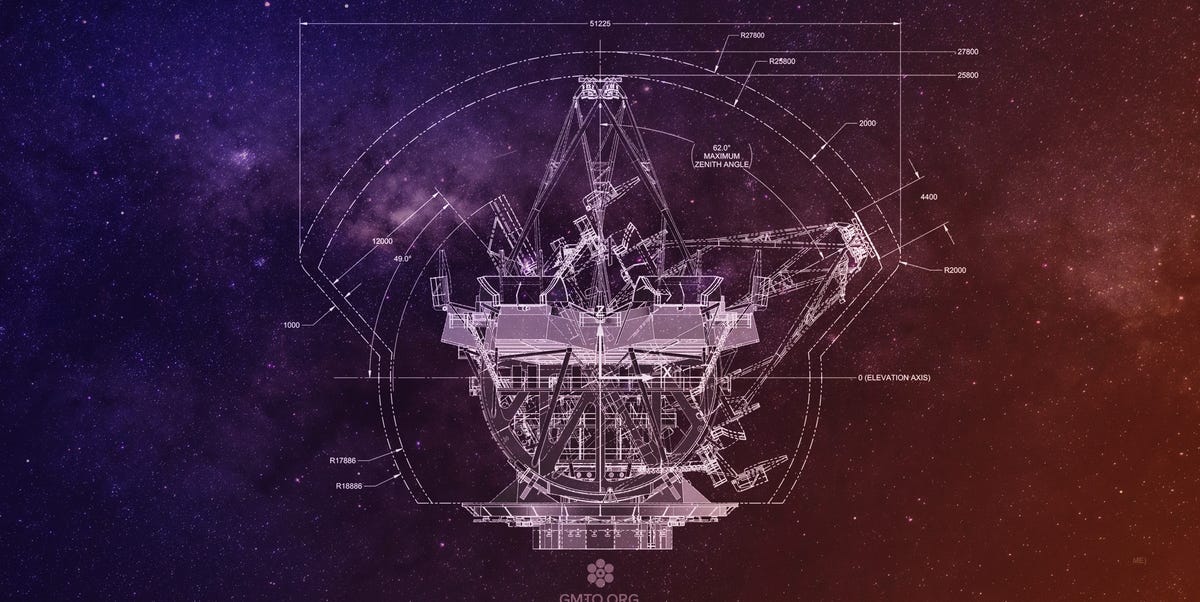
If astronomy had a gym membership, the Giant Magellan Telescope would be the member deadlifting the whole universe and making it look easy. This next-generation observatory, rising on Las Campanas Peak in Chile’s Atacama Desert, is not just another giant telescope with a dramatic render and a heroic budget. It is a serious scientific machine designed to answer some of the oldest questions humans have ever asked: How did the first galaxies form? What do black holes really do when nobody is looking? And, of course, is Earth the only planet in the cosmos hosting life, or are we just one more overachieving rock?
The title phrase “119-ton mirror” makes for a fantastic headline, but the real story is even better. The Giant Magellan Telescope, or GMT, does not rely on one single monolithic slab of glass. Its primary mirror system is a seven-segment optical powerhouse made of seven 8.4-meter mirrors arranged like a giant flower. Together, they form a 25.4-meter light-collecting surface that promises extraordinary sensitivity and razor-sharp imaging. In other words, this is less “one giant mirror” and more “an elite mirror squad with perfect teamwork.”
When GMT comes online in the early 2030s, it is expected to become one of the most powerful optical and infrared observatories ever built. And that matters because modern astronomy is no longer satisfied with blurry dots. Scientists want chemistry, motion, structure, origin stories, and maybe a whiff of oxygen from an alien atmosphere. GMT is being built for exactly that kind of cosmic snooping.
Why the Giant Magellan Telescope Is Such a Big Deal
The simplest way to understand GMT is this: bigger mirrors collect more light, and better optics produce sharper images. But GMT is not merely bigger for bragging rights. Its seven primary mirrors create a combined collecting area large enough to study faint, distant, and ancient objects that today’s telescopes can barely tease out of the dark. That means astronomers can look deeper into the early universe, resolve details inside faraway galaxies, and investigate exoplanets with far more precision.
Each primary mirror segment is a marvel in its own right. These 8.4-meter mirrors are among the largest and most demanding precision optics ever manufactured. They are made from low-expansion borosilicate glass and polished to a surface accuracy measured in nanometers. That is the kind of smoothness that makes a luxury bathroom mirror seem like a gravel driveway. It takes years to cast, cool, grind, and polish each one, which is a polite way of saying nobody is speed-running this project.
And the design choice is clever. Instead of using hundreds of small hexagonal segments like some other extremely large telescopes, GMT uses seven enormous mirrors. That gives it a highly efficient optical system with fewer segment boundaries and a design optimized for high resolution over a wide field of view. Astronomers love that. Engineers lose sleep over it. That is called balance.
The Mirror System: Not Just Huge, but Smart
Seven Giant Primary Mirrors Working as One
The Giant Magellan Telescope’s primary mirror array is composed of one central mirror surrounded by six off-axis mirrors. Together, they form a 25.4-meter surface and deliver 368 square meters of light-collecting area. That is the beating optical heart of the observatory. These segments are not decorative. They are the difference between seeing a faint, ancient galaxy as a smudge and studying its structure, motion, and chemistry in meaningful detail.
As of recent project updates, three mirror segments are complete, while the remaining four are in different stages of production. The seventh and final primary mirror was cast in October 2023 and is being prepared for polishing. That milestone matters because it means the full mirror set is no longer theoretical. It is physically taking shape, one giant piece of precision glass at a time.
Adaptive Optics That Fight the Atmosphere in Real Time
Even the best ground-based telescope has a nemesis: Earth’s atmosphere. It bends and blurs incoming light, making stars twinkle charmingly for poets and infuriatingly for astronomers. GMT’s answer is a set of adaptive secondary mirrors that deform their surfaces at extraordinary speed to correct for atmospheric turbulence in real time.
This system changes shape up to 2,000 times per second. Yes, per second. That kind of performance lets GMT push toward image quality that can beat out what many people expect from space telescopes. The payoff is enormous. With adaptive optics engaged, GMT is designed to deliver images far sharper than those from Hubble and even sharper than JWST in certain infrared observing modes. That is why astronomers are so excited: the telescope will not just gather more light, it will clean up the cosmic picture with frightening efficiency.
Why Chile’s Atacama Desert Is the Perfect Home
Location is everything in astronomy. You can build the greatest telescope in the world, but if you put it under humid skies next to a shopping mall parking lot, congratulations, you have built an expensive disappointment. GMT’s home at Las Campanas Observatory in Chile solves that problem beautifully.
The Atacama Desert is one of the driest non-polar places on Earth, famous for its dark skies, low humidity, high elevation, and stable atmosphere. Las Campanas Peak rises to more than 2,500 meters above sea level, and the site has decades of observing history behind it. It also provides access to the southern sky, including the center of the Milky Way, the Magellanic Clouds, Proxima Centauri, and many nearby galaxies that are high-priority scientific targets.
In plain English, GMT is being placed where the sky behaves itself. That is a smart move. The telescope can only revolutionize astronomy if the atmosphere agrees to stop being dramatic, and Chile is one of the best places on Earth to negotiate that truce.
Construction Progress: This Is Not Just a Fancy PowerPoint
One reason GMT keeps attracting attention is that it is not merely a dream with a logo. It is under active construction. Recent updates indicate that the observatory is about 40 percent complete, with major components being manufactured and tested across 36 U.S. states and at the Chilean site itself.
The telescope mount structure began fabrication in Illinois in 2024, and primary mirror support system testing has already begun in Arizona. The enclosure, which will protect the telescope from weather, wind, and earthquakes, is its own engineering spectacle. It will stand roughly 22 stories tall, weigh about 5,000 metric tons, and rotate a full 360 degrees in about four minutes. It is basically a giant smart home for one of the world’s most demanding scientific instruments.
There is also a strategic dimension here. In June 2025, the U.S. National Science Foundation advanced GMT into its Major Facilities Final Design Phase, a key step toward potential federal construction support. That move signaled confidence in the project’s scientific value, construction progress, and national importance. Translation: GMT is not just big science. It is increasingly central science.
How GMT Could Change What We Know About the Universe
1. Exoplanets and the Search for Life
One of GMT’s most exciting roles will be the study of exoplanets. Astronomers are no longer content to merely count planets around other stars. They want to characterize them. That means measuring masses, studying atmospheres, and hunting for biosignatures such as oxygen or other chemically intriguing gases.
GMT’s planned instruments, including the Large Earth Finder, are designed to push this work forward. The telescope should be able to study small rocky planets around nearby stars and help determine whether some of those worlds have atmospheres that look suspiciously alive. That does not mean GMT will wave a giant sign reading “Hello, aliens.” Science is rarely that convenient. But it could tell us whether some nearby planets deserve very serious attention.
2. The First Galaxies, Black Holes, and Cosmic Dawn
GMT is also built to investigate the early universe. Astronomers want to understand how the first stars, galaxies, and black holes emerged from the cosmic dark ages. That requires extreme sensitivity and exquisite resolution because these objects are incredibly faint and incredibly far away.
With GMT, researchers expect to resolve the inner structure of young galaxies, trace how gas flows between galaxies and the cosmic web, and search for the missing links between stellar black holes and supermassive black holes. In short, GMT will help turn broad theories into direct observations. For cosmology, that is a big step up from educated guessing in a very dark room.
3. Dark Matter, Dark Energy, and Gravitational Wave Follow-Up
The science case goes even wider. GMT will be part of a larger U.S. extremely large telescope ecosystem aimed at studying dark matter, dark energy, and transient events such as gravitational wave sources. When neutron stars or black holes merge, astronomers need to swing powerful telescopes onto the target quickly. GMT’s sensitivity and resolution will make it valuable for this kind of follow-up work, especially when faint optical signals accompany violent cosmic events.
That matters because astronomy is increasingly a team sport. Space telescopes, radio arrays, gravitational wave detectors, and giant ground-based observatories now work together. GMT will be one of the heavy hitters in that lineup.
What Makes GMT Different from Other Giant Telescopes
The world is entering the era of extremely large telescopes, and GMT is one of the stars of that movement. Its competitors and cousins are impressive in their own right, but GMT has a distinctive optical design. By using seven very large mirrors rather than hundreds of smaller segments, it aims for exceptional optical efficiency and high spatial resolution across a broad field.
That design also pairs beautifully with adaptive secondary mirrors, allowing precise control of image quality. Scientists expect GMT to be especially strong in detailed spectroscopy, high-contrast imaging, and studies requiring both sensitivity and sharpness. In other words, GMT is not just trying to be large. It is trying to be elegantly large, which sounds like something a telescope would say while adjusting its tie.
The Real Meaning of the “119-Ton Mirror” Idea
The title phrase captures the scale, but the deeper truth is more interesting than the headline. GMT represents the triumph of systems engineering over spectacle. It is not about one absurdly heavy chunk of glass dropped onto a mountain and pointed at space. It is about seven precisely made mirrors, adaptive secondary optics, high-speed control systems, scientific instruments, structural engineering, seismic design, and a world-class site all working together.
That is what will revolutionize astronomy. Not raw size alone, but size plus precision plus speed plus location plus instrumentation. Big science only changes the world when every subsystem shows up and does its job.
Conclusion
The Giant Magellan Telescope is one of the clearest examples of where astronomy is headed next: toward sharper vision, deeper time, richer chemical detail, and more direct tests of the biggest cosmic questions. Its seven primary mirrors, adaptive optics, and Chilean mountain home give it the ingredients to transform observations of exoplanets, galaxies, black holes, and the early universe.
So yes, the phrase “119-ton mirror” gets attention. But the true revolution is not a number. It is the astonishing collaboration of glassmakers, engineers, astronomers, software specialists, and instrument builders creating a machine capable of seeing farther and better than almost anything humanity has ever placed on Earth. When GMT finally opens its eye to the sky, astronomy will not just get a larger telescope. It will get a new level of ambition.
Extended Experience: What a Project Like GMT Feels Like Up Close
To really understand why the Giant Magellan Telescope matters, it helps to think beyond specifications and imagine the experience surrounding it. Picture standing inside a mirror lab where one of these giant segments is being polished. Nothing about the room feels ordinary. The mirror does not look like a household object scaled up. It looks like infrastructure for a civilization that has decided seeing farther into the universe is worth years of work, extreme patience, and engineering that borders on obsession. The scale alone changes your sense of proportion. You stop thinking in terms of “equipment” and start thinking in terms of “cathedral.”
Then imagine the human side of the project. Somewhere, a team is checking surface precision that differs by nanometers. Somewhere else, engineers are testing how a support system will carry a mirror that weighs as much as several large vehicles. In another facility, instrument teams are designing spectrographs to separate faint starlight into data-rich fingerprints of chemistry and motion. Nobody involved gets the luxury of being casual. A project like GMT turns precision into culture. Everyone is responsible for a tiny piece of a machine that will eventually look at planets, stars, and galaxies more clearly than ever before.
There is also something emotionally strange and wonderful about the waiting. The telescope is under construction now, which means we live in the awkward, exciting middle chapter. The mirror segments exist. The mount is being built. The enclosure is real. The science case is mature. But the discoveries are still ahead of us, lined up in the future like sealed envelopes. That creates a special kind of anticipation. Astronomers are not simply dreaming about what GMT might do. They are actively preparing questions for a tool that is close enough to shape research plans, yet distant enough to remain slightly mythical.
And then there is the mountain itself. Las Campanas is not a random patch of land. It is a place chosen because the sky there gives science a fighting chance. Dry air, dark nights, stable seeing, southern-sky access, and altitude all come together in a way that feels almost unfairly ideal. If you stand in such a place at night, the stars do not just appear overhead. They feel near, structured, and almost urgent. A telescope like GMT belongs in that environment because it is built to convert good sky into extraordinary knowledge.
That is the deeper experience of the Giant Magellan Telescope: awe mixed with discipline. It is thrilling because it is huge, yes, but it is meaningful because it is careful. It reminds us that modern discovery is not magic. It is craftsmanship, physics, software, logistics, international partnership, and stubborn curiosity assembled at extreme scale. When GMT eventually reaches first light, the moment will not feel like a machine simply turning on. It will feel like years of human effort finally becoming vision.