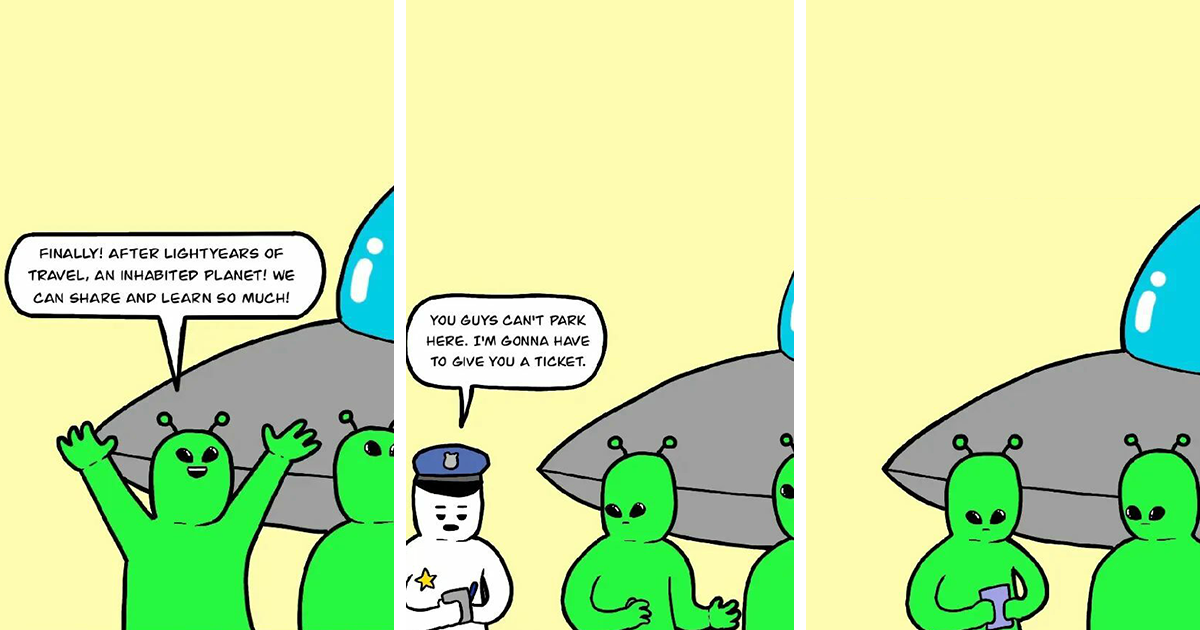
Some comics go for drama. Some go for satire. And some sneak up on you with a sweet little setup, smile politely, and then bonk you on the head with the most gloriously ridiculous ending possible. That is exactly the lane this artist occupies, and honestly, it is a lovely place to spend a few minutes of your day. The comics collected under the headline “Comics With Charming And Absurd Endings: 19 Comics By This Artist” are the kind of short-form humor pieces that work fast, hit cleanly, and leave readers wearing the universal expression of internet delight: a grin followed by, “Well, that escalated beautifully.”
The artist behind the series is known online as Glass Muffin, a creator whose work blends cute character design, sharp visual pacing, and endings that refuse to behave. On one panel, everything feels normal enough. On the next, a casual observation becomes a fantasy gag, a wordplay joke turns literal, or an ordinary moment takes a left turn into nonsense. It is absurd, yes, but not random in the lazy sense. These comics are carefully built mini-stories, and that is why they land.
Who Is the Artist Behind Glass Muffin?
Part of the appeal here is that the comics feel approachable. They do not arrive with heavy mythology, a giant cinematic universe, or a ten-page glossary. They show up, tell their joke, and leave the room before the punch bowl gets weird. That confidence comes from a creator who understands economy. In coverage of the series, the artist was described as a young graphic designer and illustrator, and on Webtoon the creator identifies himself as Hadi. That background makes sense. These comics have the clean visual communication of design work, but they also have the mischievous instinct of someone who clearly enjoys throwing logic out a window just to see if it bounces.
That combination matters. A lot of humor comics are funny in concept but clunky in execution. Others look nice but forget to be funny. Glass Muffin avoids both traps. The line work is readable, the expressions are easy to decode, and the scenes are built for fast comprehension. In other words, the comic knows you are scrolling. It respects your time. Then, once it has your trust, it pulls the rug and replaces it with a dragon, a gamer reference, a cursed pun, or an emotionally unstable loaf of bread.
Why These 19 Comics Work So Well
1. The setup is simple enough to invite you in
Great short comics understand the value of a clean setup. Glass Muffin’s jokes often begin in familiar territory: a conversation, a game reference, a fantasy trope, a tiny social annoyance, or an object behaving in a suspiciously human way. The reader gets oriented quickly, which is crucial in a one-scroll format. There is no wasted motion. The comic opens the door and lets you step inside before you realize you are about to be ambushed by silliness.
2. The punchline usually arrives through contrast
The charm comes from the contrast between tone and ending. The art is friendly. The mood is light. Then the joke swerves. A phrase becomes literal. A heroic scenario becomes awkwardly mundane. A creature that looks threatening turns out to be hilariously petty. That contrast is the engine. The comic does not need to scream to be funny. It whispers, waits, and then slides a banana peel under the logic of the scene.
3. The endings are absurd, but not empty
Absurd humor works best when it still feels intentional. These comics are not just random for randomness’ sake. The ending usually snaps back to the setup in a way that makes the nonsense feel earned. You are not laughing because the joke is chaotic. You are laughing because the chaos fits. That is a big difference, and it is what separates a memorable comic from an “okay, sure” meme that evaporates five seconds later.
4. The visuals do half the talking
One reason these strips feel so shareable is that the drawing itself participates in the joke. Expressions, pacing, spacing, and panel progression all help sell the ending. A comic like this depends on visual timing just as much as verbal wit. Sometimes the funniest beat is not the line itself but the face attached to it. The drawing says, “Yes, this is nonsense,” while the structure says, “But it is beautifully organized nonsense.”
The Signature Style of Glass Muffin
If you browse the wider body of work associated with Glass Muffin, you can see recurring interests pop up again and again. There are strips that pull from fantasy, gaming culture, wordplay, monsters, office logic, and everyday frustrations. Even the episode titles hint at the creator’s sense of humor: Fast Travel, You Live Like This?, The Wizard, Item Hoarding, Hostile Witness, Huge Wasabi Guy, and Wizard with Taxes. Those titles alone tell you a lot. This is a comic universe where epic and mundane are on a first-name basis.
That mixture is one of the series’ strongest qualities. A joke might begin with the language of video games, drift into fantasy storytelling, and end in the emotional reality of a very tired human being. Another might turn an everyday phrase into a physical scene that makes perfect cartoon sense and no real-world sense at all. The result is a style that feels internet-native without being disposable. It understands online humor, but it still behaves like comics.
And that is important, because comics are not just illustrated jokes. At their best, they are tiny machines. Every panel has a job. Every pause matters. Every reaction shot is part of the rhythm. Glass Muffin’s work succeeds because it treats even the silliest premise with structural care. The comic might be about a ridiculous misunderstanding, but the craft behind it is not ridiculous at all.
What Makes “Charming and Absurd” Such a Powerful Combination?
“Charming” and “absurd” might sound like opposites, but in humor comics they are excellent roommates. Charm lowers your defenses. Absurdity takes advantage of that open door. When a comic looks warm, playful, or innocent, the reader unconsciously expects a softer landing. That makes the weird ending hit harder. It is the comedy equivalent of a kitten opening a briefcase and revealing a tax audit.
Charm also keeps absurdity from feeling cold. Some surreal humor can be clever but emotionally distant. Glass Muffin’s work tends to avoid that problem because the comics are populated with expressive figures and recognizable human frustrations. Even when the scenario becomes impossible, the emotion stays relatable. Confusion, irritation, smugness, panic, false confidence, and tiny bursts of triumph all remain familiar. Readers recognize themselves in the reactions, even if the situation involves nonsense on stilts.
That balance is probably why these comics travel so well online. People love to share something that is weird enough to stand out but friendly enough to recommend. You can send one to a friend without having to explain twelve layers of lore. The joke is compact. The vibe is inviting. The ending is strange in a way that feels fun rather than alienating. That is a hard balance to strike, and this artist does it with impressive consistency.
How the 19-Comic Format Helps the Humor Land
A collection of 19 comics is not just a random pile of jokes. It creates a reading rhythm. One comic makes you smile. The next one surprises you. A few strips later, you start to understand the creator’s comedic language. By the time you are deep into the set, you are reading with anticipation. You know a twist is probably coming, but you do not know what shape it will take. That tension makes even simple jokes feel more rewarding.
There is also something satisfying about seeing a cluster of short comics together rather than one isolated post floating in the digital void. A roundup allows patterns to emerge. You notice how often the artist uses literal thinking, how frequently fantasy collides with bureaucracy, or how often a cute visual style is used to deliver a completely unhinged final beat. In that sense, the 19-comic collection works almost like a sampler platter of the creator’s comedic instincts.
And let us be honest: short comics are ideal for modern attention spans. Not because readers are incapable of depth, but because sometimes you want art that meets you where you are. You are between emails. Your coffee is cooling. Your brain is running on three browser tabs and one brave little protein bar. A compact comic with a terrific payoff is not a lesser form of storytelling. It is efficient joy.
Why Readers Keep Coming Back to This Artist
The answer is consistency. Readers return to creators who can surprise them without betraying the tone they came for. Glass Muffin has that sweet spot. The comics are unpredictable, but they still feel like they belong to the same sensibility. There is a house style to the humor: playful, nimble, slightly chaotic, and never too self-important. Even when a joke gets dark around the edges, it usually stays buoyant.
Another reason is re-read value. The best absurd comics do not just deliver a punchline; they create a comic image that sticks. You remember the scenario later because it is visually odd in a specific way. Maybe it is a facial expression. Maybe it is the literal interpretation of a phrase. Maybe it is the sheer confidence with which the comic commits to a nonsense premise. Whatever the mechanism, the image lingers. That makes the artist memorable, and memorable artists build loyal audiences.
There is also the pleasure of recognition. If you are into games, internet humor, fantasy tropes, or the strange poetry of everyday annoyance, these comics feel like they were made by someone who understands the modern comic brain. The jokes are not trying too hard to be timeless museum pieces. They are comfortable being online, being current, and being delightfully unserious.
The Reading Experience: Why These Comics Feel So Good
Reading comics like these is a very specific kind of pleasure. You open one expecting a quick laugh and end up getting a tiny burst of creative energy. That is the sneaky magic of charming absurdity. It does not just entertain; it gently rearranges your mood. Suddenly the world seems a little more flexible. A little less stiff. A little more open to nonsense, which, frankly, is healthy in moderation.
There is also a comforting generosity in this format. These comics do not demand that you decode a philosophical thesis before enjoying them. They are inviting from the first panel. The reader is not tested; the reader is welcomed. Then, once that welcome is established, the comic earns the right to be strange. That progression feels good because it mirrors good conversation. Someone gets you comfortable, then says something unexpectedly hilarious, and now the room is alive.
For many readers, the experience goes something like this: first comes the half-smile, then the laugh, then the instinct to send the comic to someone else with the message, “This is so dumb. You’ll love it.” That is not a minor achievement. Shareability is not just about being funny. It is about being socially useful. A good comic becomes a tiny gift people can hand each other. It says, “Here, this made my day slightly better. Maybe it will do the same for you.”
That feeling grows stronger when you read a whole batch, like these 19 comics. The collection starts to function like a mood elevator. One joke might lean on wordplay. Another might parody fantasy logic. Another might turn a universal annoyance into cartoon poetry. By the end, you are not only laughing at the individual strips; you are appreciating the artist’s worldview. It is a worldview that says ordinary life is already weird, and comics are simply the most honest way to admit it.
There is something else happening, too. Absurd comics can be oddly reassuring because they take the pressures of real life and distort them into shapes we can laugh at. Office stress becomes a monster joke. Gaming habits become a heroic flaw. Social awkwardness becomes a visual gag. The comic exaggerates reality just enough to make it manageable. You are still looking at familiar emotions, but now they are wearing a ridiculous costume. That costume helps.
And maybe that is why artists like Glass Muffin matter more than people sometimes realize. In a crowded online environment, they create short encounters with surprise, wit, and delight. They remind readers that humor does not have to be loud, cynical, or mean to be effective. It can be weird and warm at the same time. It can be absurd without collapsing into emptiness. It can charm you first, then throw you into nonsense, and somehow make you grateful for both.
So yes, these 19 comics are funny. But they are also a neat case study in why short-form webcomics continue to thrive. They are visual, quick, memorable, and emotionally light on their feet. Most of all, they understand a truth that great humor has always known: the line between adorable and absurd is not a boundary. It is a runway.
Conclusion
Comics With Charming And Absurd Endings: 19 Comics By This Artist works as more than a catchy headline. It accurately captures why Glass Muffin’s comics connect with readers. These strips are friendly without being bland, weird without being messy, and clever without feeling smug. Their endings surprise, but the setups are so clean and inviting that the absurdity never feels forced. In a digital world full of disposable jokes, this artist’s work stands out because the humor is built, not tossed together. If you enjoy comics that mix visual clarity, internet-savvy wit, and gloriously silly final beats, Glass Muffin is the kind of creator worth following closely.