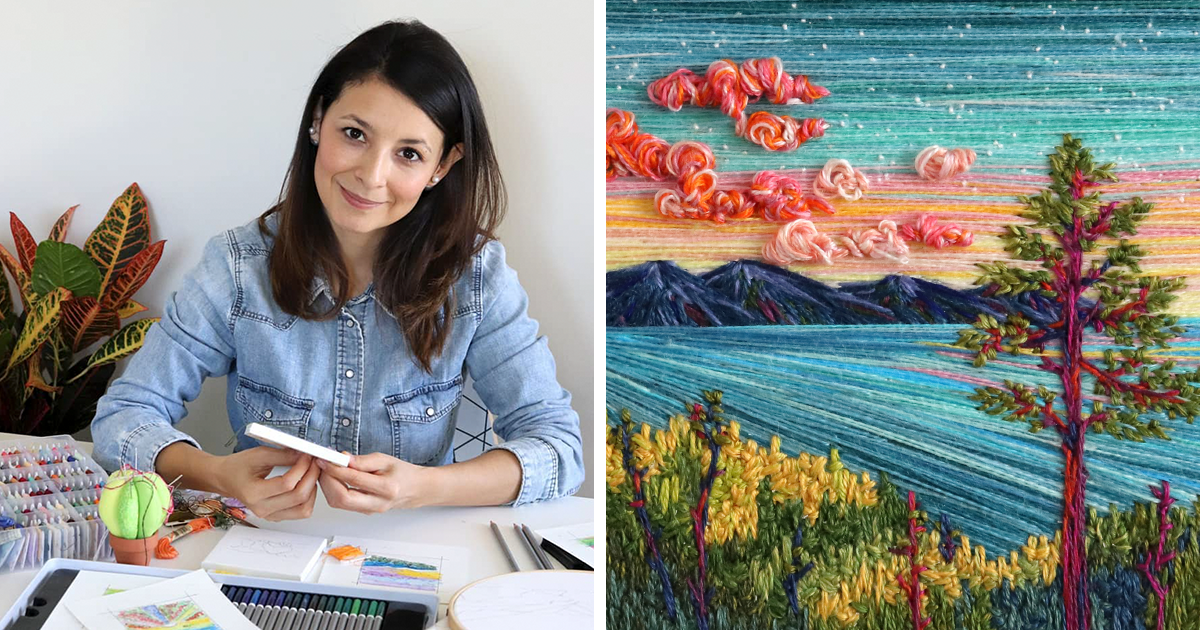
There is a special kind of magic in turning a handful of embroidery floss into a mountain, a meadow, a stormy sky, or a coastline that looks like it might start whispering if you lean in close enough. My series, “My 30 Vivid Landscapes Made With Thread,” began as a simple creative challenge: could I make thread behave like paint? The answer, after many tangled knots, suspiciously dramatic sighs, and one needle that vanished into another dimension, was yes.
Thread painting is often described as embroidery that borrows the soul of a brushstroke. Instead of spreading pigment across canvas, the artist layers stitches to build color, depth, texture, light, and movement. In landscape embroidery, this technique becomes especially expressive. A single strand can become a blade of grass. A row of French knots can turn into a field of wildflowers. A few sweeping stitches can suggest a river bending through a valley. It is slow art, patient art, and occasionally “why did I choose a forest with 900 tiny trees?” art.
This collection of 30 thread landscapes celebrates nature in miniature: rolling hills, glowing sunsets, quiet lakes, desert light, rocky coastlines, forest paths, and sky after sky after sky. Each piece is made to feel vivid, tactile, and alive, proving that embroidery landscape art can be just as emotional and immersive as painting, photography, or digital illustration.
Why Thread Landscapes Feel So Alive
Landscape art has always invited viewers to step into another place. Traditional painters use perspective, color temperature, shadow, and scale to create that invitation. Textile artists use those same visual principles, but they add something painting cannot fully imitate: raised texture. When thread crosses fabric, it catches light. When stitches overlap, they create ridges. When colors are blended strand by strand, the surface begins to shimmer like grass in wind or water under sun.
That physical dimension is why thread landscapes can feel surprisingly vivid even when they are small. In a stitched meadow, the viewer does not simply see green; they see individual lines of green moving in different directions. In a stitched ocean, layers of blue, gray, white, and turquoise can mimic waves better than a flat block of color. In a sunset, warm embroidery floss can glow against darker stitched silhouettes, giving the scene a quiet cinematic drama. Basically, thread has main-character energy.
Contemporary fiber art has gained more recognition in museums and galleries because textiles are no longer seen only as domestic craft. They are increasingly understood as serious artistic media capable of carrying memory, identity, history, abstraction, and storytelling. Embroidery, quilting, weaving, and fiber sculpture all show how humble materials can create complex visual experiences. Thread painting belongs beautifully in that conversation because it combines technical skill with painterly imagination.
The Creative Idea Behind the 30 Landscapes
The goal of the series was not to copy nature exactly. Nature already does a very good job of being nature, and frankly, I am not here to compete with a mountain range. Instead, I wanted each piece to capture a feeling: the hush before rain, the warm blur of late afternoon, the sharp glitter of snow, the smell of pine trees after a storm, the strange peace of staring at a horizon and temporarily forgetting your inbox exists.
Each of the 30 landscapes was designed around one emotional note. Some are peaceful, with soft gradients and gentle lines. Others are bold, stitched with bright colors and energetic marks. A few are moody enough to deserve their own soundtrack. Together, they form a visual travel diary made not with tickets and postcards, but with cotton thread, fabric, and many cups of coffee.
1. Mountains Built With Directional Stitches
Mountain scenes are perfect for thread painting because their shapes are naturally dramatic. Slanted stitches can suggest cliffs, ridgelines, and shadowed slopes. Short stitches in cool gray, lavender, navy, and white create the feeling of stone catching light. For distant peaks, softer colors work best; for foreground rocks, thicker or denser stitches add weight.
In several pieces from the collection, mountains act as the backbone of the composition. They divide the sky from the land and create instant depth. The trick is to avoid making them too stiff. Real mountains are rugged, uneven, and a bit rude about symmetry. Letting the stitched edges wobble slightly makes them feel more natural.
2. Forests Made From Tiny Repeating Marks
Forests are both beautiful and mildly dangerous for an embroiderer’s patience. A forest landscape may look simple from far away, but once you start stitching, every tree wants attention. The solution is rhythm. Instead of sewing every branch, I used small vertical and diagonal marks to suggest clusters of trunks, needles, leaves, and shadows.
Thread landscapes do not need literal detail everywhere. The eye is generous. Give it a dark green shape, a few lighter highlights, and some varied stitch direction, and it will happily decide, “Yes, that is a forest.” This is one of the great joys of embroidery landscape art: suggestion can be more powerful than precision.
3. Water Created With Layered Color
Water is where thread painting becomes addictive. Rivers, lakes, oceans, and waterfalls all depend on movement, reflection, and light. Long horizontal stitches can make a lake feel calm. Curved stitches can create the pull of waves. Small white highlights can suggest foam, sparkle, or ripples.
For seascapes, I layered blues, greens, grays, and bright whites in loose, flowing lines. The best part of stitching water is that mistakes often look intentional. A slightly uneven line becomes a ripple. A knot becomes a rock. A thread tail becomes “experimental texture,” which is artist language for “we are moving forward with confidence.”
Materials That Make Thread Painting Work
The materials for vivid thread landscapes are simple, but choosing them thoughtfully makes a major difference. Cotton embroidery floss is popular because it is widely available, comes in a huge range of colors, and can be split into thinner strands. Using one strand creates delicate detail, while two or three strands produce stronger texture. Pearl cotton, silk thread, wool thread, and machine embroidery thread can also be used depending on the desired effect.
Fabric matters too. A sturdy cotton canvas or linen can hold dense stitching without warping too much. For small hoop art, the fabric must be pulled taut so the needle can move cleanly and the finished piece does not sag. Stabilizers can help when using heavy layers, especially in machine embroidery or free-motion thread painting.
Needles, hoops, scissors, washable markers, and good lighting are the unsung heroes of the process. Good lighting is especially important because thread colors can shift dramatically from morning to evening. A blue that looks like peaceful lake water at noon may look like old gym socks under bad lighting. Test first. Your future self will applaud.
How I Planned Each Thread Landscape
Before stitching, I usually began with a rough sketch. The sketch did not need to be perfect; it only needed to map the main shapes: horizon, sky, land, water, trees, rocks, and focal point. Landscape embroidery works best when the composition is clear before the first stitch goes in. Otherwise, the scene can become crowded, and suddenly your peaceful meadow looks like it is hosting a very disorganized plant conference.
After sketching, I selected a color palette. For a sunset, that might mean peach, coral, gold, purple, and deep blue. For a forest, it might include moss green, olive, pine, dark brown, pale yellow, and a few surprising highlights. Color is what gives thread landscapes their emotional voice. A scene stitched in soft neutrals feels nostalgic. A scene stitched in saturated colors feels joyful and bold. A scene stitched in deep blues and grays feels quiet, almost cinematic.
Layering From Background to Foreground
Most pieces were stitched from back to front. The sky came first, then distant mountains, then middle-ground trees or fields, then foreground details. This method helps create depth because each layer slightly overlaps the one behind it. It also prevents delicate background areas from being crushed by heavier foreground stitches.
For skies, I used long, soft stitches and subtle blending. For clouds, I mixed white, cream, gray, pale pink, and lavender. For land, I changed stitch direction often to suggest slopes, grasses, paths, and shadows. The foreground usually received the most texture: French knots for flowers, small straight stitches for grass, and denser satin-like stitches for rocks or tree trunks.
Specific Examples From the 30-Piece Series
One of my favorite landscapes in the collection shows a golden field under a lavender sky. The field was built with loose, uneven stitches in yellow, tan, ocher, and pale green. Up close, it looks almost abstract, like a wild argument between strands of thread. From a distance, it becomes a sunlit meadow. That transformation is one of the most satisfying parts of textile art landscapes.
Another piece features a rocky coast with white waves breaking against dark stone. The rocks were stitched with short, angular marks, while the water used sweeping horizontal and curved lines. The contrast between rough and smooth textures made the scene feel energetic. It reminded me that in embroidery, texture can tell the story as much as color.
A third landscape shows a small forest path disappearing into blue-green trees. The path was created with warm brown and beige stitches that became narrower as they moved toward the horizon. That simple perspective trick made the whole piece feel deeper. It is proof that even tiny embroidered landscapes can create a sense of place when scale and direction are handled carefully.
Why Handmade Landscapes Connect With Viewers
Handmade art carries visible time. Every stitch is a decision. Every color change means the artist paused, looked, adjusted, and continued. In a fast digital world, that slowness feels meaningful. A thread landscape is not just an image of a place; it is evidence of attention. It says, “I looked at this moment long enough to rebuild it one stitch at a time.”
That is why viewers often respond emotionally to embroidered landscapes. They notice the labor. They lean closer. They see the thread paths and the tiny raised details. The artwork becomes intimate because it rewards slow looking. A photograph can capture a landscape instantly, but embroidery recreates it through patience. Both are beautiful. One just comes with more needle-related drama.
Tips for Creating Your Own Vivid Thread Landscapes
Start Small
A small hoop is less intimidating than a large fabric panel. Try a simple scene first: sky, hill, tree, and path. You do not need to stitch the Grand Canyon on day one. The Grand Canyon can wait; it has been waiting for millions of years.
Limit Your Palette
Choose 8 to 12 colors for your first landscape. Too many colors can make the design muddy. A limited palette teaches you how to blend and layer effectively.
Use Stitch Direction Like Brushstrokes
Horizontal stitches feel calm. Diagonal stitches suggest slopes and movement. Vertical stitches work well for trees, grasses, and rain. Curved stitches can create clouds, waves, and rolling hills.
Do Not Fear Imperfection
Nature is not tidy. A slightly crooked tree or uneven hill can make a stitched landscape feel more alive. The goal is expression, not robotic perfection.
Extra Studio Notes: What Making These 30 Thread Landscapes Taught Me
Creating 30 vivid landscapes with thread taught me that patience is not a personality trait; it is a muscle. At the beginning of the series, I wanted every piece to move quickly. I wanted the sky to blend on command, the trees to behave, and the thread to stop forming tiny knots that looked personally motivated. But embroidery has its own pace. It asks you to slow down, breathe, and accept that a single square inch can contain a surprising amount of decision-making.
The first big lesson was that landscapes are built from relationships, not objects. A mountain is not just a mountain; it is the shape that makes the sky feel open. A river is not just water; it is the line that carries the viewer through the scene. A tree is not just a tree; it is contrast, rhythm, and scale. Once I stopped thinking, “I need to stitch a perfect tree,” and started thinking, “I need a dark vertical texture here to balance the light path,” the work became freer and stronger.
The second lesson was that color blending in thread painting is both technical and emotional. With paint, colors mix physically. With embroidery floss, colors mix optically. That means the eye blends neighboring stitches from a distance. A row of blue beside a row of green can become water. A few pink stitches inside a gray cloud can make the sky feel warmer. I learned to place colors like a mosaic, trusting the viewer’s eye to do some of the work. This made the process feel collaborative, as if the audience completes the landscape by looking.
The third lesson was that texture can create mood. Dense stitches feel heavy and grounded. Loose stitches feel airy. French knots are playful, almost musical. Long satin-like stitches can feel smooth and polished, while rough overlapping stitches can suggest wild grass, bark, stone, or weather. In one piece, I stitched a stormy hillside with dark, uneven marks, and the whole scene suddenly felt windy. Nothing was actually moving, of course, except my hand and possibly my patience leaving the room, but the texture created motion.
The fourth lesson was practical: protect your hands, organize your thread, and never underestimate the chaos potential of a small pile of floss. Thread looks innocent until 12 colors decide to become one giant friendship bracelet. Keeping colors labeled, trimming thread to manageable lengths, and taking breaks saved both the artwork and my mood.
Most importantly, this series reminded me why handmade landscapes matter. They are not only pictures of outdoor places. They are records of noticing. Each stitch says: this shadow mattered, this curve mattered, this little burst of yellow in the grass mattered. In a world that often rewards speed, making 30 landscapes with thread felt like a quiet rebellion. A soft one, yes, but still a rebellionwith better color choices.
Conclusion
“My 30 Vivid Landscapes Made With Thread” is a celebration of embroidery as a painterly, expressive, and deeply human art form. Through layered stitches, blended colors, raised textures, and careful composition, thread can become sky, water, grass, stone, sunlight, and memory. These landscapes show that textile art is not limited by softness or scale. In fact, its softness is part of its power.
Thread painting invites us to look closely at nature and even more closely at the act of making. It transforms ordinary materials into scenes filled with atmosphere and emotion. Whether you are an artist, collector, embroidery beginner, or someone who simply enjoys beautiful handmade things, vivid thread landscapes offer a reminder that art does not always need a giant canvas to feel expansive. Sometimes, an entire world can fit inside a hoop.
Note: This article synthesizes real information from reputable museum, craft, embroidery, and contemporary textile-art sources. Direct source links are intentionally omitted to match the requested publishing format.