At first glance, the old black-and-white photos look almost charming: tiny houses, quiet streets, tidy lawns, and trees scattered across what appears to be a sleepy American neighborhood. Look a little closer, though, and the whole scene starts to feel suspicious. The trees look oddly short. The houses seem strangely flat. The roads do not lead anywhere useful. And beneath this peaceful “town” was not a suburb at all, but one of the most important aircraft factories of World War II.
This was Boeing Plant 2 in Seattle, Washington, a massive wartime production facility hidden under an elaborate fake rooftop town designed to confuse potential Japanese air attackers. The disguise was part engineering, part military strategy, and part Hollywood magic. In a sentence: America put a movie set on top of an airplane factory and hoped enemy pilots would buy the performance.
The rare photos of Boeing’s camouflaged factory reveal more than a clever optical trick. They show how fear after Pearl Harbor reshaped the American home front, how industrial workers became part of the war machine, and how creativity sometimes wears a hard hat, carries chicken wire, and paints fake grass on burlap.
Why Boeing Plant 2 Needed To Disappear
During World War II, Boeing Plant 2 was no ordinary building. Located along the Duwamish River near Boeing Field, it became a key production site for the B-17 Flying Fortress, one of the most recognizable American heavy bombers of the war. Thousands of workers moved through the plant in round-the-clock shifts, building aircraft that would become essential to Allied air campaigns.
After Japan attacked Pearl Harbor on December 7, 1941, the West Coast suddenly felt exposed. Cities such as Seattle, Los Angeles, San Francisco, and Portland were not abstract points on a map anymore. They were possible targets. Military planners worried that Japanese aircraft or submarines could threaten ports, shipyards, aircraft plants, and fuel depots. In that anxious climate, Boeing’s huge factory looked less like a workplace and more like a giant bullseye.
The problem was obvious from the air. A large industrial facility next to an airfield and river is not exactly subtle. If an enemy pilot had flown over Seattle, Boeing Plant 2 would have stood out like a dinner plate on a picnic blanket. The solution? Make the dinner plate look like a neighborhood.
The Fake Rooftop Town: Boeing Wonderland
The camouflage project became known by many as “Boeing Wonderland,” and the nickname fits. Instead of simply throwing netting over the roof, the U.S. Army Corps of Engineers and camouflage experts created an entire make-believe residential district above the factory.
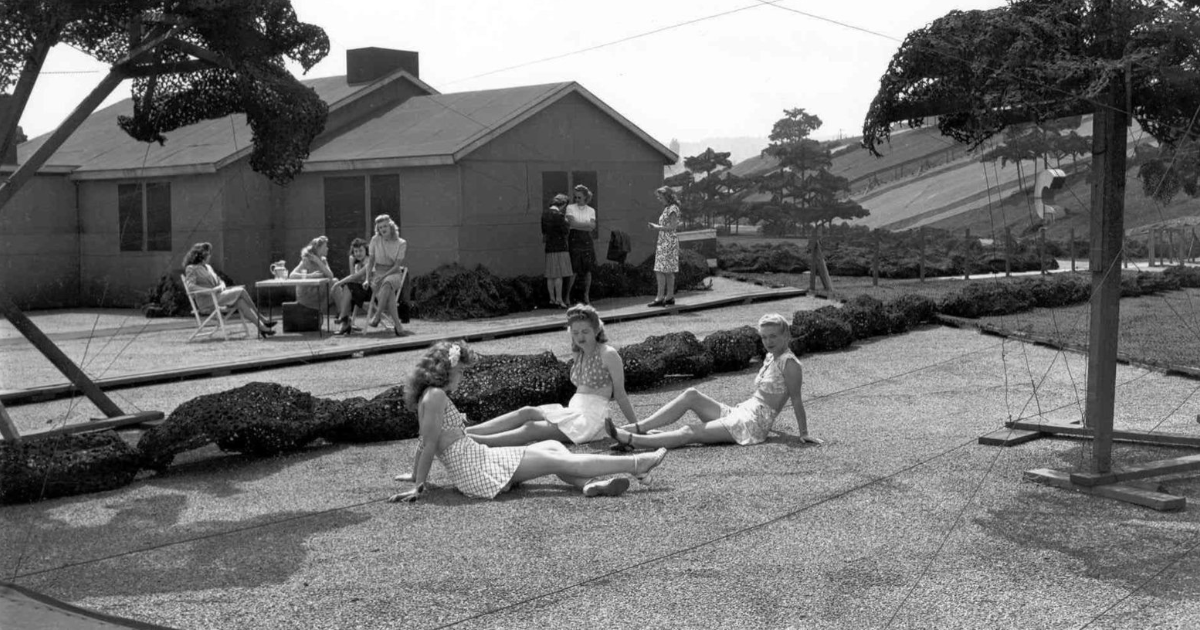
The rooftop scene included fake streets, sidewalks, houses, lawns, fences, trees, shrubs, and even cars. From high above, the goal was to break up the factory’s industrial shape and blend it into the surrounding city. From the roof itself, the illusion was much funnier. Some “trees” were not much taller than a person. Houses were shells. Lawns were not lawns. The whole neighborhood had the architectural honesty of a stage play backdrop.
Still, that was the point. Camouflage does not need to fool someone standing five feet away. It needs to fool the eye at speed, altitude, and distance. For a bomber crew searching for targets through haze, weather, antiaircraft pressure, and motion, a convincing pattern could be enough to cause hesitation or misidentification.
Hollywood Helped Build The Illusion
One of the most fascinating figures connected to the project was John Stewart Detlie, a Hollywood art director and set designer. His background was perfect for the job. Movie sets are built to persuade the camera, not the person leaning on the wall. A Western town on a studio lot may look solid on film while being nothing more than timber, paint, and clever angles. Boeing’s fake rooftop town used the same principle, except the “camera” was potentially an enemy aircraft.
Detlie helped translate theatrical deception into military camouflage. The project also involved Washington camouflage director William James Bain and other local design and engineering talent. The result was a strange but effective blend of architecture, wartime urgency, and show-business trickery.
In normal life, a fake house with no kitchen is a problem. In wartime camouflage, it is a feature. A roof did not need plumbing, mailboxes, or neighborhood gossip. It needed shadows, shapes, textures, and believable visual clutter.
What The 17 Rare Photos Reveal
The famous collection of rare photos from Boeing Plant 2 shows the illusion from several angles. Together, they tell a story that words alone cannot quite capture.
1. A Factory That Looks Like A Suburb From Above
Aerial images show the full trick: the huge aircraft plant is visually broken into blocks that resemble a residential neighborhood. Fake streets and lawns interrupt the factory’s long rooflines, making the industrial site harder to recognize from the sky.
2. Tiny Houses With A Big Job
The rooftop houses were not true homes, of course. They were lightweight structures built for appearance. Their job was to create recognizable domestic shapes that could fool an aerial observer. Think less “dream home,” more “strategic dollhouse.”
3. Trees Made From Unlikely Materials
The trees and greenery were artificial, built from materials such as wire, mesh, burlap, feathers, and paint. Their purpose was texture. From above, the eye reads color and pattern before it reads construction quality.
4. Streets That Went Nowhere
The fake roads were painted or constructed to suggest a normal neighborhood grid. They did not need to carry traffic. They needed to carry the illusion.
5. Workers Walking Through A Make-Believe World
Some photos show people standing or walking among the fake houses and trees. These images are especially delightful because they reveal the scale. What looks like a town from the air becomes a miniature stage set at human level.
6. The Plant Below The Performance
Under the rooftop disguise, thousands of men and women were building bombers. The contrast is powerful: above, a quiet fake neighborhood; below, one of the busiest aircraft production lines in America.
The Materials Behind The Magic
Boeing’s camouflage was a serious construction effort. Archival descriptions note that the project used enormous quantities of lumber, chicken wire, support wires, steel, painted canvas, burlap, and other materials. The “lawns” were not grass but green burlap. Some trees used wire mesh and wood, with texturing that could include feathers or similar lightweight materials to create a leafy look from altitude.
That sounds whimsical until you remember the stakes. The goal was to protect a plant producing aircraft at wartime speed. Even a temporary shutdown from a successful attack could have affected military production schedules, worker safety, and supply chains.
Camouflage on this scale had to consider weather, weight, visibility, maintenance, and fire risk. Seattle rain does not politely avoid fake suburbs. Materials had to be light enough for rooftops, strong enough to stay in place, and convincing enough to work from the air.
How Big Was Boeing Plant 2?
Boeing Plant 2 began as a modern manufacturing facility in the 1930s and expanded dramatically as war production increased. By the time the United States was fully engaged in World War II, the plant had grown into a massive industrial complex. It produced thousands of B-17 Flying Fortress bombers, and later played roles in other aircraft programs, including early B-29 work.
The B-17 itself was a symbol of American air power. Designed as a four-engine heavy bomber, it became famous for its range, defensive guns, durability, and role in strategic bombing campaigns. Plant 2 was therefore more than a local factory. It was part of the machinery that connected Seattle workers to global war strategy.
Did The Fake Town Actually Work?
The honest answer is both simple and complicated: the disguise was never tested by a Japanese bombing raid on Seattle. Enemy bombers never appeared over Boeing Plant 2, so there was no dramatic moment when a pilot looked down, saw a peaceful suburb, and flew away muttering, “Well, nothing to see here.”
But that does not mean the project was pointless. Wartime defense often involves preparing for threats that never happen. Blackout drills, coastal patrols, air raid wardens, camouflage nets, and decoy sites all belonged to the same logic: reduce risk before disaster arrives.
The fake rooftop town also had psychological value. It showed workers and residents that the military took the threat seriously. It protected morale. It gave the public a visible, if secretive, sign that important facilities were being defended.
The Humor And Strangeness Of Wartime Camouflage
There is something irresistibly funny about the Boeing rooftop town. Not funny in a disrespectful way, but funny in the way history sometimes is when human beings improvise under pressure. Imagine clocking in to build bombers, then taking a break under a fake tree on top of your workplace. Imagine explaining your commute: “I work under a pretend suburb.”
The whole operation feels like a collaboration between a general, an architect, and someone’s uncle who insists he can build anything with chicken wire. Yet the humor makes the story more memorable, not less serious. It reminds us that innovation is not always sleek. Sometimes it is awkward, handmade, and slightly ridiculous until viewed from exactly the right angle.
Seattle’s Home Front And The People Beneath The Roof
The story of Boeing Plant 2 is also the story of wartime Seattle. The factory employed tens of thousands of people at peak production, including many women who entered industrial jobs as part of the broader American home-front labor shift. These workers were not posing for heroic posters every day. They were riveting, assembling, inspecting, hauling, typing, cleaning, scheduling, and solving problems under intense pressure.
The fake town above them is visually dramatic, but the real drama happened below. A camouflage roof could hide the factory’s shape, but it could not hide the scale of human effort inside. Every completed bomber represented thousands of coordinated tasks. Every shift depended on workers who showed up despite fatigue, fear, and uncertainty.
What Happened To Boeing Plant 2 After The War?
After World War II, the camouflage came down. Boeing Plant 2 continued to have a long industrial life, contributing to later aircraft programs and remaining part of Boeing’s larger Seattle-area presence. Over time, however, the aging facility became outdated and environmentally complicated.
Decades of industrial activity along the Duwamish Waterway left contamination concerns, and Plant 2 eventually became tied to major cleanup and habitat restoration efforts. The old structure was demolished in the early 2010s, clearing space for environmental restoration along part of the river. That ending gives the site another layer of meaning: a place once hidden for war later became part of a long process of repair.
Why This Story Still Fascinates People Today
The fake rooftop town keeps circulating online because it hits several sweet spots at once. It has rare photos. It has World War II history. It has aviation. It has architecture. It has a “wait, that was real?” twist. And it has the irresistible image of a factory wearing a neighborhood as a hat.
More importantly, the story shows how broad the war effort really was. Battles were fought overseas, but strategy also unfolded on rooftops, riversides, factory floors, drafting tables, and Hollywood design boards. The Boeing camouflage project proves that national defense was not only about weapons. It was also about perception, design, logistics, and imagination.
Lessons From A Fake Town On A Real Factory
The Boeing rooftop town offers several lessons that still feel relevant. First, creativity becomes more powerful when paired with practical engineering. A wild idea is not enough; it must survive weather, gravity, budgets, and deadlines.
Second, visual information can be manipulated. Long before digital editing, drones, and satellite imagery, military planners understood that what people see from above can be shaped. The rooftop town was an analog version of image management.
Third, history is often stranger than fiction. If a novelist invented a fake neighborhood on top of a bomber factory, an editor might say it was too on-the-nose. Reality, as usual, did not ask permission.
Experiences Related To The Fake Rooftop Town Story
Looking at the rare photos of Boeing’s fake rooftop town can feel like stepping into two worlds at once. The first world is playful: small houses, artificial lawns, fake streets, and trees that look like they might have been assembled by a theater crew in a hurry. The second world is deadly serious: a nation at war, a city worried about attack, and a factory producing aircraft that crews would fly into combat.
For many modern readers, the experience begins with disbelief. The photos almost look like internet folklore. A fake town on a factory roof sounds like the kind of story that would come with a blurry caption and three exclamation points. But the more you learn, the more believable it becomes. Wartime America had the motive, the resources, and the fear required to attempt something so unusual.
There is also an emotional experience in imagining the workers inside Plant 2. They may have heard rain hitting the roof above them, knowing that somewhere up there was a pretend neighborhood built to protect them. Some may have joked about it. Others may have barely thought about it because production schedules were relentless. Yet the camouflage was part of their daily environment, a silent reminder that their work mattered enough to hide.
Visiting aviation museums or seeing a restored B-17 today adds another dimension to the story. Standing near one of these aircraft, you understand the size and complexity of what Plant 2 produced. The bomber is not just a machine; it is a collection of labor, material, risk, and urgency. When you connect that physical aircraft to the fake town above the factory, the story becomes more than a clever trick. It becomes a portrait of an entire wartime system.
The Boeing camouflage story also changes how you look at ordinary city landscapes. A roof is not always just a roof. A factory is not always visible for what it is. A quiet neighborhood shape can be a mask. During World War II, American cities contained layers of secrecy, production, anxiety, and improvisation that are easy to miss today.
Perhaps the most memorable experience is the humor that sneaks in despite the serious context. The fake trees, fake houses, and fake roads are charming because they are so human. They show people solving a terrifying problem with the tools available: wood, canvas, wire, paint, and imagination. It is hard not to smile at the absurdity. It is also hard not to respect it.
That combination is why these 17 rare photos continue to matter. They do not simply show a disguised factory. They reveal a moment when fear met creativity, when Hollywood techniques served military defense, and when a city helped protect its industrial heart by pretending that a bomber plant was just another quiet place to mow the lawn.
Conclusion
The fake rooftop town above Boeing Plant 2 remains one of the most remarkable examples of World War II camouflage in the United States. Built to conceal a vital aircraft factory from potential Japanese air strikes, it turned industrial Seattle into a stage set viewed from the sky. The illusion was never tested in combat, but its legacy endures because it captures the ingenuity, anxiety, humor, and determination of the American home front.
Those rare photos are more than historical curiosities. They are proof that defense can be creative, that factories can become theaters, and that sometimes the best way to protect a city-sized machine is to hide it under a pretend suburb with fake trees and very serious intentions.