The cloud software market is not exactly falling off a cliff. Let’s get that out of the way before anyone throws a laptop into a conference-room wall. Companies are still buying software. Public cloud spending is still growing. AI is still attracting budgets, boardroom attention, and enough hype to power a mid-sized city.
But traditional SaaS growth is clearly not enjoying its 2021 glow-up anymore. The Q1 2025 numbers show a market that is bigger, more mature, more selective, and much less forgiving. Buyers are scrutinizing renewals. CFOs are asking whether every dashboard, workflow tool, and “mission-critical platform” is truly mission critical. Investors are no longer clapping just because a company says “recurring revenue” three times in an earnings call.
The short version: SaaS is still growing, but it is slowing. The cloud software market has moved from “land grab” to “prove it.” That shift is uncomfortable, but it is also healthy. The companies that survive this reset will likely be stronger, more efficient, and more useful than the bloated software bundles of the easy-money era.
The Q1 2025 SaaS Slowdown: What the Big Number Says
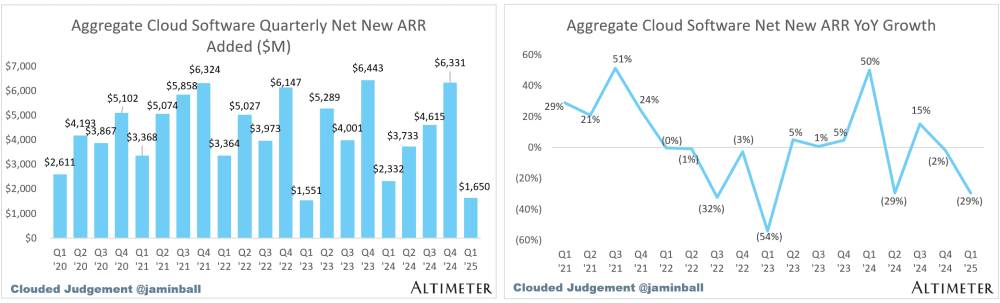
The most striking signal from Q1 2025 came from public cloud software data tracking aggregate net new annual recurring revenue. According to SaaStr’s discussion of Jamin Ball’s Clouded Judgement analysis, aggregate quarterly net new ARR across the cloud software universe fell to about $1.65 billion in Q1 2025, down from roughly $2.33 billion in Q1 2024. That is a year-over-year decline of about 29%.
That number matters because net new ARR is the heartbeat of SaaS growth. Revenue tells you how big the company already is. Net new ARR tells you how much fresh recurring business is being added. When that figure falls across the public cloud software universe, it suggests the problem is not one weak sales team, one botched product launch, or one awkward enterprise procurement cycle. It points to a broader market cooling.
In plain English: the SaaS engine is still running, but it is not accelerating the way it used to. The old model of “hire more sales reps, buy more ads, sponsor more airport billboards, and wait for ARR to appear” is having a harder time.
Cloud Spending Is Up, So Why Does SaaS Feel Slower?
Here is the confusing part: overall public cloud spending is still expanding rapidly. Gartner forecast worldwide public cloud end-user spending to reach $723.4 billion in 2025, up from $595.7 billion in 2024. That is not exactly a market hiding under the bed.
The key is that “cloud” and “SaaS” are not identical. Cloud includes infrastructure, platform services, AI compute, storage, security, data workloads, and application software. In 2025, a growing share of incremental cloud budget is going toward AI infrastructure, data platforms, automation, and mission-critical systems rather than yet another point solution with a cheerful onboarding email.
So yes, cloud is still growing. But classic SaaS applications are fighting harder for budget. The growth is moving toward areas that either save money, generate measurable revenue, improve productivity, or help companies deploy AI. Nice-to-have tools are facing a colder room.
The New SaaS Buyer: Less Romantic, More Spreadsheet
The modern SaaS buyer has changed. During the boom years, companies often bought software like they were decorating a new apartment: one tool for collaboration, one for analytics, one for employee engagement, one for customer success, one for customer success analytics, and possibly one for analyzing the analytics of customer success. It got crowded fast.
By Q1 2025, that behavior looked very different. Buyers are consolidating vendors, renegotiating contracts, delaying new purchases, and demanding proof that software produces real outcomes. Procurement teams are more involved. Finance teams are more skeptical. Department heads have less freedom to swipe the corporate card for tools that promise “alignment” but deliver another login screen.
This is especially tough for horizontal SaaS products that sell into crowded categories. Marketing automation, sales engagement, collaboration, project management, HR software, and customer support tools are still important, but buyers now ask sharper questions: Can this replace another product? Does it reduce headcount needs? Does it improve retention? Does it integrate with our data? Does it have AI that actually works, or just a chatbot wearing a tiny SaaS-branded hat?
Public SaaS Earnings Show a Split Market
Q1 2025 earnings did not tell one single story. Instead, they showed a split market. Some large cloud and SaaS companies continued to post respectable growth, while others showed the reality of maturity.
Microsoft: Cloud Scale Still Wins
Microsoft remained one of the clearest examples of cloud strength. In its fiscal Q3 2025 results, Microsoft reported Microsoft Cloud revenue of $42.4 billion, up 20% year over year. Azure and other cloud services revenue grew 33%, helped by demand for AI services and enterprise cloud workloads.
That is not a slowdown in the scary sense. It is a reminder that infrastructure, AI platforms, enterprise productivity, and cloud ecosystems remain powerful. Microsoft benefits from being deeply embedded in corporate IT, where switching costs are high and budgets are strategic.
Salesforce: Huge, Profitable, But Mature
Salesforce reported Q1 fiscal 2026 revenue of $9.8 billion, up 8% year over year. Subscription and support revenue reached $9.3 billion, also up 8%. Current remaining performance obligation grew 12% year over year.
Those are solid numbers for a company at Salesforce’s scale. But they also show the reality of mature SaaS. Salesforce is no longer a hypergrowth story; it is a massive enterprise software business focused on profitability, AI monetization, platform expansion, and customer wallet share. The growth is real, but it is not the rocket-ship chart of earlier SaaS eras.
ServiceNow: Workflow Automation Still Has Momentum
ServiceNow was one of the stronger enterprise software performers. In Q1 2025, it reported subscription revenue of about $3.0 billion, up 19% year over year, with current remaining performance obligations up 22%.
ServiceNow benefits from selling into complex enterprise workflows where automation, IT service management, and AI-powered operations are tied to measurable business value. In a slower SaaS market, platforms that reduce friction inside large organizations still have room to run.
Snowflake and Datadog: Data and Observability Hold Up Better
Snowflake reported first-quarter fiscal 2026 product revenue of $996.8 million, up 26% year over year, with net revenue retention of 124%. Datadog reported Q1 2025 revenue of $762 million, up 25% year over year, along with strong free cash flow.
These companies sit closer to infrastructure, data, monitoring, security, and AI-enabling workloads. That matters. When budgets tighten, companies may cut a nice-to-have productivity app, but they are less likely to cut the platform that stores mission-critical data or monitors cloud systems before customers start screaming on social media.
Workday, Atlassian, and HubSpot: Good Businesses, Tougher Math
Workday reported fiscal Q1 2026 revenue of $2.24 billion, up 12.6%, with subscription revenue up 13.4%. Atlassian delivered Q3 fiscal 2025 revenue of about $1.4 billion, with cloud revenue up 25%. HubSpot reported Q1 2025 revenue of $714.1 million, up 16% as reported and 18% in constant currency.
These are not weak companies. They are strong software businesses navigating more demanding conditions. But the market now evaluates them through a different lens: efficient growth, net retention, customer expansion, AI strategy, and margin quality. Growth alone is no longer enough. Growth must arrive wearing a clean margin profile and carrying a receipt.
Why SaaS Growth Is Slowing
1. Market Maturity Has Arrived
The cloud software market is no longer early. Most enterprises already use dozens or hundreds of SaaS applications. Many workflows have already moved to cloud platforms. The easiest conversions from on-premise systems to SaaS have happened. That does not mean growth is over, but it does mean growth is harder.
In mature markets, vendors must win by replacing incumbents, expanding existing accounts, or creating new categories. That is much harder than selling into a world where every department is discovering SaaS for the first time.
2. Net Revenue Retention Is Under Pressure
Net revenue retention has always been one of the most important SaaS metrics because it shows whether existing customers are expanding or shrinking their spend. Clouded Judgement data in May 2025 showed median net retention around 108% for public cloud software companies. That is still positive, but far below the expansion-heavy glory days when top SaaS names routinely posted much higher retention rates.
Lower net retention changes the growth equation. If customers are not expanding as aggressively, companies must rely more on new customer acquisition. But new customer acquisition is expensive, especially when buyers are cautious.
3. CAC Payback Is Still Painful
Customer acquisition cost payback remains a central challenge. Clouded Judgement’s public software metrics showed median CAC payback around 43 months. That means many companies must wait years to earn back the cost of acquiring a customer.
In a zero-interest-rate fantasyland, long payback periods were easier to tolerate. In a more disciplined capital environment, they are harder to justify. Investors now want efficient growth, not growth that requires lighting a bonfire of sales and marketing dollars every quarter.
4. AI Is Redirecting Budget
AI is not simply adding a new software category. It is changing how companies think about software value. High Alpha’s 2025 SaaS Benchmarks Report noted that AI is no longer a differentiator for new companies; it is increasingly the baseline. The report also emphasized that companies deeply incorporating AI into products are outperforming peers across ARR bands.
This creates pressure on traditional SaaS vendors. A basic workflow tool now competes not only with similar SaaS products, but also with AI-native tools that promise to automate the workflow entirely. That is a very different competitive fight. It is one thing to lose a deal to a rival vendor. It is another to lose because the customer decided the entire category should become an AI agent.
Private SaaS Benchmarks Tell the Same Story
The slowdown is not limited to public companies. SaaS Capital’s 2025 private B2B SaaS growth benchmarks showed median growth across surveyed companies at 25%, down from 30% in 2023. Equity-backed companies reported median growth of 25%, down from 30%, while bootstrapped companies reported 23%, down slightly from 25%.
That data suggests the reset is broad. Private SaaS companies are still growing, but the median growth rate has cooled. The best operators are responding by improving retention, refining pricing, reducing waste, and building more focused go-to-market motions.
High Alpha’s 2025 benchmarks added another useful angle: growth and efficiency are increasingly connected to retention, CAC discipline, and AI execution. Companies with strong net revenue retention and low acquisition costs can still compound nicely. Companies with weak retention and expensive sales motions are discovering that gravity has not been abolished.
What This Means for SaaS Founders
For founders, Q1 2025 was a reminder that the market is not rewarding vague ambition. The best SaaS companies now need a sharper answer to three questions: Why this product? Why now? Why will customers expand?
Founders should focus on fewer, stronger customer segments rather than chasing every possible buyer. They should prove return on investment quickly, ideally within the first 90 days of usage. They should design pricing that grows with customer value, not merely seat count. And they should treat AI as a product and business-model shift, not a decorative feature hidden behind a sparkle icon.
The days of raising a huge round, hiring aggressively, and assuming revenue will eventually catch up are not completely gone, but they are definitely wearing a disguise. Efficient growth is now the grown-up in the room.
What This Means for SaaS Buyers
For buyers, the slowdown can be good news. Vendors are more willing to prove value, negotiate terms, and support consolidation. Customers have more leverage than they did during the boom years, when every SaaS salesperson acted like the product had a waitlist guarded by dragons.
Buyers should audit their software stack carefully. Which tools are used daily? Which tools overlap? Which products have become expensive habits? Which platforms are central to data, security, revenue, or customer operations?
The goal is not to cut software blindly. That usually creates chaos and angry Slack messages. The goal is to shift budget toward software that clearly improves productivity, revenue, customer retention, compliance, or decision-making.
What This Means for Investors
For investors, Q1 2025 reinforced the need to separate durable cloud software from fragile SaaS packaging. The question is no longer simply, “Is this a SaaS company?” The better question is, “Does this company have durable demand, strong retention, efficient distribution, pricing power, and a credible AI strategy?”
Infrastructure, data, observability, cybersecurity, automation, and vertical AI workflows may deserve different treatment than crowded horizontal categories. Meanwhile, mature application software companies should be judged on margins, cash flow, customer expansion, and platform defensibility.
The market is not saying SaaS is dead. It is saying the lazy SaaS premium is dead. That is a big difference.
The Bottom Line: Slower Does Not Mean Broken
SaaS is still slowing down, unfortunately. The Q1 2025 numbers make that hard to ignore. Aggregate net new ARR declined sharply, private-company growth benchmarks cooled, and many public software companies showed the math of maturity.
But the cloud software market is not broken. It is being repriced, re-sorted, and re-trained. The strongest companies are still growing. AI-native businesses are creating new demand. Data and infrastructure platforms remain essential. Enterprise workflow automation still solves expensive problems. The difference is that buyers and investors now demand proof.
That may feel less glamorous than the old days, but it is probably better for the industry. SaaS companies that deliver measurable value will keep growing. Those that sell software confetti may find the party ending early.
Experience-Based Lessons From the SaaS Slowdown
Anyone who has worked around SaaS teams over the last few years has seen the mood shift in real time. In the boom period, the typical growth meeting sounded like a pep rally with dashboards. Pipeline was king. Headcount plans were ambitious. A 14-month payback period looked responsible, and a 30-month payback period was explained away with enough acronyms to make everyone tired.
By Q1 2025, the same conversations had become more practical. Sales leaders were no longer asking only how many reps they could hire. They were asking which reps were productive, which segments converted fastest, and which customers expanded after onboarding. Marketing teams were no longer judged only by lead volume. They had to prove pipeline quality, conversion rates, and influence on revenue. Customer success teams moved from “make customers happy” to “protect renewals, drive adoption, and find expansion.”
The biggest lesson is that SaaS growth now depends on operational honesty. A company cannot hide weak product usage behind a beautiful sales deck forever. If customers do not activate, adopt, and expand, the numbers eventually confess. And numbers, unlike executives on earnings calls, are terrible at spin.
Another experience-based lesson is that consolidation is real. Many buyers are tired of managing too many tools. They want fewer vendors, cleaner integrations, better security controls, and simpler procurement. This favors platforms and deeply embedded products. It hurts small point solutions that solve narrow problems without becoming part of a larger workflow.
That does not mean startups are doomed. In fact, startups can still win if they solve painful problems with speed and clarity. But they need sharper positioning. A new SaaS company cannot merely be “better.” It must be obviously better for a specific buyer with a specific pain. The product must earn its renewal before the renewal conversation begins.
AI adds both opportunity and pressure. The best teams are not just adding AI features to impress investors. They are using AI to improve onboarding, support, analytics, workflow automation, and internal productivity. They are asking how AI changes the cost structure of the business, not just the product demo. That is where the real advantage begins.
For content, SEO, and demand generation teams, the slowdown also changes the playbook. Generic SaaS content is less effective because buyers are more educated and more skeptical. They do not need another article titled “What Is Workflow Automation?” unless it actually says something useful. Winning content now needs benchmarks, examples, comparison pages, ROI calculators, implementation guides, and honest explanations of trade-offs.
From a leadership perspective, the most important experience is learning to say no. No to bad-fit customers. No to bloated roadmaps. No to expensive channels that produce vanity metrics. No to AI features that look impressive but do not improve retention or revenue. In a slower SaaS market, focus becomes a growth strategy.
The SaaS slowdown is painful because it removes easy excuses. But it also rewards better habits. Companies that understand their customers, price around value, improve retention, and build products that matter will still have plenty of room to grow. The market is not anti-SaaS. It is anti-waste. Honestly, that is probably overdue.