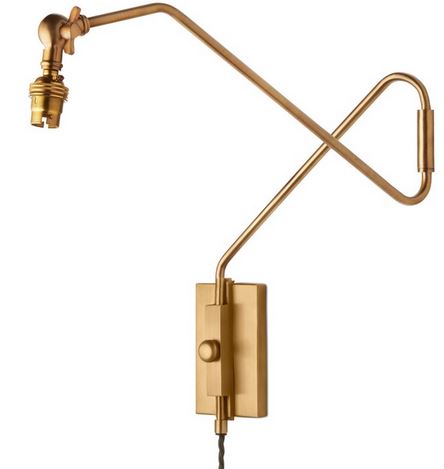
The Antique Brass Cooper Wall Fitting is what happens when a practical reading lamp dresses for dinner. Its articulated arm, warm brass finish, adjustable neck, and plug-in design combine the usefulness of task lighting with the character of a well-traveled vintage find. It can fold close to the wall when the room needs breathing space, then stretch outward when a book, desk, artwork, or suspiciously complicated crossword requires focused illumination.
Unlike a fixed wall sconce that simply glows in one direction and hopes for the best, the Cooper fitting is designed to move. That flexibility makes it especially useful in bedrooms, reading corners, home offices, compact living rooms, and other spaces where floor and tabletop space are valuable. Add the right shade and bulb, and this adjustable brass wall light can feel traditional, playful, tailored, or quietly modern.
What Is the Antique Brass Cooper Wall Fitting?
The Cooper is an adjustable swing-arm wall light made by Pooky. The original model is built with a brass body, an antiqued finish, a jointed arm, and a pivoting neck that lets the user direct the shade toward a specific area. According to the manufacturer’s specifications, the full-size fitting can project approximately 73 centimeters, or about 28.7 inches, from the wall when extended.
Its most convenient feature is the external electrical cord. Instead of requiring a cable hidden inside the wall, the fitting can be mounted near an existing outlet and plugged in. An inline switch on the cord controls the light. That does not make installation completely tool-freethe mounting plate still needs a secure attachmentbut it can avoid the expense and disruption of opening a wall for new wiring.
A Finish, Not an Archaeological Discovery
The phrase antique brass describes the appearance of the finish, not necessarily the age of the fixture. Nobody dug this lamp out of a Victorian attic beside a trunk of mysterious letters. The surface is intentionally darkened and softened to suggest the mellow patina associated with older brass.
This distinction matters when shopping. A genuine antique light may have old wiring, obsolete sockets, missing safety labels, or previous repairs. The Antique Brass Cooper Wall Fitting offers a period-inspired look with modern components and contemporary adjustability.
Why the Cooper Wall Fitting Stands Out
It Delivers Light Where It Is Needed
The articulated arm gives the Cooper a practical advantage over decorative sconces with fixed shades. Pull the light toward a chair for reading, angle it over a desk for paperwork, or direct it toward a display shelf. When the task is finished, the arm can be folded back toward the wall.
Directional lighting is especially valuable in shared bedrooms and living spaces. Rather than flooding the entire room with brightness, the fixture can concentrate light on one activity. One person can read while another continues the serious business of falling asleep during a movie.
It Saves Floor and Table Space
A wall-mounted reading light frees the surfaces normally occupied by a table lamp. This is useful beside a narrow nightstand, above a compact writing desk, or next to a sofa without an end table. The result is a cleaner layout with fewer cords, bases, and lampshades competing for territory.
In a small apartment, that reclaimed surface can hold a glass of water, a stack of books, or the phone that was supposedly going to stay outside the bedroom.
It Works as Decoration Even When Switched Off
The warm antique brass finish gives the fitting visual weight without making it appear bulky. Its joints and slender arms introduce an architectural quality, while a fabric shade can soften the mechanical profile. Installed over paneling, patterned wallpaper, painted brick, or a deep-colored wall, it acts like a piece of functional wall jewelry.
Best Places to Use an Antique Brass Swing-Arm Wall Light
Beside the Bed
Bedside placement is perhaps the most natural use for the Antique Brass Cooper Wall Fitting. It provides direct reading light without occupying the nightstand, and its arm can be moved out of the way during the day. For comfortable use, position the fitting so the shade can be drawn over the shoulder without shining directly into the eyes.
Before drilling, sit against the pillows and mark the position from your actual reading posture. Mounting a light based only on how the bed looks from the doorway can produce a beautiful installation that illuminates one ear.
Over a Sofa or Reading Chair
A Cooper wall light can create a defined reading zone without adding a floor lamp. It works particularly well above the end of a sofa or beside a lounge chair. The adjustable arm can bring the light closer for reading, knitting, sketching, or examining the snack crumbs that somehow appeared between the cushions.
Make sure the folded arm does not interfere with framed art, shelves, curtains, or traffic through the room. Consider both the fixture’s closed position and its maximum reach.
At a Home-Office Desk
Mounted above or beside a desk, the Cooper becomes an adjustable task lamp that leaves the work surface clear. Position it on the side opposite the dominant writing hand to reduce shadows. A right-handed person will generally benefit from light arriving from the left, while a left-handed person may prefer the reverse.
The antique brass finish also prevents a home office from feeling overly corporate. It says, “Important work happens here,” but not, “Please complete this spreadsheet before enjoying human emotion.”
In a Kitchen or Breakfast Nook
An adjustable wall light can brighten a cookbook shelf, coffee station, breakfast table, or small preparation area. However, verify that the fitting is appropriate for the proposed location. Standard indoor wall lights should not be placed where they may be exposed to splashing water, heavy grease, excessive steam, or direct heat.
For Artwork and Shelving
The pivoting head can provide accent lighting for artwork, books, or decorative objects. It is not a substitute for a specialized museum light, but it can create an attractive pool of illumination in a residential setting. Keep the bulb at a reasonable distance from delicate paper, textiles, and heat-sensitive materials.
Choosing the Right Shade
The shade dramatically changes the personality and performance of the Cooper fitting. A narrow shade directs more light downward, while a wider shade spreads illumination across a broader area. Fabric, parchment, and pleated shades create a softer glow; metal shades produce a more focused beam; patterned shades add color and personality.
For Traditional Rooms
Try a pleated, gathered, or empire-shaped fabric shade in cream, muted green, rust, burgundy, or a small botanical print. These options complement the antique brass finish and work well with wood furniture, paneled walls, vintage rugs, and traditional upholstery.
For Modern Interiors
A plain linen shade, simple drum, or restrained geometric pattern keeps the silhouette cleaner. Antique brass looks especially effective against charcoal, navy, forest green, warm white, and earthy plaster tones. The contrast allows the fixture to feel contemporary without losing its warmth.
For an Eclectic Look
Pair the brass fitting with a striped, scalloped, block-printed, or brightly colored shade. Because the arm itself is visually disciplined, it can support a shade with more personality. This is the lighting equivalent of wearing a tailored jacket with excellent socks.
Selecting a Bulb for Comfortable Light
Brightness should be evaluated in lumens rather than watts. Lumens describe how much visible light a bulb produces, while watts measure energy consumption. For gentle ambient light, approximately 400 to 500 lumens may be sufficient. For reading or desk work, many users prefer roughly 600 to 800 lumens, depending on the shade, surrounding colors, and distance from the task.
A warm-white bulb near 2700K usually flatters antique brass, timber, textiles, and traditional interiors. A slightly clearer 3000K bulb can work well for reading and office tasks while still feeling comfortable in a home. Very cool bulbs may make the brass appear less rich and can create an unexpectedly clinical atmosphere.
An LED bulb is generally the sensible choice. Residential LEDs use substantially less electricity and typically last much longer than traditional incandescent bulbs. They also produce less radiant heat, which is helpful when the bulb sits close to a fabric shade.
Always follow the maximum wattage, bulb-base, voltage, and dimmer-compatibility instructions supplied with the exact version purchased. The original U.K. fitting and products adapted for the U.S. market may use different sockets, plugs, electrical ratings, or included shades.
Installation and Safety Considerations
A plug-in wall sconce avoids hardwiring, but it still needs to be mounted securely. Because the Cooper has a long moving arm, pulling it outward creates leverage on the wall plate. Use a wall stud where possible or choose anchors rated for the fixture, wall material, and expected movement.
Drywall, plaster, masonry, tile, and wood paneling require different fasteners. Historic plaster deserves particular care because careless drilling can loosen surrounding material. When the wall condition is uncertain, consult a qualified installer rather than testing structural theories with a favorite lamp.
Plan the Cord Route
The outlet should be close enough for the cord to reach without tension. Do not place the cord where it can be pinched by furniture, stretched across a walkway, trapped beneath a rug, or exposed to sharp edges. Cord covers can create a neater vertical line and may be painted to coordinate with the wall, provided they are used according to their instructions.
Check U.S. Compatibility
Before using an imported fixture in the United States, confirm that it is designed for 110- to 120-volt service and has the correct plug, socket, and recognized safety certification. Do not assume that a travel adapter makes an incompatible light fixture safe. A market-specific version is generally preferable to an improvised conversion.
Avoid Unsuitable Wet Locations
Do not install the standard Cooper fitting in a bathroom wet zone, outdoors, or near a sink unless the exact model carries the appropriate damp- or wet-location rating. Brass may look nautical, but that does not automatically qualify every brass lamp for life beside a shower.
How to Clean and Maintain the Antique Brass Finish
Antique brass finishes should usually be cleaned gently. Aggressive metal polish may remove intentional darkening, protective coatings, or surface variation. Begin by switching off and unplugging the light. Allow the bulb to cool completely before handling the fixture.
Use a soft, dry microfiber cloth for routine dusting. For fingerprints or light grime, wipe carefully with a barely damp cloth and a small amount of mild soap, then dry the surface immediately. Avoid abrasive pads, scouring powders, strong solvents, vinegar mixtures, baking-soda pastes, and enthusiastic polishing sessions fueled by online cleaning videos.
Move the articulated arm through its normal range gently. If a joint becomes loose, stiff, or noisy, consult the manufacturer’s instructions before applying lubricant or tightening hardware. Random household oil can stain nearby fabric shades and attract dust.
Decorating With Antique Brass Lighting
Antique brass is effective because it bridges design periods. It feels natural in Georgian-inspired, Victorian, cottage, Arts and Crafts, traditional, and industrial interiors, yet it also warms minimalist and midcentury spaces.
Materials That Pair Well With Brass
- Dark or medium-toned wood
- Painted wall paneling
- Linen, velvet, wool, and patterned cotton
- Marble and soapstone
- Blackened steel and bronze
- Warm white, ocher, navy, olive, and burgundy paint
- Handmade ceramics and aged leather
Brass finishes do not need to match perfectly throughout a room. In fact, a mixture of aged brass, bronze, and darker metals often looks more collected than a regiment of identical shiny fixtures. Repeat the brass tone once or twice through a frame, cabinet pull, mirror, or decorative object to make the wall light feel intentional.
Advantages and Possible Drawbacks
Advantages
- The articulated arm provides adjustable task lighting.
- The wall-mounted design saves table and floor space.
- A plug-in cord can eliminate the need for new concealed wiring.
- The fixture folds closer to the wall when not required.
- Interchangeable shades allow considerable decorative flexibility.
- The antique brass finish works with many interior styles.
Possible Drawbacks
- The visible cord may not suit homeowners who want a completely seamless installation.
- The long projection requires careful placement in narrow rooms.
- Moving arms place more stress on wall anchors than fixed sconces.
- Imported and U.S. versions may have different electrical specifications.
- The shade may be sold separately, depending on the retailer and product configuration.
- Decorative brass finishes require gentler care than unfinished solid brass.
Living With the Antique Brass Cooper Wall Fitting: The Everyday Experience
The most noticeable part of living with an adjustable Cooper wall fitting is how often its position changes. In the morning, it may sit folded neatly against the wall, functioning almost like a decorative bracket. At night, the arm can be extended over a chair or bed and angled toward a book. That movement becomes part of the room’s routine rather than an occasional novelty.
Beside a bed, the experience is particularly satisfying when the mounting position has been planned correctly. The user can pull the shade forward without leaning toward a distant table lamp, and the nightstand remains open for necessities. The light feels more private because it illuminates a smaller zone. In a shared bedroom, this can reduce glare for the person on the other side of the bedalthough it cannot prevent complaints about page-turning, midnight snacks, or the decision to begin a 700-page novel at 11:45 p.m.
The folding mechanism also changes how a small room feels during the day. A floor lamp occupies the same patch of space whether it is needed or not. The Cooper can retreat. In a compact living room, folding the arm back before guests arrive reduces visual clutter and protects the shade from accidental bumps. When someone settles into the reading chair, the lamp extends again without rearranging furniture.
Shade choice has a major effect on the daily experience. A pale linen shade creates an easy, diffused glow and is forgiving in multipurpose rooms. A darker or more opaque shade produces a concentrated pool of light, which feels intimate but may be too focused for general illumination. Patterned shades provide more visual pleasure during daylight hours, when the lamp is essentially part of the wall decor.
The visible flex is another feature owners tend either to accept immediately or analyze with the seriousness of a diplomatic negotiation. Against a patterned wall, the cord may nearly disappear. On a plain wall, it becomes a deliberate vertical line. A tidy cord cover can create a more architectural finish, while an exposed fabric-covered cord can support the relaxed, old-house character of the fitting.
After repeated use, secure installation becomes especially important. An adjustable wall light invites touching, pulling, and repositioning. A poorly anchored plate may begin to shift, while a properly mounted fitting feels reassuringly solid. The best experience comes from taking time during installation rather than treating the wall anchors as an exciting opportunity for improvisation.
Cleaning is generally uncomplicated. Dust tends to gather around joints, the top of the shade, and the horizontal sections of the arm. A soft cloth used regularly prevents buildup and protects the finish from aggressive cleaning later. Owners who enjoy the aged appearance will probably find minor variations charming; those expecting mirror-bright perfection may prefer polished brass instead.
Most importantly, the Antique Brass Cooper Wall Fitting creates a warmer relationship with task lighting. It does not look like office equipment bolted to the wall. It feels domestic, decorative, and pleasantly mechanical. The user interacts with it, adjusting the reach and direction to suit the moment. That combination of movement, character, and practical illumination explains why the design works equally well in a historic townhouse, a colorful cottage, or a modern apartment that could use one less anonymous lamp.
Final Verdict
The Antique Brass Cooper Wall Fitting is a strong choice for anyone seeking an adjustable wall sconce with vintage character and modern convenience. Its articulated arm provides useful directional light, its plug-in format can simplify installation, and its warm brass finish gives a room depth even when the bulb is off.
It is most successful when the location is carefully measured, the wall plate is securely anchored, and the shade is selected for the intended task. A soft fabric shade suits relaxed ambient lighting, while a more focused design supports reading and desk work. Add an efficient warm-white LED, and the fixture becomes a practical everyday tool rather than decoration pretending to have a job.
For bedrooms, reading corners, desks, and compact living areas, the Cooper offers something increasingly valuable: light that moves where life happens.